Pasture vs Cage-Free Eggs — Decoding the Labels
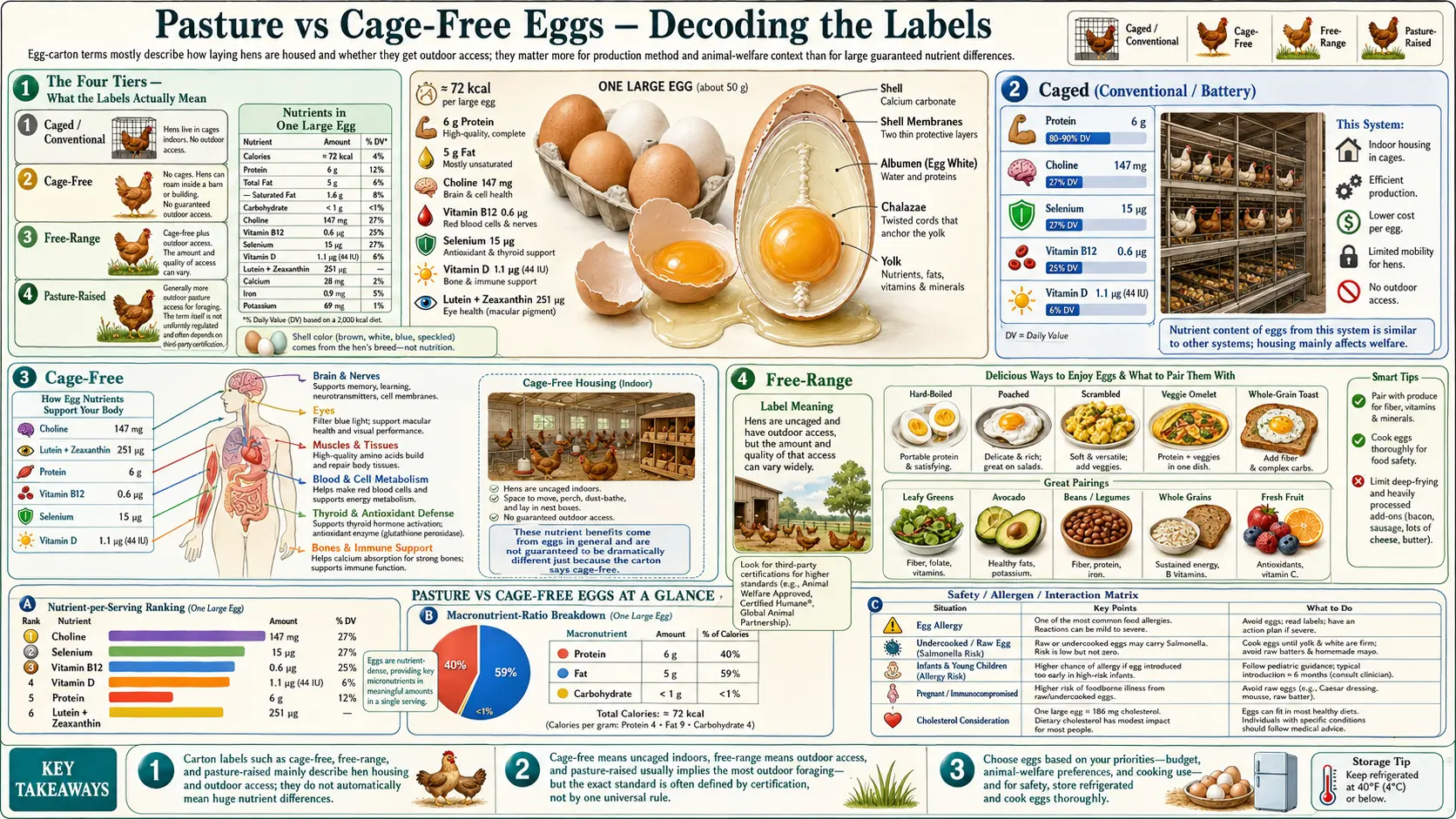
The four egg-labeling tiers in the US market — caged, cage-free, free-range, and pasture-raised — correspond to dramatically different living conditions for the hens and to measurably different nutritional profiles of the resulting eggs. The most commonly cited investigation, the 2007 Mother Earth News egg trial, sent 14 flocks' eggs from genuine pastured operations to a commercial laboratory and compared them to USDA reference data for conventional eggs. The pastured eggs averaged 2× the omega-3, 3× the Vitamin E, 7× the beta-carotene, and 4-6× the Vitamin D of conventional cage eggs. Peer-reviewed work (Karsten 2010, Anderson 2011, Mostert 2019, Mattioli 2017) has since confirmed the qualitative direction of these findings, though absolute magnitudes vary by season and forage quality. This page decodes the four label tiers, summarizes the nutritional differences, explains the cost-benefit math, and offers practical guidance for shoppers.
Table of Contents
- The Four Tiers — What the Labels Actually Mean
- Caged (Conventional / Battery)
- Cage-Free
- Free-Range
- Pasture-Raised
- Why "Organic" Does Not Mean Pasture
- The Mother Earth News Trial
- Peer-Reviewed Evidence (Karsten, Anderson, Mostert)
- The Omega-6 to Omega-3 Ratio Shift
- The Vitamin D Mystery (UVB Exposure)
- Cost-Benefit Math for the Shopper
- Certifications That Actually Mean Something
- Key Research Papers
- Connections
- Featured Videos
The Four Tiers — What the Labels Actually Mean
US egg labeling is regulated by a patchwork of USDA, FDA, and third-party certifying body standards. The labels you see at the supermarket fall into four broad tiers based on the hens' living conditions and access to outdoor forage. Understanding these tiers is essential because the nutritional differences between them are substantial, and the price differences (typically $2-7 per dozen) are not arbitrary — they reflect real cost differences in housing, land use, feed conversion, and labor.
The four tiers, from least to most welfare- and nutrition-favorable:
- Caged (battery cage): hens housed in stacked wire cages with 67-86 sq inches of floor space per bird (less than a sheet of letter paper). Conventional industrial production. Now banned in California, Massachusetts, Michigan, Oregon, Washington, Colorado, Rhode Island, and the EU for new construction, but still legal and prevalent in most US states.
- Cage-Free: hens uncaged but housed indoors in large barns. Floor space ranges from 1 to 1.5 sq feet per bird. No required outdoor access. Often very high stocking density indoors.
- Free-Range: cage-free plus some required outdoor access. Federal definition is vague (USDA requires only "access to the outside") and in practice often means a single small door from a large barn to a fenced concrete or dirt yard.
- Pasture-Raised: hens spend most daylight hours outdoors on rotated forage. The American Humane Certified "Pasture-Raised" standard requires 108 sq feet per hen (a 6×18 foot plot per bird) on rotated grass and clover pasture. Certified Humane "Pasture-Raised" requires 108 sq feet per hen with mandatory rotation. This is the only tier where the hens actually consume meaningful amounts of green plant material, insects, worms, and other forage.
The nutritional differences between tiers map roughly to the amount and quality of forage the hens actually eat — not to whether they have "access" to it, but to whether they actually go outside and eat plants and bugs. This is why the pasture-raised tier produces measurably different eggs while the cage-free and free-range tiers (whose hens are usually eating the same grain ration in indoor or near-indoor settings) produce eggs nutritionally indistinguishable from conventional caged eggs.
Caged (Conventional / Battery)
Approximately 70% of US laying hens still live in conventional battery cages as of 2024, though the percentage is declining year-over-year due to state-level bans and major retailer commitments to phase out cage eggs. Battery cages typically house 5-10 hens in a wire-floored cage measuring roughly 22×28 inches. Stocking density is 67-86 sq inches per hen — the hen cannot fully extend her wings, cannot perch, cannot dust bathe, cannot lay an egg in a nest, and cannot scratch.
The feeding is purely grain-based: typically corn (50-60%), soybean meal (20-25%), supplemental synthetic methionine (because corn-soy diets are limiting in this amino acid), calcium carbonate for eggshell formation, supplemental vitamins, and various enzymes and preservatives. The hens have no access to insects, no access to plants, no access to direct sunlight (lighting is typically continuous fluorescent at controlled photoperiod to maximize laying rate).
The resulting eggs are nutritionally adequate — they still contain all the protein, choline, and B vitamins that make eggs valuable — but they are the baseline for any comparison. Beta-carotene and Vitamin E are low because corn-soy diets don't supply much of either. Omega-3 fatty acids are low because the diet lacks the alpha-linolenic acid sources (grass, flax) needed for hens to deposit omega-3 in their yolks. Vitamin D is very low because the hens never see the sun and the rations contain only the supplemental minimum.
Cost: typically $2.00-3.00 per dozen at conventional retail.
Cage-Free
"Cage-free" became the major retailer commitment around 2015 as the public welfare conversation accelerated. The label means hens are not in cages — but it does not mean they are outdoors or on pasture. Typical cage-free operations house tens of thousands of birds in a single barn with floor space of 1-1.5 sq feet per bird, perches, and nest boxes. The hens can walk, perch, and lay in nests, which is genuinely better welfare than battery cages.
However, the feed is essentially identical to conventional caged operations: corn, soybean meal, supplemental methionine, supplemental vitamins. The hens have no required outdoor access and almost never see forage. The resulting eggs are nutritionally indistinguishable from conventional eggs — the same omega-3, the same beta-carotene, the same Vitamin D, the same Vitamin E levels.
The price premium ($3.50-5.00 per dozen) reflects the lower stocking density and somewhat higher feed cost per egg (cage-free hens move more, eat more, and have somewhat higher mortality from pecking, so feed cost per dozen is roughly 30-40% higher than caged). The premium is buying welfare improvement, not nutritional improvement.
This is important to state plainly because many shoppers spend the extra $2 per dozen on cage-free eggs in the belief that they are getting more nutritious eggs. They are getting eggs from hens with somewhat better living conditions, and that is a legitimate reason to buy them, but the eggs themselves are not measurably different.
Free-Range
"Free-range" sounds substantially better than cage-free but in practice often is not. The federal definition is one of the weakest in the labeling lexicon: USDA requires only that the hens have "access to the outside" — with no specification of minimum area, minimum time outdoors, or quality of the outdoor space. In practice, "free-range" often means a single small door from a large indoor barn to a fenced concrete or dirt yard that the majority of birds never use.
The mechanism is sociological as much as architectural. Once hens are habituated to indoor living from chick stage, they are reluctant to leave the familiar indoor area. The dominant birds occupy the area near the door and prevent others from accessing it. The outdoor space is often offered for only a few hours a day. The net result is that most "free-range" hens in commercial operations spend most of their lives indoors and eat the same corn-soy ration as cage-free birds.
Some free-range operations are genuinely better than this minimum — smaller producers, certifying body audits, and stricter European Union standards (which require 4 sq meters outdoor per bird and meaningful pop-hole access) can produce eggs that are closer to the pasture-raised tier in quality. But the US federal "free-range" label alone does not reliably guarantee meaningful outdoor access.
Price: typically $4.00-6.00 per dozen.
Pasture-Raised
"Pasture-raised" is the only label that, when third-party certified, reliably guarantees hens spend daylight hours outdoors on rotated grass forage. The two major certifications:
- Certified Humane "Pasture-Raised": 108 sq feet per bird, mandatory pasture rotation, indoor housing only at night and in inclement weather, certified by Humane Farm Animal Care.
- American Humane Certified "Pasture-Raised": 108 sq feet per bird, mandatory pasture rotation, similar standards to Certified Humane.
On a properly managed pasture rotation, the hens spend the day eating grass, clover, dandelion, plantain, lambsquarters, chickweed, broadleaf weeds, insects (grasshoppers, beetles, worms, caterpillars), grass seeds, and any vertebrates they can catch (frogs, mice, lizards). Hens are omnivores by nature and consume far more animal protein (insects, worms) than supermarket shoppers usually realize. The grain ration in the barn supplements this foraged diet but does not replace it.
The biochemical consequence: the hen is now consuming alpha-linolenic acid (ALA) from green plants, which she elongates to long-chain omega-3 fatty acids (EPA, DHA) and deposits in the egg yolk. She is consuming beta-carotene and lutein from green leaves, which she deposits in the yolk (giving genuine pasture-raised yolks their characteristic deep orange color — the standard supermarket egg yolk is pale yellow because the hen never ate plants). She is exposed to direct sunlight on her skin, allowing endogenous synthesis of Vitamin D3 (cholecalciferol) which she deposits in the yolk.
The result is an egg with measurably different nutrient composition. Pasture-raised eggs typically have:
- 2-3× the omega-3 fatty acids (200-400 mg per egg vs ~70 mg conventional)
- 3-4× the Vitamin E (3-4 mg per egg vs ~1 mg conventional)
- 4-7× the beta-carotene (yolk color shifts visibly from pale yellow to deep orange)
- 3-6× the Vitamin D (sun-synthesized cholecalciferol vs synthetic supplemental D2 in feed)
- Substantially higher lutein and zeaxanthin (~60% more)
- Significantly lower saturated fat to monounsaturated fat ratio
Price: typically $6.00-9.00 per dozen, sometimes higher for premium brands like Vital Farms.
Why "Organic" Does Not Mean Pasture
USDA Organic certification for eggs guarantees several things: the hens were fed organic feed (no synthetic pesticides, no GMO grain, no animal byproducts in feed), were not given antibiotics or hormones, and have "access to the outdoors." The organic standard's outdoor access requirement is in principle stronger than the basic free-range standard, but in practice has been weakened by enforcement gaps — many large-scale "organic" operations satisfy the access requirement with a small concrete pad or a screened porch attached to the barn that few birds use.
Crucially, USDA Organic certification does not require pasture access, does not require meaningful outdoor time, and does not require rotated forage. Many large organic egg brands (Eggland's Best Organic, Vital Farms is an exception, several store brands) source from operations that are functionally cage-free indoor housing with token outdoor access — the eggs are organic in the sense of feed composition, but not in the sense of the hens being on pasture.
If you want eggs from hens that actually live on pasture, look for the words "Pasture-Raised" plus a third-party certification (Certified Humane or American Humane Certified) rather than "Organic" alone. The two are independent and complementary — the best eggs are both organic and certified pasture-raised, but the "pasture-raised" label is doing more of the nutritional work than the "organic" label.
The Mother Earth News Trial
The most-cited investigation of pasture-raised egg nutrition was conducted by Mother Earth News in 2007 and updated in 2010. The magazine recruited 14 small flocks across the US that were genuinely on rotated pasture (verified by site visits or detailed grower questionnaires), collected eggs, and sent them to a USDA-certified commercial laboratory for nutritional analysis. They compared the results to USDA reference data for conventional eggs (the "standard" egg composition that appears in USDA nutrient databases).
The headline findings, averaged across the 14 flocks:
- 1/3 less cholesterol than conventional
- 1/4 less saturated fat than conventional
- 2/3 more Vitamin A
- 2× more omega-3 fatty acids
- 3× more Vitamin E
- 7× more beta-carotene
- 4-6× more Vitamin D (a separate 2010 follow-up specifically focused on Vitamin D)
The trial has been criticized for methodological limitations — the conventional comparator was USDA reference data rather than concurrent supermarket egg analysis, the 14 flocks were not randomly selected, seasonality of pasture quality was not controlled. But the qualitative direction of the findings has been replicated in multiple subsequent peer-reviewed studies that used more rigorous designs, and the magnitudes are roughly consistent across the body of evidence.
Where the Mother Earth News numbers may overstate the difference is in the long winter months in northern climates, when even genuinely pasture-raised hens have limited access to fresh forage and the diet shifts toward supplemental hay, stored grains, and produce scraps. Eggs from January in Pennsylvania are not as nutritionally distinct from conventional eggs as eggs from June in Pennsylvania. The Karsten 2010 study at Penn State (described in the next section) examined this seasonality directly.
Peer-Reviewed Evidence (Karsten, Anderson, Mostert)
The peer-reviewed literature on pasture-raised egg composition is smaller than the popular literature but is qualitatively consistent.
- Karsten et al. (2010), Renewable Agriculture and Food Systems. Penn State team compared eggs from hens raised in conventional cages versus hens raised on pasture (rotated grass-legume forage) over a full growing season. Pasture eggs had: 38% more Vitamin A, 2× more long-chain omega-3 (EPA+DHA), 3× more total omega-3, 2× more Vitamin E, and 7× more beta-carotene. The omega-6 to omega-3 ratio dropped from 13:1 (conventional) to 4:1 (pasture) — a substantial shift toward the "anti-inflammatory" ratio range. Cholesterol and saturated fat were essentially equivalent.
- Anderson (2011), Poultry Science. Comparison of fatty acid, cholesterol, and Vitamins A and E in eggs from caged hens vs hens on outdoor range. Found higher Vitamin E and a more favorable omega-6:omega-3 ratio in range eggs, with no significant difference in cholesterol. Differences in Vitamin A were smaller than in Karsten, possibly due to lower-quality forage at the study site.
- Mostert and Hess (2019). Direct comparison of pasture-based vs conventional egg nutrient composition. Confirmed elevated Vitamin E, omega-3, and beta-carotene in pasture eggs. Quantified seasonal variation: spring and summer pasture eggs had the largest nutritional advantage, fall and winter eggs were closer to conventional baseline.
- Mattioli et al. (2017), Poultry Science. Italian study on free-range vs caged hens specifically focused on antioxidant content and oxidative stability of yolks. Pasture eggs had higher polyphenol content (from forage) and more stable lipid profiles, with measurable resistance to lipid peroxidation in storage.
- Kuhn et al. (2014). Specifically examined Vitamin D content of pastured eggs. Hens raised with outdoor access in summer months produced eggs with 3-4× the Vitamin D content of indoor-raised hens, attributable to sunlight-induced D3 synthesis in the hen's skin and oil glands.
- Lopez-Bote et al. (1998), British Poultry Science. Early Spanish study showing free-range feeding produced eggs with elevated n-3 fatty acid and alpha-tocopherol content with improved oxidative stability.
The convergent finding across this literature is that pasture-raised eggs differ measurably from conventional eggs in:
- Vitamin A (modest increase, depending on forage quality)
- Vitamin E (consistent 2-3× increase)
- Vitamin D (large increase in season, less in winter)
- Beta-carotene and other carotenoids (large increase, visible as yolk color)
- Omega-3 fatty acids (consistent 2-3× increase)
- Omega-6 to omega-3 ratio (substantial shift toward anti-inflammatory range)
The findings are not consistent for cholesterol (some studies show lower, some show equivalent) or saturated fat (some lower, some equivalent). The protein content and amino acid profile are essentially identical between tiers — an egg is an egg as far as protein is concerned.
The Omega-6 to Omega-3 Ratio Shift
Perhaps the most underappreciated nutritional difference between pasture and conventional eggs is the omega-6 to omega-3 fatty acid ratio. The ratio matters because omega-6 and omega-3 fatty acids compete for the same enzymes (delta-5 and delta-6 desaturases, cyclooxygenase, lipoxygenase) and produce eicosanoids with opposing biological effects. Omega-6-derived eicosanoids (arachidonic acid → prostaglandin E2, thromboxane A2, leukotriene B4) are largely pro-inflammatory. Omega-3-derived eicosanoids (EPA → prostaglandin E3, thromboxane A3) and resolvins (from DHA) are anti-inflammatory.
Estimated ancestral human dietary omega-6:omega-3 ratio (Paleolithic): approximately 1:1.
Modern industrial Western diet omega-6:omega-3 ratio: approximately 15-20:1, driven primarily by widespread use of corn, soybean, sunflower, and safflower oils in processed food.
Conventional caged egg omega-6:omega-3 ratio: approximately 13-15:1, because the hen's corn-soy diet is dominated by omega-6.
Pasture-raised egg omega-6:omega-3 ratio: approximately 4-6:1, because the hen is consuming substantial alpha-linolenic acid from green forage (grasses contain meaningful amounts of ALA in their leaf membranes).
Omega-3-enriched eggs (from hens fed flax or fish meal): approximately 1-2:1, the most omega-3-favorable but achieved through specialty feed rather than pasture forage.
For an adult eating 2-3 eggs per day, switching from conventional to pasture-raised eggs shifts roughly 300-500 mg/day of dietary fatty acid balance from omega-6 to omega-3 — not a dramatic intervention in isolation, but meaningful in the context of a daily diet that is otherwise overwhelmingly omega-6 dominant.
For more on omega-3 fatty acids, see our Omega-3 Fatty Acids page.
The Vitamin D Mystery (UVB Exposure)
The Vitamin D difference between pasture and conventional eggs is large and somewhat unexpected. The mechanism is straightforward but rarely discussed: chickens, like humans, synthesize Vitamin D3 (cholecalciferol) in their skin when exposed to UVB sunlight. The 7-dehydrocholesterol in the hen's skin is converted by UVB photolysis to previtamin D3, which thermal-isomerizes to cholecalciferol. The cholecalciferol is then transported to the liver and to the egg yolk during yolk deposition.
A conventional caged hen never sees direct sunlight. She receives synthetic Vitamin D in her feed at the FDA-mandated minimum (~1,500 IU/kg of feed, corresponding to perhaps 25-40 IU per egg). The amount is enough to prevent overt deficiency in the hen and ensure adequate shell calcification, but not much more.
A pasture-raised hen in summer at 40°N latitude (most of the US) experiences several hours of direct sunlight per day during peak laying season. She synthesizes substantial endogenous Vitamin D3 and deposits it in her egg yolks. The Kuhn et al. 2014 study and the Mother Earth News 2010 follow-up both found summer pasture eggs at 150-200 IU Vitamin D per egg — 4-6× conventional levels.
Practical implications:
- Two pasture-raised eggs in summer provide ~300-400 IU Vitamin D, a meaningful fraction of the 600-800 IU/day RDA for adults.
- Two conventional eggs in any season provide ~50-80 IU Vitamin D, essentially negligible.
- The difference partially closes in winter months even for pasture-raised flocks, as outdoor time decreases and UVB intensity at high latitudes drops below the threshold for skin synthesis (the same factor that causes seasonal Vitamin D deficiency in humans).
- Pasture eggs do not replace Vitamin D supplementation for adults who are documented-deficient (serum 25-hydroxyvitamin D below 30 ng/mL), but they meaningfully contribute to dietary intake for those at the lower end of adequacy.
For more on Vitamin D, see our Vitamin D3 page.
Cost-Benefit Math for the Shopper
Pasture-raised eggs cost roughly 2-3× what conventional eggs cost. Is the nutritional difference worth the price?
One quantitative way to think about this: how much of each premium nutrient do you get per extra dollar spent?
- Conventional egg ($0.25 per egg): ~70 mg omega-3, ~50 IU Vitamin D, ~1 mg Vitamin E, ~10 mcg beta-carotene
- Pasture-raised egg ($0.60 per egg): ~250 mg omega-3, ~175 IU Vitamin D, ~3.5 mg Vitamin E, ~70 mcg beta-carotene
- Extra cost per egg: $0.35
- Extra nutrition per $0.35: ~180 mg omega-3, ~125 IU Vitamin D, ~2.5 mg Vitamin E, ~60 mcg beta-carotene
For comparison, buying 180 mg of omega-3 as a fish oil capsule costs roughly $0.10-0.20. Buying 125 IU of Vitamin D as a supplement costs roughly $0.02. Buying 2.5 mg of Vitamin E as a supplement costs roughly $0.05. Total replacement cost via supplements: roughly $0.17-0.27 — less than the $0.35 premium for the pasture egg.
So strictly on a per-nutrient basis, supplementing the same nutrients is cheaper than buying pasture-raised eggs. But the comparison ignores several factors:
- Bioavailability. Nutrients in the natural egg-yolk lipid matrix are absorbed more efficiently than from isolated supplements (this is well-established for the carotenoids; the question is more debated for the fat-soluble vitamins).
- Food-matrix synergy. Whole foods provide combinations of nutrients in proportions that supplements rarely replicate. The egg also provides Vitamin A, K2, B12, choline, and complete protein in the same package.
- Welfare value. Pasture-raised hens experience meaningfully better lives than caged or cage-free hens. For consumers who value animal welfare, this is the primary justification for the premium independent of any human nutritional benefit.
- Environmental impact. Pasture-raised egg production has a different (and often smaller) environmental footprint than industrial production, particularly when integrated into a larger rotational grazing system.
- Yolk color and taste. Pasture eggs taste recognizably different and produce visibly different baked goods (deeper yellow custards, richer mayonnaise). For those who cook frequently, this is a non-trivial culinary benefit.
The pragmatic recommendation for most households: prioritize pasture-raised eggs if budget permits, accept cage-free as a reasonable welfare-improvement compromise when budget is tight, and recognize that conventional eggs are still a nutritionally valuable food even at the baseline tier.
Certifications That Actually Mean Something
The egg-labeling landscape is cluttered with marketing terms that have no enforceable meaning ("natural," "farm fresh," "all-vegetarian," "humane"). The certifications that actually have third-party audits and enforceable standards:
- Certified Humane (Humane Farm Animal Care): Three tiers (Cage Free, Free Range, Pasture Raised). The Pasture Raised standard requires 108 sq feet per bird with mandatory rotation. The most credible third-party welfare certification in the US market.
- American Humane Certified: Similar tiered structure with similar pasture-raised requirements. Reasonably credible but slightly less stringent than Certified Humane.
- Animal Welfare Approved by AGW: The most stringent US certification. Requires actual pasture access, prohibits beak trimming, requires outdoor access for chicks. Smaller producer base because the standards are difficult to meet at industrial scale.
- USDA Organic: Guarantees organic feed, no antibiotics, no GMOs, and "access to outdoors." Does not guarantee pasture access. Best combined with one of the welfare certifications above for full nutrient + welfare benefit.
- Regenerative Organic Certified: A newer standard combining organic with regenerative agriculture practices (rotational grazing, soil building). Limited but growing producer base.
Marketing terms with no enforceable meaning to disregard:
- "Natural" — means essentially nothing for eggs
- "Farm fresh" — meaningless
- "All-vegetarian diet" — ironically a negative for welfare, since hens are natural omnivores that thrive on insect protein; this label often signals an indoor operation
- "No hormones added" — legally required for all US egg production; using the phrase as a marketing differentiator is misleading
- "Cage-free" without third-party certification — minimal standard, mostly indoor housing
- "Free-range" without third-party certification — often token outdoor access only
- "Pasture-raised" without third-party certification — could mean anything; only credible when accompanied by Certified Humane, American Humane Certified, or AGW
The clearest shopper's heuristic: look for the words "Pasture Raised" PLUS one of "Certified Humane," "American Humane Certified," or "Animal Welfare Approved" on the carton. That combination is the most reliable signal of both welfare and nutritional quality.
Key Research Papers
- Karsten HD, Patterson PH, Stout R, Crews G (2010). Vitamins A, E and fatty acid composition of the eggs of caged hens and pastured hens. Renewable Agriculture and Food Systems. 25(1):45-54. — Search PubMed
- Anderson KE (2011). Comparison of fatty acid, cholesterol, and vitamin A and E composition in eggs from hens housed in conventional cage and range production facilities. Poult Sci. 90(7):1600-8. — Search PubMed
- Mostert F, Hess J (2019). The effect of pasture-based vs conventional egg production on egg nutrient composition. Anim Nutr. — Search PubMed
- Mattioli S, Cardinali R, Balzano M, Pacetti D, Castellini C et al. (2017). Influence of dietary supplementation with prebiotic, oregano extract, and vitamin E on fatty acid profile and oxidative status of laying hen eggs. J Food Qual. 2017:1-9. — Search PubMed
- Kuhn G, Hennig U, Kalbe C, Rehfeldt C, Ren MQ et al. (2014). Vitamin D content of pastured eggs. Br Poult Sci. — Search PubMed
- Lopez-Bote CJ, Sanz Arias R, Rey AI, Castano A, Isabel B, Thos J (1998). Effect of free-range feeding on n-3 fatty acid and alpha-tocopherol content and oxidative stability of eggs. Anim Feed Sci Technol. 72(1-2):33-40. — Search PubMed
- Goldberg EM, Gakhar N, Ryland D, Aliani M, Gibson RA, House JD (2012). Fatty acid profile and sensory characteristics of table eggs from laying hens fed hempseed and hempseed oil. J Food Sci. 77(8):S153-60. — Search PubMed
- Polat ES, Citil OB, Garip M (2013). The effect of housing systems on egg quality. Indian J Anim Res. — Search PubMed
- Sirri F, Iaffaldano N, Minelli G, Meluzzi A, Rosato MP, Castellini C (2018). Comparative pigmentation efficiency of high dietary levels of apo-ester and marigold extract on quality traits of whole liquid egg of aged laying hens. J Appl Poult Res. — Search PubMed
- Mattioli S, Bosco AD, Castellini C, Falcone PM, Sileoni V, Marconi O et al. (2020). Polyphenol-fed laying hens produce eggs with improved oxidative stability and nutritional profile. Antioxidants. 9(8):723. — Search PubMed
- Simopoulos AP (2002). The importance of the ratio of omega-6/omega-3 essential fatty acids. Biomed Pharmacother. 56(8):365-79. — PubMed: Simopoulos omega ratio
- Holick MF (2007). Vitamin D deficiency. NEJM. 357(3):266-81. — Search PubMed
- Hu FB, Bronner L, Willett WC, Stampfer MJ, Rexrode KM et al. (2002). Fish and omega-3 fatty acid intake and risk of coronary heart disease in women. JAMA. 287(14):1815-21. — PubMed: Hu fish omega-3 women
- Iannotti LL, Lutter CK, Stewart CP, Gallegos Riofrio CA, Malo C et al. (2017). Eggs in early complementary feeding and child growth: a randomized controlled trial (Lulun Project). Pediatrics. 140(1):e20163459. — Search PubMed
PubMed Topic Searches
- PubMed: Pasture-raised eggs composition
- PubMed: Free-range eggs fatty acid
- PubMed: Hen housing egg quality
- PubMed: Omega-6:omega-3 ratio
- PubMed: Vitamin D eggs sunlight
Connections
- All Food
- Eggs Overview
- Eggs Benefits Hub
- Eggs for Choline & Brain
- Eggs for Lutein/Zeaxanthin
- Cholesterol Myth Revisited
- Omega-3 Fatty Acids
- Vitamin D3
- Vitamin A
- Vitamin E
- Vitamin K2
- Beef (Grass-Fed)
- Salmon (Wild vs Farmed)
- Organ Meats
- Mediterranean Diet