Coffee — Benefits Deep Dive (Food Science)
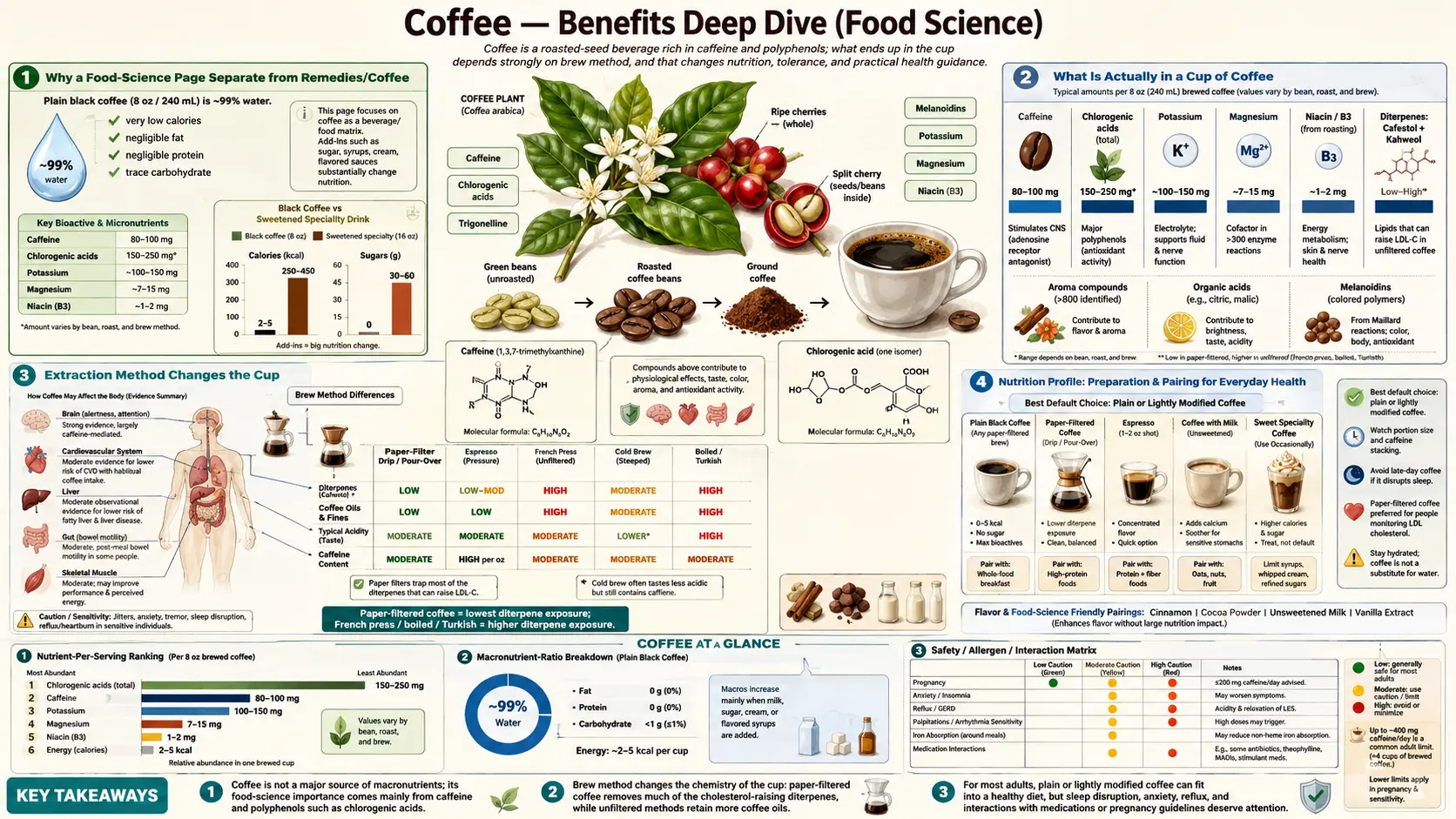
Coffee is the single most chemically complex beverage in the human diet. A finished cup contains more than 1,000 identified compounds — chlorogenic acids, melanoidins, diterpenes (cafestol and kahweol), trigonelline and its roasting products (notably N-methylpyridinium), caffeine, theobromine, theophylline, niacin, potassium, magnesium, and several hundred volatile aroma molecules. From a food-science perspective the relevant questions are not whether coffee is "good" or "bad" but rather: which compounds survive the roast, which are created by it, how does extraction (drip vs espresso vs French press) change the final cup, why do Arabica and Robusta beans produce measurably different physiological responses, and what changes when the caffeine is removed. These four deep-dive pages map the food-chemistry of coffee — complementary to the remedies-and-disease-prevention angle on the Remedies side — with an emphasis on what is in the cup, why, and how to optimize the brew for cognitive and sensory benefit.
Deep-Dive Articles
Polyphenols and Chlorogenic Acid
Coffee is the largest single source of polyphenols in the Western diet by a wide margin — ahead of tea, red wine, and cocoa. Chlorogenic acids (5-caffeoylquinic acid and 13 related isomers) deliver 70-350 mg per cup depending on roast and bean. Roast progression degrades CGAs into quinolactones and melanoidins. Bioavailability, gut-microbiome metabolism to hippuric acid and dihydroferulic acid, and the practical consequences for green-coffee-extract supplements vs the brewed cup.
Cognitive Performance
The adenosine receptor antagonism behind caffeine's alertness effect, dose-response curves for reaction time, sustained attention, working memory, and the inverted-U above 400 mg/day. CYP1A2 polymorphisms that split the population into fast and slow metabolizers (the same dose lasts 2 hours in one person and 8 in another), tolerance kinetics over 7-14 days of regular use, withdrawal headache mechanism (rebound adenosine sensitization), and the limited but real evidence for long-term protection against Alzheimer's and Parkinson's disease.
Bean Variety and Roast
Why Arabica (Coffea arabica) contains roughly half the caffeine of Robusta (Coffea canephora) but more lipids and aromatic compounds. The four roast tiers (light/cinnamon, medium/American, medium-dark/Vienna, dark/French-Italian) and how each changes CGA content, melanoidin formation, acidity, body, and bitter compounds. Why darker roasts are not stronger in caffeine. Single-origin vs blend, washed vs natural-process, and the Specialty Coffee Association cupping protocol used to score beans.
Decaf vs Caffeinated
The four decaffeination processes (Swiss Water, CO2, ethyl acetate, methylene chloride) and what each does to flavor and CGA retention. Why decaf is never zero caffeine (typically 2-15 mg per cup vs 80-200 for regular). Which benefits survive decaffeination (most CGA-mediated effects, T2D protection, some liver protection) and which do not (cognitive alertness, ergogenic effects, much of the Parkinson's and headache benefit). Practical decision rules for pregnancy, sleep, hypertension, anxiety, and cardiac arrhythmia.
Caffeine Cutoff Timing and Sleep
Caffeine has a 5-hour half-life and a 10-hour quarter-life, so a 2 PM coffee still has caffeine on board at midnight. The Drake 2013 polysomnography trial showed 400 mg taken 6 hours before bed cut total sleep time by an hour — even when drinkers did not notice. Adenosine antagonism, CYP1A2 fast vs slow metabolizer cutoffs, effects on REM and slow-wave sleep, hidden caffeine sources, and a practical cutoff strategy by chronotype and genotype.
Interactive Visualization Caffeine, Adenosine & Why Coffee Stops Working Caffeine doesn’t give you energy — it blocks the tiredness signal while adenosine keeps piling up behind the blockade. Move your coffee to 2 p.m. and watch your deep sleep vanish. Launch →
Table of Contents
- Deep-Dive Articles
- Why a Food-Science Page Separate from Remedies/Coffee
- What Is Actually in a Cup of Coffee
- Extraction Method Changes the Cup
- Research Papers: Polyphenols and Chlorogenic Acid
- Research Papers: Cognitive Performance
- Research Papers: Bean Variety, Roast, and Sensory
- Research Papers: Decaffeination and Decaf Effects
- Research Papers: Cross-Cutting (Brewing, Aroma, Microbiome)
- External Authoritative Resources
- Connections
- Featured Videos
Why a Food-Science Page Separate from Remedies/Coffee
This site carries two parallel coffee-benefits hubs and the distinction is deliberate. The Remedies/Coffee/Benefits/ deep-dive answers disease-prevention questions: cardiovascular mortality, type 2 diabetes incidence, hepatic fibrosis and NAFLD, and the CYP1A2-by-coffee gene-environment interaction that splits coffee drinkers into two cardiovascular risk groups. Those pages are organized around clinical endpoints — the questions a patient or clinician asks when deciding whether and how much coffee to drink for a specific condition.
The Food/Coffee/Benefits/ deep-dive you are reading now takes the opposite organizing principle. Here the questions are food-science questions: what molecules are in the cup, where did they come from, how does the brew choice and bean choice change the cup, what does the body do with the polyphenols (a separate question from what the polyphenols do to disease risk), and how do the sensory aspects map to physiology. The two hubs cross-link extensively and the same primary literature underlies both — but the framing differs, and a reader interested in the chemistry and brewing of coffee is best served by the food-science angle.
The split also reflects a real division in the coffee research literature itself. Cardiovascular and oncologic outcomes studies typically treat coffee as a single exposure variable (cups per day) and rarely distinguish Arabica from Robusta, light from dark roast, filtered from unfiltered, or caffeinated from decaffeinated. Food-science research, by contrast, lives in those distinctions — quantifying CGA content by roast level, measuring volatile aroma molecules by extraction method, and tracing the gut microbiome metabolism of specific polyphenol classes. Both literatures are necessary; neither is sufficient on its own.
What Is Actually in a Cup of Coffee
A typical 240 mL (8 fl oz) cup of drip-brewed Arabica coffee contains, in approximate order of mass:
- Water — 235 mL (98% of the cup by mass)
- Carbohydrates and melanoidins — 300-500 mg (mostly polymerized Maillard reaction products formed during roasting)
- Chlorogenic acids — 70-350 mg (highly roast-dependent; light roast retains more)
- Caffeine — 80-200 mg (varies more by brewing method and grind than by roast level)
- Potassium — ~120 mg per 240 mL cup
- Niacin (Vitamin B3) — 0.5-2 mg per cup (formed by thermal degradation of trigonelline)
- Trigonelline — 40-200 mg (degraded by roasting, so light roasts retain more)
- Diterpenes (cafestol and kahweol) — trace in paper-filtered drip (0.2-0.6 mg combined); 6-12 mg in French press; 5-10 mg in espresso; 80-100+ mg/day in boiled unfiltered Scandinavian-style coffee
- Magnesium — ~7 mg
- Volatile aroma compounds — under 1 mg combined but representing 800+ identified molecules including furans, pyrazines, pyrroles, thiols, aldehydes, ketones, and the dominant 2-furfurylthiol that gives roasted coffee its characteristic aroma
Several of these categories overlap with this site's other content. The niacin from coffee is a small but real contributor to dietary Vitamin B3 in heavy coffee drinkers. The potassium content is meaningful in the context of cardiovascular risk, particularly for hypertensive patients on potassium-wasting diuretics. The magnesium contribution is modest but non-trivial across multiple cups per day.
The most chemically distinctive feature of coffee — the thing no other major dietary item provides in remotely comparable quantity — is chlorogenic acid. A heavy coffee drinker takes in 1.5-2 grams of CGAs per day, more than they take in of any other polyphenol class from any other source. This is the subject of the first deep-dive.
Extraction Method Changes the Cup
The same beans produce a quite different chemical cup depending on how the coffee is brewed. The dimensions that matter:
- Contact time — espresso extracts in 20-30 seconds; drip in 4-6 minutes; French press in 4 minutes; cold brew in 12-24 hours. Longer contact extracts more of the slow-to-dissolve high-molecular-weight compounds (melanoidins, lipid-bound diterpenes); shorter contact favors caffeine and the low-molecular-weight acids that give bright flavor.
- Water temperature — 90-96°C for drip, espresso, and pour-over; ~80°C for some Japanese drip methods that minimize bitter extraction; ambient/cold for cold brew which avoids most of the bitter compounds but extracts caffeine over its longer contact time.
- Grind size — finer grind has more surface area and extracts faster. Espresso uses very fine grind (powder consistency); drip uses medium; French press uses coarse to avoid over-extracting bitter and to allow filtration through the mesh.
- Filter type — this is the single most consequential variable for cardiovascular risk. Paper filters trap nearly all the diterpene molecules (cafestol and kahweol), which would otherwise raise LDL cholesterol. Metal mesh filters (French press, espresso group, Aeropress without paper) let the diterpenes through. Cloth filters are intermediate. Unfiltered boiled coffee delivers the highest diterpene dose.
- Pressure (espresso) — 9 bars of pressure forces water through the puck and emulsifies the lipid-soluble compounds in a way that drip cannot. The resulting crema is a microfoam of these emulsified lipids plus CO2 from the freshly-roasted beans.
The practical implication: a person drinking 4 cups of French press a day is consuming a measurably different beverage from a person drinking 4 cups of paper-filtered drip. The cardiovascular literature in our Remedies/Coffee cardiovascular page shows the unfiltered drinker has an LDL cholesterol approximately 10-15 mg/dL higher attributable to the diterpene exposure, on top of any other risk-factor differences. For aroma, body, and sensory experience, the same comparison runs the other way — the unfiltered cup is fuller and more aromatic because it carries the lipid-bound volatiles that paper filters strip out.
The Bean Variety and Roast deep-dive explores how the upstream choices (bean origin, varietal, processing, roast level) interact with these extraction choices to produce the final cup.
Research Papers: Polyphenols and Chlorogenic Acid
- Clifford MN, chlorogenic acid nomenclature and food content review — PubMed: Clifford CGA nomenclature
- Coffee as largest dietary source of polyphenols in Western populations (Vinson et al.) — PubMed: Coffee largest polyphenol source
- Chlorogenic acid bioavailability and absorption in humans — PubMed: CGA bioavailability
- Gut microbiome metabolism of CGAs to hippuric acid and dihydroferulic acid — PubMed: CGA microbiome metabolism
- Roasting degrades CGAs to quinolactones and melanoidins — PubMed: Roast degrades CGA
- Green coffee extract vs brewed coffee for chlorogenic acid delivery — PubMed: Green coffee extract
- Chlorogenic acid and glucose absorption / postprandial glycemia — PubMed: CGA glycemia
- Caffeoylquinic acid (5-CQA) as principal coffee CGA — PubMed: 5-CQA principal CGA
- Polyphenol intake and total mortality cohort studies (EPIC) — PubMed: Polyphenol mortality cohorts
- Coffee melanoidins as functional dietary fiber — PubMed: Melanoidins as fiber
Research Papers: Cognitive Performance
- Adenosine A2A receptor antagonism mechanism of caffeine alertness — PubMed: Caffeine adenosine A2A
- Caffeine dose-response for vigilance and reaction time — PubMed: Caffeine vigilance dose-response
- CYP1A2 polymorphisms and caffeine metabolism rate (Cornelis, El-Sohemy) — PubMed: CYP1A2 caffeine metabolism
- Caffeine and cognitive performance meta-analysis (McLellan, Caldwell, Lieberman) — PubMed: Caffeine cognitive meta-analysis
- Caffeine withdrawal headache mechanism (Juliano, Griffiths) — PubMed: Caffeine withdrawal
- Coffee and risk of Parkinson's disease (Honolulu Heart Program) — PubMed: Coffee Parkinson's
- Coffee and Alzheimer's / dementia risk (Eskelinen, Kivipelto) — PubMed: Coffee dementia
- Caffeine tolerance development over days to weeks — PubMed: Caffeine tolerance
- Caffeine and working memory / executive function — PubMed: Caffeine working memory
- Theobromine and theophylline in coffee (minor methylxanthines) — PubMed: Minor methylxanthines
Research Papers: Bean Variety, Roast, and Sensory
- Arabica vs Robusta chemical composition comparison — PubMed: Arabica vs Robusta
- Maillard reaction and melanoidin formation in coffee roasting — PubMed: Maillard in coffee
- Roast degree and antioxidant capacity (ORAC, FRAP) of brewed coffee — PubMed: Roast and antioxidant
- Volatile aroma compounds in roasted coffee (Czerny, Grosch) — PubMed: Coffee aroma volatiles
- 2-Furfurylthiol as principal coffee aroma compound — PubMed: 2-Furfurylthiol
- Acrylamide formation in dark-roast coffee — PubMed: Acrylamide in coffee
- Trigonelline degradation and niacin formation during roasting — PubMed: Trigonelline and niacin
- N-methylpyridinium from trigonelline thermal degradation — PubMed: N-methylpyridinium
- Washed vs natural-process coffee chemistry and sensory — PubMed: Washed vs natural process
- SCA cupping protocol and sensory evaluation methodology — PubMed: SCA cupping
Research Papers: Decaffeination and Decaf Effects
- Swiss Water decaffeination process and CGA retention — PubMed: Swiss Water decaf
- Supercritical CO2 decaffeination chemistry — PubMed: Supercritical CO2 decaf
- Methylene chloride decaffeination residue and safety — PubMed: Methylene chloride decaf
- Ethyl acetate decaffeination and natural designation — PubMed: Ethyl acetate decaf
- Residual caffeine content in commercial decaf coffee — PubMed: Residual caffeine in decaf
- Decaffeinated coffee and type 2 diabetes risk — PubMed: Decaf and T2D
- Decaffeinated coffee and liver enzymes / NAFLD — PubMed: Decaf and liver
- Caffeinated vs decaffeinated for Parkinson's protection — PubMed: Decaf vs caffeinated Parkinson's
- Coffee in pregnancy: caffeine intake guidelines — PubMed: Coffee in pregnancy
- Decaf coffee and gastric acid secretion — PubMed: Decaf and gastric acid
Research Papers: Cross-Cutting (Brewing, Aroma, Microbiome)
- Paper filter retention of cafestol and kahweol diterpenes (Urgert) — PubMed: Urgert filter retention
- Cold brew coffee chemistry vs hot brew — PubMed: Cold brew chemistry
- Espresso vs drip vs French press caffeine and CGA extraction — PubMed: Brewing method extraction
- Coffee consumption and gut microbiome composition — PubMed: Coffee and microbiome
- Caffeine metabolism via CYP1A2 and paraxanthine production — PubMed: Caffeine metabolism
- Specialty Coffee Association brewing standards (golden cup) — PubMed: SCA brewing standards
- Coffee staling and oxidation post-roasting — PubMed: Coffee staling
- Espresso crema composition and stability — PubMed: Espresso crema
- Coffee water chemistry: TDS, mineral content, brewing impact — PubMed: Coffee water chemistry
- Coffee silverskin and grounds as valorized food byproduct — PubMed: Coffee byproducts
External Authoritative Resources
- Specialty Coffee Association — cupping protocol, brewing standards, sensory lexicon
- International Coffee Organization — global production statistics, varietal data, market reports
- National Coffee Association USA — consumption surveys, brewing guides
- NIH ODS — Caffeine Fact Sheet (Health Professionals)
- PubMed — All research on coffee chemistry
Connections
- All Food
- Caffeine, Adenosine & Why Coffee Stops Working — interactive animation
- Coffee (Food Hub)
- Polyphenols and Chlorogenic Acid
- Cognitive Performance
- Bean Variety and Roast
- Decaf vs Caffeinated
- Caffeine Cutoff Timing and Sleep
- Coffee (Remedies Benefits Hub)
- Coffee Cardiovascular & Mortality
- Coffee as a Natural Remedy
- Green Tea
- Dark Chocolate
- Vitamin B3 (Niacin)
- Potassium
- Magnesium
- Parkinson's Disease
- Alzheimer's Disease