Coffee: History and Origins
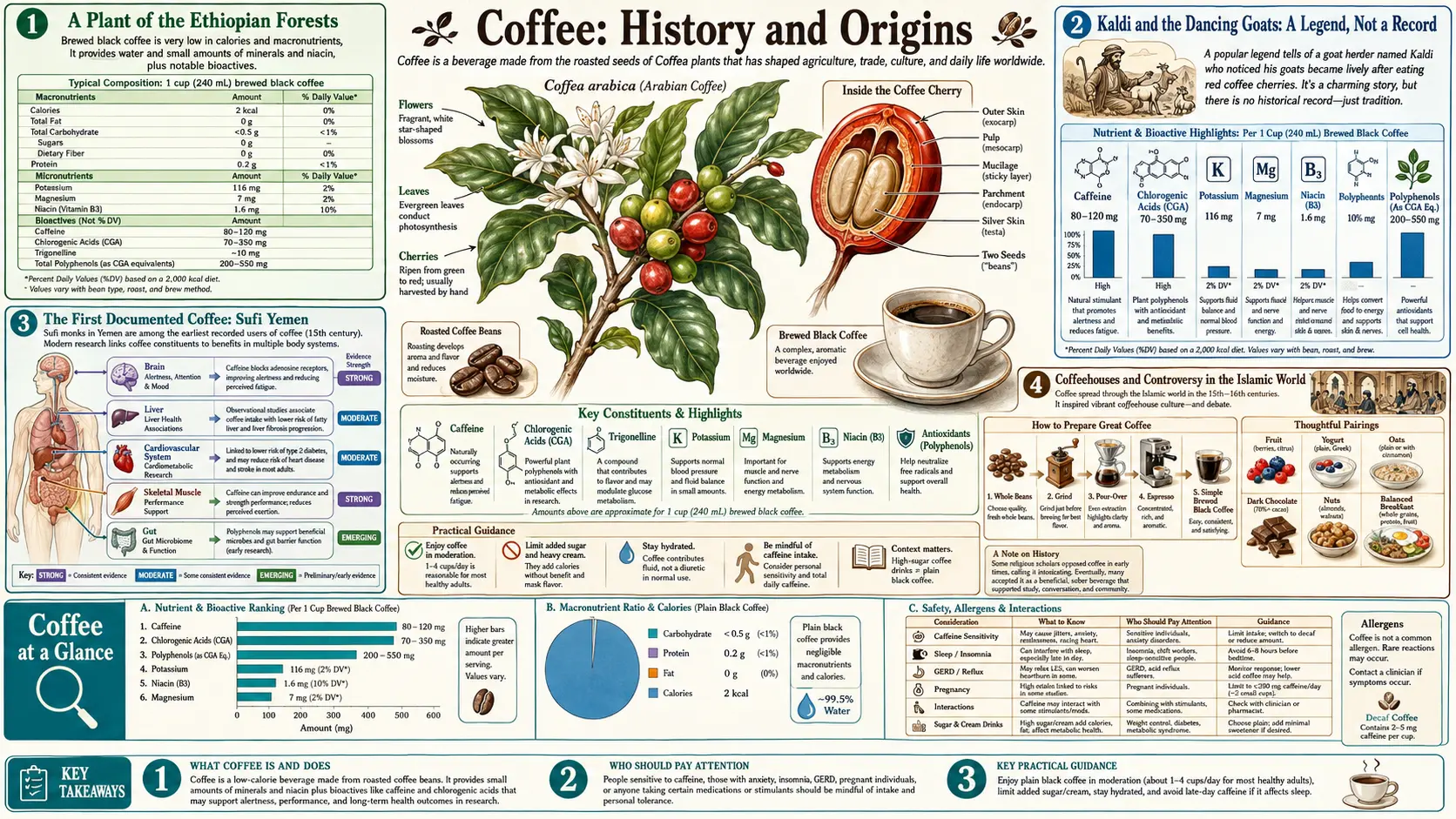
Coffee is not an invention, and it has no inventor. The plant behind it — Coffea arabica — grew wild in the cool, misty highland forests of southwestern Ethiopia long before any human noticed it, the product of a chance crossing of two wild coffee species that genome studies now date to roughly 350,000 to 610,000 years ago. How and when people first turned its bitter cherries into a drink is genuinely lost to us; the famous tale of the goat herder Kaldi is a charming legend, first written down only in 1671, not a historical record. What the documents do support begins later and elsewhere: by the late 1400s, Sufi worshippers in Yemen were brewing coffee to stay awake for night-long prayer, and from the Red Sea port of Mocha the drink spread across the Islamic world and then to Europe, gathering coffeehouses, controversies, and a papal legend along the way. This article follows that journey using what the record actually supports, names legends as legends, and keeps the firm dates separate from the many good stories that have grown up around the world's favourite stimulant.
Interactive Visualization Caffeine, Adenosine & Why Coffee Stops Working Caffeine doesn’t give you energy — it blocks the tiredness signal while adenosine keeps piling up behind the blockade. Move your coffee to 2 p.m. and watch your deep sleep vanish. Launch →
Table of Contents
- A Plant of the Ethiopian Forests
- Kaldi and the Dancing Goats: A Legend, Not a Record
- The First Documented Coffee: Sufi Yemen
- Coffeehouses and Controversy in the Islamic World
- Coffee Comes to Europe
- Around the World: The Global Coffee Belt
- The Word "Coffee"
- From Folk Drink to Modern Science
- Research Papers and References
- Connections
- Featured Videos
A Plant of the Ethiopian Forests
The story of coffee begins not with a person but with a plant, and that plant's own origin is itself a small drama. The coffee of the cup — Coffea arabica — is what botanists call an allopolyploid: a species born from the natural crossing of two other wild coffee species, the ancestors of today's Coffea canephora (the source of robusta) and Coffea eugenioides. The 2024 genome study led by Jarkko Salojärvi and colleagues in Nature Genetics dated this founding hybridisation to roughly 350,000 to 610,000 years ago, placing it in the forests of Africa long before any human cultivated anything. Arabica thus carries a double inheritance, which is why it has twice the chromosomes of its parents.
Where this happened, and where the plant grew wild, is the high country of southwestern Ethiopia (with related wild populations across the region around the Great Rift Valley). There, in cool, humid montane forest, arabica still grows as a wild understorey shrub today. This is the genuine cradle of the species, and it is the one part of coffee's deep history that is settled by hard evidence rather than story. The second wild species behind so much modern coffee, Coffea canephora, is native to the lowland tropical forests of central and western Africa and was domesticated far more recently; it is the hardier, more caffeine-rich bean now grown widely as robusta.
An honest history has to admit a gap here. We know where the plant came from, but we do not know who first realised that roasting and brewing its seeds made a stimulating drink, or when. Various traditions hold that Ethiopian communities ate the cherries, chewed the leaves, or made infusions long before the practice was written down, and that is entirely plausible — but it is oral tradition and inference, not documented record. The plant is African and ancient; the beverage, as the next sections show, enters the written record much later, on the other side of the Red Sea.
Kaldi and the Dancing Goats: A Legend, Not a Record
No account of coffee escapes the tale of Kaldi, the Ethiopian goat herder. In the popular telling, Kaldi noticed that his goats grew strangely frisky — even sleepless — after nibbling the bright red cherries of a certain shrub. Curious, he tried the berries himself, felt their lift, and carried them to a nearby monastery; the monks, the story goes, brewed a drink that kept them awake through long hours of prayer. It is a delightful origin myth, and it is told as fact on countless coffee bags and cafe walls. It should not be.
The historical problem is plain: the Kaldi story does not appear anywhere before 1671, when it was set down by Antoine Faustus Nairon, a Maronite scholar in Rome, in a Latin treatise on coffee — many centuries after coffee was actually being drunk in Yemen. The name "Kaldi" itself seems to be an even later addition, attached to the tale only in modern times. Scholars therefore treat the goat-herder legend as apocryphal: a picturesque after-the-fact explanation, not testimony from anyone who witnessed coffee's discovery.
A second, related legend credits a Sufi holy man — variously the thirteenth-century North African mystic Abu al-Hasan al-Shadhili or his disciple, often called Omar — with discovering coffee's power to sustain devotion. These pious origin stories are valuable as folklore and as evidence of how strongly coffee became bound up with Sufi religious life, but, like Kaldi, they are tradition rather than dated record. The takeaway is simple and worth stating clearly: the romantic discovery stories belong to the realm of legend, while coffee's firm, documented history starts with the Yemeni Sufis of the next section.
The First Documented Coffee: Sufi Yemen
The earliest credible, written evidence of coffee as a beverage comes from fifteenth-century Yemen, where it was embraced by Sufi communities. For these mystics, coffee had a practical religious value: a drink that drove off sleep allowed worshippers to keep the long night-time vigils of dhikr, the repeated remembrance of God. Coffee, in other words, entered recorded history not as a luxury or a medicine but as a tool of prayer.
Our best source for this is an Arabic manuscript written in 1587 by Abd al-Qadir al-Jaziri, titled Umdat al-safwa fi hill al-qahwa ("The Argument in Favour of the Legitimate Use of Coffee"). Al-Jaziri gathered the earlier accounts and traced coffee's spread, naming the Yemeni Sufi Jamal al-Din al-Dhabhani (a religious judge who died around 1470) as an early adopter who endorsed the drink among his followers. From scholarship built on this and related texts — above all Ralph Hattox's standard history, Coffee and Coffeehouses (1985) — historians place coffee drinking as well established in Yemen by the latter half of the fifteenth century.
The geography matters as much as the date. The cultivated coffee of this era moved through the Yemeni highlands and out through the Red Sea port of Mocha (al-Makha), whose name became so bound to the trade that it still clings to a style of coffee today. For roughly two centuries Mocha was effectively the world's gateway for coffee, and Yemen guarded its monopoly jealously — a control that, as later sections show, could only hold for so long. Genome and historical studies agree on the broad arc: arabica was almost certainly first domesticated from Ethiopian stock, but it was in Yemen that it was first cultivated as a crop and turned into an article of long-distance trade.
Coffeehouses and Controversy in the Islamic World
From Yemen, coffee travelled with pilgrims and merchants up the trade routes of the Islamic world, and wherever it went it produced a new and faintly subversive institution: the coffeehouse (in Arabic qahveh khaneh, in Turkish kahvehane). These were places where men gathered not to worship or to trade but simply to talk — to argue politics, recite poetry, play chess and backgammon, hear the news, and linger. The first coffeehouse in Constantinople (Istanbul) is recorded as opening around 1554, and similar establishments multiplied across Mecca, Cairo, Damascus, and beyond.
That very sociability made coffee politically suspect, and its early career was punctuated by attempts to ban it. The most famous episode came in Mecca in 1511, when the local governor Kha'ir Beg, alarmed by the gatherings and the drink's stimulating effect, moved to prohibit coffee — convening jurists to debate whether it was an unlawful intoxicant. A comparable crackdown is recorded in Cairo in 1532. These bans never held for long: coffee was simply too popular, and the religious-legal arguments against it were never decisive. By 1524 the Ottoman authorities had effectively settled the question in coffee's favour, and the drink became woven into Ottoman daily life.
It is worth noticing what these recurring controversies reveal. The fight was never really about whether coffee was harmful; it was about the coffeehouse as a space of unsupervised conversation. Rulers across several centuries and several empires would draw the same lesson and reach for the same remedy — periodic bans that never stuck. Coffee's history, from its very first decades, is as much a social and political story as a botanical one, and the institution it created proved far harder to suppress than the beverage itself.
Coffee Comes to Europe
European travellers to the Ottoman lands began describing coffee in the sixteenth century, and the drink itself followed by sea. Venice, with its deep trading ties to the eastern Mediterranean, was among the first European cities to know coffee; the beverage was being discussed and imported there around the turn of the seventeenth century, and the city's first true coffeehouse opened in the following decades. From Italy the habit spread north and west across the continent over the 1600s.
A much-loved story attaches to coffee's European debut: that Pope Clement VIII, urged by advisers to condemn the "Muslim" drink as the work of Satan, tasted it himself, found it delicious, and jokingly "baptised" it to make it fit for Christians. It is a good anecdote — but it should be flagged as legend. Historians note that there is no firm contemporary evidence for the episode, and standard reference accounts say plainly that it is not clear whether the tale is true. Like the Kaldi story, it has survived because it is charming, not because it is documented.
What is firmly recorded is the explosion of European coffeehouses. England's first opened in Oxford in 1650, and London's first followed in 1652, run by a servant named Pasqua Rosée; within a generation London had hundreds of them. These "penny universities" became engines of news, commerce, and ideas. The most consequential example is Edward Lloyd's coffeehouse, which opened by 1686 and became the haunt of merchants and ship-owners trading marine-insurance risks — the gathering that grew, over time, into the insurance market Lloyd's of London. Coffee's cultural reach even entered the concert hall: around 1732–1735 Johann Sebastian Bach wrote his comic Coffee Cantata (BWV 211), a small staged joke about a young woman who refuses to give up her beloved coffee — proof that, within a century of arriving, the drink had become a fixture of everyday European life worth teasing in music.
Around the World: The Global Coffee Belt
For a long time Yemen tried to keep coffee to itself, reportedly allowing only roasted or boiled beans to leave so that no one could plant a rival crop. That monopoly was broken by smuggling and by the colonial ambitions of European powers. Tradition credits an Indian Sufi named Baba Budan with carrying seven fertile coffee seeds out of Yemen, around the seventeenth century, and planting them in the hills of southern India — a story often repeated, and plausible, though its details are traditional rather than firmly documented. More securely recorded is the role of the Dutch, who obtained living plants in the early 1600s, raised them in the Amsterdam botanical garden, and established coffee plantations in their colony of Java (and later Ceylon), giving the world the enduring nickname "java" for coffee.
From these botanical-garden plants coffee leapt to the Americas. In 1720–1723 a French naval officer, Gabriel de Clieu, famously carried a seedling across the Atlantic to the Caribbean island of Martinique, where it flourished and seeded plantations across the region. The French colony of Saint-Domingue (today Haiti) became so productive that by the late 1780s it is estimated to have supplied around half of the world's coffee. Cultivation spread on into Central and South America, and in time Brazil rose to become — as it remains — the largest coffee producer on Earth. This is the origin of the modern "coffee belt," the band of tropical countries between the Tropics of Cancer and Capricorn where nearly all of the world's coffee is now grown.
This global spread carries a sombre truth that an honest history must name. The plantation coffee of the seventeenth, eighteenth, and nineteenth centuries — in the Caribbean, in Brazil, and elsewhere — was very largely produced by enslaved and coerced labour. The same beverage that filled the convivial coffeehouses of Europe depended, on the other side of the ocean, on brutal colonial labour systems. The pleasant ritual and the exploitation were two faces of a single trade, and the story of how coffee conquered the world is inseparable from that history.
The Word "Coffee"
The name of the drink traces its own neat path across languages, mirroring the route the beverage itself travelled. The chain begins with the Arabic qahwa (قَهْوَة). The word originally appears to have denoted a kind of wine or, more generally, a dark drink, and was applied to coffee for its colour and its power to dull the appetite — a fitting borrowing for a drink that the Sufis valued precisely for what it did to the body and mind.
From Arabic the word passed into Ottoman Turkish as kahve, and it was through Turkish that it entered Europe. Italian rendered it caffè, the Dutch koffie, the French café — and English, drawing on these, settled on coffee. Even the names tell the history: a word born in Arabia, handed to Europe by the Ottomans, and reshaped by each language it touched.
One related name carries its own freight. Mocha, now a word for a coffee-and-chocolate drink, began simply as the name of the Yemeni port through which the world's coffee once flowed — a small linguistic fossil of the centuries when nearly every bean drunk anywhere on Earth had passed through that single Red Sea harbour.
From Folk Drink to Modern Science
The final chapter of coffee's history is the one still being written: the turn from custom to laboratory. For most of its life coffee was drunk for pleasure, sociability, and wakefulness, and its supposed effects on health were a matter of folk belief and physicians' opinion. Over the last half-century it has become instead one of the most intensively studied items in the human diet, the subject of thousands of epidemiological and clinical investigations into its links with the heart, the liver, the brain, and metabolism.
That scrutiny has, on the whole, been kinder to coffee than its detractors once expected. A telling marker came in 2016, when the World Health Organization's International Agency for Research on Cancer reviewed the evidence and removed coffee from its "possibly carcinogenic" listing, concluding that drinking coffee is not classifiable as a cancer risk to humans. That reversal — a careful re-reading of decades of data — is a good emblem of how the modern era treats coffee: not with legend or suspicion, but with evidence. The detailed weighing of benefits, mechanisms, and cautions belongs to the companion Coffee Benefits articles and the main Coffee page; this history is concerned only with how the drink came to be in our cups in the first place.
It is worth ending where the honesty of this page began. Coffee was discovered by no one and invented by no one; it is an African plant, made into a drink by communities whose names are lost, carried into history by Yemeni worshippers, argued over in Mecca and Rome, and spread around the planet on trade routes both glorious and shameful. Knowing that fuller story — legends marked as legends, dates kept honest, the costs not hidden — is part of drinking the cup with open eyes.
Research Papers and References
The list below combines peer-reviewed and standard scholarly sources on the botany and history of coffee with curated PubMed topic-search links. Historical primary sources — above all Abd al-Qadir al-Jaziri's 1587 manuscript Umdat al-safwa fi hill al-qahwa, and Antoine Faustus Nairon's 1671 treatise that first records the Kaldi legend — are named in the article as historical sources rather than as modern citations. Author names, titles, and journals are given as plain text; only the stable DOI, PMID, or archive link is hyperlinked, and each opens in a new tab.
- Salojärvi J, Rambani A, Yu Z, Guyot R, Strickler S, Lepelley M, et al. The genome and population genomics of allopolyploid Coffea arabica reveal the diversification history of modern coffee cultivars. Nature Genetics. 2024;56(4):721-731. — doi:10.1038/s41588-024-01695-w · PMID: 38622339
- Montagnon C, Mahyoub A, Solano W, Sheibani F. Unveiling a unique genetic diversity of cultivated Coffea arabica L. in its main domestication center: Yemen. Genetic Resources and Crop Evolution. 2021;68(6):2411-2422. — doi:10.1007/s10722-021-01139-y
- Scalabrin S, Toniutti L, Di Gaspero G, Scaglione D, Magris G, Vidotto M, et al. A single polyploidization event at the origin of the tetraploid genome of Coffea arabica is responsible for the extremely low genetic variation in wild and cultivated germplasm. Scientific Reports. 2020;10:4642. — doi:10.1038/s41598-020-61216-7 · PMID: 32170172
- Hattox RS. Coffee and Coffeehouses: The Origins of a Social Beverage in the Medieval Near East. Seattle: University of Washington Press; 1985. — WorldCat: 11971412
- Tucci SA. Coffee, caffeine and history — ethnobotany and ethnopharmacology of Coffea — PubMed: Coffea arabica history, origin and domestication
- Coffee, caffeine and human health — epidemiology overview — PubMed: coffee, caffeine and health
External Authoritative Resources
- Wikipedia — History of Coffee (overview with primary-source citations)
- Encyclopaedia Britannica — Coffee
- PubMed — Research on Coffea arabica origin and domestication
Connections
- All Food
- Caffeine, Adenosine & Why Coffee Stops Working — interactive animation
- Coffee
- Coffee Benefits
- Green Tea
- Dark Chocolate
- Honey
- Olive Oil