Coffee Polyphenols and Chlorogenic Acid
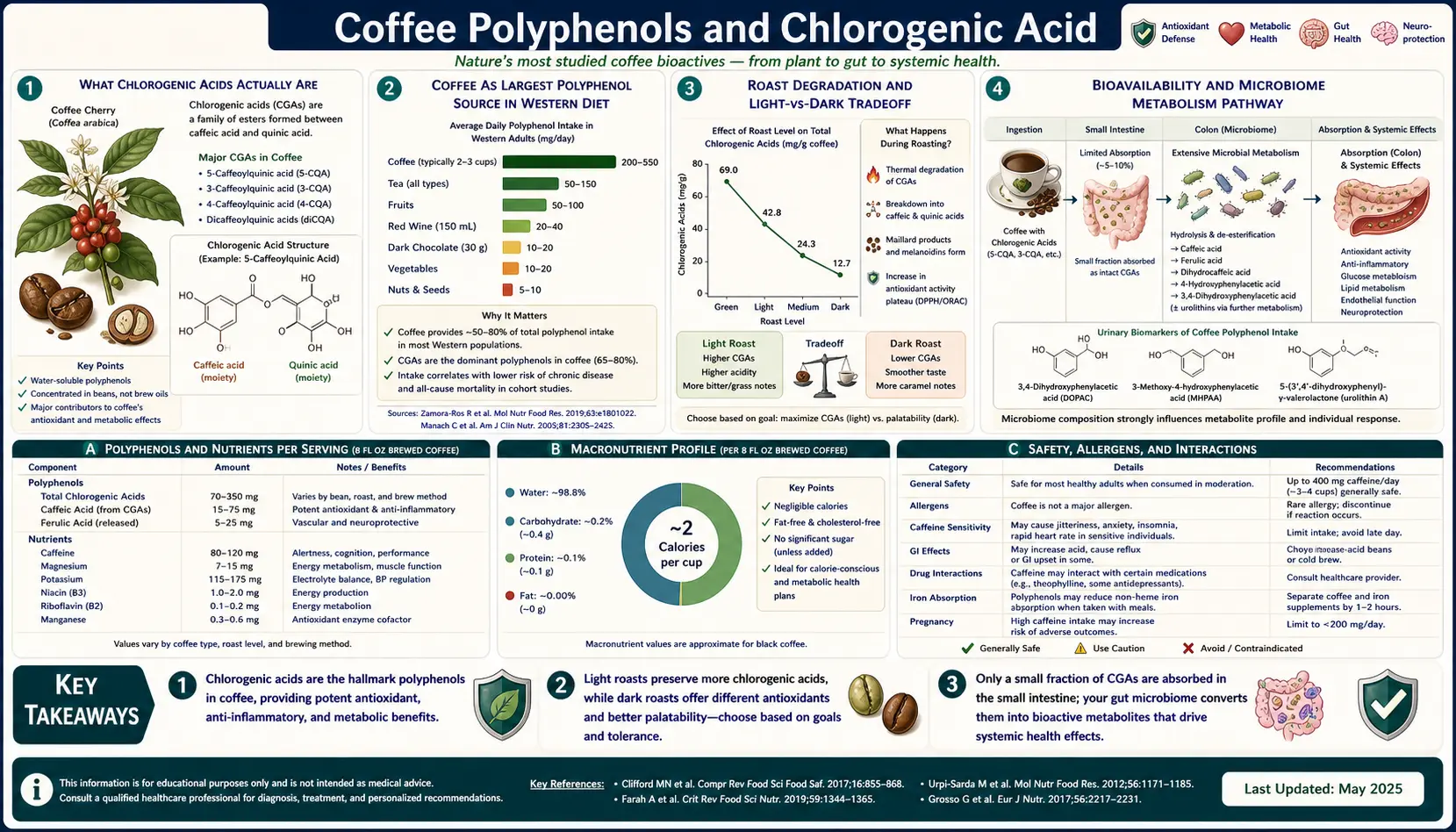
Coffee is the largest single source of polyphenols in the typical Western diet — more than tea, more than red wine, more than cocoa, and more than all berries combined. The dominant polyphenol class is the chlorogenic acids (CGAs), of which 5-caffeoylquinic acid alone provides 50-70% of total CGA mass. A heavy coffee drinker consumes 1.5-2 grams of CGAs per day, an amount no other dietary source approaches at realistic intake. The catch is that roasting actively destroys CGAs: a dark French roast retains roughly 50% of the CGA mass of a light roast from the same bean. The other catch is that CGAs are poorly absorbed intact — most of their physiological action happens through gut-microbiome-derived metabolites such as hippuric acid and dihydroferulic acid. This page maps the chemistry, the brewing factors that determine CGA dose, and the practical question of whether a green-coffee-extract supplement can substitute for actually drinking the coffee.
Interactive Visualization Caffeine, Adenosine & Why Coffee Stops Working Caffeine doesn’t give you energy — it blocks the tiredness signal while adenosine keeps piling up behind the blockade. Move your coffee to 2 p.m. and watch your deep sleep vanish. Launch →
Table of Contents
- What Chlorogenic Acids Actually Are
- Coffee as Largest Polyphenol Source in Western Diet
- Roast Degradation and the Light-vs-Dark Tradeoff
- Bioavailability and the Microbiome Metabolism Pathway
- Brewing Method and Final CGA Dose
- CGA, Glucose Absorption, and Postprandial Glycemia
- CGA and Blood Pressure
- Green Coffee Extract Supplements vs Brewed Coffee
- Melanoidins — the Roast-Created Polyphenol
- Other Coffee Polyphenols (Lignans, Diterpene-Linked)
- Practical Recommendations
- Key Research Papers
- Connections
- Featured Videos
What Chlorogenic Acids Actually Are
The name "chlorogenic acid" is misleading on two counts. It contains no chlorine (the name comes from Greek chloros, pale green, the color of an iron-CGA complex used in early plant chemistry). And there is no single chlorogenic acid — the term refers to a family of more than 80 related esters formed between trans-cinnamic acids (caffeic, ferulic, p-coumaric, sinapic) and quinic acid.
The main subgroups in coffee, by mass:
- Caffeoylquinic acids (CQAs) — one caffeic acid esterified to quinic acid. Three position isomers (3-CQA, 4-CQA, 5-CQA), with 5-CQA the dominant one and frequently the only molecule meant when researchers write "chlorogenic acid" without further specification. CQAs account for roughly 70% of total CGA mass in green coffee.
- Dicaffeoylquinic acids (diCQAs) — two caffeic acids esterified to one quinic acid. Three principal isomers (3,4-diCQA, 3,5-diCQA, 4,5-diCQA). 15-20% of total CGA mass. More antioxidant per molecule than CQAs because of the second catechol group.
- Feruloylquinic acids (FQAs) — ferulic acid esters. 3-FQA, 4-FQA, 5-FQA. Around 10% of total. Ferulic acid is itself bioactive after gut-microbiome ester hydrolysis.
- p-Coumaroylquinic and sinapoylquinic acids — minor isomers, less than 5% combined.
Green (unroasted) Arabica beans contain 5-12% CGAs by dry weight. Green Robusta beans contain 7-14%, somewhat more than Arabica, which is one reason Robusta tastes harsher and more bitter (CGAs themselves contribute astringency and the quinolactones formed from them on roasting are markedly bitter).
The functional point: every brewed cup of coffee delivers a complex mixture of these compounds, not a pure single CGA species. Most published bioactivity studies use either 5-CQA (the most abundant) or a green-coffee extract standardized to total CGA content. Both are reasonable proxies but neither fully reproduces the in-cup mixture, which also contains the quinolactones, the CGA degradation products from roasting, and the unrelated polyphenol classes discussed below.
Coffee as Largest Polyphenol Source in Western Diet
Coffee provides roughly one-third to one-half of all dietary polyphenols in adults living in the United States, France, the United Kingdom, Spain, and most other Western European countries, per the EPIC cohort and the NHANES dietary intake surveys.
Per-cup polyphenol content (approximate, varies considerably by roast and brew):
- Drip coffee, light roast — 200-350 mg total polyphenols per 240 mL cup
- Drip coffee, dark roast — 130-200 mg per cup
- Espresso, single shot (30 mL) — 100-200 mg total (a tiny volume but a much higher concentration than drip)
- Green tea, brewed 3 min — 150-200 mg total polyphenols (mostly catechins)
- Black tea, brewed 3 min — 150-200 mg (mostly theaflavins)
- Red wine, 150 mL — 150-200 mg (mostly anthocyanins and resveratrol-class)
- Dark chocolate, 30 g — 50-150 mg (cacao flavanols)
- Blueberries, 100 g — 350-500 mg (anthocyanins)
The reason coffee dominates the total in most populations is not that the per-cup amount is uniquely high — tea and wine are comparable per serving. The dominance is volumetric: typical coffee drinkers have 2-5 cups per day, while heavy red-wine drinkers cap out below one 150 mL glass per day, and most adults eat far less than 100 g of blueberries daily. Across a typical Western day, the heavy coffee drinker takes in 800-1,800 mg of polyphenols from coffee against a few hundred mg combined from all other sources.
This makes the chlorogenic-acid signal in observational coffee-and-disease epidemiology hard to separate from other "coffee drinker" lifestyle factors — you cannot find a control group in the standard Western diet who consume comparable polyphenol intake from non-coffee sources. The CGA-driven mechanism is plausible but interventional confirmation is sparse.
Roast Degradation and the Light-vs-Dark Tradeoff
Chlorogenic acids are thermally unstable. Roasting begins to degrade them at around 180°C, and degradation accelerates rapidly between 200 and 230°C — precisely the temperature range covered by commercial coffee roasting.
Approximate CGA retention by roast level (relative to green-bean content):
- Light roast (cinnamon, light city; first-crack only, bean surface temp ~205°C): 60-70% CGA retention
- Medium roast (city, American; into first crack, bean temp ~210-219°C): 40-60% retention
- Medium-dark roast (full city, Vienna; approaching second crack, ~220-225°C): 25-40% retention
- Dark roast (French, Italian; into and past second crack, ~225-235°C): 10-25% retention
The degraded CGAs become four main product classes:
- Quinolactones (chlorogenic acid lactones) — intramolecular ester rearrangement products that retain antioxidant activity and contribute meaningfully to bitterness. They are the dominant bitter compounds in moderate-roast coffee before the dark-roast quinic-acid-and-phenolic bitter compounds dominate.
- Melanoidins — high-molecular-weight brown polymers formed from CGA fragments cross-linked with carbohydrate and protein fragments via Maillard reactions. The CGA-derived portion of the melanoidin pool gives dark-roast coffee much of its color and contributes a still-bioactive (though less well characterized) antioxidant pool. Melanoidins are the topic of the section below.
- Free phenolic acids — small amounts of free caffeic acid, ferulic acid, and quinic acid hydrolyzed off the CGA ester backbone, plus their decarboxylation products (e.g. 4-vinylcatechol from caffeic acid).
- Volatile phenols — guaiacol, 4-ethylguaiacol, and related smoky/spicy aroma compounds, plus more complex pyrazines and furans. These contribute to the characteristic dark-roast aroma.
The light-vs-dark tradeoff is therefore not a simple one. Light roast delivers more intact CGA mass. Dark roast delivers more melanoidins (which carry their own bioactivity) and N-methylpyridinium (a trigonelline degradation product associated with less gastric acid stimulation). Dark roast also delivers more acrylamide (a Maillard byproduct, classified as a probable human carcinogen by IARC, although coffee's contribution to total dietary acrylamide is modest compared to fried potato products). For maximum CGA dose, a light or medium-light roast is the clear choice; for the full melanoidin-and-bitter complex, medium-dark is the standard.
Bioavailability and the Microbiome Metabolism Pathway
The pharmacokinetics of CGAs are the single most important and most under-appreciated point about coffee polyphenols. CGAs as ingested are poorly absorbed intact in the small intestine — roughly one-third of an oral CGA dose appears in portal blood as intact CQA, and most of the rest passes intact to the colon, where the resident gut microbiota hydrolyze the quinic acid ester bond and then degrade the released caffeic acid by reductive metabolism, ring fission, and alpha-oxidation.
The dominant CGA-derived metabolites recovered from urine over 24 hours after a coffee dose:
- Hippuric acid (~25-40% of dose) — the largest single metabolite. Formed by ring fission of caffeic acid to benzoic acid, then conjugation with glycine in the liver. Hippuric acid is a long-recognized urinary biomarker of total polyphenol intake.
- Dihydroferulic acid (~10-15%) — a reductive metabolite of caffeic acid via dihydrocaffeic acid intermediate, then O-methylation in the liver.
- 3-Hydroxyhippuric acid and 4-hydroxyhippuric acid (~10%) — positional isomers from incomplete ring fission.
- Ferulic acid sulfate and glucuronide conjugates (~5-10%) — from ferulic acid released by FQA hydrolysis.
- Intact 5-caffeoylquinic acid (less than 2%) — the small fraction absorbed intact in the small intestine and excreted unchanged.
Two important consequences follow:
- Gut microbiome composition substantially modifies CGA bioavailability. Individuals with different microbiome composition produce different metabolite profiles from the same dose. Antibiotic treatment in the days preceding a coffee dose dramatically reduces hippuric acid output, confirming the microbial origin. This means inter-individual variation in coffee benefits may be partly mediated by microbiome composition, not just CYP1A2 genotype.
- Most coffee-polyphenol bioactivity in vivo is mediated by the small metabolites, not by intact CGAs. In vitro studies using pure 5-CQA at concentrations achievable in portal blood overstate the relevant exposure; the gut microbial metabolites at their actual plasma concentrations are the more physiologically relevant test compounds for most distant-organ effects (heart, brain, kidney).
The peak plasma concentration of intact 5-CQA after a single 400 mL cup of coffee is on the order of 1 micromolar, returning to baseline by 6-8 hours. Hippuric acid peaks later (4-12 hours, reflecting the colonic metabolism step) at 5-15 micromolar and remains detectable for 24+ hours, which is consistent with the observed accumulation of urinary hippuric acid with regular daily coffee intake.
Brewing Method and Final CGA Dose
Holding bean and roast constant, brewing method changes the per-cup CGA dose by roughly a factor of two:
- Espresso, 30 mL single shot — 100-200 mg total CGAs. High concentration, low volume. The pressure-extraction and short contact time favor the more soluble CGA species over the larger melanoidins.
- Drip / pour-over, 240 mL cup, 14 g dose — 150-250 mg total CGAs. The mainstream Western reference.
- French press, 240 mL serving from 240 mL water + 14 g dose — 150-280 mg. Slightly higher than drip because more of the lipid-bound and larger compounds extract through the metal mesh.
- Aeropress, 240 mL serving from concentrate — comparable to drip, ~150-250 mg.
- Cold brew, 240 mL serving (typically diluted from concentrate) — widely variable, 100-300 mg depending on concentrate strength and dilution. The longer contact time at lower temperature extracts CGAs efficiently but also extracts less of the bitter quinolactones, so cold brew tends to taste less bitter than its CGA content alone would predict.
- Turkish / boiled coffee, 60 mL serving — 75-150 mg in a small cup. Very high concentration; the grounds are not filtered, so the cup also delivers the highest dose of cafestol and kahweol diterpenes (relevant for cardiovascular risk as discussed in Cardiovascular and Mortality).
- Instant coffee, 240 mL reconstituted from 2 g powder — 100-200 mg. Spray-dried or freeze-dried CGA content survives processing reasonably well, although the volatile aroma compounds are largely lost.
For a person trying to maximize daily polyphenol intake from coffee, the practical levers in approximate order of effect size are: roast level (light beats dark by roughly 2x), cups per day (each cup adds linearly), brewing method (French press and cold-brew slightly favor extraction), and bean origin/variety (modest differences within Arabica, larger between Arabica and Robusta where Robusta carries more CGA). Roast level is by far the biggest individual factor.
CGA, Glucose Absorption, and Postprandial Glycemia
One of the most consistently demonstrated CGA effects in human trials is reduced glucose absorption from the small intestine. The mechanism appears to be partial inhibition of glucose-6-phosphate translocase and inhibition of intestinal alpha-glucosidase, with a secondary effect on GLUT-2 expression with chronic exposure.
Acute crossover trials in healthy adults consistently show:
- Postprandial glucose excursion after a standard oral glucose tolerance test is reduced 10-20% when 400-1000 mg of CGAs are co-ingested.
- The effect is dose-dependent across a roughly 100-1000 mg CGA range.
- The effect is present with brewed coffee as the CGA delivery vehicle, with green coffee extract capsules, and with isolated 5-CQA — suggesting the active species is the CGA itself rather than a co-extracted molecule.
- The effect is preserved in decaffeinated coffee, confirming that the relevant compound is not caffeine.
The chronic-exposure question is more complex. Long-term coffee drinkers have lower type 2 diabetes incidence in essentially every large prospective cohort (a roughly 6% relative risk reduction per cup per day, plateauing around 4-6 cups). Both caffeinated and decaffeinated coffee show this effect, although caffeinated tends to be slightly stronger in pooled analyses. The CGA-driven postprandial glucose attenuation is the most plausible single mechanism, supplemented by improved insulin sensitivity at the cellular level over months of regular intake.
The clinical relevance: for a patient with prediabetes or early type 2 diabetes who already drinks coffee, the most CGA-efficient strategy is moderate intake of light-to-medium roast taken near meals (where the postprandial glucose attenuation can act on the food bolus). For a patient who does not drink coffee, the evidence is not strong enough to initiate coffee specifically as an antidiabetic measure — the effect size is real but modest compared to standard lifestyle interventions or pharmacotherapy. See also our Type 2 Diabetes page and the Remedies/Coffee discussion of this same evidence base.
CGA and Blood Pressure
Chlorogenic acid has a small but reproducible blood-pressure-lowering effect demonstrated in multiple randomized trials of green coffee extract in mildly hypertensive adults — typically 4-7 mmHg systolic reduction over 4-12 weeks of 200-1000 mg/day CGA dosing.
Mechanism: caffeic acid (released from CGA by gut microbial hydrolysis) and the further metabolite dihydrocaffeic acid both inhibit endothelial nitric oxide synthase uncoupling, improving endothelial function. Direct vasodilator activity at endothelium is supplemented by modest ACE-inhibitory activity in some in vitro studies, though the in vivo contribution of the latter mechanism is unclear.
The complication: caffeine acutely raises blood pressure by 5-10 mmHg systolic for 1-2 hours in caffeine-naive subjects (less in tolerant regular drinkers). So a single cup of regular coffee produces a net effect that is dominated by the caffeine pressor effect acutely, masking the CGA antihypertensive effect. The cleanest demonstrations of the CGA blood-pressure benefit come from decaf coffee trials and from green-coffee-extract trials — both of which deliver CGA without the caffeine confound.
For hypertensive patients who drink regular coffee, the question of whether the net 24-hour blood pressure effect is positive or negative depends on caffeine tolerance state, CYP1A2 genotype, dosing pattern, and underlying autonomic tone. Most regular daily drinkers tolerate normal coffee intake without clinically significant pressor effect. Caffeine-naive individuals and slow CYP1A2 metabolizers may have larger and longer pressor responses and should consider decaf if they are otherwise drawn to coffee for the polyphenol intake.
Green Coffee Extract Supplements vs Brewed Coffee
Green coffee extract is a commercial CGA-standardized supplement made from unroasted Arabica or Robusta beans. Typical formulations deliver 200-400 mg of CGAs per capsule from a 400-800 mg extract standardized to 45-50% CGA content. Two capsules per day delivers roughly the CGA equivalent of 3 cups of light-roast coffee, without the caffeine of an equivalent amount of brewed coffee (a typical green-coffee-extract capsule contains 10-20 mg caffeine vs 80-200 mg per cup of regular drip).
Reasonable candidates for green-coffee extract as a substitute for coffee:
- Pregnant women who want the CGA benefits but need to limit caffeine to under 200 mg/day per ACOG guidance
- Patients with cardiac arrhythmia (especially atrial fibrillation) where the caffeine load is a clinical concern
- Anxiety-disorder patients sensitive to caffeine
- Slow CYP1A2 metabolizers (the "coffee makes me wired all day" phenotype) who still want polyphenol intake
- People who simply do not like the taste of coffee but want the polyphenol profile
Caveats and limitations:
- Green coffee extract delivers CGAs but not the full coffee polyphenol mixture. It misses the melanoidins (which only form during roasting), the quinolactones, the trigonelline-derived N-methylpyridinium, the roast-formed niacin, and the volatile aroma compounds. If the relevant bioactivity is in the broader matrix rather than CGAs alone, the supplement will under-deliver.
- Quality varies dramatically by brand. Independent assays of commercial green-coffee-extract products find some that match label CGA content within 10% and others that contain 30-60% of the labeled amount. NSF, USP, and ConsumerLab certifications are useful but not universal in this category.
- The weight-loss claims often attached to green coffee extract are not well supported. The Vinson 2012 trial that drove the supplement boom was later retracted (data fabrication issues). Independent trials show negligible weight-loss effects at typical doses.
- The diabetes-prevention and blood-pressure data are stronger with brewed coffee than with green-coffee extract. Most of the diabetes-prevention epidemiology and the cardiovascular-mortality data come from prospective cohorts of brewed-coffee drinkers, not supplement users.
Net practical assessment: green coffee extract is a reasonable plan B for people who cannot drink caffeinated coffee for medical or personal reasons. It is not a superior plan A for someone who already drinks coffee and tolerates it.
Melanoidins — the Roast-Created Polyphenol
Melanoidins are not polyphenols in the strict botanical sense (they are not synthesized by the coffee plant) — they are high-molecular-weight brown polymers formed during roasting via the Maillard reaction between reducing sugars, amino acids, and CGA fragments. They give roasted coffee its color and a substantial fraction of its body. Estimated content: 25% of the dry weight of dark-roast beans, comparable to or greater than the original protein content of the green bean.
Functional properties of coffee melanoidins:
- Antioxidant activity — measurable in vitro ORAC and FRAP assays, although less per gram than intact CGAs. The contribution to total coffee antioxidant capacity rises with darker roast as melanoidins displace CGAs.
- Dietary fiber-like behavior — melanoidins are poorly digested in the small intestine, reach the colon largely intact, and are fermented by the gut microbiota with measurable production of short-chain fatty acids. This is one mechanism by which coffee consumption favors growth of Bifidobacterium species and increases butyrate-producing organisms.
- Metal chelation — melanoidins bind divalent cations (iron, zinc, copper) with moderate affinity. This is the molecular basis for the well-documented observation that coffee consumed with iron-containing meals reduces non-heme iron absorption by 40-60%. Iron-deficient individuals (menstruating women, vegetarians, post-bariatric patients) should separate coffee from iron-containing meals or supplements by at least one hour.
- Antimicrobial activity — in vitro inhibition of Streptococcus mutans (dental caries pathogen), Helicobacter pylori, and several oral periodontopathogens. Modest contribution to the inverse association between coffee intake and dental caries in some cohorts.
The melanoidin contribution to coffee bioactivity is consistently underestimated by studies that focus narrowly on CGAs and caffeine. A reasonable framing: a dark-roast coffee delivers less CGA but more melanoidin, and the net antioxidant and microbiome-fermentation effect is comparable to that of a light roast despite the very different chemical profile.
Other Coffee Polyphenols (Lignans, Diterpene-Linked)
Beyond CGAs and melanoidins, coffee delivers smaller amounts of two additional polyphenol-class compounds worth brief mention:
- Coffee lignans — secoisolariciresinol and matairesinol, at roughly 1-5 mg per cup. Mammalian gut bacteria convert these to enterolactone and enterodiol, the same enterolignans produced from flaxseed lignans. Enterolignans are weak phytoestrogens with modest effects on estrogen-related cancer risk and bone metabolism. Coffee's per-cup contribution is small but the cumulative daily intake for a heavy coffee drinker can rival flax intake.
- Cafestol- and kahweol-linked phenolics — the diterpene molecules cafestol and kahweol exist in the bean partly as free diterpenes and partly as fatty acid esters. Within the diterpene pool a small fraction is bound to ferulic acid in the form of cafestol-ferulate and kahweol-ferulate. These esters carry the same cardiovascular implications as the parent diterpenes (LDL elevation) covered in detail on the Cardiovascular and Mortality page; they survive paper filtration even less well than the free diterpenes do.
Neither class is quantitatively important compared to CGAs and melanoidins, but both are part of the complete picture of coffee polyphenol delivery.
Practical Recommendations
- Choose light to medium roast for maximum CGA delivery. A medium-light roast retains 50-65% of green-bean CGA mass vs 15-25% for a dark French roast. The flavor profile is brighter and more acidic; coffee drinkers used to dark roast typically need a few days to adjust.
- Buy whole beans and grind shortly before brewing. CGAs themselves are reasonably stable in roasted whole beans for 2-4 weeks after roast date. They degrade faster in ground coffee due to greater surface area for oxidation. The aroma loss is even more dramatic — pre-ground coffee from the supermarket loses most of its volatile aroma within days of grinding.
- Use a paper-filtered method (drip, pour-over, Aeropress with paper filter) unless cardiovascular diterpene exposure is not a concern. Paper filters strip out 95%+ of cafestol and kahweol while leaving CGAs intact in the cup. French press and unfiltered methods favor body and aroma but carry the LDL-cholesterol-raising diterpene load.
- Drink coffee with or near meals if the metabolic-syndrome / postprandial glycemia benefits are the goal. The acute CGA effect on glucose absorption is in the 30-90 minute window after intake.
- Separate coffee from iron supplements and iron-rich meals by 1+ hour if iron deficiency or anemia is a concern. The melanoidin-mediated iron chelation effect is dose-dependent and clinically meaningful in vulnerable populations.
- For pregnancy, anxiety disorder, arrhythmia, or hypertension, consider decaf or green-coffee extract if you specifically want the CGA polyphenol benefits without the caffeine load. See the Decaf vs Caffeinated deep-dive for which benefits survive decaffeination.
- Cap intake at 3-4 cups per day for most adults. The polyphenol benefit largely plateaus and the caffeine, diterpene, and other compound exposures continue to scale linearly without proportional further benefit.
Key Research Papers
- Clifford MN (2000). Chlorogenic acids and other cinnamates — nature, occurrence, dietary burden, absorption and metabolism. Journal of the Science of Food and Agriculture. — PubMed
- Vinson JA et al. (2005). Polyphenol antioxidants in foods: coffee as the leading contributor. Journal of Agricultural and Food Chemistry. — PubMed
- Stalmach A et al. (2009). Bioavailability of chlorogenic acids following acute ingestion of coffee by humans with an ileostomy. Archives of Biochemistry and Biophysics. — PubMed
- Gonthier MP et al. (2003). Chlorogenic acid bioavailability in humans is largely poor and the colon microflora contribute to the absorbed metabolites. Journal of Nutrition. — PubMed
- Olthof MR, Hollman PCH, Katan MB (2001). Chlorogenic acid and caffeic acid are absorbed in humans. Journal of Nutrition. — PubMed
- Moreira ASP et al. (2012). Melanoidins of coffee: structures, formation mechanism, and health implications. Trends in Food Science & Technology. — PubMed
- Tomas-Barberan F, Garcia-Conesa MT et al. (2014). Coffee and circulating short-chain fatty acids and gut microbiota. Molecular Nutrition & Food Research. — PubMed
- Onakpoya I, Spencer E, Thompson M, Heneghan C (2015). The effect of chlorogenic acid on blood pressure: systematic review and meta-analysis. Journal of Human Hypertension. — PubMed
- Johnston KL, Clifford MN, Morgan LM (2003). Coffee acutely modifies gastrointestinal hormone secretion and glucose tolerance. American Journal of Clinical Nutrition. — PubMed
- Hurrell RF, Reddy M, Cook JD (1999). Inhibition of non-haem iron absorption in man by polyphenolic-containing beverages. British Journal of Nutrition. — PubMed
- Farah A, de Paulis T, Trugo LC, Martin PR (2005). Effect of roasting on the formation of chlorogenic acid lactones in coffee. Journal of Agricultural and Food Chemistry. — PubMed
- Mills CE et al. (2017). In vitro colonic metabolism of coffee and chlorogenic acid results in selective changes in human faecal microbiota. British Journal of Nutrition. — PubMed
PubMed Topic Searches
- PubMed: Coffee CGA bioavailability
- PubMed: Coffee polyphenol antioxidant diet
- PubMed: Coffee melanoidin microbiome
- PubMed: CGA postprandial glucose
- PubMed: Green coffee extract
Connections
- All Food
- Caffeine, Adenosine & Why Coffee Stops Working — interactive animation
- Coffee Benefits Hub (Food Science)
- Cognitive Performance
- Bean Variety and Roast
- Decaf vs Caffeinated
- Coffee (Food Hub)
- Coffee (Remedies Benefits Hub)
- Coffee Cardiovascular & Mortality
- Green Tea (EGCG Polyphenols)
- Dark Chocolate (Cacao Flavanols)
- Iron (Coffee Inhibits Non-Heme Absorption)
- Type 2 Diabetes
- Hypertension
- Vitamin B3 (Niacin from Trigonelline)
- All Antioxidants