Coffee Bean Variety and Roast
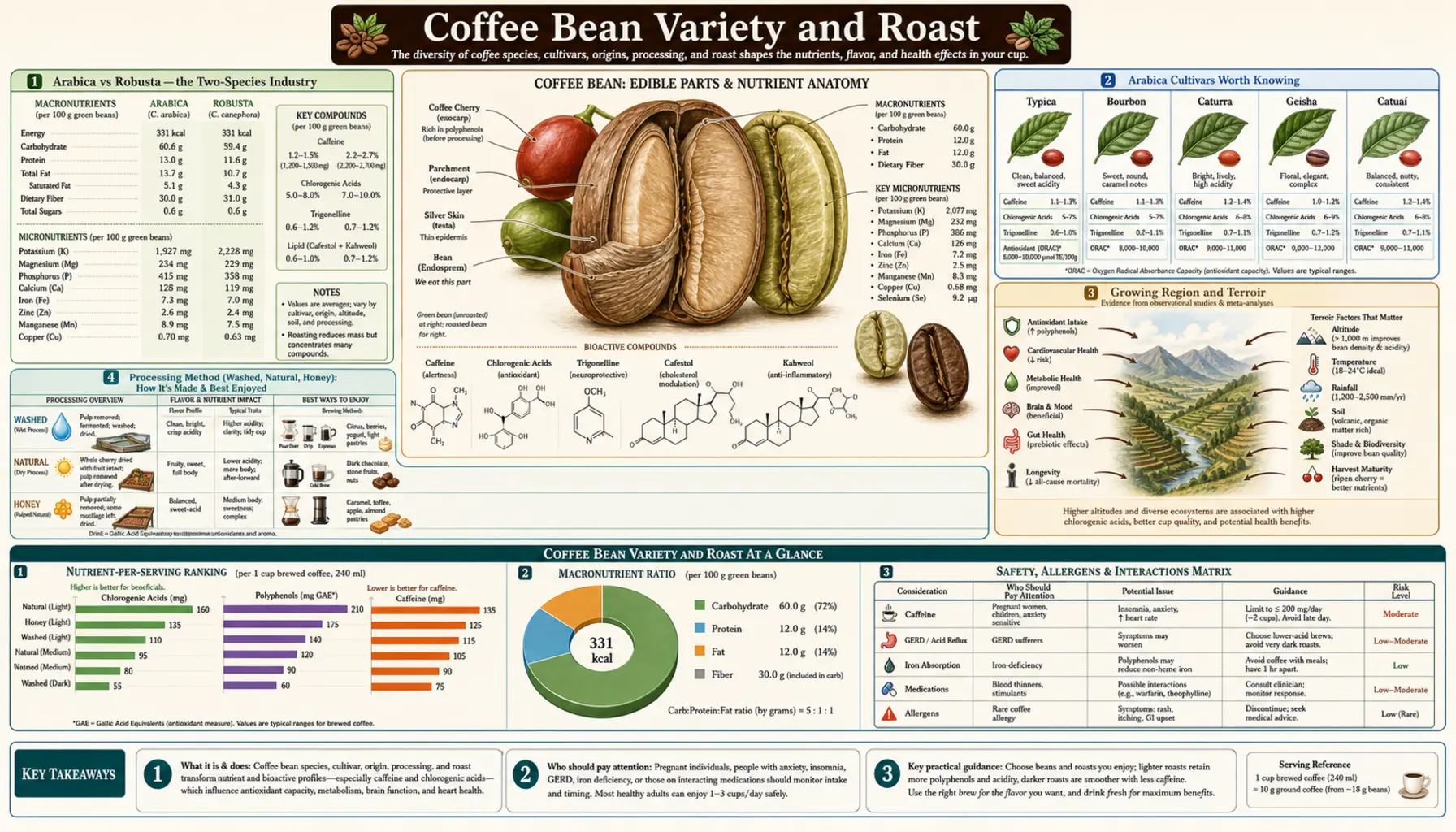
Two coffee species supply almost the entire commercial market: Coffea arabica (roughly 60-70% of global production) and Coffea canephora, marketed as Robusta (30-40%). Arabica produces a more nuanced cup with a wider aroma range; Robusta carries roughly twice the caffeine, more chlorogenic acids, and a harsher bitter profile. Within each species there are dozens of cultivated varieties — Typica, Bourbon, Caturra, Catuai, SL28, Geisha — each with distinct cup characteristics. Layered on top of bean choice is the roasting decision: light cinnamon roasts retain the most CGAs and acidity; dark French roasts deliver more melanoidins, less caffeine per equal weight (counterintuitively), and a flatter, smokier flavor. The four classic roast tiers map to measurably different cup chemistry. This page walks through what those choices actually deliver in the cup, why darker roasts are not stronger in caffeine, and the Specialty Coffee Association cupping framework that produces the published 80+ cupping scores on premium beans.
Interactive Visualization Caffeine, Adenosine & Why Coffee Stops Working Caffeine doesn’t give you energy — it blocks the tiredness signal while adenosine keeps piling up behind the blockade. Move your coffee to 2 p.m. and watch your deep sleep vanish. Launch →
Table of Contents
- Arabica vs Robusta — the Two-Species Industry
- Arabica Cultivars Worth Knowing
- Growing Region and Terroir
- Processing Method (Washed, Natural, Honey)
- The Four Roast Tiers
- Why Dark Roast Is Not Stronger in Caffeine
- Roast Effect on Cup Chemistry (CGA, Melanoidins, Acidity, Bitter)
- Aroma and Volatile Compound Formation
- Freshness and Staling After Roasting
- SCA Cupping and the 80-Point Specialty Threshold
- Choosing Bean and Roast for Specific Purposes
- Key Research Papers
- Connections
- Featured Videos
Arabica vs Robusta — the Two-Species Industry
Of more than 100 known Coffea species, only two dominate commerce. The distinctions are deeper than just flavor preference:
- Coffea arabica — the species discovered first (originally in Ethiopian and Yemeni highlands), the more delicate plant requiring 1,200-2,000 m elevation, 15-24°C mean temperature, well-defined wet/dry seasons, and shade. Self-pollinating, so cultivars breed true. Caffeine content 0.9-1.7% by dry bean weight. Total CGA content 5-8%. Lipid content 14-17% (the high lipid load contributes to body and to the lipid-bound diterpenes cafestol and kahweol). Wide aroma range — sweet, floral, fruity, citric, chocolaty depending on origin and processing. 60-70% of global production by mass. Higher market price.
- Coffea canephora (Robusta) — discovered in central African forests in the 1860s, named for its hardier growth. Tolerates lower elevations (200-800 m), higher temperatures, and is much more resistant to coffee leaf rust and the coffee berry borer. Outcrossing (requires another tree for pollination), so cultivars are more variable. Caffeine content 1.6-2.7% by dry bean weight — roughly twice Arabica. Total CGA content 7-10%. Lipid content 10-12%. Aroma range narrower, more grain/rubber/earth notes, less sweetness, more bitter. 30-40% of global production by mass. Significantly cheaper than Arabica.
Practical occurrence:
- Specialty coffee shops, single-origin offerings, and most named pour-over beans are almost universally Arabica.
- Italian espresso blends often include 10-30% Robusta for body, crema stability, and a kick of caffeine.
- Instant coffee, most supermarket pre-ground brands, and most institutional coffee (gas stations, hotel breakfast bars, hospital cafeterias) are Robusta-heavy or all-Robusta blends.
- Vietnamese coffee, including the now-popular ca phe sua da, is overwhelmingly Robusta, which is grown extensively in Vietnam's central highlands (Vietnam is the world's largest Robusta producer).
From a chemistry standpoint, Robusta delivers more CGA per gram — potentially relevant for someone optimizing for the polyphenol profile rather than the flavor experience. A medium-roast Robusta arguably delivers more CGA per cup than a medium-roast Arabica from the same brewer. The trade-off is the harsher bitter profile and the higher caffeine per cup (relevant for slow metabolizers or sensitive individuals).
Arabica Cultivars Worth Knowing
Within Arabica, the named cultivars matter more for flavor and yield than for major health-relevant chemistry. A short list of the cultivars that show up most often on specialty-coffee labels:
- Typica — the original cultivated Arabica, traced back to seeds taken from Yemen by Dutch traders. Conservative grower, modest yield, classically "clean" flavor. The genetic parent of many derived cultivars.
- Bourbon — a natural mutation of Typica that emerged on Bourbon Island (now Reunion) in the 17th-18th centuries. Higher yield than Typica and a sweeter, more complex cup. Several sub-cultivars including Caturra (a Brazilian dwarf mutation of Bourbon).
- Caturra — dwarf Bourbon, easier to harvest, dominates production in much of Central America.
- Catuai — cross between Caturra and Mundo Novo (itself a Bourbon-Typica hybrid). Vigorous, high yield, standard commercial Brazilian variety.
- SL28 and SL34 — selections developed in Kenya in the 1930s by Scott Laboratories (hence "SL"). Distinctive blackcurrant and citric notes; the genetic backbone of most premium Kenyan coffees.
- Geisha (also spelled Gesha) — originally Ethiopian, brought to Panama where it produced extraordinary cupping scores. Distinctive floral, jasmine-tea, and bergamot character. Famously expensive at specialty auctions — some lots sell for over $1,000 per pound.
- Pacamara — large-bean cross of Pacas (a Bourbon mutation) and Maragogipe (the "elephant bean" mutation of Typica). Distinctive in Salvadoran offerings.
- Heirloom (Ethiopian) — a catch-all term for the genetically diverse landrace varieties grown in Ethiopia, the species' center of origin. Highly variable cup characteristics within the heirloom designation; lots are often distinguished by region (Yirgacheffe, Sidamo, Harrar) rather than cultivar name.
The cultivar typically appears on a specialty-coffee label alongside origin (country and farm or cooperative), elevation, processing method, and roast date. For health-relevant chemistry, cultivar effects are smaller than the species, region, processing, and roast effects. For sensory experience, cultivar is a major axis of variation.
Growing Region and Terroir
Coffee terroir — the regional and microregional influence on cup character — is meaningful enough that most premium offerings name the specific farm, mill, or cooperative on the label. Major regional flavor archetypes:
- Ethiopia (Yirgacheffe, Sidamo, Harrar, Guji) — floral, citric, blueberry-and-fruit-forward. Heirloom genetics produce the widest aroma range of any origin.
- Kenya (Nyeri, Kiambu, Embu) — blackcurrant, bright acidity, complex sugars. SL28/SL34 cultivars on high-elevation volcanic soils.
- Colombia (Huila, Antioquia, Narino, Cauca) — balanced sweetness, medium body, caramel-and-fruit, accessible profile. The classic "safe choice" specialty origin.
- Brazil — chocolate, nut, low acidity, full body. The largest producing nation by far. Often a blend foundation rather than single origin in specialty contexts.
- Costa Rica — bright, clean, balanced sweetness. Strict quality regulations (Robusta is banned by law).
- Guatemala (Antigua, Huehuetenango, Atitlan) — spicy, chocolate, smoky, full body.
- Indonesia (Sumatra, Java, Sulawesi) — earthy, heavy body, low acidity, distinctive Mandheling cup character. Wet-hulled Sumatran process is unique.
- Yemen — wild, complex, wine-like. Small production. Where the cultivated coffee tradition began.
- Panama — small high-quality production, famous for the Hacienda Esmeralda Geisha that catapulted that cultivar to global attention.
- Hawaii (Kona) — sweet, smooth, low acidity, mild. Often heavily blended with other origins under "Kona Blend" labels containing as little as 10% actual Kona by Hawaiian law.
Terroir effects on health-relevant chemistry are real but smaller than roast and processing effects. A Kenyan high-elevation lot may have slightly higher CGA content than a Brazilian low-elevation lot at the same roast level (high elevation correlates with slower bean maturation and higher organic acid retention), but the cross-region variation is dwarfed by the within-region variation across roast levels.
Processing Method (Washed, Natural, Honey)
After harvest, the coffee cherry must be reduced to the green bean inside before drying and shipping. Three main processing approaches, each with distinct cup-chemistry consequences:
- Washed (wet-process) — the cherry pulp is mechanically removed, the bean is fermented in water tanks for 12-48 hours to digest the mucilage layer, then washed clean and dried. Produces the cleanest, brightest, most origin-transparent cup. Highlights acidity and varietal character. The dominant approach in Central America, Colombia, Kenya, and most specialty production.
- Natural (dry-process) — the whole cherry is laid on raised beds or patios to dry intact, with the bean fermenting inside the drying fruit over 2-4 weeks. The dried cherry is then mechanically dehulled. Produces a sweeter, fruitier, often wine-like cup with more body. Higher risk of inconsistent fermentation and off-flavors ("ferment" defects). The traditional approach in Ethiopia and Brazil and increasingly popular in specialty applications elsewhere.
- Honey (pulped natural) — intermediate. The pulp is removed but the bean is dried with some or all of the mucilage layer still attached, no water fermentation. The amount of mucilage retained produces sub-categories (white, yellow, red, black honey, in order of increasing mucilage retention and darker color of the drying bean). Produces a sweet-but-clean cup that balances washed brightness with natural fruit notes. Popular in Costa Rica and gaining traction elsewhere.
- Wet-hulled (giling basah) — an Indonesian approach where the bean is dehulled while still relatively wet (28-35% moisture vs the usual 11-12% for dry beans). Produces the distinctive earthy, full-bodied Sumatran cup. Unique to Indonesian processing.
- Anaerobic / experimental fermentation — emerging approaches using sealed fermentation vessels, often with added cultures or specific gas atmospheres. Highly variable but capable of producing extreme fruity and fermented profiles. Specialty-only.
Processing affects CGA content modestly. Natural-process coffees tend to retain slightly more sugar-derived complexity in the final cup but the CGA chemistry is similar to washed. The bigger health-relevant chemistry difference is mycotoxin contamination — natural-process coffees from poorly managed drying have higher risk of ochratoxin A and aflatoxin contamination from molds growing on the drying cherry. Well-managed natural process in clean drying conditions has no clinical mycotoxin issue, but the variability is greater than for washed process.
The Four Roast Tiers
The roast nomenclature is irregular but the four-tier categorization is well established:
- Light roast (cinnamon, light city, half city, New England roast) — bean surface temperature 196-205°C, first crack just complete or partially through. Bean color light brown, dry surface, no visible oil. Cup character bright, acidic, complex, origin-transparent. Maximum CGA retention (60-70% of green-bean content). Higher caffeine per gram of bean than darker roasts (counterintuitively, because the bean has lost less mass to roasting and degradation).
- Medium roast (city, American, regular, breakfast roast) — bean temperature 210-219°C, fully through first crack but not approaching second crack. Bean color medium brown, dry surface. Balanced sweetness, body, and acidity. The mainstream Western reference point. CGA retention 40-60%.
- Medium-dark roast (full city, Vienna, light French, after-dinner roast) — bean temperature 220-225°C, into second crack. Bean color dark brown with first hints of surface oil. Bittersweet, less acidity, fuller body, beginning to taste "roasty" rather than "coffee." CGA retention 25-40%. Common espresso blend roast level.
- Dark roast (French, Italian, Spanish, dark espresso roast) — bean temperature 225-235°C, well into or past second crack. Bean color very dark brown to nearly black, visibly oily surface (the diterpenes have leached to the bean exterior). Smoky, bitter, charcoal-like notes overwhelm origin character. CGA retention 10-25%. The Starbucks dark roast and the classic Italian espresso end of the spectrum.
The terminology is genuinely inconsistent across roasters — one roaster's "medium" is another's "medium-dark" with substantial overlap in actual bean temperature. The SCA Agtron color scale (a reflectance measurement of the ground coffee, with lower numbers = darker) is the closest thing to an objective measure. Agtron 95-75 = light, 75-55 = medium, 55-45 = medium-dark, below 45 = dark.
The transition events visible to the roaster:
- First crack — around 196°C, the bean's internal water vapor pressure exceeds the bean structure's tensile strength, causing an audible popping similar to popcorn. This marks the transition from drying to roasting.
- Development — the period between first and second crack, where Maillard reactions and CGA degradation accelerate.
- Second crack — around 224°C, structural cellulose fractures and the bean exterior begins to crack again, this time more quietly. This marks the transition from medium-dark to dark roasting.
The decision to drop the beans (stop the roast) is made by the roaster using temperature curves, color, smell, and crack timing. A 12 kg roaster batch typically takes 10-15 minutes from charge to drop.
Why Dark Roast Is Not Stronger in Caffeine
A widely repeated but mostly wrong belief is that dark-roast coffee is "stronger" in caffeine than light-roast. The actual chemistry:
- Caffeine is exceptionally thermally stable. Caffeine's sublimation point is 178°C but in the closed environment of the roasting drum (with bean structure and water vapor preventing free sublimation), caffeine survives even the highest commercial roasting temperatures with less than 10% loss.
- Roasting drives off water and breaks down cellulose, reducing bean mass by ~15% (light) to ~22% (dark). So per equal weight, dark-roast beans contain slightly more caffeine than light-roast beans (the caffeine is concentrated by the mass loss).
- But coffee is typically dosed by volume (scoops, tablespoons) rather than by weight. Dark-roast beans, having lost more mass, are physically larger per gram, so a tablespoon of dark-roast beans contains less mass and slightly less caffeine than a tablespoon of light-roast beans from the same green coffee.
- When dosed by weight (the right way, with a scale) the two roasts deliver caffeine within 5-10% of each other, which is well within the within-bean variation.
So the practical truth: caffeine per cup is essentially the same across roast levels when the brewer uses a consistent dose by weight. Dark-roast coffee tastes "stronger" (more bitter, more roasty, more body) but the caffeine content is not meaningfully different.
What does change with roast level:
- CGA mass drops by 50-75% from light to dark.
- Trigonelline drops by 50-90%, with much of it converted to niacin (so niacin content per cup rises slightly with darker roasts).
- N-methylpyridinium rises substantially in darker roasts (formed from trigonelline). N-MP has been shown to reduce gastric acid secretion in clinical trials, which is why dark-roast and especially espresso-roast coffee is often better tolerated by GERD and gastritis patients than light-roast.
- Melanoidins increase by mass with darker roasting.
- Acrylamide initially rises with roasting then begins to fall in very dark roasts. Light roasts have less acrylamide than medium roasts, dark roasts somewhat less than medium-dark.
- Acidity (organic acids: citric, malic, quinic, formic, acetic) changes complexly. Some acids degrade with roasting (citric, malic), others are formed (formic, acetic from carbohydrate breakdown). Net perceived acidity drops with darker roasts.
Roast Effect on Cup Chemistry (CGA, Melanoidins, Acidity, Bitter)
Pulling the roast-chemistry strands together, the per-cup chemistry of brewed Arabica at standard SCA dose (60 g/L) approximately:
- Light roast brewed cup, 240 mL: 250-350 mg CGAs, 50-80 mg melanoidins, ~150 mg caffeine, ~150 mg trigonelline, 0.5 mg niacin, bright sweet-tart character, complex aroma profile.
- Medium roast brewed cup, 240 mL: 180-260 mg CGAs, 100-180 mg melanoidins, ~150 mg caffeine, 80-150 mg trigonelline, 1.0 mg niacin, balanced character.
- Medium-dark roast brewed cup, 240 mL: 110-180 mg CGAs, 200-300 mg melanoidins, ~145 mg caffeine, 40-100 mg trigonelline, 1.5 mg niacin, bittersweet character, body forward.
- Dark roast brewed cup, 240 mL: 60-130 mg CGAs, 300-450 mg melanoidins, ~140 mg caffeine, 15-60 mg trigonelline, 2.0 mg niacin, bitter/smoky character.
The melanoidin numbers are uncertain because melanoidins are a heterogeneous high-molecular-weight pool that is operationally defined by extraction method rather than by a single molecule. Different analytical approaches give different absolute values; the directional trend (darker = more melanoidin) is consistent.
The total antioxidant capacity of brewed coffee, measured by ORAC or FRAP assays, is roughly equivalent across roast levels — what darker roasts lose in CGA they regain in melanoidin antioxidant activity. The biological relevance of in vitro antioxidant capacity is its own debate, but it does mean the total "antioxidant dose" from coffee is not strongly roast-dependent.
For drinkers optimizing for CGA-driven effects (postprandial glucose attenuation, mild blood pressure benefit), light to medium roast is the clear choice. For drinkers optimizing for melanoidin-driven effects (gut microbiome, iron-binding, antimicrobial), darker roasts deliver more. For drinkers optimizing for flavor experience, the choice depends on the bean and the preparation method — high-quality single-origin beans typically benefit from lighter roasting that preserves origin character; commodity blends benefit from medium-dark roasting that masks varietal limitations.
Aroma and Volatile Compound Formation
Roasted coffee contains more than 800 identified volatile aroma compounds, the highest count of any common beverage. The dominant character-impact compounds (those most responsible for coffee's distinctive smell) include:
- 2-Furfurylthiol — the "coffee smell" molecule. Sulfur-containing, with an aroma threshold in the sub-parts-per-billion range. Formed during roasting from the reaction of sulfur amino acids with arabinose. Extremely unstable post-roasting — the rapid loss of 2-furfurylthiol explains why coffee aroma fades quickly in storage.
- Pyrazines (2-methylpyrazine, 2-ethyl-3,5-dimethylpyrazine) — nutty, earthy, roasted notes. Form via Maillard reaction at high temperatures.
- Furans (2-furanmethanol, furfural) — caramel and sweet roasted notes from carbohydrate degradation.
- Pyrroles — smoky, sweet, caramel notes from amino acid degradation.
- Aldehydes (acetaldehyde, propanal, methional) — green, fresh, malty notes; methional gives the cooked-potato note found in some dark roasts.
- Phenols (guaiacol, 4-vinylguaiacol) — smoky, clove, spice notes from ferulic acid decarboxylation during roasting.
- Beta-damascenone — sweet, floral, honey-like; one of the few non-Maillard aroma compounds with significant impact.
Different roast levels favor different volatile profiles. Light roasts retain more "green" aldehydes and the bright fruit-like esters carried over from the bean's pre-roast character. Medium roasts develop the largest pool of pyrazines, furans, and 2-furfurylthiol — the classic coffee aroma. Dark roasts shift toward the phenols (smoky character) and lose much of the freshness from earlier in the volatile family.
The cup's aroma depends not just on the bean and roast but on the brewing temperature (volatiles vaporize and are lost above 80°C; cold brew preserves more original character but extracts less of the bigger flavor compounds) and the extraction time (longer extraction extracts more total compounds but also more bitter degradation products).
Freshness and Staling After Roasting
Roasted coffee stales rapidly. The relevant timescales:
- Hours after roasting: beans are still degassing CO2 from the Maillard reaction. Most roasters recommend a 24-72 hour rest before brewing to avoid the "sour" or under-extracted character of fresh-roast beans (the CO2 displaces water during brewing and reduces extraction).
- 1-2 weeks: optimal flavor window for most beans, particularly for espresso where the CO2 affects extraction more critically.
- 2-4 weeks: aroma decline accelerates as 2-furfurylthiol oxidizes. Cup loses brightness and complexity but is still recognizably good coffee.
- 1-3 months: substantial staling. Cup is dull, possibly with stale/cardboard notes. CGAs are still mostly intact but the volatile aroma is significantly diminished.
- 3+ months: most aroma compounds are degraded. The coffee tastes flat and may develop rancid notes from lipid oxidation, particularly in darker roasts with more surface oil.
Storage variables that affect staling rate (in order of importance):
- Grinding — ground coffee loses aroma roughly 10x faster than whole bean due to the dramatic surface area increase. The single most consequential storage decision is to keep beans whole until brew time.
- Oxygen exposure — oxidation is the main staling mechanism. One-way-valve bags (Foil-Tech / similar) allow CO2 to escape while preventing oxygen entry; vacuum-sealing is even better.
- Light — UV accelerates aroma compound degradation. Opaque or dark-glass containers are better than clear glass.
- Temperature — cool storage (60-70°F room temperature) is better than warm. Refrigeration is generally not recommended due to condensation when the bag is opened and the bag warms; freezing is OK for long-term storage of vacuum-sealed unopened beans but condensation issues recur when opened.
- Moisture — beans should be kept dry. Coffee absorbs moisture from humid air, accelerating staling.
Roast date should appear on every specialty coffee bag. The absence of a roast date (only a "best by" date many months out) is a strong signal that the product is commodity coffee with a long supply chain and substantial post-roast time.
SCA Cupping and the 80-Point Specialty Threshold
The Specialty Coffee Association cupping protocol is the international standard for sensory evaluation of green coffee. A typical professional cupping session involves:
- Standardized brew: 8.25 g of coffee per 150 mL cup, ground to medium-coarse, brewed by full immersion (water poured directly on grounds) at 93°C for 4 minutes.
- The cupper "breaks the crust" (stirs the floating grounds aside) with a spoon to release aroma, then evaluates wet aroma.
- After cooling to drinkable temperature, the cupper takes loud-slurp sips from each cup, evaluating flavor, aftertaste, acidity, body, balance, sweetness, clean cup, uniformity, and overall impression.
- Scoring is on a 100-point scale, with 80 points as the threshold for "specialty grade." Anything below 80 is commodity coffee. Scores above 85 are uncommon; above 90 are exceptional and command premium prices.
- Defects are recorded separately and subtract points: ferment, mold, sour, phenolic, woody, baggy (storage), etc.
The published cupping scores on specialty bean labels ("Cupping Score: 87") come from this protocol applied by certified Q-graders. The scores are reasonably reproducible across trained cuppers within ~2 points for the same lot, and predict consumer preference moderately well in sensory studies.
The SCA also maintains the Coffee Taster's Flavor Wheel, a structured vocabulary for describing coffee flavor that ranges from broad categories (Fruity, Floral, Sweet, Nutty/Cocoa, Roasted, Spicy, Sour/Fermented, Other) to specific notes (blackcurrant, jasmine, brown sugar, hazelnut, ash, anise, sherry, papery). The Flavor Wheel is the basis for the descriptive notes that appear on specialty coffee labels.
For consumers, the SCA cupping score is a moderately useful purchase signal — an 85+ score reliably indicates a clean, well-prepared coffee with no major defects. It does not predict which coffee a given person will prefer, since preference within the "clean and well-prepared" category is dominated by the flavor archetype (fruity-acidic Ethiopian vs sweet-balanced Colombian vs chocolaty-full Brazilian) rather than by absolute quality score.
Choosing Bean and Roast for Specific Purposes
A short decision guide:
- For maximum CGA polyphenol delivery: light to medium-light roast, Arabica or Robusta (Robusta delivers more CGA per gram), brewed strong (60 g/L SCA ratio or denser). See Polyphenols deep-dive.
- For minimum cardiovascular diterpene exposure: paper-filtered drip or pour-over, any roast level (filter type matters more than roast for diterpene exposure).
- For acid-reflux / gastritis-friendly cup: medium-dark to dark roast, espresso preparation (the high N-methylpyridinium content reduces gastric acid stimulation).
- For maximum aroma complexity: high-elevation single-origin Arabica (Ethiopian heirloom, Kenyan SL28, Panamanian Geisha), light to medium roast, freshly roasted (within 2 weeks of roast date), whole bean ground at brew time.
- For best espresso shot: medium-dark roast of a blend formulated for espresso (often 10-30% Robusta for crema stability and body), rested 7-14 days post-roast.
- For maximum exercise-performance caffeine dose: bean and roast matter less than total dose. A strong Robusta-heavy espresso delivers more caffeine per shot than an Arabica drip cup; either works.
- For low-caffeine but full-flavor: high-quality Swiss Water decaf of a single-origin Arabica. See Decaf vs Caffeinated.
- For travel / on-the-go reliability: medium-roast vacuum-sealed whole-bean coffee from a reputable specialty roaster. A handheld grinder (Hario Mini Mill, 1Zpresso) and an Aeropress make consistent coffee in any hotel room.
The single highest-leverage upgrade for most regular coffee drinkers: switch from pre-ground supermarket coffee to a freshly-roasted whole-bean coffee from a local roaster, ground at brew time. The flavor and aroma difference is typically dramatic. The CGA content difference is modest but real (less oxidative loss from intact beans). The cost premium is real but not extreme — specialty coffee runs $14-22 per 12 oz vs $6-10 per 12 oz for supermarket commodity, working out to roughly $0.25-0.40 per cup vs $0.10-0.20 per cup.
Key Research Papers
- Farah A, Donangelo CM (2006). Phenolic compounds in coffee. Brazilian Journal of Plant Physiology. — PubMed
- Trugo LC, Macrae R (1984). Chlorogenic acid composition of instant coffees. Analyst. — PubMed
- Czerny M, Grosch W (2000). Potent odorants of raw Arabica coffee. Journal of Agricultural and Food Chemistry. — PubMed
- Stadler RH et al. (2002). Acrylamide from Maillard reaction products. Nature. — PubMed
- Boekschoten MV et al. (2003). N-methylpyridinium from coffee inhibits gastric acid secretion. — PubMed
- Sunarharum WB et al. (2014). Complexity of coffee flavor: a compositional and sensory perspective. Food Research International. — PubMed
- Bhumiratana N, Adhikari K, Chambers E (2011). Evolution of sensory aroma attributes from coffee beans to brewed coffee. LWT - Food Science and Technology. — PubMed
- Buffo RA, Cardelli-Freire C (2004). Coffee flavour: an overview. Flavour and Fragrance Journal. — PubMed
- De Maria CAB et al. (1996). Composition of green coffee water-soluble fractions and identification of volatiles. Food Chemistry. — PubMed
- Hecimovic I, Belscak-Cvitanovic A et al. (2011). Comparative study of polyphenols and caffeine in different coffee varieties affected by the degree of roasting. Food Chemistry. — PubMed
- Specialty Coffee Association cupping protocol documents (SCA 2018 revisions) — PubMed
- Anthony F et al. (2002). Genetic diversity of wild coffee (Coffea arabica L.) using molecular markers. Euphytica. — PubMed
PubMed Topic Searches
- PubMed: Arabica vs Robusta chemistry
- PubMed: Roasting and CGA degradation
- PubMed: Coffee aroma volatiles
- PubMed: Coffee processing methods
- PubMed: Coffee staling oxidation
Connections
- All Food
- Caffeine, Adenosine & Why Coffee Stops Working — interactive animation
- Coffee Benefits Hub (Food Science)
- Polyphenols and Chlorogenic Acid
- Cognitive Performance
- Decaf vs Caffeinated
- Coffee (Food Hub)
- Coffee as a Natural Remedy
- Coffee Cardiovascular & Mortality
- Green Tea
- Dark Chocolate
- GERD (Acid Reflux)
- Vitamin B3 (Niacin)
- All Antioxidants
- Mycotoxins
- Acrylamide