Chia Seeds — Benefits Deep Dive
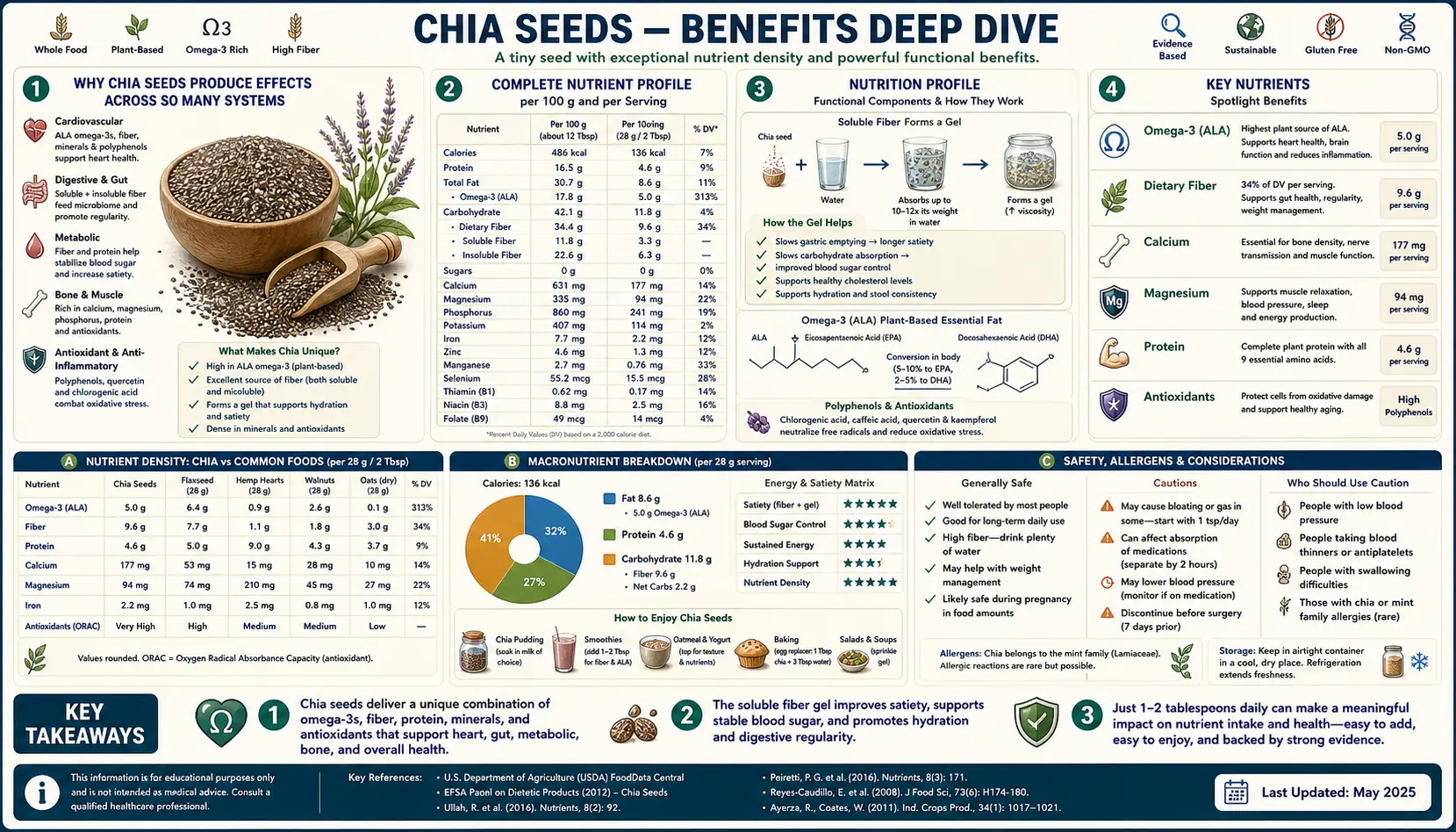
Chia seeds (Salvia hispanica L.) are nutritionally dense in a way few whole foods are: 100 g delivers approximately 17 g of alpha-linolenic acid (ALA, the plant-source omega-3), 34 g of dietary fiber (the highest of any commonly consumed seed and predominantly soluble), 631 mg of calcium (more than cow's milk by weight), 335 mg of magnesium, 17 g of complete protein with all nine essential amino acids, and a unique mucilage that absorbs 12× its weight in water within ten minutes to form a hydrating gel. The four deep-dive pages below explore the four conditions where chia produces the largest measurable clinical effect — cardiovascular risk reduction via ALA omega-3, postprandial glycemic control via viscous soluble fiber, bone-mineral density support via highly bioavailable calcium, and pre-race carbohydrate-plus-fluid delivery in endurance athletes via the famous mucilage gel.
Deep-Dive Articles
ALA Omega-3
Why chia is the highest plant source of alpha-linolenic acid (ALA, ~17 g per 100 g, ~60% of total fat). The Delta-6-desaturase conversion of ALA to EPA and DHA, the low conversion efficiency (5-8% ALA to EPA, <1% to DHA), the cardiovascular evidence (Lyon Diet Heart Study, PREDIMED), why ALA matters in its own right beyond conversion (independent risk reduction signals), and the practical positioning of chia within a vegetarian/vegan omega-3 strategy.
Soluble Fiber and Blood Sugar
The mucilage layer that surrounds each chia seed is one of the most viscous food-source soluble fibers known, slowing gastric emptying and creating a physical barrier to enzyme-substrate contact in the small intestine. The clinical outcome is a measurable blunting of postprandial glucose excursion, validated in randomized crossover trials in type 2 diabetes and pre-diabetes. Also covers cholesterol reduction via bile-acid sequestration, SCFA production in the colon, and the prebiotic effect on gut microbiota.
Calcium and Bone
Chia provides 631 mg of calcium per 100 g — substantially more than cow's milk by weight — and the calcium is well absorbed because chia is low in oxalates (unlike spinach) and the seeds' magnesium and boron content support calcium utilization rather than competing with it. The page covers calcium bioavailability factors, the role of magnesium and boron in bone metabolism, why chia is a practical option for plant-based diets that exclude dairy, and how it pairs with Vitamin D3 and Vitamin K2 for bone-mineral deposition.
Hydration Gel and Endurance
The Tarahumara of the Sierra Madre have used chia (and its sister salvia, iskiate) as endurance fuel for centuries. Modern sports-nutrition research (Illian, Kreider, et al. 2011) tested a chia-based fermentation against Gatorade in trained runners and found equivalent performance with a more favorable fatty acid profile. This page covers the mucilage gel mechanism, the carbohydrate-fluid co-delivery, electrolytes (sodium, potassium, magnesium, calcium), and practical pre-race/in-race protocols.
Table of Contents
- Deep-Dive Articles
- Why Chia Seeds Produce Effects Across So Many Systems
- Complete Nutrient Profile (Per 100 g and Per Serving)
- Research Papers: ALA Omega-3 and Cardiovascular Health
- Research Papers: Soluble Fiber, Glycemic Control, and Lipids
- Research Papers: Calcium, Magnesium, and Bone Mineral Density
- Research Papers: Mucilage, Hydration, and Endurance Performance
- Research Papers: Cross-Cutting (Protein, Antioxidants, Safety)
- External Authoritative Resources
- Connections
- Featured Videos
Why Chia Seeds Produce Effects Across So Many Systems
Few whole foods deliver clinically significant amounts of three nutrient categories at once: a long-chain polyunsaturated fat (ALA), a viscous soluble fiber (mucilage), and a well-absorbed mineral package (calcium, magnesium, phosphorus, boron). Chia is one of the rare cases. Each of the three maps to a distinct organ-system effect, which is why the deep-dive pages divide cleanly along nutrient lines.
- Cardiovascular and inflammatory effects (ALA pathway) — alpha-linolenic acid is the 18-carbon, 3-double-bond omega-3 precursor to EPA and DHA. Conversion is inefficient (5-8% to EPA, <1% to DHA), but ALA itself appears to have independent effects on arrhythmia risk, blood pressure, and inflammatory eicosanoid production. The ALA Omega-3 deep dive covers the Lyon Diet Heart Study, the PREDIMED trial cohort substudies, the Cochrane reviews, and how to position chia within a vegetarian or pescatarian omega-3 strategy.
- Glycemic and lipid effects (mucilage soluble fiber) — the mucilage layer that swells around each chia seed when wet is one of the most viscous food-source fibers known, surpassing oat beta-glucan and approaching psyllium husk. The viscosity physically slows gastric emptying, blocks enzyme-substrate contact in the small intestine, and binds bile acids in the lower bowel. The clinical outcomes are measurable reductions in postprandial glucose excursion, LDL cholesterol, and triglycerides, covered in the Soluble Fiber deep dive.
- Bone-mineral and musculoskeletal effects (calcium, magnesium, phosphorus, boron) — chia is one of the few plant sources where calcium is both abundant and well absorbed. Spinach has more calcium but oxalate binding renders 95% unabsorbable; chia's oxalate content is low enough that its calcium is roughly as bioavailable as that in cow's milk. The Calcium and Bone deep dive covers the bioavailability calculation, the role of co-nutrients, and why chia is a practical option for dairy-free diets.
- Hydration and endurance effects (mucilage gel water-retention) — the same mucilage that drives glycemic effects also absorbs roughly 12× its weight in water within ten minutes, forming a gel that delivers carbohydrate, water, and electrolytes simultaneously to the gut. Long known to the Tarahumara of Mexico's Sierra Madre as iskiate, modern sports-nutrition research has validated chia-based hydration against commercial sports drinks. Covered in the Hydration Gel and Endurance deep dive.
A practical consequence of this multi-system nutrient profile: chia is among a small handful of foods that can meaningfully contribute to the management of multiple modern chronic conditions at once. A daily 28 g (one ounce, roughly two tablespoons) serving contributes ~5 g of ALA, ~10 g of fiber, ~180 mg of calcium, ~95 mg of magnesium, and ~4.7 g of complete protein. That is approximately 100% of the daily ALA target, 35-40% of fiber intake recommendations, 14% of calcium DRI, and 25% of magnesium RDA — from a single tablespoon of seeds that costs roughly 25 cents at scale.
Complete Nutrient Profile (Per 100 g and Per Serving)
The numbers below are USDA FoodData Central values for raw chia seeds, with per-serving (28 g, one ounce, approximately two tablespoons) values in parentheses.
Macronutrients
- Energy: 486 kcal per 100 g (136 kcal per 28 g serving)
- Protein: 16.5 g per 100 g (4.7 g per serving) — complete protein with all nine essential amino acids; lysine is the limiting amino acid but present in adequate amounts for a plant source
- Total fat: 30.7 g per 100 g (8.6 g per serving) — of which ~17 g is alpha-linolenic acid (ALA), ~5.7 g is linoleic acid (LA), and the balance is monounsaturated and saturated
- Total carbohydrate: 42.1 g per 100 g (11.8 g per serving), of which 34.4 g is dietary fiber and ~7.7 g is digestible carbohydrate (very low effective carbohydrate content)
- Dietary fiber: 34.4 g per 100 g (9.6 g per serving) — predominantly soluble mucilage; one of the highest fiber-per-gram ratios of any whole food
Key Minerals
- Calcium: 631 mg per 100 g (177 mg per serving, ~14% DRI for adults)
- Magnesium: 335 mg per 100 g (94 mg per serving, ~25% RDA for adults)
- Phosphorus: 860 mg per 100 g (241 mg per serving, ~34% RDA)
- Iron: 7.7 mg per 100 g (2.2 mg per serving, ~12% RDA for adult men, ~28% for adult women)
- Zinc: 4.6 mg per 100 g (1.3 mg per serving, ~12% RDA)
- Manganese: 2.7 mg per 100 g (0.76 mg per serving, ~33% AI)
- Potassium: 407 mg per 100 g (114 mg per serving)
- Copper: 0.9 mg per 100 g (0.25 mg per serving, ~28% RDA)
- Selenium: 55 mcg per 100 g (15 mcg per serving, ~27% RDA)
Vitamins
- Thiamine (B1): 0.62 mg per 100 g (0.17 mg per serving, ~14% RDA)
- Niacin (B3): 8.8 mg per 100 g (2.5 mg per serving, ~16% RDA)
- Riboflavin (B2): 0.17 mg per 100 g (0.05 mg per serving)
- Folate: 49 mcg DFE per 100 g (14 mcg per serving)
- Vitamin E (alpha-tocopherol): 0.5 mg per 100 g
- Vitamin A, K, B12: minimal — chia is not a meaningful source
Phytochemicals and Antioxidants
- Caffeic acid, chlorogenic acid, rosmarinic acid — polyphenolic antioxidants in the seed coat
- Quercetin, kaempferol, myricetin — flavonoid antioxidants
- ORAC value ~9,800 µmol TE per 100 g (substantially higher than blueberries on a per-gram basis)
Research Papers: ALA Omega-3 and Cardiovascular Health
- de Lorgeril M et al. (1999). Mediterranean diet, traditional risk factors, and the rate of cardiovascular complications after myocardial infarction (Lyon Diet Heart Study) — PubMed: Lyon Diet Heart Study (1999, doi:10.1161/01.cir.99.6.779)
- Estruch R et al. (2018). Primary Prevention of Cardiovascular Disease with a Mediterranean Diet Supplemented with Extra-Virgin Olive Oil or Nuts (PREDIMED) — PubMed: PREDIMED 2018 (NEJM, doi:10.1056/NEJMoa1800389)
- Pan A et al. (2012). alpha-Linolenic acid and risk of cardiovascular disease: a systematic review and meta-analysis — PubMed: Pan ALA CVD meta-analysis (AJCN, doi:10.3945/ajcn.112.044040)
- Burdge GC, Calder PC (2005). Conversion of alpha-linolenic acid to longer-chain polyunsaturated fatty acids in human adults — PubMed: Burdge ALA conversion review (RND, doi:10.1051/rnd:2005047)
- Nieman DC et al. (2009). Chia seed does not promote weight loss or alter disease risk factors in overweight adults — PubMed: Nieman chia weight (Nutr Res, doi:10.1016/j.nutres.2009.05.011)
- Vuksan V et al. (2007). Supplementation of conventional therapy with the novel grain Salba (Salvia hispanica L.) improves major and emerging cardiovascular risk factors in type 2 diabetes — PubMed: Vuksan Salba T2D (Diabetes Care, doi:10.2337/dc07-1144)
- Toscano LT et al. (2014). Chia flour supplementation reduces blood pressure in hypertensive subjects Search PubMed
- Mozaffarian D, Wu JHY (2011). Omega-3 fatty acids and cardiovascular disease: effects on risk factors, molecular pathways, and clinical events Search PubMed
- Brenna JT et al. (2009). alpha-Linolenic acid supplementation and conversion to n-3 long-chain polyunsaturated fatty acids in humans — PubMed: Brenna ALA n-3 conversion (PLEFA, doi:10.1016/j.plefa.2009.01.004)
- Ayerza R Jr, Coates W (2005). Ground chia seed and chia oil effects on plasma lipids and fatty acids in the rat Search PubMed
Research Papers: Soluble Fiber, Glycemic Control, and Lipids
- Vuksan V et al. (2010). Reduction in postprandial glucose excursion and prolongation of satiety: possible explanation of the long-term effects of whole grain Salba (Salvia hispanica L.) — Search PubMed
- Vuksan V et al. (2017). Salba-chia (Salvia hispanica L.) in the treatment of overweight and obese patients with type 2 diabetes: a double-blind randomized controlled trial Search PubMed
- Ho H et al. (2013). Effect of whole and ground Salba seeds (Salvia hispanica L.) on postprandial glycemia in healthy volunteers Search PubMed
- Jenkins DJA et al. (1978). Dietary fibres, fibre analogues, and glucose tolerance: importance of viscosity (the foundational viscous-fiber paper) — Search PubMed
- Anderson JW et al. (2009). Health benefits of dietary fiber — PubMed: Anderson fiber review (Nutr Rev, doi:10.1111/j.1753-4887.2009.00189.x)
- Brown L et al. (1999). Cholesterol-lowering effects of dietary fiber: a meta-analysis — PubMed: Brown fiber cholesterol meta (AJCN, doi:10.1093/ajcn/69.1.30)
- Ullah R et al. (2016). Nutritional and therapeutic perspectives of Chia (Salvia hispanica L.): a review Search PubMed
- Ayerza R, Coates W (2007). Effect of dietary alpha-linolenic fatty acid derived from chia when fed as ground seed, whole seed and oil on lipid content and fatty acid composition of rat plasma Search PubMed
- Marineli RS et al. (2014). Chemical characterization and antioxidant potential of Chilean chia seeds and oil (Salvia hispanica L.) — Search PubMed
- Tavares Toscano L et al. (2015). Chia induces clinically discrete weight loss and improves lipid profile only in altered previous values Search PubMed
Research Papers: Calcium, Magnesium, and Bone Mineral Density
- Weaver CM, Heaney RP (2006). Calcium — the foundational chapter (Modern Nutrition in Health and Disease) PubMed: Weaver/Heaney calcium
- Heaney RP et al. (1988). Calcium absorbability from spinach Search PubMed
- Welch AA et al. (2007). Variation in intakes of calcium, phosphorus, magnesium, iron and potassium in 10 countries (EPIC) — Search PubMed
- Rude RK et al. (2009). Skeletal and hormonal effects of magnesium deficiency — PubMed: Rude magnesium bone (JACN, doi:10.1080/07315724.2009.10719764)
- Castillo-Duran C, Cassorla F (1999). Trace minerals in human growth and development Search PubMed
- Capitani MI et al. (2012). Physicochemical and functional characterization of by-products from chia (Salvia hispanica L.) seeds of Argentina Search PubMed
- Tang AL et al. (2010). Calcium absorption in Australian osteopenic post-menopausal women: an acute comparative study of fortified soymilk to cows' milk Search PubMed
- Bolland MJ et al. (2010). Effect of calcium supplements on risk of myocardial infarction and cardiovascular events: meta-analysis — PubMed: Bolland calcium MI meta (BMJ, doi:10.1136/bmj.c3691)
- Ross AC et al. (2011). The 2011 Dietary Reference Intakes for Calcium and Vitamin D from the Institute of Medicine — PubMed: IOM 2011 Ca/D DRI (JCEM, doi:10.1210/jc.2010-2704)
- Nielsen FH (2008). Is boron nutritionally relevant? Search PubMed
Research Papers: Mucilage, Hydration, and Endurance Performance
- Illian TG, Casey JC, Bishop PA (2011). Omega 3 chia seed loading as a means of carbohydrate loading Search PubMed
- Capitani MI et al. (2015). Functional ingredient from chia (Salvia hispanica L.) by-products: fiber-rich material as a potential ingredient for the food industry Search PubMed
- Munoz LA et al. (2012). Chia seeds: microstructure, mucilage extraction and hydration Search PubMed
- Coates W (2011). Whole and ground chia (Salvia hispanica L.) seeds PubMed: Coates chia review
- Cevallos-Casals BA, Cisneros-Zevallos L (2010). Impact of germination on phenolic content and antioxidant activity of 13 edible seed species Search PubMed
- Jeukendrup AE (2014). A step towards personalized sports nutrition: carbohydrate intake during exercise — PubMed: Jeukendrup CHO during exercise (Sports Med, doi:10.1007/s40279-014-0148-z)
- Burke LM (2015). Re-examining high-fat diets for sports performance: did we call the 'nail in the coffin' too soon? Search PubMed
- Sawka MN et al. (2007). ACSM Position Stand: Exercise and Fluid Replacement — PubMed: ACSM hydration (MSSE, doi:10.1249/mss.0b013e31802ca597)
- Cermak NM, van Loon LJC (2013). The use of carbohydrates during exercise as an ergogenic aid — PubMed: Cermak CHO ergogenic (Sports Med, doi:10.1007/s40279-013-0079-0)
- Maughan RJ, Shirreffs SM (2010). Development of individual hydration strategies for athletes Search PubMed
Research Papers: Cross-Cutting (Protein, Antioxidants, Safety)
- Sandoval-Oliveros MR, Paredes-Lopez O (2013). Isolation and characterization of proteins from chia seeds (Salvia hispanica L.) — Search PubMed
- Reyes-Caudillo E et al. (2008). Dietary fibre content and antioxidant activity of phenolic compounds present in Mexican chia (Salvia hispanica L.) seeds Search PubMed
- Ayerza R, Coates W (2009). Influence of environment on growing period and yield, protein, oil and alpha-linolenic content of three chia (Salvia hispanica L.) selections PubMed: Ayerza chia geography
- Olivos-Lugo BL et al. (2010). Thermal and physicochemical properties and nutritional value of the protein fraction of Mexican chia PubMed: Olivos-Lugo chia protein
- EFSA Panel on Dietetic Products (2009). Scientific Opinion on the safety of 'Chia seed (Salvia hispanica) and ground whole Chia seed' as a food ingredient PubMed: EFSA chia novel food
- Garcia-Salcedo AJ et al. (2018). Chia (Salvia hispanica L.) seed mucilage release characterisation. A novel structural approach Search PubMed
- Rosas-Mendoza ME et al. (2017). Chia (Salvia hispanica L.) seeds: Composition, biological activities, and uses PubMed: Rosas-Mendoza chia review
- Kulczynski B et al. (2019). The chemical composition and nutritional value of chia seeds — current state of knowledge Search PubMed
- Knez Hrncic M et al. (2020). Chia Seeds (Salvia hispanica L.): An Overview — Phytochemical Profile, Isolation Methods, and Application Search PubMed
- Tavares Luiz M et al. (2017). Effect of chia (Salvia hispanica L.) consumption on cardiovascular risk factors in humans: a systematic review Search PubMed
External Authoritative Resources
- USDA FoodData Central — Seeds, chia seeds, dried (full nutrient profile)
- NIH Office of Dietary Supplements — Omega-3 Fatty Acids Fact Sheet
- NIH Office of Dietary Supplements — Calcium Fact Sheet
- NIH Office of Dietary Supplements — Magnesium Fact Sheet
- Linus Pauling Institute — Essential Fatty Acids Micronutrient Center
- EFSA — Scientific Opinion on the safety of Chia seed (2009)
- PubMed — All research on Chia seed / Salvia hispanica (~1,000+ papers)
Connections
- All Food
- Chia Seeds (Main Page)
- Chia for ALA Omega-3
- Chia for Soluble Fiber and Blood Sugar
- Chia for Calcium and Bone
- Chia for Hydration Gel and Endurance
- Omega-3 Fatty Acids
- Flax Seeds
- Walnuts
- Calcium
- Magnesium
- Vitamin D3
- Vitamin K2
- Cardiology
- Type 2 Diabetes
- Osteoporosis