⚠ Evidence warning: Clinical trials or other evidence do not support the claim that coffee strongly protects against colorectal cancer, including a 15 to 20 percent lower risk. This page keeps it as a report of what people, websites or other media say.
Coffee and Cancer Prevention: Colorectal, Endometrial, Liver, and Melanoma
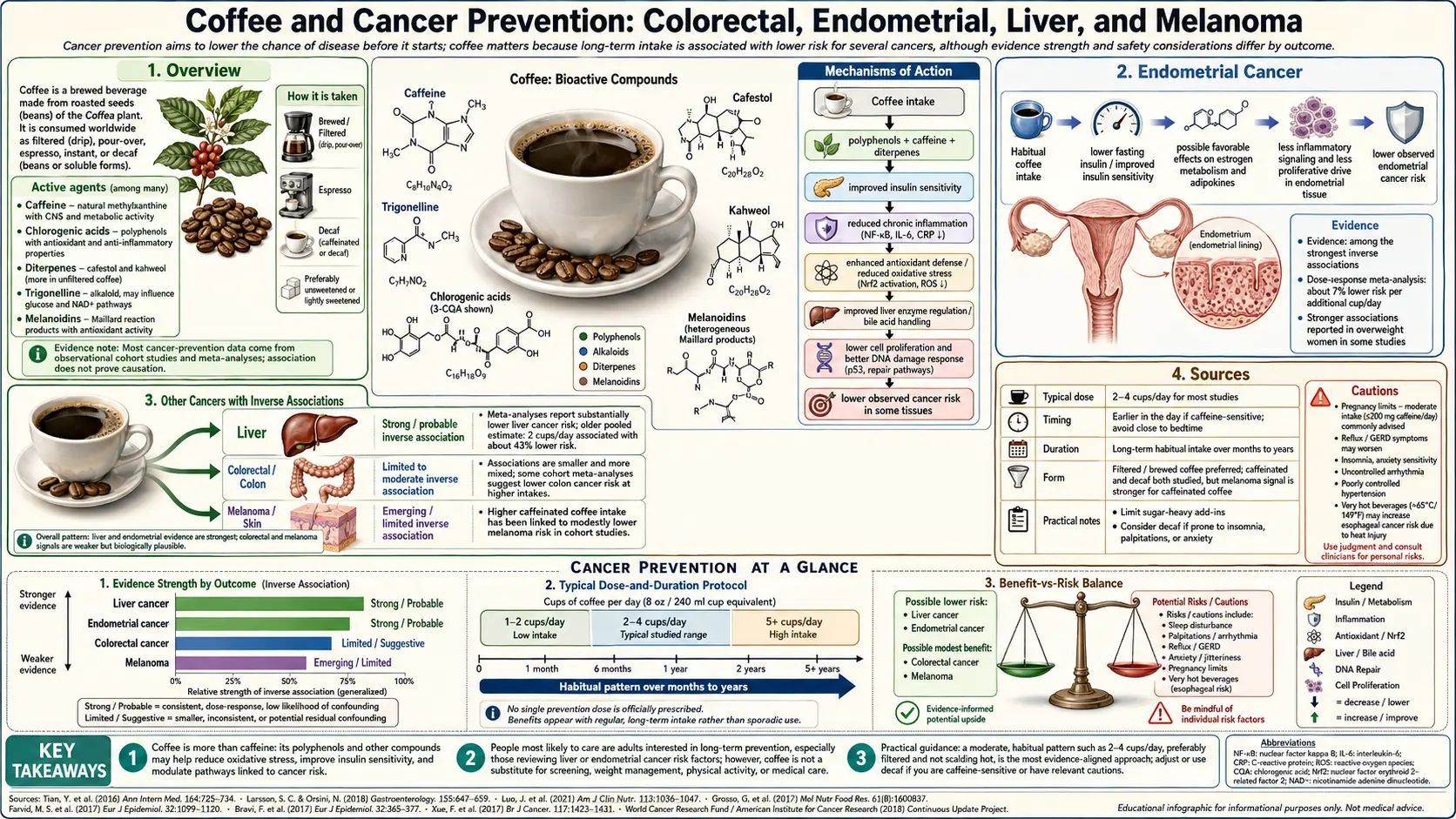
Table of Contents
Overview
The International Agency for Research on Cancer (IARC) reclassified coffee in 2016: after reviewing more than 1,000 human and animal studies, it moved coffee from its Group 2B "possibly carcinogenic" designation to Group 3, "not classifiable". Its Working Group "found no conclusive evidence for a carcinogenic effect of drinking coffee". That is a finding of no conclusive harm, not a finding of protection, though the agency also noted reduced risks for cancers of the liver and uterine endometrium. For several cancers—most notably liver and endometrial—observational studies report inverse associations, and colorectal results are split; some accounts go further and call coffee one of the best-studied protective dietary exposures. The human evidence is observational, so it shows an association and not a cause.
Coffee is a complex mixture of more than a thousand compounds, several of which have demonstrated anti-cancer activity in preclinical studies. Caffeine, chlorogenic acids, cafestol, kahweol, trigonelline, and melanoidins each contribute distinct effects, and together they may explain why the protective associations are observed across such a diverse range of tumor types.
Colorectal Cancer
Colorectal cancer is the second leading cause of cancer death globally. Coffee is often described as protective against it: some accounts call this evidence among the strongest for any dietary factor, with a 15 to 20 percent lower risk among the heaviest drinkers and an effect that appears at two cups per day and plateaus around four. The large analyses do not report those figures, and their results are split.
Sartini and colleagues' 2019 systematic review and meta-analysis in Nutrients pooled 26 prospective studies and found no significant relationship with colorectal cancer overall. Protective results appeared only in subgroups (US subjects; colon cancer in men and women combined and in men alone; decaffeinated coffee), and rectal cancer showed no association. Micek and colleagues' 2019 dose-response meta-analysis "did not find evidence for the association between coffee consumption and CRC risk" (CRC is colorectal cancer). Some of its pooled analyses showed lower colon cancer risk in subgroups and higher rectal cancer risk, and the authors called the association "controversial".
Other large studies also differ. Support comes from Gan and colleagues' 2017 meta-analysis (19 prospective cohorts, 2,046,575 people), which found lower colorectal cancer risk only at 5 or more cups per day, and from a case-control study in northern Israel (5,145 cases, 4,097 controls), where coffee drinkers had lower odds than non-drinkers (odds ratio 0.74, 95% CI 0.64–0.86). A case-control study asks people about their diet after the diagnosis, so it is open to recall bias. In contrast, the European Prospective Investigation into Cancer and Nutrition (EPIC), with 477,071 people and 4,234 cases, found no association (high versus non or low coffee intake: hazard ratio 1.06, 95% CI 0.95–1.18). The Multiethnic Cohort Study found inverse associations that were similar across five ethnic groups for liver, ovarian and thyroid cancers, melanoma, and endometrial cancer in women with obesity; colorectal cancer is not among the cancers its abstract lists.
Coffee also appears to protect against colorectal adenomas, the precancerous lesions from which most colorectal cancers arise, suggesting the effect operates early in carcinogenesis. A meta-analysis of 8 studies, 6 of them case-control, found a pooled odds ratio of 0.70 (95% CI 0.55–0.90) for the highest versus lowest coffee intake; rectal adenoma was the exception, and the authors say the finding needs careful reading.
Separate studies look at survival after diagnosis. Among 1,171 people with advanced or metastatic colorectal cancer, each extra daily cup went with a lower risk of death (hazard ratio 0.93, 95% CI 0.89–0.98), and 4 or more cups a day with a hazard ratio of 0.64 (95% CI 0.46–0.87). A 2026 meta-analysis of 4 cohorts and 5,442 patients linked coffee to better overall survival (hazard ratio 0.78, 95% CI 0.71–0.85) and less recurrence (hazard ratio 0.77, 95% CI 0.66–0.91). A 2026 Multiethnic Cohort analysis of 1,098 patients found coffee overall was not associated with mortality, though decaffeinated coffee went with lower all-cause mortality (hazard ratio 0.71, 95% CI 0.55–0.91). These are observational studies and cannot show cause.
Liver Cancer
The coffee-liver cancer association is covered in detail on the Liver Disease page, but the headline finding bears repeating: Kennedy and colleagues' 2017 meta-analysis in BMJ Open found a 35 percent reduction in hepatocellular carcinoma risk per two extra cups per day (relative risk 0.65), with a weaker result in cohort studies alone (0.71). The reduction was 27 percent for caffeinated coffee and 14 percent for decaffeinated coffee (relative risk 0.86, 95% CI 0.74–1.00), from only 2 and 3 cohorts, and the association was not significantly altered by stage of liver disease. The authors rated the quality of evidence "very low" under the GRADE system, because there are no randomized trials, publication bias is possible, and "coffee" has no accepted definition. This is the single strongest coffee-cancer association in the epidemiological literature; a 2021 umbrella review of diet and cancer at 11 sites also names liver cancer and skin basal cell carcinoma as coffee's inverse associations.
Endometrial Cancer
Endometrial cancer is the most common gynecologic cancer in developed countries, with type 2 diabetes and obesity as major risk factors. The 2012 meta-analysis by Je and colleagues in the International Journal of Cancer pooled 16 studies and found that the highest coffee consumers had roughly a 30 percent lower risk of endometrial cancer compared with the lowest consumers (relative risk 0.71, 95% CI 0.62–0.81), and a relative risk of 0.92 for each extra daily cup. A prospective cohort analysis by Je and colleagues from the Nurses' Health Study found that women drinking four or more cups per day had a 25 percent reduction in endometrial cancer risk over 26 years of follow-up compared with those drinking less than one cup; fewer than four cups per day had no association.
The protective effect is thought to operate via improved insulin sensitivity and reduced circulating estrogen levels, both of which mitigate the hormonal drivers of endometrial carcinogenesis.
Melanoma and Skin Cancer
A 2015 analysis of the NIH-AARP Diet and Health Study by Loftfield and colleagues found that non-Hispanic white adults drinking four or more cups of coffee per day had about a 20 percent lower risk of malignant melanoma over a median 10.5 years (hazard ratio 0.80), and 25 percent lower with caffeinated coffee (hazard ratio 0.75). A 2016 meta-analysis by Wang and colleagues pooled 12 studies and reported a 20 percent reduction in melanoma risk among higher coffee consumers (relative risk 0.80, 95% CI 0.69–0.93). The results by coffee type are mixed: the NIH-AARP association was significant for caffeinated coffee only, while the pooled results for caffeinated (0.85, 95% CI 0.71–1.01) and decaffeinated coffee (0.92, 95% CI 0.81–1.05) were not significant. The effect may operate through caffeine's action on adenosine receptors and its ability to enhance ultraviolet-induced apoptosis of damaged keratinocytes.
For non-melanoma skin cancer, several prospective studies have also found inverse associations with basal cell carcinoma, though the evidence is more mixed for squamous cell carcinoma.
Other Cancers with Inverse Associations
Beyond the best-established associations above, coffee has shown inverse relationships—of varying strength—with several additional cancers:
- Oral and pharyngeal cancer: A pooled analysis of nine case-control studies from the International Head and Neck Cancer Epidemiology (INHANCE) Consortium (5,139 cases) found an odds ratio of 0.61 (95% CI 0.47–0.80) for more than 4 cups a day of caffeinated coffee versus none, with no association for laryngeal cancer. The 2025 update (9,548 cases, 15,783 controls) found lower odds of oral cavity cancer (odds ratio 0.70, 95% CI 0.55–0.89) and oropharyngeal cancer (odds ratio 0.78, 95% CI 0.61–0.99) at the same intake.
- Prostate cancer (advanced/lethal): Several Harvard cohort studies have shown inverse associations specifically with advanced and lethal prostate cancer, though not with localized disease.
- Breast cancer (postmenopausal): Moderate inverse associations in some but not all cohorts, with stronger effects in hormone-receptor-negative disease.
- Glioma: Pooled prospective data show a modest reduction in risk with high coffee intake.
Proposed Anti-Cancer Mechanisms
- Cafestol and kahweol: These diterpenes induce phase II detoxification enzymes (glutathione S-transferase, NQO1), enhance excretion of carcinogens, and suppress NF-kB and STAT3 oncogenic signaling in preclinical models.
- Chlorogenic acids: Reduce oxidative DNA damage, modulate gut microbiota in a direction linked to colonic health, and inhibit DNA methyltransferases that silence tumor suppressor genes.
- Caffeine: Enhances apoptosis of ultraviolet-damaged cells, inhibits ATR kinase to selectively kill DNA-damaged cells, and may improve response to certain chemotherapies.
- Insulin and insulin-like growth factor 1 (IGF-1) reduction: Improved insulin sensitivity reduces insulin-like growth factor 1 bioavailability, a known driver of epithelial proliferation in multiple cancer types.
- Gut microbiome effects: Coffee polyphenols and fiber shift the colonic microbiota toward taxa associated with reduced colorectal cancer risk.
Caveats and What Coffee Does Not Protect Against
Coffee is not universally protective. Very hot beverages (above 65°C / 149°F) have been classified by International Agency for Research on Cancer as probably carcinogenic to the esophagus; the agency's director said it is "the temperature, rather than the drinks themselves, that appears to be responsible". For most cancers, coffee is best described as neutral or modestly protective. The evidence does not support large protective effects against lung, pancreatic, stomach, or bladder cancers, and early reports of associations with pancreatic and bladder cancer have not held up in later meta-analyses that adjusted properly for smoking. An umbrella review on lung cancer found higher risk with coffee, which its authors say may be confounded by smoking. A 2021 umbrella review of diet and cancer at 11 sites estimated that only a few food links have strong or highly suggestive evidence.
The coffee studies above are observational and do not test coffee as a substitute for proven cancer screening (colonoscopy, mammography, cervical cancer screening) or known risk-reduction strategies (tobacco cessation, alcohol moderation, physical activity).
Sources
- Sartini M et al. (2019). "Coffee consumption and risk of colorectal cancer: a systematic review and meta-analysis of prospective studies." Nutrients. PMID: 30909640
- Micek A et al. (2019). "Coffee consumption and colorectal cancer risk: a dose-response meta-analysis on prospective cohort studies." International Journal of Food Sciences and Nutrition. PMID: 30922134
- Gan Y et al. (2017). "Association of coffee consumption with risk of colorectal cancer: a meta-analysis of prospective cohort studies." Oncotarget. PMID: 27078843
- Kennedy OJ et al. (2017). "Coffee, including caffeinated and decaffeinated coffee, and the risk of hepatocellular carcinoma." BMJ Open. PMID: 28490552
- Bhurwal A et al. (2020). "Inverse association of coffee with liver cancer development." Journal of Gastrointestinal and Liver Diseases. PMID: 32830818
- Je Y, Giovannucci E (2012). "Coffee consumption and risk of endometrial cancer: findings from a large up-to-date meta-analysis." International Journal of Cancer. PMID: 22190017
- Je Y, Hankinson SE et al. (2011). "A prospective cohort study of coffee consumption and risk of endometrial cancer over a 26-year follow-up." Cancer Epidemiology, Biomarkers and Prevention. PMID: 22109346
- Loftfield E et al. (2015). "Coffee drinking and cutaneous melanoma risk in the NIH-AARP Diet and Health Study." Journal of the National Cancer Institute. PMID: 25604135
- Wang J, Li X, Zhang D (2016). "Coffee consumption and the risk of cutaneous melanoma: a meta-analysis." European Journal of Nutrition. PMID: 26695410
- Galeone C et al. (2010). "Coffee and tea intake and risk of head and neck cancer: pooled analysis in the international head and neck cancer epidemiology consortium." Cancer Epidemiology, Biomarkers and Prevention. PMID: 20570908
- Nguyen T et al. (2025). "Coffee and tea consumption and the risk of head and neck cancer: An updated pooled analysis in the International Head and Neck Cancer Epidemiology Consortium." Cancer. PMID: 39711146
- Dik VK et al. (2014). "Coffee and tea consumption, genotype-based CYP1A2 and NAT2 activity and colorectal cancer risk-results from the EPIC cohort study." International Journal of Cancer. PMID: 24318358
- Park SY et al. (2018). "Prospective Study of Coffee Consumption and Cancer Incidence in Non-White Populations." Cancer Epidemiology, Biomarkers and Prevention. PMID: 29777049
- Schmit SL et al. (2016). "Coffee Consumption and the Risk of Colorectal Cancer." Cancer Epidemiology, Biomarkers and Prevention. PMID: 27196095
- Wang Y et al. (2020). "Dose-response meta-analysis of coffee consumption and risk of colorectal adenoma." European Journal of Clinical Nutrition. PMID: 31308476
- Mackintosh C et al. (2020). "Association of Coffee Intake With Survival in Patients With Advanced or Metastatic Colorectal Cancer." JAMA Oncology. PMID: 32940631
- Kim JY et al. (2026). "Coffee Consumption and Colorectal Cancer Survival: A Dose-Response Meta-analysis by Coffee Type and Disease Stage." Cancer Epidemiology, Biomarkers and Prevention. PMID: 41416862
- Benson KRK et al. (2026). "Association of coffee intake with risk of all-cause and colorectal cancer-specific mortality among individuals with colorectal cancer in the Multiethnic Cohort Study." Cancer Causes and Control. PMID: 42714649
- Papadimitriou N et al. (2021). "An umbrella review of the evidence associating diet and cancer risk at 11 anatomical sites." Nature Communications. PMID: 34321471
- Bunjaku J et al. (2024). "Lung Cancer and Lifestyle Factors: Umbrella Review." Hematology/Oncology Clinics of North America. PMID: 37369612
- Loomis D et al. (2016). "Carcinogenicity of drinking coffee, mate, and very hot beverages." Lancet Oncology. PMID: 27318851
- International Agency for Research on Cancer (2016). "IARC Monographs evaluate drinking coffee, maté, and very hot beverages." Press release 244. IARC press release 244
Connections
- All Food
- Caffeine, Adenosine & Why Coffee Stops Working — interactive animation
- Coffee
- Coffee (Food)
- Cancer
- Coffee & Liver Disease
- Liver Disease
- Bladder Cancer
- Coffee & Type 2 Diabetes
- Gerson Detoxification
- Glutathione
- Obesity
- Coffee Health Benefits
- Coffee & Cardiovascular Health
- Coffee & Kidney Injury
- Coffee & Mental Health
- Coffee & Parkinson's Disease
- Cancer Treatment
- Green Tea
- Broccoli
- Coffee Enemas