Coffee and Mental Health: Depression, Suicide Risk, and Mood
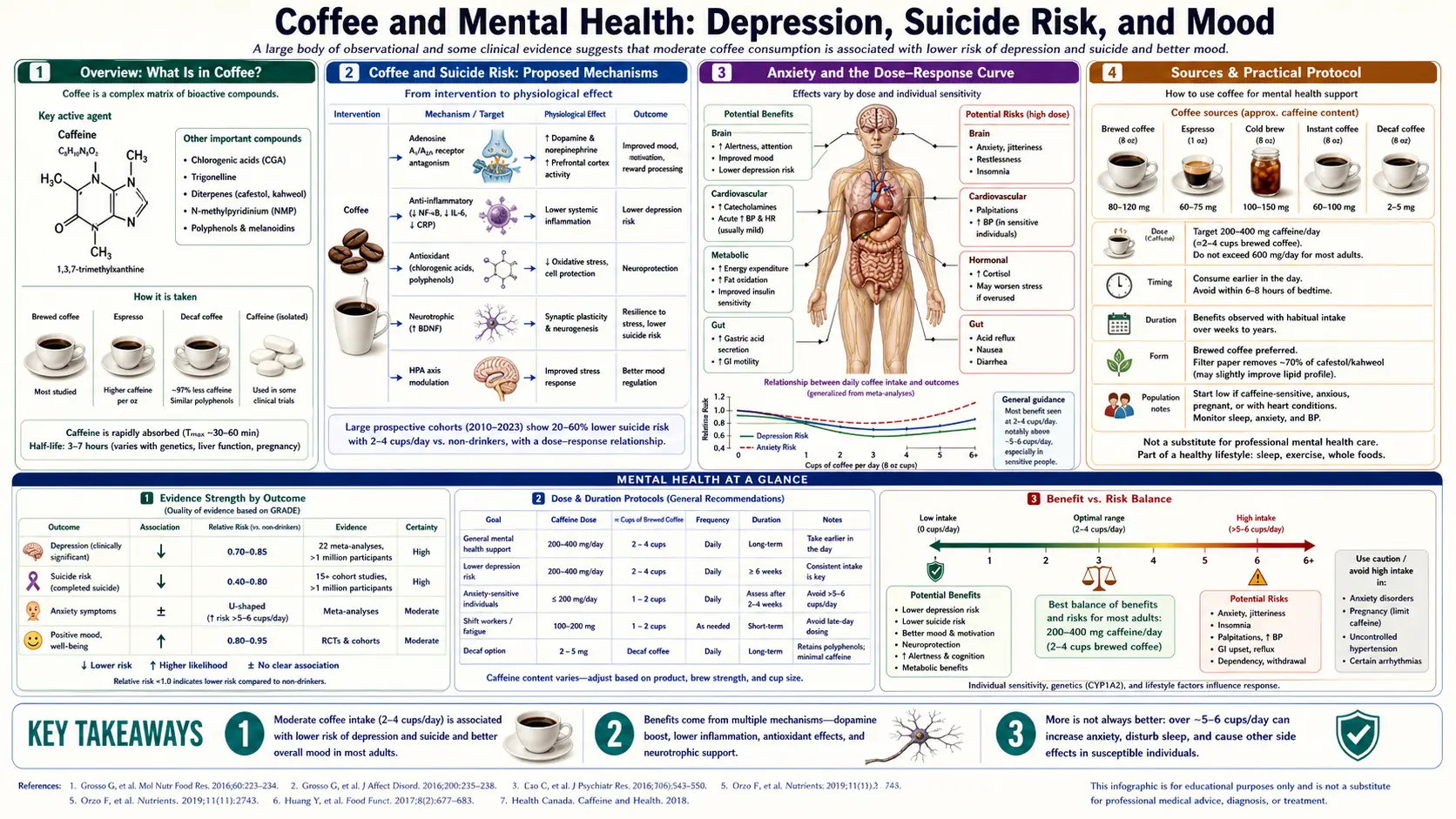
Table of Contents
Overview
The relationship between coffee and mental health is complex and dose-dependent. At moderate intakes, regular coffee consumption is associated with lower rates of clinical depression, reduced suicide risk, and improved short-term cognitive performance. At high intakes, especially in caffeine-sensitive individuals, coffee can worsen anxiety, disrupt sleep, and trigger panic symptoms. Both sides of this curve are described below.
Unlike the liver-disease or diabetes literature—where decaffeinated coffee retains most of the benefit—the mental-health effects of coffee are driven primarily by caffeine and its downstream effects on dopamine, serotonin, and adenosine signaling in the brain.
Coffee and Depression Risk
The landmark study in this area is Lucas and colleagues' 2011 analysis of the Nurses' Health Study, published in Archives of Internal Medicine. Following over 50,000 women for 10 years, the researchers found that those drinking four or more cups of caffeinated coffee per day had a 20 percent lower risk of developing clinical depression compared with women drinking one cup or less per week. The protective effect was specific to caffeinated coffee; decaffeinated coffee and other caffeine sources showed weaker or no association.
A 2016 meta-analysis by Wang and colleagues pooled 11 observational articles (case-control, cohort and cross-sectional studies) and confirmed the inverse association: in its coffee analysis of seven studies and 330,677 participants, the highest coffee intake carried a relative risk of depression of 0.757 compared with the lowest, and the risk fell by 8 percent for each extra cup a day in a linear pattern, with no plateau. For caffeine the association was nonlinear and became significant between 68 and 509 mg a day. A second 2016 meta-analysis, by Grosso and colleagues (12 studies), found a J-shaped curve for coffee, with the strongest protective effect at about 400 mL a day. More recent Mendelian randomization studies using genetic variants as instrumental variables have produced mixed results, suggesting that part of the association may reflect reverse causation (depressed people drink less coffee) rather than a pure causal effect—but even the most conservative estimates leave a modest protective signal.
Coffee and Suicide Risk
Lucas and colleagues' 2014 follow-up analysis, published in The World Journal of Biological Psychiatry, pooled data from three large US cohorts (Nurses' Health Study, NHS II, and Health Professionals Follow-up Study) with combined follow-up of over 16 years and more than 200,000 participants. The study counted 277 suicides. Compared with people drinking one cup a week or less of caffeinated coffee, those drinking two to three cups a day had a relative risk of suicide of 0.55, roughly half, and those drinking four or more cups a day a relative risk of 0.47.
The effect was specific to caffeinated coffee—decaf showed no association—and the authors proposed that caffeine's mild antidepressant effect, mediated through dopamine and serotonin pathways, might explain the reduction. They also cautioned that a general recommendation to increase caffeine intake may not be justified, because most people adjust their caffeine intake to the level that suits them and drinking more may cause unpleasant side effects; they noted, too, that a Finnish study found the highest suicide rate in people drinking 8 or more cups a day, which suggests the response to caffeine may be biphasic. High caffeine intake can worsen insomnia and anxiety, both of which are suicide risk factors on their own.
Alertness, Focus, and Cognitive Performance
Caffeine's cognitive effects are among the best-studied in all of pharmacology. Acute doses of 40 to 200 mg (roughly half a cup to two cups of coffee) reliably improve sustained attention, reaction time, vigilance, and working memory, particularly during sleep deprivation or low arousal states. The effect on more complex cognitive tasks is smaller and more variable.
A 2016 review by Nehlig in Practical Neurology summarized the evidence that regular coffee consumption is associated with a modest reduction in the risk of cognitive decline, dementia, and Alzheimer's disease in older adults, though this evidence is less robust than for Parkinson's disease. In the Finnish CAIDE cohort study (Eskelinen 2009; 1,409 people followed for an average of 21 years), people who drank 3 to 5 cups a day in midlife had the lowest risk of dementia later in life, 65 percent lower than those drinking no or little coffee; as an observational finding, it requires further replication.
Proposed Mechanisms
- Adenosine antagonism: Caffeine blocks adenosine A1 and A2A receptors, reducing the sleep-promoting and mood-suppressing effects of adenosine that accumulate during wakefulness.
- Dopaminergic modulation: Via A2A antagonism in the striatum and prefrontal cortex, caffeine indirectly enhances dopamine signaling, which may contribute to antidepressant effects.
- Inflammation reduction: Chronic low-grade inflammation is implicated in depression pathophysiology, and coffee's anti-inflammatory effects may reduce this burden.
- Antioxidant protection: Chlorogenic acids and melanoidins reduce oxidative stress, which is elevated in depression and neurodegenerative disease.
- Brain-derived neurotrophic factor (BDNF) elevation: Some preclinical studies suggest coffee increases brain-derived neurotrophic factor (BDNF), a key protein in mood regulation and neuroplasticity.
Anxiety and the Dose-Response Curve
The benefits of coffee for mood do not extend indefinitely with increasing dose. At high intakes—above the 400 mg of caffeine a day that the U.S. Food and Drug Administration (FDA) cites as an amount not generally associated with negative effects for most adults (about two to three 12-fluid-ounce cups of coffee)—caffeine can worsen anxiety, trigger panic attacks in susceptible individuals, disrupt sleep architecture, and produce jitteriness, palpitations, and irritability. The FDA estimates that toxic effects such as seizures can occur with rapid intake of around 1,200 mg. The European Food Safety Authority (EFSA, 2015) concluded that single doses up to 200 mg and intakes up to 400 mg a day raise no safety concerns for healthy adults other than pregnant women, and that in pregnancy intakes up to 200 mg a day raise no safety concerns for the unborn baby. People with diagnosed panic disorder, generalized anxiety disorder, or bipolar disorder may be especially sensitive.
Genetic variation in the CYP1A2 enzyme, which metabolizes caffeine, also matters: "slow metabolizers" (roughly 40 percent of the population) experience stronger and longer-lasting effects from a given dose and are more likely to report adverse mood effects. The FDA likewise notes wide variation in how sensitive people are to caffeine and how fast they eliminate it.
Caffeine withdrawal—headache, fatigue, low mood, and difficulty concentrating within 12 to 24 hours of stopping—is itself a well-documented syndrome and is listed as a diagnosis in DSM-5. This underscores that caffeine is a real psychoactive drug, not a benign stimulant, and that its effects on mood are mediated by genuine pharmacology.
Practical Facts
- For adults without anxiety disorders, two to four cups of caffeinated coffee per day is associated with lower rates of depression in the cohort studies above.
- People with anxiety, panic disorder, or insomnia are the most sensitive to caffeine. EFSA's no-concern levels are single doses up to 200 mg, up to 400 mg a day for healthy adults other than pregnant women, and up to 200 mg a day in pregnancy; decaf retains metabolic benefits without the psychoactive effect.
- Caffeine's half-life is 5 to 6 hours, so part of the caffeine from a coffee drunk 8 to 10 hours before bed is still in the body at bedtime. EFSA found that a single 100 mg dose may affect sleep duration and patterns in some adults, particularly close to bedtime, and sleep disruption is a significant driver of mood symptoms.
- Coffee is not a substitute for evidence-based treatment of clinical depression (psychotherapy, selective serotonin reuptake inhibitors (SSRIs), exercise, structured behavioral activation). For anyone having thoughts of suicide, the U.S. National Institute of Mental Health lists the 988 Suicide & Crisis Lifeline (call or text 988, or chat at 988lifeline.org), and 911 in life-threatening situations.
- Sudden cessation of high caffeine intake can produce a withdrawal syndrome (see above). The FDA notes that caffeine withdrawal is not considered dangerous but can be unpleasant, and that for people used to caffeine every day, cutting back gradually is best.
Sources
- Lucas M et al. (2011). "Coffee, caffeine, and risk of depression among women." Archives of Internal Medicine. PMID: 21949167
- Lucas M et al. (2014). "Coffee, caffeine, and risk of completed suicide: results from three prospective cohorts of American adults." The World Journal of Biological Psychiatry. PMID: 23819683
- Wang L et al. (2016). "Coffee and caffeine consumption and depression: a meta-analysis of observational studies." Australian and New Zealand Journal of Psychiatry. PMID: 26339067
- Grosso G et al. (2016). "Coffee, tea, caffeine and risk of depression: a systematic review and dose-response meta-analysis of observational studies." Molecular Nutrition and Food Research. PMID: 26518745
- Nehlig A (2016). "Effects of coffee/caffeine on brain health and disease: what should I tell my patients?" Practical Neurology. PMID: 26677204
- Eskelinen MH et al. (2009). "Midlife coffee and tea drinking and the risk of late-life dementia: a population-based CAIDE study." Journal of Alzheimer's Disease. PMID: 19158424
- Smith AP (2002). "Effects of caffeine on human behavior." Food and Chemical Toxicology. PMID: 12204388
Connections
- All Food
- Caffeine, Adenosine & Why Coffee Stops Working — interactive animation
- Coffee
- Coffee (Food)
- Depression
- Anxiety
- Insomnia
- Insomnia (Symptoms)
- Dementia
- Alzheimer's Disease
- Parkinson's Disease
- N-Acetylcysteine & Mental Health
- Bipolar Disorder
- Oxidative Stress
- Coffee Health Benefits
- Coffee & Cardiovascular Health
- Coffee & Parkinson's Disease
- Cancer Prevention