Coffee and Cardiovascular Health: Heart Disease, Arrhythmia, and Longevity
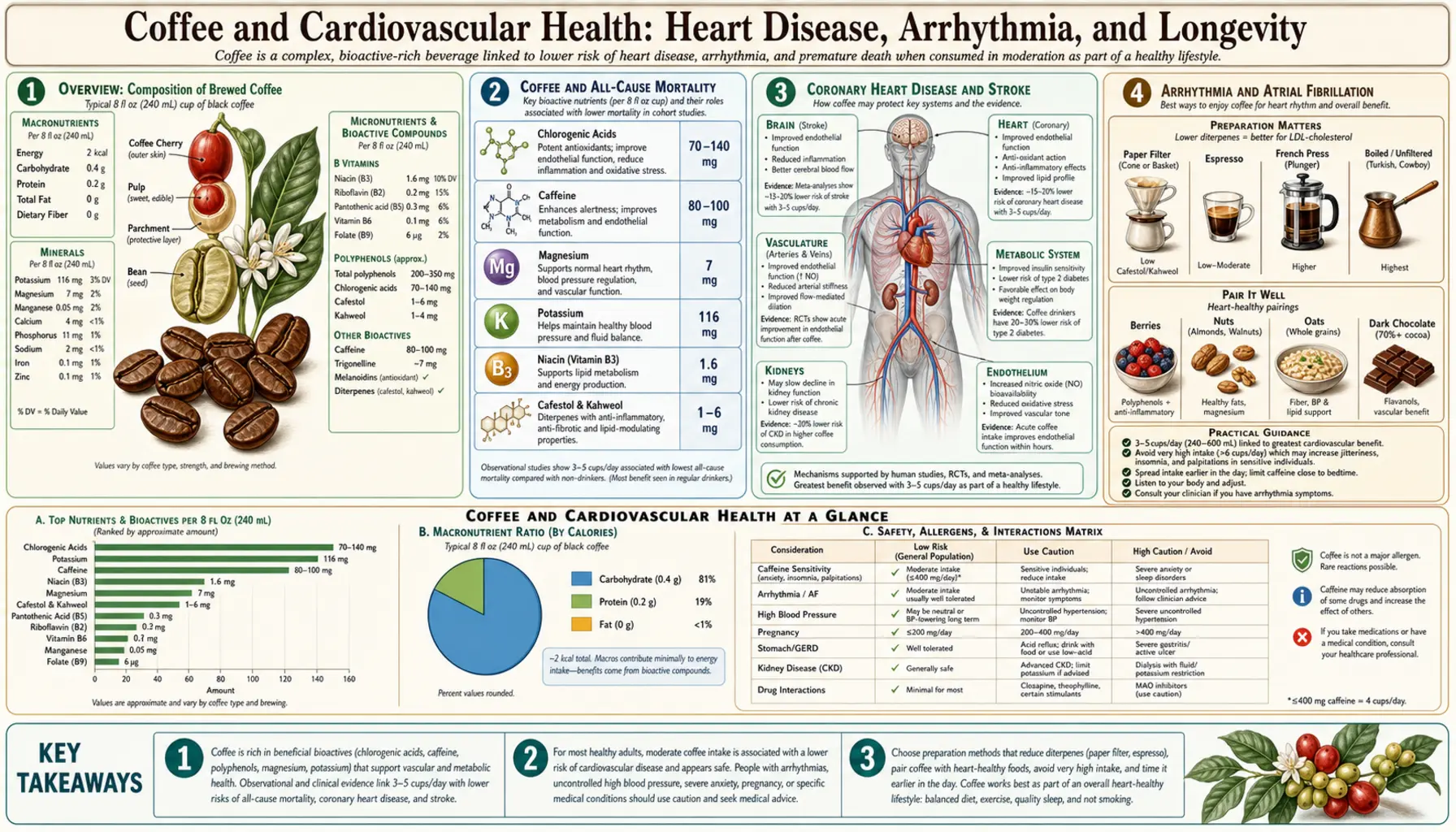
Table of Contents
Overview
For decades, coffee was viewed with suspicion by cardiologists, largely because of its ability to acutely raise heart rate and blood pressure and because unfiltered coffee was shown to raise low-density lipoprotein (LDL) cholesterol. Modern cardiovascular epidemiology has overturned that view. Large prospective cohort studies and umbrella reviews now consistently show that moderate coffee consumption is associated with a lower risk of cardiovascular disease, stroke, heart failure, and all-cause mortality. The protective pattern holds across both caffeinated and decaffeinated coffee and in populations with established cardiovascular disease.
Coffee and All-Cause Mortality
The most influential studies on coffee and mortality include Freedman and colleagues' 2012 NIH-AARP Diet and Health Study of over 400,000 adults, which found that men drinking six or more cups per day had about a 10 percent lower risk of death from all causes, and women had a 15 percent reduction, compared with non-drinkers. The protective association was strongest for death from heart disease, stroke, diabetes, and infections.
Ding and colleagues' 2015 analysis pooling three large Harvard cohorts (Nurses' Health Study, NHS II, and Health Professionals Follow-up Study) found that, compared with non-drinkers, one to five cups per day was associated with lower mortality, while more than five cups per day was not associated with mortality either way. A 2017 umbrella review by Poole and colleagues in the BMJ, synthesizing 201 meta-analyses across hundreds of outcomes, concluded that the "sweet spot" for mortality reduction is three to four cups per day, with roughly a 17 percent lower risk of all-cause mortality at that intake.
A 2017 multiethnic cohort analysis by Park and colleagues in Annals of Internal Medicine confirmed that the mortality benefit holds across African American, Native Hawaiian, Japanese American, Latino, and white populations—strong evidence against the idea that the association is confined to one demographic.
Coronary Heart Disease and Stroke
The 2014 meta-analysis by Ding and colleagues in Circulation, pooling 36 prospective studies, found a nonlinear relationship between coffee and cardiovascular disease risk (coronary heart disease, stroke, heart failure and cardiovascular death counted together; 1,279,804 participants), with the lowest risk at three to five cups per day: about 15 percent lower than non-drinkers at a median of 3.5 cups (relative risk 0.85), while the 5 percent lower risk at a median of 5 cups was not statistically significant. Intakes above six cups per day showed no additional benefit but also no significant harm in most populations.
For stroke, the pattern is similar. A 2011 meta-analysis by Larsson and Orsini (11 prospective studies, 479,689 participants) found that, compared with no coffee, two cups per day was associated with a 14 percent lower stroke risk and three to four cups with a 17 percent lower risk (relative risks 0.86 and 0.83), an association the authors describe as weakly inverse. The benefit was present for both ischemic and hemorrhagic stroke, though the effect size was smaller for the latter.
Arrhythmia and Atrial Fibrillation
A long-standing concern has been whether caffeine triggers atrial fibrillation (AF) or other arrhythmias. The evidence from modern cohort studies actually suggests the opposite: regular coffee consumption is associated with a lower, not higher, risk of atrial fibrillation. A 2014 meta-analysis by Cheng and colleagues pooled six prospective cohort studies (228,465 participants) and found caffeine weakly associated with a lower risk of atrial fibrillation (relative risk 0.90, just short of statistical significance); in the studies that adjusted for other factors, the risk was 11 percent lower at low and 16 percent lower at high caffeine intakes. A 2018 meta-analysis by Abdelfattah and colleagues likewise found no increase in atrial fibrillation with coffee, and a lower incidence above 436 mg of caffeine per day.
A 2022 study from the UK Biobank by Chieng and colleagues (senior author Kistler), following 449,563 participants for about 12.5 years, found that ground and instant coffee at one to five cups per day were associated with less arrhythmia (lowest risk at four to five cups a day for ground coffee and two to three cups for instant), but decaffeinated coffee was not. All three types, particularly at two to three cups per day, were associated with less cardiovascular disease and lower mortality. The authors suggested that long-standing clinical advice to avoid coffee for palpitations may not be justified by the data.
The first randomized trial on the question, DECAF (2026), enrolled 200 coffee drinkers with persistent atrial fibrillation or atrial flutter who were due for an electrical shock to restore normal rhythm (cardioversion). Those assigned to keep drinking caffeinated coffee (about one cup a day on average) had less return of the arrhythmia over 6 months than those assigned to give up coffee and all caffeine: 47% vs 64%, a 39% lower risk (hazard ratio 0.61). Adverse events did not differ between the groups.
In the 2023 CRAVE trial, 100 adults wore a heart monitor, a step counter and a glucose monitor for 14 days while daily text messages randomly told them to drink caffeinated coffee or avoid caffeine. Coffee days did not bring significantly more extra beats from the upper chambers of the heart (58 vs 53 premature atrial contractions a day), but did bring more extra beats from the lower chambers (154 vs 102 premature ventricular contractions a day), about 1,000 more steps (1,058) and 36 minutes less sleep; blood sugar did not differ.
Cholesterol and the Brewing Method Effect
One genuine concern is the effect of unfiltered coffee on low-density lipoprotein cholesterol. The diterpenes cafestol and kahweol—the same compounds that contribute to anti-cancer effects—raise serum low-density lipoprotein by inhibiting hepatic low-density lipoprotein receptor activity. French press, Turkish, and Scandinavian boiled coffee retain the highest levels of these compounds and can raise low-density lipoprotein by 5 to 10 mg/dL at moderate intakes over several weeks.
Paper filtration removes nearly all cafestol and kahweol, which is why drip coffee does not raise low-density lipoprotein. Tverdal and colleagues' 2020 analysis followed 508,747 Norwegian adults for an average of 20 years. Compared with no coffee, filtered coffee was linked to a lower risk of death from any cause (hazard ratio 0.85 in both men and women) and unfiltered coffee less so (0.96 in men, 0.91 in women); for cardiovascular death the figures were 0.88 (men) and 0.80 (women) for filtered and 0.97 and 0.83 for unfiltered coffee. The authors concluded that unfiltered brew was associated with higher mortality than filtered brew, consistent with this mechanism. The difference matters most for people with dyslipidemia or existing cardiovascular disease.
Blood Pressure
Acute caffeine intake raises blood pressure by roughly 5 to 10 mm Hg systolic in non-habitual drinkers, but this effect diminishes within a few weeks of regular consumption as tolerance develops. In long-term cohort studies, regular coffee drinkers do not show higher rates of hypertension than non-drinkers, and some analyses suggest a modest protective effect. The American Heart Association does not advise abstention from coffee for hypertension, though the short-term rise of 5 to 10 mm Hg matters most for people whose blood pressure is very high or uncontrolled.
Proposed Cardioprotective Mechanisms
- Polyphenol antioxidants: Chlorogenic acids, melanoidins, and hydroxycinnamic acids reduce oxidative stress and low-density lipoprotein oxidation, a key step in atherogenesis.
- Endothelial function: Coffee polyphenols increase nitric oxide bioavailability and improve flow-mediated dilation in multiple short-term trials.
- Anti-inflammatory effects: Regular coffee consumption is associated with lower C-reactive protein and other inflammatory markers in several observational studies.
- Improved glucose metabolism: Via the same mechanisms that lower type 2 diabetes risk, coffee indirectly reduces downstream cardiovascular risk.
- Favorable effects on body weight: Caffeine increases resting metabolic rate and fatty acid oxidation modestly, supporting weight maintenance.
What the Studies Show About Intake and Brewing
- In the cohort studies above, the lowest cardiovascular risks were seen at roughly two to four cups per day, with three cups often identified as the statistical sweet spot.
- Filtered brewing methods (paper drip, pour-over, espresso machines with paper filters) remove the cholesterol-raising compounds, which matters most for people with elevated low-density lipoprotein or cardiovascular disease.
- Decaffeinated coffee retains most of the cardiovascular benefit in the cohort studies (though the UK Biobank study found no lower arrhythmia risk with decaffeinated coffee), and its low caffeine content is relevant to people with hypertension, anxiety, or pregnancy.
- Uncontrolled hypertension, severe arrhythmia, and known caffeine sensitivity are the situations in which caffeine's short-term effects on heart rate and blood pressure matter most.
- Large amounts of sugar, cream, or syrups offset the metabolic benefit seen with black or lightly sweetened coffee.
Sources
- Freedman ND et al. (2012). "Association of coffee drinking with total and cause-specific mortality." New England Journal of Medicine. PMID: 22591295
- Ding M et al. (2015). "Association of coffee consumption with total and cause-specific mortality in three large prospective cohorts." Circulation. PMID: 26572796
- Ding M et al. (2014). "Long-term coffee consumption and risk of cardiovascular disease: a systematic review and a dose-response meta-analysis of prospective cohort studies." Circulation. PMID: 24201300
- Poole R et al. (2017). "Coffee consumption and health: umbrella review of meta-analyses of multiple health outcomes." BMJ. PMID: 29167102
- Tverdal A et al. (2020). "Coffee consumption and mortality from cardiovascular diseases and total mortality: does the brewing method matter?" European Journal of Preventive Cardiology. PMID: 32320635
- Park SY et al. (2017). "Association of coffee consumption with total and cause-specific mortality among nonwhite populations." Annals of Internal Medicine. PMID: 28693036
- Chieng D et al. (2022). "The impact of coffee subtypes on incident cardiovascular disease, arrhythmias, and mortality: long-term outcomes from the UK Biobank." European Journal of Preventive Cardiology. PMID: 36162818
- Larsson SC, Orsini N (2011). "Coffee consumption and risk of stroke: a dose-response meta-analysis of prospective studies." American Journal of Epidemiology. PMID: 21920945
- Cheng M et al. (2014). "Caffeine intake and atrial fibrillation incidence: dose response meta-analysis of prospective cohort studies." Canadian Journal of Cardiology. PMID: 24680173
- Abdelfattah R et al. (2018). "Does caffeine consumption increase the risk of new-onset atrial fibrillation?" Cardiology. PMID: 29966128
- Wong CX et al. (2026). "Caffeinated coffee consumption or abstinence to reduce atrial fibrillation: the DECAF randomized clinical trial." JAMA. PMID: 41206802
- Marcus GM et al. (2023). "Acute effects of coffee consumption on health among ambulatory adults." New England Journal of Medicine. PMID: 36947466
Connections
- All Food
- Caffeine, Adenosine & Why Coffee Stops Working — interactive animation
- Coffee
- Coffee (Food)
- Cardiovascular Disease
- Stroke
- Hypertension
- Arrhythmia
- Atrial Fibrillation
- Heart Failure
- Coffee & Type 2 Diabetes
- Celery Juice & Blood Pressure
- Oxidative Stress
- Inflammatory Markers
- Coffee Health Benefits
- Coffee & Cancer Prevention
- Coffee & Liver Disease
- Ginger
- Mental Health
- Parkinsons Disease