Coffee Health Benefits: Cafestol, Kahweol, and Beyond
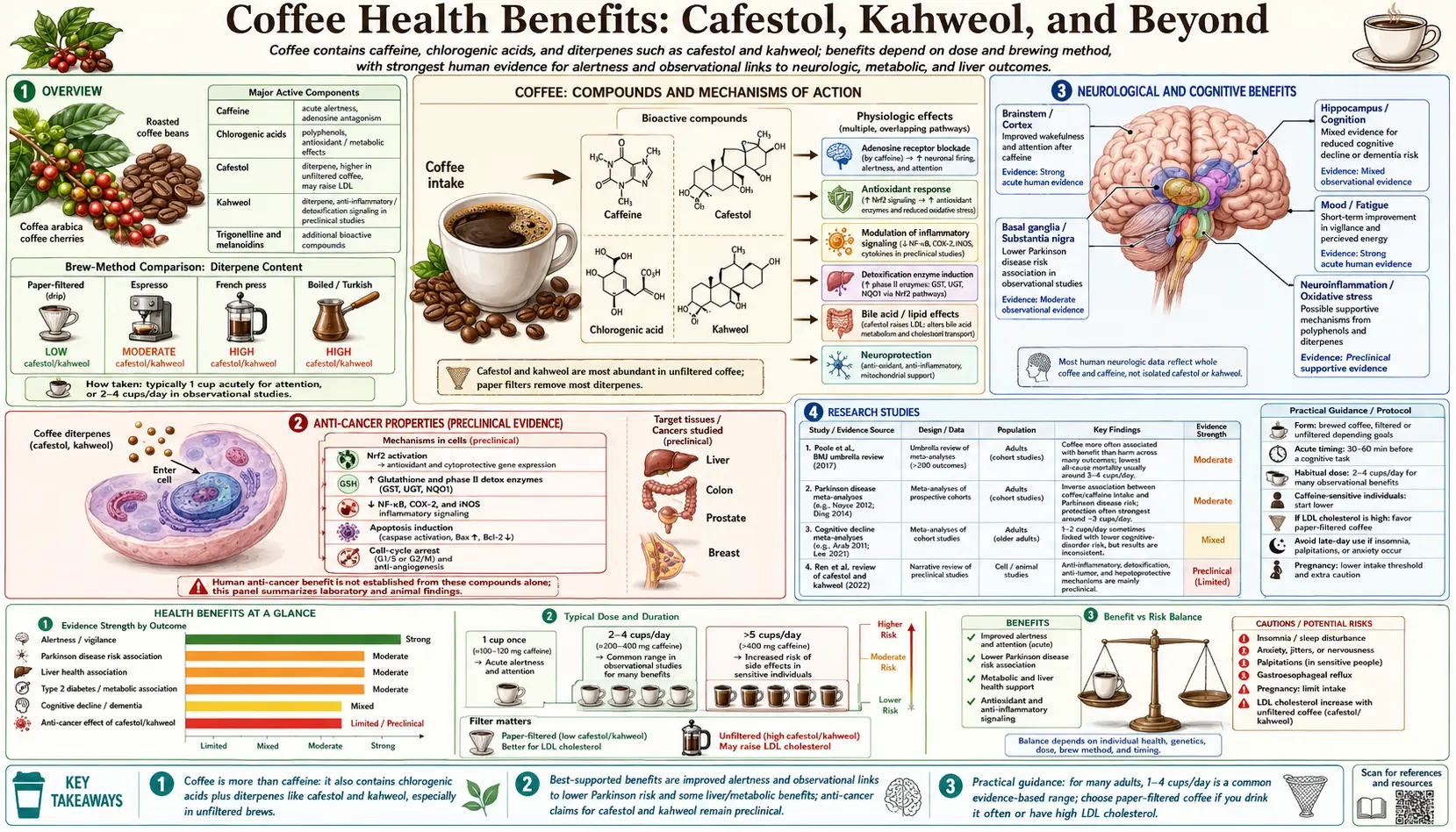
Table of Contents
- Overview
- Cafestol and Kahweol: The Coffee Diterpenes
- Anti-Inflammatory and Antioxidant Effects
- Anti-Cancer Properties (Preclinical Evidence)
- Liver Protection
- Cardiovascular Considerations
- Type 2 Diabetes and Metabolic Health
- Neurological and Cognitive Benefits
- How Brewing Method Affects Benefits
- Amount, Brewing, and Timing: What the Research Reports
- Research Studies
- Connections
- Featured Videos
Overview
Coffee's reputation has undergone a dramatic transformation in the scientific literature. Where earlier generations of epidemiological studies suggested that heavy coffee consumption might be harmful, modern, better-controlled research consistently shows the opposite: moderate daily coffee intake is associated with reduced mortality and a lower risk of many chronic diseases. A growing share of credit for these effects is being assigned to two relatively obscure but remarkably active compounds found almost nowhere else in the human diet: the diterpenes cafestol and kahweol.
These two molecules, together with chlorogenic acids, trigonelline, melanoidins, and caffeine itself, form a complex biochemical matrix that appears to benefit the liver, digestive tract, cardiovascular system, and brain in ways that are only beginning to be understood.
Cafestol and Kahweol: The Coffee Diterpenes
Cafestol and kahweol are structurally similar pentacyclic diterpenes derived from the fat fraction of coffee beans. They are found in appreciable quantities only in Coffea arabica and Coffea canephora (robusta) and essentially nowhere else in the typical human diet, which makes coffee the exclusive source for anyone seeking their effects through food.
Because both diterpenes are lipid-soluble, they are retained in the oil fraction of coffee. This means brewing method dramatically influences how much of each ends up in the cup:
- Paper filter brewing (drip coffee, pour-over, filter machines) removes most cafestol and kahweol
- French press, Turkish, boiled (Scandinavian), moka pot, and metal-filter brewing retain substantially higher levels
- Espresso retains a moderate amount due to its short extraction time and lack of paper filtration
This distinction matters clinically because unfiltered coffee has been shown to modestly raise low-density lipoprotein (LDL) cholesterol, a direct effect of these same diterpenes. The tradeoff is real: unfiltered coffee delivers more of the anti-cancer and anti-inflammatory diterpenes but at the cost of a measurable cholesterol-elevating effect. A 1997 review by Urgert and Katan explains the difference: the diterpenes are extracted by hot water but retained by a paper filter, which is why filtered coffee does not affect cholesterol, whereas Scandinavian boiled, cafetière (French press), and Turkish coffees do. Because cafestol and kahweol are coffee-specific diterpenes, other polyphenol-rich foods do not supply them.
Anti-Inflammatory and Antioxidant Effects
Both cafestol and kahweol have been shown in laboratory studies to reduce oxidative stress and inflammation at the cellular level. They activate the Nrf2 pathway, one of the master regulators of cellular antioxidant defense, which in turn upregulates production of glutathione, heme oxygenase-1, and other protective enzymes. This cellular response helps defend cells against damage from free radicals, environmental toxins, and chronic inflammatory signals linked to aging and chronic disease.
Mechanistically, the diterpenes have been shown to:
- Suppress NF-kB signaling, a key driver of chronic inflammation
- Reduce production of inflammatory cytokines including tumor necrosis factor-alpha and interleukin-6
- Inhibit inducible nitric oxide synthase (iNOS) and cyclooxygenase-2 (COX-2)
- Enhance phase II detoxification enzymes such as glutathione S-transferase
- Increase expression of the rate-limiting enzyme in glutathione synthesis
Together these effects may help explain why regular coffee drinkers consistently show lower circulating markers of inflammation (C-reactive protein and interleukin-6 [IL-6]) in observational studies, even after adjusting for lifestyle and dietary factors.
Anti-Cancer Properties (Preclinical Evidence)
The anti-cancer research on cafestol and kahweol is primarily preclinical, meaning most of the direct evidence comes from cell culture and animal studies rather than large human trials. Within those limitations, the findings are intriguing and consistent.
Laboratory studies have demonstrated that the diterpenes may:
- Inhibit tumor cell proliferation in colon, liver, breast, prostate, and leukemia cell lines
- Induce apoptosis (programmed cell death) selectively in cancer cells while sparing healthy cells
- Suppress angiogenesis, the process by which tumors recruit new blood supply
- Enhance the body's detoxification of carcinogens through induction of phase II enzymes
- Reduce the bioactivation of procarcinogens through downregulation of certain cytochrome P450 enzymes
Kahweol in particular has shown notable activity against colon and liver cancer cells in laboratory models, inhibiting growth signaling pathways and inducing selective cell death. Population studies reinforce these findings indirectly: higher coffee intake has been associated with modestly lower risks of colorectal, hepatocellular, and endometrial cancers in multiple large cohort studies.
Importantly, this research does not show that coffee treats cancer: the laboratory findings come from cell and animal studies, and the human findings come from population studies of cancer risk, not from treatment trials.
Liver Protection
Of all the health benefits attributed to coffee, the evidence for liver protection may be the strongest. Large epidemiological studies have consistently shown that populations with higher coffee intake have lower rates of liver cirrhosis, hepatocellular carcinoma, and non-alcoholic fatty liver disease. The effect is dose-dependent, meaning more daily cups generally correspond to greater protection (up to a plateau around 3 to 4 cups per day).
The diterpenes appear to play a significant role. Mechanistic studies suggest that cafestol and kahweol help protect liver cells against toxins, reduce hepatic inflammation, and interfere with the activation of hepatic stellate cells that drive fibrosis. Coffee consumption has been linked to:
- Lower serum liver enzymes (alanine aminotransferase (ALT), aspartate aminotransferase (AST), gamma-glutamyl transferase (GGT)) indicating reduced hepatocyte stress
- Reduced fibrosis progression in chronic hepatitis C patients
- Lower risk of cirrhosis regardless of the underlying cause
- Lower incidence of hepatocellular carcinoma in long-term coffee drinkers
- Improved markers of fatty liver in patients with non-alcoholic fatty liver disease (NAFLD)
A 2016 meta-analysis of nine observational studies (432,133 participants) found that each increase of two cups a day was associated with a relative risk of cirrhosis of 0.56 (95% confidence interval 0.44 to 0.68). These findings are remarkable and have led some hepatologists to actively encourage moderate coffee consumption in patients at risk for chronic liver disease.
Cardiovascular Considerations
The cardiovascular profile of coffee is nuanced. On one hand, moderate coffee consumption is associated with reduced risk of stroke, heart failure, and overall cardiovascular mortality. On the other hand, unfiltered coffee (due to its cafestol and kahweol content) can modestly raise low-density lipoprotein cholesterol and apolipoprotein B, which are established cardiovascular risk markers.
For most healthy individuals, the net effect appears to be favorable, especially when coffee is consumed filtered or in moderation. For people with high blood cholesterol (dyslipidemia), familial hypercholesterolemia, or established coronary disease, the relevant fact is that paper-filtered coffee does not raise cholesterol, while boiled, cafetière, and Turkish coffees do (Urgert and Katan, 1997). Those with controlled hypertension can usually tolerate moderate coffee intake, though habitual high consumption may cause small sustained blood pressure increases in sensitive individuals.
Type 2 Diabetes and Metabolic Health
The link between coffee consumption and reduced type 2 diabetes risk is one of the most consistent findings in nutritional epidemiology. A 2014 meta-analysis of 28 prospective studies (1,109,272 participants) found a relative risk of type 2 diabetes of 0.91 for each extra daily cup of caffeinated coffee and 0.94 for each extra cup of decaffeinated coffee, and the risk kept falling across 1 to 6 cups a day (relative risk 0.92 at one cup and 0.67 at six cups, compared with none or rare drinking).
The proposed mechanisms are multi-layered. Chlorogenic acids slow carbohydrate absorption and improve post-meal glucose response. Trigonelline improves insulin sensitivity in some animal studies. Magnesium from coffee contributes to glucose metabolism. Diterpenes and other polyphenols reduce hepatic fat accumulation, which improves hepatic insulin sensitivity. The cumulative effect is a measurably lower risk of progression to diabetes in regular coffee drinkers.
Neurological and Cognitive Benefits
Beyond its well-known stimulant effect on alertness, coffee has been linked to reduced risk of Parkinson's disease, Alzheimer's disease, and cognitive decline in multiple large cohort studies. Mechanistically, caffeine blocks adenosine receptors (particularly A2A receptors) that are implicated in neurodegeneration, while chlorogenic acids and diterpenes contribute additional antioxidant and anti-inflammatory effects in brain tissue.
Several studies have also reported reduced risk of depression among moderate coffee drinkers, potentially reflecting coffee's effects on dopaminergic signaling and the gut-brain axis via its polyphenol-induced changes in gut microbiota.
How Brewing Method Affects Benefits
The choice of brewing method matters more than most people realize. Consider the following general ranking of diterpene content (cafestol plus kahweol per cup):
- Boiled Scandinavian coffee: highest diterpene content, roughly 6 to 12 milligrams per cup
- Turkish coffee: very high, around 4 to 8 milligrams per cup
- French press (cafetière): high, typically 3 to 6 milligrams per cup
- Moka pot: moderate, around 1 to 4 milligrams per cup
- Espresso: moderate, around 1 to 4 milligrams per cup depending on extraction
- Paper-filtered drip or pour-over: low, typically less than 0.5 milligrams per cup
- Instant coffee: low to very low
There is no single "best" method. French press and Turkish coffee deliver the most diterpenes; paper-filtered coffee delivers the least and, according to Urgert and Katan's 1997 review, does not raise cholesterol, while boiled, cafetière, and Turkish coffees do.
Amount, Brewing, and Timing: What the Research Reports
- Amount: a 2017 umbrella review in the BMJ (Poole and colleagues) found the largest relative risk reductions for several outcomes, including death from any cause and cardiovascular disease, at three to four cups a day compared with none, and judged coffee generally safe within usual levels of intake
- Brewing: unfiltered methods deliver more cafestol and kahweol; paper-filtered coffee does not raise cholesterol (Urgert and Katan, 1997)
- Timing: a common practice is a last cup about 8 hours before bedtime to protect sleep, and taking iron or calcium supplements at least 30 minutes apart from coffee
- Quality: some buyers choose organic, shade-grown, or mold-tested coffee to reduce exposure to pesticides and mycotoxins
- Additions: excess sugar, flavored syrups, and heavy creamers can offset the metabolic associations seen with plain coffee; many people drink it black or with whole milk
- Pregnancy: the same 2017 umbrella review found that in pregnancy, high compared with low or no coffee intake was associated with low birth weight (odds ratio 1.31), preterm birth in the first and second trimester, and pregnancy loss (odds ratio 1.46); the American College of Obstetricians and Gynecologists states that moderate caffeine intake (less than 200 mg a day) does not appear to be a major contributing factor in miscarriage or preterm birth
- Anxiety, sleep, heart rhythm, and reflux: caffeine is commonly reported to worsen anxiety and insomnia, and people with heart-rhythm problems (arrhythmia) or severe reflux often cut down or stop coffee
Research Studies
- Ren Y, Wang C, Xu J, Wang S (2019). "Cafestol and Kahweol: A Review on Their Bioactivities and Pharmacological Properties." International Journal of Molecular Sciences. 20(17):4238. — PubMed PMID: 31480213
- Cavin C, Holzhaeuser D, Scharf G, Constable A, Huber WW, Schilter B (2002). "Cafestol and kahweol, two coffee specific diterpenes with anticarcinogenic activity." Food and Chemical Toxicology. 40(8):1155-1163. — PubMed PMID: 12067578
- Kim JY, Jung KS, Jeong HG (2004). "Suppressive effects of the kahweol and cafestol on cyclooxygenase-2 expression in macrophages." FEBS Letters. 569(1-3):321-326. — PubMed PMID: 15225655
- Park GH, Song HM, Jeong JB (2016). "The coffee diterpene kahweol suppresses the cell proliferation by inducing cyclin D1 proteasomal degradation via ERK1/2, JNK and GSK3β-dependent threonine-286 phosphorylation in human colorectal cancer cells." Food and Chemical Toxicology. 95:142-148. — PubMed PMID: 27424123
- Cárdenas C, Quesada AR, Medina MA (2011). "Anti-angiogenic and anti-inflammatory properties of kahweol, a coffee diterpene." PLoS ONE. 6(8):e23407. — PubMed PMID: 21858104
- Kennedy OJ, Roderick P, Buchanan R, Fallowfield JA, Hayes PC, Parkes J (2017). "Coffee, including caffeinated and decaffeinated coffee, and the risk of hepatocellular carcinoma: a systematic review and dose-response meta-analysis." BMJ Open. 7(5):e013739. — PubMed PMID: 28490552
- Kennedy OJ, Roderick P, Buchanan R, Fallowfield JA, Hayes PC, Parkes J (2016). "Systematic review with meta-analysis: coffee consumption and the risk of cirrhosis." Alimentary Pharmacology and Therapeutics. 43(5):562-574. — PubMed PMID: 26806124
- Poole R, Kennedy OJ, Roderick P, Fallowfield JA, Hayes PC, Parkes J (2017). "Coffee consumption and health: umbrella review of meta-analyses of multiple health outcomes." BMJ. 359:j5024. — PubMed PMID: 29167102
- Ding M, Bhupathiraju SN, Chen M, van Dam RM, Hu FB (2014). "Caffeinated and decaffeinated coffee consumption and risk of type 2 diabetes: a systematic review and a dose-response meta-analysis." Diabetes Care. 37(2):569-586. — PubMed PMID: 24459154
- Urgert R, Katan MB (1997). "The cholesterol-raising factor from coffee beans." Annual Review of Nutrition. 17:305-324. Classic paper characterizing cafestol's effect on low-density lipoprotein. — PubMed PMID: 9240930
- American College of Obstetricians and Gynecologists (2010). "ACOG Committee Opinion No. 462: Moderate caffeine consumption during pregnancy." Obstetrics and Gynecology. 116(2 Pt 1):467-468. — PubMed PMID: 20664420
Connections
- All Food
- Caffeine, Adenosine & Why Coffee Stops Working — interactive animation
- Coffee
- Coffee (Food)
- Coffee & Kidney Injury
- Coffee Grounds
- Liver Cleansing
- Coffee & Type 2 Diabetes
- Cancer
- Cirrhosis
- Coffee & Liver Disease
- Coffee & Mental Health
- Glutathione
- Diabetes
- Oxidative Stress
- Non-Alcoholic Fatty Liver Disease
- Gamma-Glutamyl Transferase
- Coffee & Cardiovascular Health
- Cancer Prevention
- Parkinsons Disease
- Remedies Overview