Bananas — Benefits Deep Dive
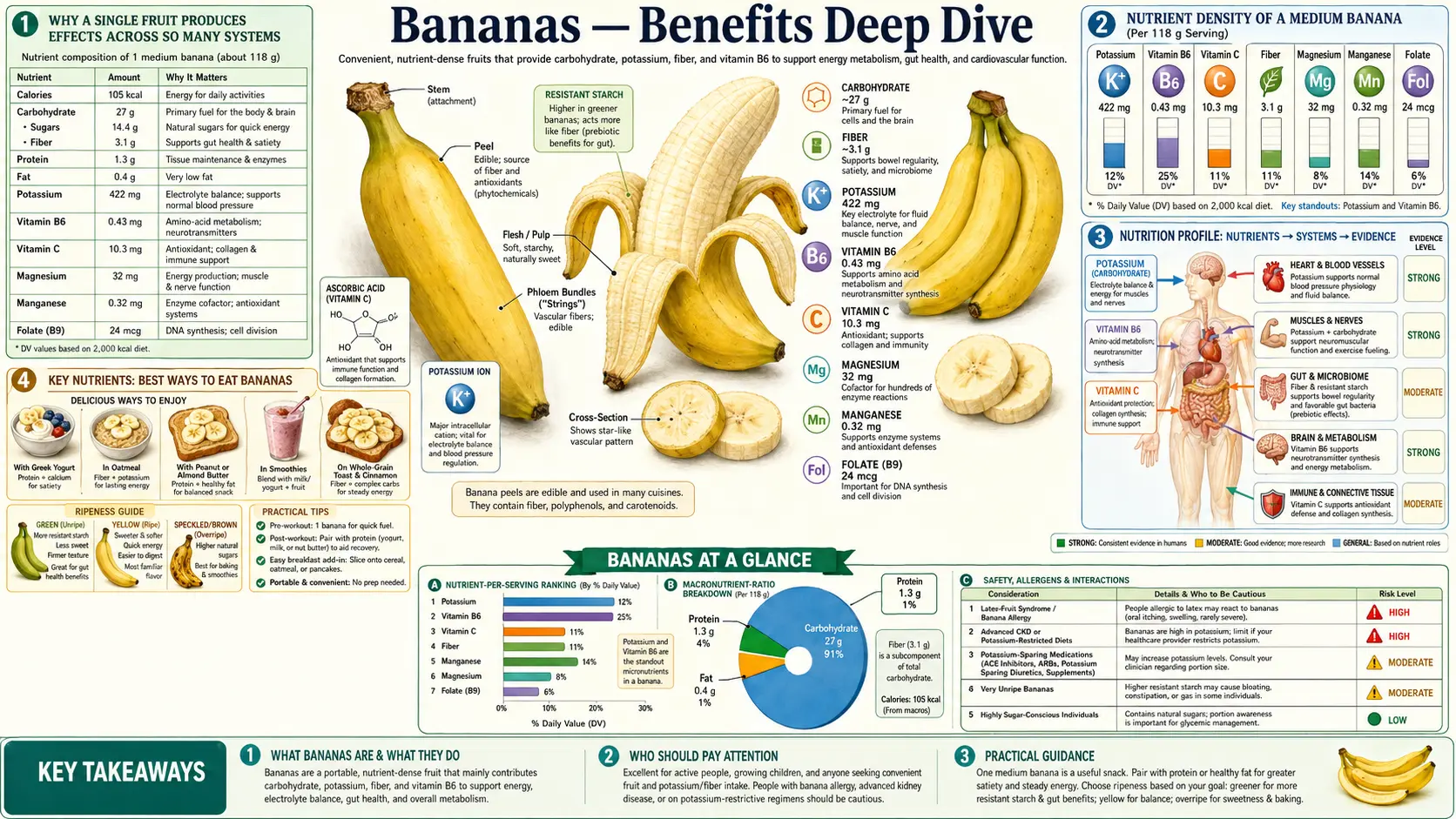
The banana is one of the most metabolically interesting foods in the human diet. A single medium fruit delivers roughly 422 mg of potassium (12% of the daily value), 0.4 mg of Vitamin B6 (25% of the DV), 10 mg of magnesium, and a starch-to-sugar ratio that swings dramatically with ripeness — from 70% resistant starch in a green fruit to nearly pure free sugars in a brown-spotted ripe one. Four benefit pages below explore the conditions where bananas produce the largest clinical effect: blood pressure and heart rhythm via the potassium / sodium ratio, gut microbiome and metabolic health via resistant starch (a unique dual-fiber that changes form with ripeness), serotonin precursor delivery and mood regulation via Vitamin B6, and the athletic performance and electrolyte literature that has made bananas the iconic endurance fuel.
Deep-Dive Articles
Potassium & Heart Rhythm
The potassium / sodium ratio as the deeper driver of blood pressure beyond sodium restriction alone, the DASH diet evidence base, the INTERSALT and PURE epidemiological studies, why low intracellular potassium predisposes to ventricular ectopy and atrial fibrillation, the bananas-and-diuretic-induced hypokalemia interaction, and the loop-diuretic patient's repeated banana prescription.
Resistant Starch: Green vs Ripe
Why a green banana is functionally a different food from a ripe banana — the conversion of type-2 resistant starch to free sugars during ripening, fermentation to butyrate by colonic bacteria, the second-meal effect on glycemic control, the green-banana flour literature for ulcerative colitis and pediatric diarrhea, and the clinical trade-off between gut-health benefits (green) and energy availability (ripe).
Vitamin B6 & Mood
Pyridoxal-5-phosphate (P5P) as the obligate cofactor for the decarboxylase that converts 5-hydroxytryptophan to serotonin and L-DOPA to dopamine, the small but documented Vitamin B6 deficiency × depression signal, the PMS irritability literature, the homocysteine-lowering pathway, and why a single banana delivers about a quarter of the daily Vitamin B6 requirement.
Athletic Performance
The Appalachian State / North Carolina Research Campus controlled trial comparing bananas to a 6% carbohydrate sports drink in trained cyclists, the dopamine and oxylipin signals that distinguish banana from sucrose / fructose alone, the muscle-cramp literature (which is more nuanced than the iconic banana-for-cramps belief), and the practical timing for a banana before, during, and after exercise.
Table of Contents
- Deep-Dive Articles
- Why a Single Fruit Produces Effects Across So Many Systems
- Nutrient Density of a Medium Banana
- Research Papers: Potassium & Cardiovascular
- Research Papers: Resistant Starch & Gut
- Research Papers: Vitamin B6, Tryptophan, Mood
- Research Papers: Athletic Performance
- Research Papers: Cross-Cutting (Glycemic, Sleep, Pregnancy)
- External Authoritative Resources
- Connections
- Featured Videos
Why a Single Fruit Produces Effects Across So Many Systems
Most fruits are dominated by a single nutritional axis — an orange is primarily a Vitamin C delivery vehicle, a blueberry is primarily an anthocyanin / polyphenol delivery vehicle, an avocado is primarily a monounsaturated-fat delivery vehicle. The banana is unusual because it operates through four fundamentally different mechanisms, and each maps to a distinct category of clinical effect.
- Potassium / sodium ratio (mineral electrolyte) — a medium banana delivers 422 mg of potassium against less than 2 mg of sodium, a ratio of roughly 200:1. Potassium is the dominant intracellular cation and the principal counter-regulator to sodium in vascular smooth muscle, the cardiac conduction system, and the renal tubule. This mechanism drives the blood pressure and arrhythmia effects.
- Resistant starch (microbiome substrate) — the green banana contains type-2 resistant starch (RS2), a polysaccharide that escapes small-intestine digestion and reaches the colon, where it is fermented by Bifidobacteria and Faecalibacterium prausnitzii to short-chain fatty acids (primarily butyrate). This mechanism drives the gut-health, glycemic, and inflammatory effects — and these effects diminish or reverse as the fruit ripens and the resistant starch converts to free sugars.
- Vitamin B6 (neurotransmitter cofactor) — pyridoxal-5-phosphate is the obligate cofactor for aromatic L-amino acid decarboxylase (AADC), the enzyme that converts 5-hydroxytryptophan to serotonin and L-DOPA to dopamine. A single banana delivers approximately 25% of the adult daily Vitamin B6 requirement, with implications for mood, sleep architecture, and premenstrual symptoms.
- Glucose / sucrose / fructose blend with low gastric burden — the ripe banana is approximately 23% carbohydrate by weight as a roughly equal mix of glucose, fructose, and sucrose, packaged in a soft matrix that empties from the stomach quickly. This makes it the most-studied "real-food" alternative to engineered sports drinks for endurance fueling, with controlled-trial evidence comparing it head-to-head with 6% carbohydrate beverages.
The therapeutic complication is that two of these mechanisms point in opposite directions depending on ripeness. A green banana is dominated by resistant starch and is the appropriate choice for glycemic control, gut-microbiome support, and post-exercise recovery aimed at preferential muscle (rather than liver) glycogen replenishment. A fully ripe banana with brown spots is dominated by free sugars and is the appropriate choice for rapid endurance fueling, post-exercise glycogen replacement when total carbohydrate delivery matters most, and palatability for children or patients with appetite loss. The same fruit purchased at the same grocery store delivers a different physiological signal depending on whether it is consumed on Monday or Friday.
Nutrient Density of a Medium Banana
A medium banana (118 g, raw, edible portion) delivers, per USDA FoodData Central:
- Energy: 105 kcal
- Carbohydrate: 27 g (of which fiber 3.1 g; sugars 14.4 g in a ripe fruit, near zero in a fully green one)
- Potassium: 422 mg (12% DV; one of the highest single-food sources after potato, white beans, and yogurt)
- Vitamin B6 (pyridoxine): 0.43 mg (25% DV)
- Vitamin C: 10.3 mg (11% DV)
- Magnesium: 31.9 mg (8% DV)
- Manganese: 0.32 mg (14% DV)
- Folate: 23.6 mcg (6% DV)
- Tryptophan: ~11 mg (a small amount, but relevant to the serotonin synthesis pathway when paired with Vitamin B6)
- Sodium: 1.2 mg (essentially sodium-free)
The single most-cited number from this profile is the 422 mg of potassium, which is convenient nutritional shorthand — though it is actually less potassium per gram than a baked potato, a cup of yogurt, or a cup of cooked spinach. The banana's reputation as the iconic potassium food is more a function of its convenience (no preparation, biodegradable packaging, year-round availability) than its absolute potassium density.
Research Papers: Potassium & Cardiovascular
- DASH-Sodium trial (Sacks FM et al., NEJM 2001) — Search PubMed
- INTERSALT international cooperative study on sodium, potassium, and blood pressure — PMID: 3416162
- PURE study on potassium excretion and cardiovascular outcomes — PMID: 25119608
- Aburto NJ et al., effect of increased potassium intake on blood pressure (meta-analysis, BMJ 2013) — PMID: 23558164
- Sodium-to-potassium ratio and cardiovascular mortality (Yang Q et al., Arch Intern Med 2011) — Search PubMed
- Hypokalemia and ventricular arrhythmia in heart failure PubMed: Hypokalemia and VT
- Loop diuretic-induced hypokalemia and potassium replacement strategies PubMed: Diuretic hypokalemia
- SPRINT trial implications for blood pressure target and electrolytes Search PubMed
- NHANES potassium intake versus recommendations in U.S. adults PubMed: NHANES potassium
- Potassium and stroke risk meta-analysis (D'Elia L et al., J Am Coll Cardiol 2011) — PMID: 21371638
Research Papers: Resistant Starch & Gut
- Englyst HN et al., classification of resistant starch types (RS1-RS4) — PMID: 1330528
- Birt DF et al., resistant starch: promise for improving human health (Adv Nutr 2013) — PMID: 24228189
- Cassidy A, Bingham SA, Cummings JH — starch intake and colorectal cancer risk Search PubMed
- Green banana flour for pediatric persistent diarrhea (Rabbani GH et al., Gastroenterology 2001) — Search PubMed
- Butyrate and colonocyte energy metabolism PubMed: Butyrate colonocytes
- Resistant starch and insulin sensitivity (Robertson MD et al., Diabetes Care 2005) — Search PubMed
- Second-meal effect of resistant starch on postprandial glucose PubMed: Second-meal effect
- Banana starch and ripening-related changes (Tribess TB et al.) — Search PubMed
- Faecalibacterium prausnitzii and butyrate-producing colonic bacteria PubMed: F. prausnitzii
- Topi T et al., short-chain fatty acids in colonic health PubMed: SCFA colonic health
Research Papers: Vitamin B6, Tryptophan, Mood
- Pyridoxal-5-phosphate as cofactor for aromatic L-amino acid decarboxylase PubMed: P5P and AADC
- Hvas AM et al., Vitamin B6 level and depression in elderly — PMID: 15479988
- Wyatt KM et al., Vitamin B6 for premenstrual syndrome (BMJ 1999 meta-analysis) — PMID: 10334745
- Skarupski KA et al., longitudinal association of vitamin B-6, folate and vitamin B-12 with depressive symptoms among older adults (Am J Clin Nutr 2010;92(2):330-335) — PMID: 20519557
- Mascher H et al., Vitamin B6 and homocysteine reduction PubMed: B6 and homocysteine
- Mascher H et al., pyridoxine for nausea and vomiting of pregnancy (ACOG-recommended) PubMed: B6 NVP
- Field DT et al., Vitamin B6 and dream recall (Perceptual and Motor Skills 2002) — Search PubMed
- Tryptophan as serotonin precursor and large neutral amino acid competition at BBB PubMed: Tryptophan and BBB
- Vitamin B6 toxicity and sensory neuropathy at high chronic intake (Schaumburg H et al., NEJM 1983) — PMID: 6308447
- NIH Office of Dietary Supplements Vitamin B6 Fact Sheet review PubMed: B6 review
Research Papers: Athletic Performance
- Nieman DC et al., bananas as an exercise fuel compared to sports drink (PLOS ONE 2012) — Search PubMed
- Nieman DC et al., metabolomics-based examination of carbohydrate ingestion during cycling Search PubMed
- Nieman DC et al., banana vs sports drink and exercise-induced inflammation Search PubMed
- Jeukendrup AE, carbohydrate intake during exercise and performance Search PubMed
- Stofan JR et al., sweat sodium and potassium losses in athletes PubMed: Sweat electrolyte losses
- Schwellnus MP et al., exercise-associated muscle cramps: review of evidence Search PubMed
- Miller KC et al., neural origin of exercise-associated muscle cramps PubMed: EAMC neural origin
- Carbohydrate mouth rinse and central performance effects PubMed: Mouth rinse studies
- Ivy JL, post-exercise carbohydrate timing for glycogen resynthesis PubMed: Post-exercise CHO timing
- Fructose-glucose ratio for high-rate exogenous carbohydrate oxidation (Jentjens / Jeukendrup) PubMed: Glucose/fructose ratio
Research Papers: Cross-Cutting (Glycemic, Sleep, Pregnancy)
- Glycemic index of bananas at varying stages of ripeness PubMed: Banana GI by ripeness
- Banana flour for type 2 diabetes glycemic control (Cassettari VMG et al.) — Search PubMed
- Banana intake and risk of stroke (epidemiological meta-analyses) PubMed: Banana and stroke
- Phytochemicals in banana pulp and peel (dopamine, catecholamines, carotenoids) PubMed: Banana phytochemicals
- Tryptophan, serotonin, and sleep architecture (Halson SL et al.) PubMed: Tryptophan and sleep
- Folate intake from fruit and neural tube defect prevention PubMed: Folate from fruit
- Banana and irritable bowel syndrome (high-FODMAP ripe vs low-FODMAP green) PubMed: Banana FODMAP IBS
- Latex-fruit syndrome and banana cross-reactivity PubMed: Latex-fruit syndrome
- Banana and migraine trigger food review PubMed: Migraine triggers
- Cavendish banana genetic vulnerability and Tropical Race 4 (Panama disease) PubMed: Cavendish TR4
External Authoritative Resources
- USDA FoodData Central — Bananas, raw — the authoritative nutrient composition data
- American Heart Association — How Potassium Can Help Control High Blood Pressure
- NIH Office of Dietary Supplements — Potassium Fact Sheet
- NIH Office of Dietary Supplements — Vitamin B6 Fact Sheet
- PubMed — All research on bananas (Musa spp.) and nutrition
Connections
- All Food
- Bananas (Main Page)
- Potassium & Heart Rhythm
- Resistant Starch: Green vs Ripe
- Vitamin B6 & Mood
- Athletic Performance
- Potassium
- Magnesium
- Vitamin B6
- Vitamin C
- Tryptophan
- Hypertension
- Atrial Fibrillation
- Irritable Bowel Syndrome
- Probiotics
- Sweet Potatoes