Bananas: History and Origins
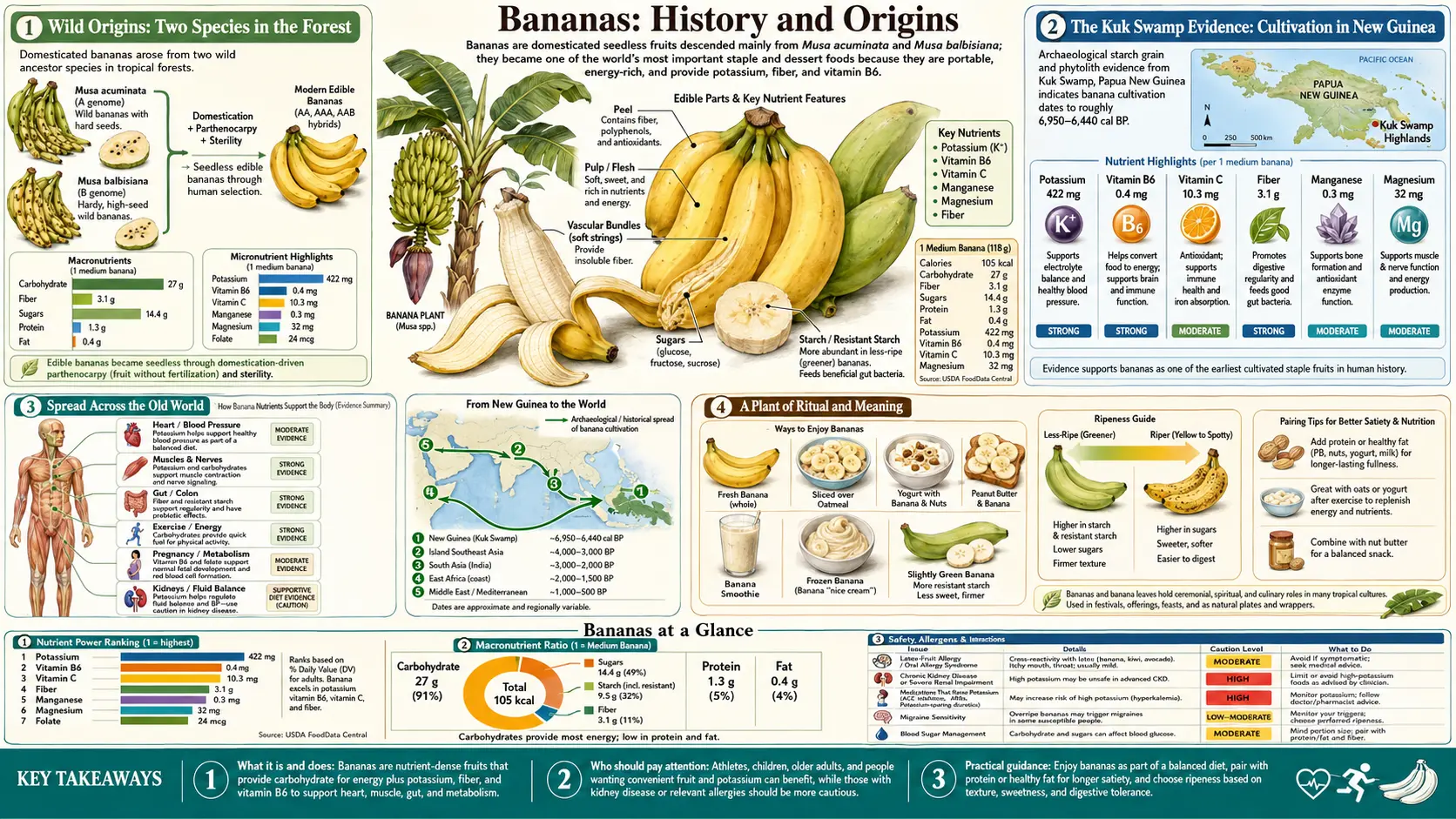
The banana is not an invention, and it has no inventor. It is the result of one of the oldest acts of plant-keeping on record — people in the rainforests of Island Southeast Asia and New Guinea, thousands of years ago, noticing the rare wild banana plant that bore a few sweet, nearly seedless fruits, and choosing to grow it again and again until the seeds all but disappeared. The clearest archaeological trace of that work comes from a swamp in the highlands of Papua New Guinea, where soil layers dated to roughly 6,950 to 6,440 years before present are dense with the silica skeletons of cultivated bananas. From that tropical cradle the fruit travelled almost the whole way around the world — carried by Austronesian seafarers, Indian Ocean traders, Arab and Swahili merchants, and finally Portuguese and Spanish ships that planted it in Africa's Atlantic islands and then the Americas. This article follows that journey using what the documented record actually supports, names legends as legends, and is careful to separate firm dates from the many stories that have grown up around this most familiar of fruits.
Table of Contents
- Wild Origins: Two Species in the Forest
- The Kuk Swamp Evidence: Cultivation in New Guinea
- Spread Across the Old World
- A Plant of Ritual and Meaning
- Naming the Banana
- Into the Atlantic World and the Americas
- The Gros Michel, the Cavendish, and Panama Disease
- Research Papers and References
- Connections
- Featured Videos
Wild Origins: Two Species in the Forest
Every banana in a modern supermarket descends from wild plants that look almost nothing like the fruit we eat. The ancestors are two species in the genus Musa: Musa acuminata, which contributes what botanists call the "A genome," and Musa balbisiana, which contributes the "B genome." Both are native to the tropics of Island Southeast Asia, New Guinea, and the nearby mainland. Their wild fruits are small, starchy, and packed with hard, seed-stone-like seeds — useful to the plant, but a mouthful of grit to a person.
The edible banana came into being through a long, accidental-then-deliberate process of selecting plants whose fruit set without fertilisation (a trait called parthenocarpy) and therefore grew flesh instead of seeds. Many cultivated bananas are also triploid — they carry three sets of chromosomes rather than two — which makes them sterile and seedless but means they can only be propagated by replanting offshoots, not by seed. In the multidisciplinary review by Xavier Perrier, Edmond De Langhe and colleagues published in the Proceedings of the National Academy of Sciences in 2011, the authors trace how different subspecies of Musa acuminata met and crossed in several contact zones across the islands — between New Guinea and Java, around the Philippines, and across Borneo and mainland Southeast Asia — and how some of these forms then hybridised with Musa balbisiana. Those crosses produced the great range of cultivated bananas and plantains grown today.
The honest summary is that the banana was not domesticated in one place at one moment. It emerged from a web of selection and hybridisation spread across the islands of Southeast Asia and New Guinea, over a very long time, by many communities of growers whose names are lost to us. What the genetics make clear is the cast of wild ancestors and the general theatre — the warm, wet forests of the Malay Archipelago — in which the modern banana was made.
The Kuk Swamp Evidence: Cultivation in New Guinea
The firmest archaeological evidence for early banana growing comes from Kuk Swamp, an archaeological site in the Western Highlands of Papua New Guinea. There, in the waterlogged soils of an ancient wetland that people drained and farmed, researchers have recovered enormous numbers of banana phytoliths — tiny, durable particles of silica that form inside plant cells and survive in the ground for thousands of years after the plant itself has rotted away. The shape of these phytoliths can distinguish cultivated bananas from wild ones.
The Perrier and De Langhe review reports that abundant banana-family phytoliths, found in soil features tied to farming and dated to 6,950 to 6,440 calibrated years before present, point to banana cultivation at Kuk. This is among the oldest records of plant cultivation anywhere in the world, and it places one of the key chapters of the banana's domestication firmly in New Guinea. It is worth being precise here: phytoliths show that bananas were being grown and tended, which is itself a major finding, even where they cannot by themselves prove the final step to a fully seedless, parthenocarpic crop.
A note on dates is in order, because popular accounts vary widely — you will see figures from "about 7,000 years ago" to "as much as 10,000 years ago." The range that the peer-reviewed evidence directly supports for cultivated-banana phytoliths at Kuk is the roughly 6,950–6,440-years-before-present window cited above. The larger numbers reflect either the deeper history of human use of the wetland or more generous interpretations; this page reports the conservative, securely dated figure and flags the rest as less certain.
Spread Across the Old World
From its island homeland the banana spread west and south in stages, mostly along the great maritime networks of the ancient world. The first carriers were the Austronesian peoples, the seafaring communities whose voyages settled much of the Pacific and reached, remarkably, across the entire Indian Ocean to Madagascar off the coast of East Africa. As the banana became one of the staple planted crops of these communities, it travelled with them.
The arrival of the banana in Africa is genuinely old and is supported by archaeology, though the exact route is still debated. The Perrier and De Langhe review notes banana phytoliths from the site of Nkang in Cameroon dated to roughly 2,750 to 2,100 calibrated years before present — that is, well over two thousand years ago, in Central Africa, far from the coast. Strikingly, this evidence predates the usual date given for Austronesian settlement of Madagascar, which has led scholars to argue that bananas reached Africa by more than one path and earlier than once assumed, with overland and maritime routes both proposed. In East and Central Africa the banana and its cousin the plantain went on to become a true dietary foundation; in the highlands of the African Great Lakes region, dense banana-growing cultures developed in which the crop supplied a large share of daily calories.
The banana also moved north and west into South Asia, the Middle East, and the edges of the Mediterranean world, carried in later centuries along the trade routes of the Indian Ocean and the medieval Islamic world. Arab and Swahili-speaking merchants helped distribute it along the East African coast and through the lands of the early Islamic empires, where it was grown in irrigated gardens. By the time European sailors began their Atlantic voyages, the banana was already an established crop across a broad band of the warm Old World — from the western Pacific to West Africa.
A Plant of Ritual and Meaning
Wherever the banana settled in for the long term, it gathered cultural meaning, and nowhere more than in South and Southeast Asia. The banana plant is fast-growing, ever-green, and generous — a single plant yields fruit, edible flower buds, broad leaves for plates and wrappers, and fibres for cord and cloth — and that abundance made it a natural emblem of fertility and prosperity. In Hindu tradition the banana plant is treated as auspicious and sacred: whole plants, complete with stem and leaves, are tied at doorways and used to frame ritual spaces at weddings and festivals, and the fruit and leaves appear as offerings. Across much of India and Southeast Asia, food is still served on a fresh banana leaf, a practice both practical and ceremonial.
These associations are documented features of living cultural practice, and this page presents them as such — as the religious and folk significance of the plant, not as historical-medical claims. (You will sometimes see the banana's sacred role "dated" to a precise ancient century by popular sources; such pinpoint dates for folklore are unreliable, and they are not repeated here.) What is clear and well attested is the breadth of the banana's usefulness, which is the practical root of its symbolism: a plant that feeds you, shelters your food, and clothes you in fibre is, understandably, a plant people came to regard as a blessing.
The whole-plant usefulness also shaped the fruit's names and reputation in the wider world. Early European and classical writers were repeatedly struck less by the fruit than by the enormous leaves — large enough, some marvelled, to shelter people — and by the cloth that could be woven from the plant's fibre, a tradition that survives today in textiles such as Japanese and Philippine banana-fibre cloth.
Naming the Banana
The word "banana" itself records part of the fruit's journey. According to standard etymological references, English borrowed the word in the late sixteenth century (the fruit sense is attested in the 1590s) from Spanish or Portuguese, who in turn took it from a West African language — possibly Wolof, a language of the Senegambia region. The West African origin is widely accepted in outline, while the precise source word is given cautiously as "possibly Wolof" rather than as a settled fact. That an Asian fruit carries an African name is itself a small monument to history: Europeans met the cultivated banana on the West African coast and the Atlantic islands, and adopted the name they heard there.
The plant's scientific name has its own twists. When Carl Linnaeus laid down the modern system of botanical naming in Species Plantarum in 1753, he placed bananas in the genus Musa and described two kinds: Musa paradisiaca — a name that nods to the old idea of the banana as a "fruit of paradise" — for plantains, and Musa sapientum for sweet dessert bananas. Botanists later realised that these are not separate wild species at all but cultivated hybrids of Musa acuminata and Musa balbisiana; today both old names are folded into the hybrid name Musa × paradisiaca. The genus name Musa is variously explained — some derive it from the Arabic word for banana (mauz), others from a court physician of the Roman emperor Augustus — and because the matter is not settled, this page leaves it as an open question rather than choosing one story.
One frequently repeated tale deserves a clear label. It is often said that Alexander the Great encountered the banana in India around 327 BCE, and that the Greek writer Theophrastus gave it its first botanical description. Theophrastus did indeed describe an extraordinary Indian fruit-bearing tree in his Enquiry into Plants, and many later writers identified it as the banana — but ancient plant descriptions are notoriously hard to pin to modern species, and the identification, while plausible and often cited, is an interpretation rather than a certainty. We treat the "Alexander and Theophrastus" episode as a long-standing tradition about the banana's first contact with the Greek world, not as an established fact.
Into the Atlantic World and the Americas
The banana is an Old World plant, and its arrival in the Americas is part of the Columbian Exchange — the vast, two-way transfer of crops, animals, people, and diseases between the hemispheres that followed 1492. Bananas did not grow in the pre-Columbian Americas; they had to be brought across the Atlantic.
The route ran through Africa's Atlantic islands. By the fifteenth century, Portuguese voyagers had encountered and were cultivating bananas in West Africa and on islands such as the Canaries, which became a staging post for plants moving between the Old World and the New. From there, the fruit made the ocean crossing: the standard account holds that bananas were carried to the Caribbean in the early sixteenth century, with the year 1516 commonly cited for their introduction to the island of Hispaniola, often credited to the Spanish friar Tomás de Berlanga. (As with many such "first" dates, the precise year and person should be read as the traditional account rather than as something provable to the day.)
In the warm, wet lands of Central America, the Caribbean, and northern South America, the transplanted banana found an ideal home and naturalised quickly. For several centuries it remained a local food and a regional staple rather than a global commodity. That changed dramatically in the late nineteenth century, when fast steamships and, above all, refrigerated shipping made it possible to carry a ripening tropical fruit to distant temperate markets before it spoiled. Within a few decades the banana was transformed from an exotic rarity into one of the cheapest and most widely eaten fruits in North America and Europe — and into the basis of a powerful and often troubled export industry across tropical Latin America.
The Gros Michel, the Cavendish, and Panama Disease
The banana that built the modern international trade was not the one most shoppers know today. For the first half of the twentieth century, the dominant export variety was the Gros Michel — by many accounts richer and sweeter than its successor, and well suited to shipping. Its reign ended because of a disease. Panama disease, a wilt caused by the soil fungus Fusarium oxysporum f. sp. cubense, spread through plantation after plantation; because export bananas are clones, all genetically near-identical, a pathogen that could kill one plant could kill them all. Through the first half of the century and into the 1950s, Panama disease devastated Gros Michel plantations and made the variety commercially unviable for the global trade.
The industry survived by switching cultivars. The replacement was the Cavendish, a banana that resisted the prevailing strain of Panama disease and tolerated long-distance shipping, and from the 1950s onward it became the standard supermarket banana across the world. This is the fruit that now fills the produce aisle — chosen, in large part, not for flavour but for its ability to survive a fungus and a sea voyage.
The story has an uneasy echo in the present. A newer and more aggressive strain of the same fungus, known as Tropical Race 4 (TR4), attacks the Cavendish itself. Identified in Southeast Asia in the 1990s, TR4 has since spread across continents; its confirmed arrival in Latin America — in Colombia in 2019 — alarmed an industry built almost entirely on this one vulnerable clone. There is no effective chemical cure for an infested field, and researchers warn that the Cavendish could one day go the way of the Gros Michel. The deeper lesson of the banana's history runs straight through this episode: a crop grown as a vast monoculture of identical clones, however convenient, is fragile in exactly the way the wild, seedy, genetically varied bananas of the Southeast Asian forest are not.
Research Papers and References
The list below combines peer-reviewed scholarship on banana domestication and disease with reputable reference and food-history sources, plus curated PubMed topic-search links. Classical sources (such as Theophrastus's Enquiry into Plants) and traditional "first-date" accounts are named in the article as history and folklore rather than as modern citations. Author names, titles, and journals are given as plain text; only the stable DOI, PMID, or archive link is hyperlinked, and each opens in a new tab.
- Perrier X, De Langhe E, Donohue M, Lentfer C, Vrydaghs L, Bakry F, et al. Multidisciplinary perspectives on banana (Musa spp.) domestication. Proceedings of the National Academy of Sciences of the United States of America. 2011;108(28):11311-11318. — doi:10.1073/pnas.1102001108 Search PubMed
- Denham TP, Haberle SG, Lentfer C, Fullagar R, Field J, Therin M, Porch N, Winsborough B. Origins of agriculture at Kuk Swamp in the highlands of New Guinea. Science. 2003;301(5630):189-193. — doi:10.1126/science.1085255 Search PubMed
- Ordonez N, Seidl MF, Waalwijk C, Drenth A, Kilian A, Thomma BPHJ, Ploetz RC, Kema GHJ. Worse comes to worst: bananas and Panama disease—when plant and pathogen clones meet. PLoS Pathogens. 2015;11(11):e1005197. — doi:10.1371/journal.ppat.1005197 · PMID: 26584184
- Maryani N, Lombard L, Poerba YS, Subandiyah S, Crous PW, Kema GHJ. Phylogeny and genetic diversity of the banana Fusarium wilt pathogen Fusarium oxysporum f. sp. cubense in the Indonesian centre of origin. Studies in Mycology. 2019;92:155-194. — doi:10.1016/j.simyco.2018.06.003 · PMID: 30122796
- Banana — origin, domestication, and history (overview). — Wikipedia: Banana
- Banana (Musa spp.) domestication and dispersal PubMed: banana Musa domestication and dispersal
- Banana phytoliths and archaeobotany PubMed: banana phytoliths and archaeobotany
External Authoritative Resources
- Encyclopaedia Britannica — Gros Michel
- Encyclopaedia Britannica — Panama disease
- Merriam-Webster — "banana" (etymology)
- ProMusa — Musa × paradisiaca and Linnaean naming