Bananas: Resistant Starch — Green vs Ripe
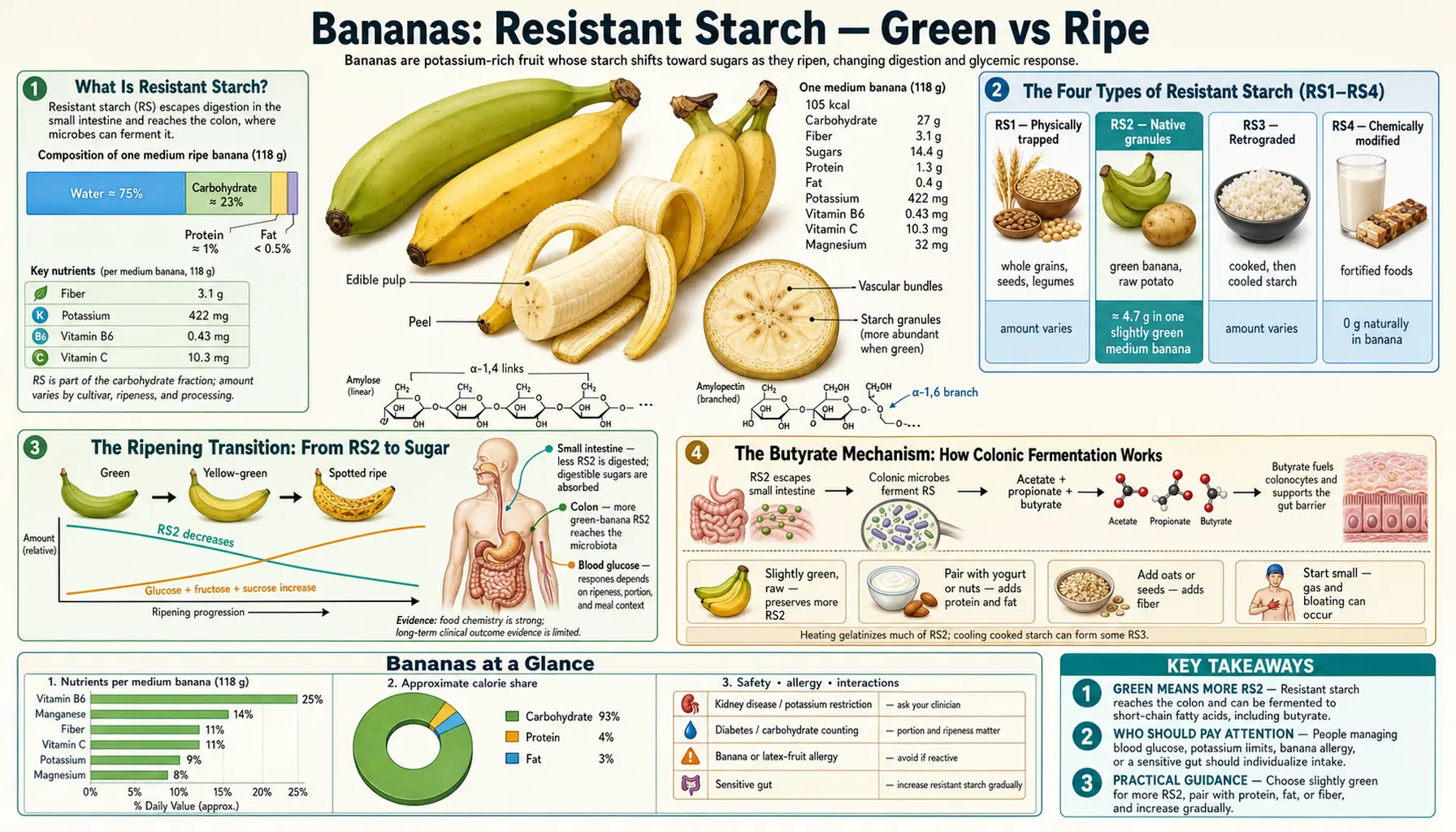
The single most consequential fact about bananas as a food is that a green banana and a ripe banana are functionally different items. A fully green Cavendish banana contains 70-80% of its dry weight as resistant starch (RS2), a polysaccharide that escapes small-intestine digestion and reaches the colon, where it is fermented to butyrate and other short-chain fatty acids by Bifidobacteria and Faecalibacterium prausnitzii. As the fruit ripens over 7-10 days at room temperature, amylase enzymes hydrolyze that resistant starch to free sugars — glucose, fructose, and sucrose — until a fully ripe brown-spotted fruit contains only 1-2% resistant starch. This means the same banana can be a low-glycemic, microbiome-feeding, butyrate-generating fiber source on Monday and a fast-absorbing, high-glycemic, palatable energy source on Friday. The clinical decision — green or ripe — depends entirely on what you are trying to accomplish.
Table of Contents
- What Is Resistant Starch?
- The Four Types of Resistant Starch (RS1-RS4)
- The Ripening Transition: From RS2 to Sugar
- The Butyrate Mechanism: How Colonic Fermentation Works
- Glycemic Effects and the Second-Meal Phenomenon
- Gut Health: IBS, IBD, and Pediatric Diarrhea
- Colorectal Cancer Risk
- Green Banana Flour as a Therapeutic Food
- Practical Guidance: Choosing Ripeness for Goals
- Cautions: FODMAP, IBS, and Mold-Sensitive Patients
- Key Research Papers
- Connections
- Featured Videos
What Is Resistant Starch?
Resistant starch is defined operationally: the fraction of dietary starch that resists hydrolysis by salivary amylase, pancreatic amylase, and small-intestinal brush-border enzymes, and therefore reaches the colon in undigested form. The colon-resident bacteria treat resistant starch the same way they treat soluble fiber — as a fermentable substrate that yields short-chain fatty acids (acetate, propionate, butyrate), gases (hydrogen, carbon dioxide, methane), and a modest amount of bacterial biomass.
The clinical implication of "resistance" is that resistant starch behaves nutritionally like a fiber, not a starch. It does not raise blood glucose, does not contribute usable calories at the rate that digestible starch does (about 2 kcal/g rather than 4), and feeds the colonic microbiome rather than directly feeding the human host. The most desirable colon-derived short-chain fatty acid is butyrate, the preferred energy substrate of colonocytes and a regulator of mucosal integrity, T regulatory cell function, and apoptosis pathways in malignant transformation.
The Four Types of Resistant Starch (RS1-RS4)
Englyst and colleagues classified resistant starch into four mechanistically distinct categories in a now-canonical 1992 paper:
- RS1 (physically inaccessible): starch trapped within an intact cell wall, as in whole or partially milled grains, seeds, and legumes. Cooking or chewing can convert RS1 to digestible starch.
- RS2 (granular, native crystalline): starch in a tightly packed B-type crystalline form that resists enzyme attack. Native granular form of green bananas, raw potatoes, and high-amylose maize starches. Cooking destroys the granular structure and converts RS2 to digestible starch — which is why a green banana is high in RS2 only when consumed raw.
- RS3 (retrograded): starch that has been gelatinized by cooking and then re-crystallized on cooling. The classic example is cooked-then-cooled potato, rice, or pasta. The retrograded amylose is partially resistant to re-digestion even if reheated.
- RS4 (chemically modified): starches with chemical cross-links or substituent groups that resist enzyme hydrolysis. Used in functional food formulations (e.g., Hi-Maize 260, Versafibe).
The green banana's resistant starch is almost entirely RS2, in the native granular form. This has two important practical consequences. First, cooking a green banana (boiling, baking, frying) largely destroys the resistant starch and converts it to fully digestible starch — which is why green-banana-derived resistant starch is studied primarily as a raw food (smoothies, slicing into yogurt) or as cold-processed green-banana flour. Second, the resistant starch effect is highly sensitive to ripeness: by the time the peel develops the first brown spot, more than half of the original RS2 has been hydrolyzed to sucrose, glucose, and fructose.
The Ripening Transition: From RS2 to Sugar
The banana ripening cascade is driven by ethylene, a plant hormone produced autocatalytically by the fruit itself. Ethylene activates a cascade of enzymes including alpha-amylase, beta-amylase, starch phosphorylase, and pulullanase that progressively hydrolyze the starch granule. The result is a measurable, time-resolved decline in resistant starch and a parallel rise in free sugars:
- Stage 1 (fully green, peel hard, fruit firm): ~70% of dry weight as starch, of which ~80% is resistant. Free sugars ~1%.
- Stage 3 (more green than yellow): ~60% starch (60% resistant). Free sugars ~5%.
- Stage 5 (fully yellow, no brown): ~20% starch (10% resistant). Free sugars ~20%. This is the "ripe but not spotted" appearance most consumers buy.
- Stage 7 (yellow with brown spots): ~5% starch (1-2% resistant). Free sugars ~25%.
- Stage 8 (brown peel, very soft): < 1% starch. Free sugars peak at 25-27%, with maximum palatability.
The implication is that the same fruit, eaten across an eight-day window from purchase to overripeness, delivers a sliding scale from "high resistant starch, low glycemic, microbiome-feeding" to "rapidly absorbed sugar bolus, fast energy, very palatable." A patient interested in glycemic control should buy green-tipped bananas and eat them within 2-3 days. An endurance athlete needing fast pre-workout fuel should let bananas ripen to brown-spotted stage 7. The choice of ripeness is a meaningful intervention.
The Butyrate Mechanism: How Colonic Fermentation Works
Colonic bacteria ferment resistant starch through a stepwise pathway. Bifidobacterium and Faecalibacterium prausnitzii are among the most efficient resistant-starch utilizers in the human colon. The fermentation products are short-chain fatty acids in the approximate molar ratio acetate:propionate:butyrate of 60:20:20, although the ratio varies considerably with substrate and individual microbiome composition. Resistant starch fermentation produces a higher proportion of butyrate than most other fermentable carbohydrates — one of the reasons it is considered particularly favorable for colon health.
Butyrate is the principal energy substrate of the colonocyte, contributing approximately 70% of its energy needs. Butyrate also acts as a histone deacetylase inhibitor in the colonic epithelium at physiological concentrations, with documented effects on cell-cycle regulation, apoptosis, and tight-junction protein expression. The contributions to mucosal health include:
- Maintenance of the colonocyte tight junctions (claudins, occludin) that prevent bacterial translocation
- Induction of mucin production by goblet cells
- Promotion of T regulatory cell differentiation in the colonic lamina propria, dampening inflammatory tone
- Pro-apoptotic effect on transformed (early malignant) colonocytes, while supporting normal colonocyte survival
- Reduction in pH of the colonic lumen, which suppresses growth of bile-acid-modifying pathobionts implicated in colorectal cancer
A green banana delivers approximately 4-5 g of resistant starch per medium fruit, which is a modest dose by therapeutic-fiber standards. A serving size that meaningfully shifts colonic fermentation would be 15-30 g of resistant starch daily, requiring 3-6 green bananas, half a cup of green-banana flour mixed into a smoothie, or other resistant-starch sources combined.
Glycemic Effects and the Second-Meal Phenomenon
The glycemic index of a banana varies dramatically with ripeness. A green banana has a measured GI of 30-40 (low). A ripe yellow banana has a GI of 50-55 (medium). An overripe brown-spotted banana approaches a GI of 60-65 (medium-high). This three-fold swing within a single fruit is unusual and clinically actionable for patients with type 2 diabetes, insulin resistance, or reactive hypoglycemia.
Beyond the direct postprandial glycemic effect, resistant starch produces a "second-meal effect" first characterized by Wolever and Jenkins in the 1980s. A meal containing resistant starch reduces the postprandial glucose excursion not only of that meal but also of the next meal, several hours later, even if the second meal contains no resistant starch. The mechanism involves colonic short-chain fatty acid production, which acts on enteroendocrine cells (L-cells) to release GLP-1 and PYY, improving insulin sensitivity at the subsequent meal.
The Robertson 2005 trial (Diabetes Care) gave healthy volunteers 30 g per day of resistant starch (Hi-Maize, an industrially produced RS2 from corn) for four weeks and documented a 33% improvement in insulin sensitivity measured by hyperinsulinemic-euglycemic clamp. A green banana smoothie that provides 15-20 g of resistant starch daily is a reasonable food-first approach to mimicking this effect.
Gut Health: IBS, IBD, and Pediatric Diarrhea
The gut-health literature on bananas is mixed because the same fruit can act in opposite directions depending on ripeness and the underlying condition. Three patient populations have specific evidence:
- Pediatric persistent diarrhea (low-resource settings): Rabbani et al. (Gastroenterology 2001) randomized Bangladeshi children with persistent diarrhea to a rice-based diet alone vs the same diet plus 250 g of green banana per day. The green-banana group had significantly faster stool normalization (3.5 vs 6.5 days) and shorter hospital stay. The mechanism is thought to be a combination of butyrate-mediated colonocyte repair, water absorption, and direct antibacterial activity of unripe banana phytochemicals against enteric pathogens.
- Ulcerative colitis (adult, mild-moderate): small trials have evaluated green-banana flour as an adjunct to standard mesalamine therapy. Results suggest modest improvement in clinical disease activity and butyrate-related markers of colonic health, though evidence is preliminary and not yet incorporated into guidelines.
- Irritable bowel syndrome (FODMAP-sensitive): ripe bananas (yellow with brown spots) are HIGH-FODMAP and can trigger IBS symptoms in sensitive patients, primarily due to fructose excess and oligosaccharide content. Green or just-yellow bananas are LOW-FODMAP and generally well-tolerated. The Monash University FODMAP database lists ripe banana as a typical IBS trigger, while green banana is on the safe list.
The clinical takeaway is that "banana" is not a single food for the IBS or IBD patient; the practical advice is to specify ripeness. For a Crohn's patient in a flare, a green banana smoothie may be soothing; for an IBS patient with fructose intolerance, a ripe banana is one of the worst single fruits.
Colorectal Cancer Risk
The colorectal cancer hypothesis for resistant starch has been one of the most-studied questions in colonic nutrition. The Cassidy / Bingham 1994 cross-cultural analysis correlated dietary starch and fiber with colorectal cancer rates across 12 countries and found an inverse association between starch intake and colorectal cancer mortality, plausibly mediated by resistant starch reaching the colon.
The CAPP2 trial (Burn J et al., NEJM 2008 and 10-year follow-up) randomized 463 carriers of Lynch syndrome (hereditary nonpolyposis colorectal cancer) to receive 30 g per day of resistant starch (as Hi-Maize) or placebo for up to four years. At the original endpoint, no difference in colorectal adenoma incidence was found. At the 10-year and 20-year follow-ups (Mathers 2022), resistant starch supplementation was associated with a significant reduction in non-colorectal Lynch syndrome cancers (upper GI cancers, endometrial, others) by approximately 50%, with the effect persisting decades after supplementation stopped — suggesting a microbiome-mediated long-term programming effect.
A green banana per day is well below the doses used in CAPP2, but as part of a broader resistant-starch-rich pattern (cooked-and-cooled rice, cold potatoes, green plantain, parboiled rice, legumes) it contributes to an evidence-supported approach to colorectal cancer risk reduction.
Green Banana Flour as a Therapeutic Food
Green-banana flour is produced by drying and milling unripe bananas (often the lower-grade Cavendish or local cultivars not suitable for fresh export) into a fine powder that retains approximately 50% of its starch as RS2. The flour can be added to smoothies, mixed into yogurt or oatmeal (uncooked or only briefly warmed), or used as a partial substitute for wheat flour in cold preparations.
Therapeutic doses studied range from 10 to 40 g per day. At the higher end of this range, green-banana flour has been associated with:
- Reduced fasting glucose and improved HbA1c in type 2 diabetes (small trials)
- Improved bowel function in chronic constipation (modest effect)
- Reduced cholesterol (LDL) in mixed-method trials
- Reduced symptom severity in pediatric inflammatory bowel disease (limited evidence)
Note that cooking the flour above approximately 60°C (which happens in baking) destroys the resistant starch and converts it to digestible starch. The flour must be used in unheated preparations (smoothies, raw energy bars, sprinkled onto cold cereal) or only briefly warmed below the gelatinization temperature.
Practical Guidance: Choosing Ripeness for Goals
| Goal | Ripeness Stage | Why |
|---|---|---|
| Blood sugar / type 2 diabetes | Stage 1-3 (green, green-tipped) | Lowest glycemic index; resistant starch produces second-meal effect |
| Microbiome support / butyrate | Stage 1-3 (green) | Maximum RS2 reaches colon for fermentation |
| Pre-workout fuel (endurance) | Stage 5-7 (yellow, lightly spotted) | Rapid gastric emptying and glucose absorption |
| Post-workout glycogen replacement | Stage 7 (brown-spotted) | Fastest glucose + fructose delivery for combined glycogen restoration |
| Pediatric diarrhea (resource-limited) | Stage 1-3 (green, mashed) | Rabbani 2001 evidence for accelerated recovery |
| IBS with fructose malabsorption | Stage 1-4 (green to just yellow) | Low-FODMAP at this stage per Monash classification |
| Easy daily potassium delivery | Stage 4-6 (yellow) | Best palatability for a single daily fruit; potassium content does not change with ripening |
| Pre-bedtime snack for sleep (tryptophan) | Stage 5-6 (yellow) | Free sugars facilitate insulin release and tryptophan crossing the blood-brain barrier |
Note that potassium content is essentially unchanged across ripening — the mineral content of the fruit is fixed at harvest and does not respond to enzymatic changes. Only the carbohydrate composition and fiber-vs-sugar ratio change with ripeness.
Cautions: FODMAP, IBS, and Mold-Sensitive Patients
- FODMAP-sensitive IBS: ripe bananas (yellow with brown spots) are HIGH-FODMAP and can trigger bloating, gas, or diarrhea in sensitive patients. The threshold for FODMAP problems is roughly stage 5-6; once brown spots appear, the FODMAP load increases sharply. Green or just-yellow bananas are typically tolerated.
- Overripe bananas and biogenic amines: as bananas overripen, tyramine and other biogenic amines accumulate. Patients on MAO inhibitors (selegiline, tranylcypromine, phenelzine) should avoid overripe bananas due to risk of tyramine-induced hypertensive crisis. Fresh ripe bananas in normal eating are not a clinically meaningful tyramine source for most people.
- Migraine-sensitive patients: bananas appear on some clinical migraine-trigger food lists, possibly due to tyramine, dopamine, or other vasoactive amines. The evidence for this is observational and inconsistent.
- Latex-fruit syndrome: approximately 30-50% of patients with latex allergy show cross-reactivity to one or more of bananas, avocados, kiwi, and chestnuts, due to shared class I chitinase epitopes. Patients with confirmed latex allergy should approach bananas cautiously.
- Mold growth on overripe peel: the brown spots and any peel cracks can harbor mold. Patients with significant mold sensitivity or recovering from mold-related illness may need to consume bananas before extensive brown-spot development.
- Pesticide / Tropical Race 4: commercial Cavendish bananas are grown as monoclonal plantings highly vulnerable to Tropical Race 4 (TR4) of Fusarium oxysporum, which is gradually destroying global production. Organic certification reduces fungicide load but does not address TR4. Patients with specific sensitivities to fungicides commonly used on bananas (Mancozeb, Chlorothalonil) may prefer organic.
Key Research Papers
- Englyst HN et al., Classification and measurement of nutritionally important starch fractions — PMID: 1330528
- Birt DF et al., Resistant starch: promise for improving human health (Adv Nutr 2013) — PMID: 24228189
- Cassidy A, Bingham SA, Cummings JH — starch intake and colorectal cancer cross-cultural analysis Search PubMed
- Rabbani GH et al., Green banana for persistent diarrhea in children — Gastroenterology 2001 — Search PubMed
- Robertson MD et al., Resistant starch and insulin sensitivity — Diabetes Care 2005 — Search PubMed
- Burn J et al., CAPP2 trial of resistant starch in Lynch syndrome — NEJM 2008 — Search PubMed
- Mathers JC et al., CAPP2 long-term follow-up: resistant starch and cancer in Lynch syndrome Search PubMed
- Tribess TB et al., Thermal properties and resistant starch content of green banana flour Search PubMed
- Cassettari VMG et al., Combined dietary intervention with green banana biomass for type 2 diabetes Search PubMed
- Topi T et al., Short-chain fatty acids in colonic health (review) PubMed: SCFA review
- Falony G et al., Cross-feeding between Bifidobacterium and butyrate-producing colon bacteria PubMed: Bifido cross-feeding
- Bird AR et al., Resistant starch, large bowel fermentation and a broader perspective of prebiotics PubMed: Bird RS review
Connections
- All Food
- Bananas Benefits (Hub)
- Bananas (Main Page)
- Potassium & Heart Rhythm
- Athletic Performance
- Irritable Bowel Syndrome
- Ulcerative Colitis
- Crohn's Disease
- Type 2 Diabetes
- Colorectal Cancer
- Probiotics
- Lentils (Resistant Starch)
- Oats (Beta-Glucan Fiber)
- Low-FODMAP Diet