Almonds — Benefits Deep Dive
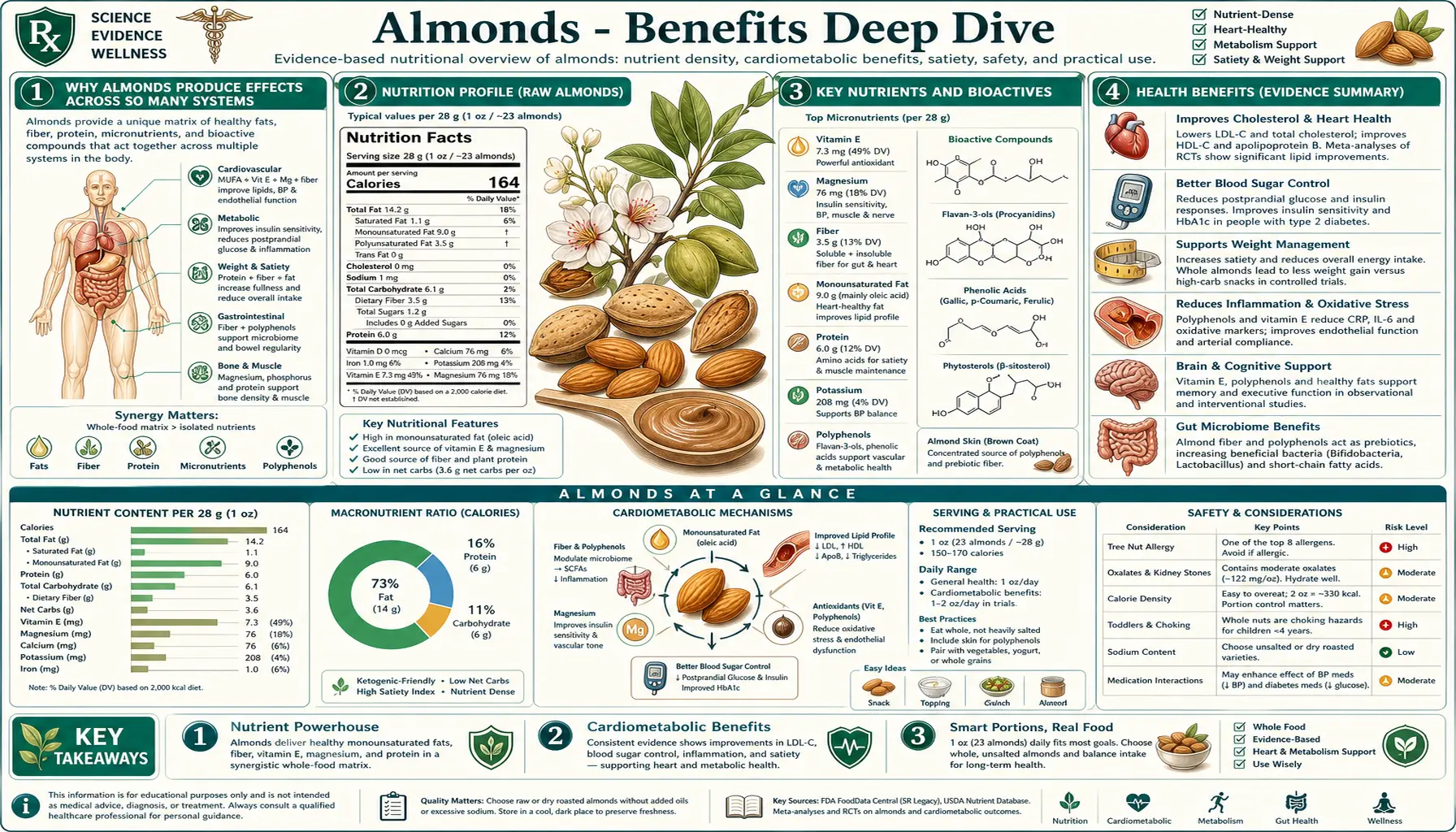
Almonds (Prunus dulcis) are one of the most clinically studied whole foods in modern nutrition science — more than 200 randomized controlled trials have measured what happens to lipids, glucose, blood pressure, body weight, bone density, and skin photoaging when a daily 28-gram (1-ounce) serving is added to the diet. The signal across these trials is unusually consistent: LDL cholesterol drops 4-7 mg/dL, HDL is preserved or modestly raised, postprandial glucose excursions flatten, and the predicted weight gain from the 164 calories never quite materializes because of the "almond calorie paradox" (Atwater factors overestimate metabolizable energy by 20-25%). Four deep-dive pages below explore the conditions where almonds produce the largest clinical effect — cardiovascular lipid management, magnesium-dependent bone and metabolic outcomes, the topical and dietary vitamin E story, and the controversial soaking-and-phytic-acid question that affects mineral bioavailability.
Deep-Dive Articles
Heart Health & LDL Cholesterol
The mechanism behind almond-mediated LDL reduction (monounsaturated fat displacement of saturated fat, plant sterol content, soluble fiber from the skin), pivotal trials including Jenkins' Toronto Portfolio Diet incorporating almonds as a core component, the FDA qualified health claim for nuts and coronary heart disease, dose-response curves from 28 to 84 grams per day, and the substitution-versus-addition framing that determines whether you get the cardiovascular benefit without weight gain.
Magnesium & Bone Health
A single ounce of almonds provides 76 mg of magnesium (18% DV), making it one of the few snack-format magnesium-dense foods. The role of magnesium in bone matrix formation (Mg is required for activation of vitamin D, parathyroid hormone signaling, and crystallization of hydroxyapatite), the Framingham Osteoporosis Study magnesium intake findings, almonds within the context of the DASH and Mediterranean dietary patterns, and the metabolic effects on insulin sensitivity and blood pressure.
Vitamin E & Skin Photoaging
Almonds contain the highest alpha-tocopherol density of any tree nut — 7.3 mg per ounce, nearly half the adult RDA. The 2019 RCT showing reduced facial wrinkle severity and pigmentation in postmenopausal women consuming 20% of daily calories from almonds versus an isocaloric snack, the topical sweet-almond-oil tradition, the alpha- vs gamma-tocopherol question, and the practical limitation that supplemental high-dose vitamin E does not reproduce the food-matrix benefit.
Soaking & Phytic Acid
The controversial traditional practice of soaking almonds overnight: the actual phytate content (1-2% by dry weight), the chelation chemistry that binds zinc, iron, and calcium in the gut lumen, the modest reduction in phytate from soaking (10-30%) versus sprouting (50-70%) versus roasting (minimal), the contrast with the Weston A. Price Foundation soaking protocols, who actually benefits from soaking (mineral-deficient individuals on plant-heavy diets), and the polyphenol-laden skin as a separate consideration.
Table of Contents
- Deep-Dive Articles
- Why Almonds Produce Effects Across So Many Systems
- Research Papers: Heart Health & LDL Cholesterol
- Research Papers: Magnesium & Bone Health
- Research Papers: Vitamin E & Skin Photoaging
- Research Papers: Soaking, Phytic Acid & Bioavailability
- Research Papers: Cross-Cutting (Metabolism, Satiety, Glycemic Control)
- External Authoritative Resources
- Connections
- Featured Videos
Why Almonds Produce Effects Across So Many Systems
Most foods that produce one signature health effect produce that effect through a single dominant mechanism. Almonds are unusual because four distinct compositional features each independently produce a measurable clinical effect, and the effects add additively rather than substituting for one another. Each of the four maps to a distinct category of clinical benefit.
- Monounsaturated fat dominance with low saturated fat — an ounce of almonds delivers 14 grams of fat, of which 9 grams is monounsaturated (predominantly oleic acid, the same fat that dominates olive oil), 3.5 grams is polyunsaturated, and only 1.1 grams is saturated. When almonds replace sat-fat-heavy snacks (crackers, chips, cookies, processed meats), LDL cholesterol falls measurably. This is the mechanism behind the cardiovascular benefit and the FDA qualified health claim for nuts.
- Magnesium density — 76 mg per ounce, or 18% of the adult Daily Value, makes almonds one of the very few snack-format foods that meaningfully addresses the widespread American magnesium gap (most US adults consume 200-300 mg/day against an RDA of 320-420 mg). This is the mechanism behind the bone density, insulin sensitivity, and blood pressure effects documented in cohort studies.
- Alpha-tocopherol (Vitamin E) concentration — almonds contain 7.3 mg of alpha-tocopherol per ounce, or about 49% of the adult RDA, the highest concentration of any tree nut by a wide margin. This is the mechanism behind the skin photoaging benefits documented in the 2019 Foolad/Sivamani RCT in postmenopausal women.
- Polyphenol-rich brown skin and soluble fiber — the brown pellicle covering each almond contains 90% of the nut's flavonoid content (catechins, epicatechins, kaempferol, quercetin glycosides) and a notable portion of the soluble fiber. This polyphenol load drives the prebiotic effect on gut microbiota and is also the source of the phytic acid that drives the soaking-versus-eating-raw controversy.
The unifying feature is that all four mechanisms operate from the same 28-gram daily serving. Unlike supplements where each mechanism would require a separate pill (a magnesium supplement, a vitamin E supplement, a fiber supplement, an oleic acid source), almonds package all four in a single food. This is the central observation behind the FDA, AHA, and ESC dietary recommendations for tree nuts — the whole food outperforms attempts to isolate any single bioactive component, as the failed isolated-vitamin-E trials (HOPE-TOO, Women's Health Study) have repeatedly demonstrated.
The therapeutic ceiling is calorie load. At 164 calories per ounce, a daily 1-2 ounce serving fits within most diets, but a 3-4 ounce snacking pattern starts to challenge weight maintenance even with the 20-25% metabolizable energy discount. The substitution framing — almonds instead of a baseline snack, not in addition to a baseline diet — is what determines whether the cardiovascular and metabolic benefits arrive without weight gain offsetting them.
Research Papers: Heart Health & LDL Cholesterol
- Jenkins DJA et al., Portfolio Diet incorporating almonds for cholesterol reduction — PubMed: Jenkins Portfolio Diet
- Sabate J et al., almonds and serum lipids meta-analysis — PubMed: Sabate meta-analysis
- FDA qualified health claim for nuts and coronary heart disease (2003) — PubMed: FDA nut health claim
- PREDIMED Mediterranean diet with mixed nuts (almonds, walnuts, hazelnuts) and major cardiovascular events — PubMed: PREDIMED trial
- Berryman CE et al., almonds and abdominal fat / centralized adiposity — PubMed: Berryman abdominal fat
- Jenkins DJA et al., dose-response of almonds (37g vs 73g) on LDL and apoB — PubMed: Jenkins dose-response
- Rajaram S et al., almonds and endothelial function in coronary artery disease patients — PubMed: Rajaram endothelial
- Phytosterols (beta-sitosterol, campesterol) in almonds and cholesterol absorption inhibition — PubMed: Almond phytosterols
- Hyson DA et al., almonds and oxidized LDL / lipoprotein oxidation — PubMed: Hyson oxidized LDL
- Liu Y et al., almonds and apolipoprotein B / non-HDL cholesterol in patients with type 2 diabetes — PubMed: Almonds and apoB in T2D
Research Papers: Magnesium & Bone Health
- Tucker KL et al., Framingham Osteoporosis Study magnesium intake and bone mineral density — PubMed: Framingham magnesium and BMD
- Rude RK, Singer FR, magnesium deficiency and bone fragility mechanism — PubMed: Rude bone fragility
- Magnesium activation of vitamin D and PTH signaling — PubMed: Mg and vitamin D activation
- Cohen JFW et al., almond consumption and serum magnesium / metabolic markers — PubMed: Almonds and serum Mg
- Dimai HP et al., magnesium supplementation and bone turnover markers — PubMed: Mg and bone turnover
- Kass L et al., magnesium and blood pressure meta-analysis — PubMed: Mg and blood pressure
- Almonds within DASH dietary pattern and blood pressure outcomes — PubMed: DASH and nuts
- Jenkins DJA et al., almonds and glycemic control in type 2 diabetes — PubMed: Almonds and glycemic control
- NHANES analysis of magnesium intake gap in US adults — PubMed: NHANES Mg gap
- Tresserra-Rimbau A et al., PREDIMED magnesium intake and cardiovascular outcomes — PubMed: PREDIMED magnesium
Research Papers: Vitamin E & Skin Photoaging
- Foolad N, Sivamani RK et al., almond consumption and facial wrinkles in postmenopausal women — PubMed: Foolad almonds and wrinkles
- Rangel-Huerta OD et al., almonds and oxidative stress markers in healthy adults — PubMed: Almonds and oxidative stress
- Vitamin E (alpha-tocopherol) and UV-induced skin damage — PubMed: Vitamin E and UV damage
- Mathew MC, Ervin AM et al., antioxidant vitamin supplementation for preventing or slowing age-related cataract — PubMed: Antioxidants and cataract
- HOPE-TOO trial (high-dose alpha-tocopherol supplementation and cardiovascular outcomes) — PubMed: HOPE-TOO trial
- Lee IM et al., Women's Health Study (vitamin E and cardiovascular events / cancer) — PubMed: Women's Health Study vitamin E
- Sweet almond oil (Prunus dulcis) topical application traditional medicine review — PubMed: Sweet almond oil topical
- Tocopherols and tocotrienols (gamma-tocopherol vs alpha-tocopherol) bioactivity — PubMed: Alpha vs gamma tocopherol
- Almonds and skin sebum content / hydration metrics — PubMed: Almonds and skin hydration
- Sweet-almond-oil emollient properties and pediatric dermatology — PubMed: Almond oil emollient
Research Papers: Soaking, Phytic Acid & Bioavailability
- Reddy NR et al., phytic acid content of food legumes, nuts, and grains review — PubMed: Reddy phytic acid review
- Schlemmer U et al., phytate in foods and impact on human nutrition — PubMed: Schlemmer phytate
- Phytic acid and zinc absorption (phytate:zinc molar ratio thresholds) — PubMed: Phytate-zinc
- Phytic acid and non-heme iron absorption inhibition — PubMed: Phytate-iron
- Hurrell RF, phytate and bioavailability of dietary minerals — PubMed: Hurrell bioavailability
- Effect of soaking, sprouting, and roasting on phytate content of nuts and seeds — PubMed: Soaking/sprouting phytate
- Bohn L et al., phytate-degrading phytase enzymes and dietary processing — PubMed: Phytase enzymes
- Almond skin polyphenols and prebiotic / antioxidant effects — PubMed: Almond skin polyphenols
- Mandalari G et al., almond cell wall structure and lipid bioaccessibility — PubMed: Mandalari almond cell wall
- Lopez-Gonzalez AA et al., phytic acid potential beneficial effects (anti-oxidant, anti-cancer) — PubMed: IP6 beneficial effects
Research Papers: Cross-Cutting (Metabolism, Satiety, Glycemic Control)
- Novotny JA et al., almond metabolizable energy and Atwater factor overestimation — PubMed: Novotny metabolizable energy
- Hollis J, Mattes RD, almonds and satiety / hunger ratings — PubMed: Hollis almonds and satiety
- Tan SY, Mattes RD, body weight and nut consumption longitudinal observational data — PubMed: Nuts and body weight
- Cassady BA et al., almonds, mastication, and energy availability — PubMed: Cassady mastication
- Almonds and postprandial glycemic response in healthy adults — PubMed: Almonds and postprandial glucose
- Liu Y et al., almonds and HbA1c reduction in Chinese type 2 diabetics — PubMed: Almonds and HbA1c
- Nut allergy epidemiology (almond as Prunus dulcis tree-nut allergen) — PubMed: Tree nut allergy
- Aflatoxin contamination risk in tree nuts and almond processing — PubMed: Aflatoxin in nuts
- Almonds and gut microbiota composition (prebiotic effect) — PubMed: Almonds and microbiota
- Bes-Rastrollo M et al., nut consumption and long-term weight maintenance Mediterranean cohort — PubMed: Long-term nuts and weight
External Authoritative Resources
- Linus Pauling Institute — Nuts Micronutrient Information Center — the most authoritative scientific summary of tree-nut biology and the included almond data
- FDA — Qualified Health Claim for Nuts and Coronary Heart Disease (the original 2003 letter and subsequent updates)
- American Heart Association — Nuts as a Heart-Healthy Snack
- USDA FoodData Central — Almonds, raw nutrient profile
- PubMed — All research on almonds / Prunus dulcis (~3,500+ papers)
Connections
- All Food
- Almonds (Main Page)
- Almonds for Heart Health & LDL
- Almonds for Magnesium & Bone
- Almonds for Vitamin E & Skin
- Soaking & Phytic Acid
- Vitamin E
- Magnesium
- High Cholesterol
- Type 2 Diabetes
- Osteoporosis
- Mediterranean Diet
- Olive Oil
- Walnuts
- Cashews