Almonds: Soaking and Phytic Acid
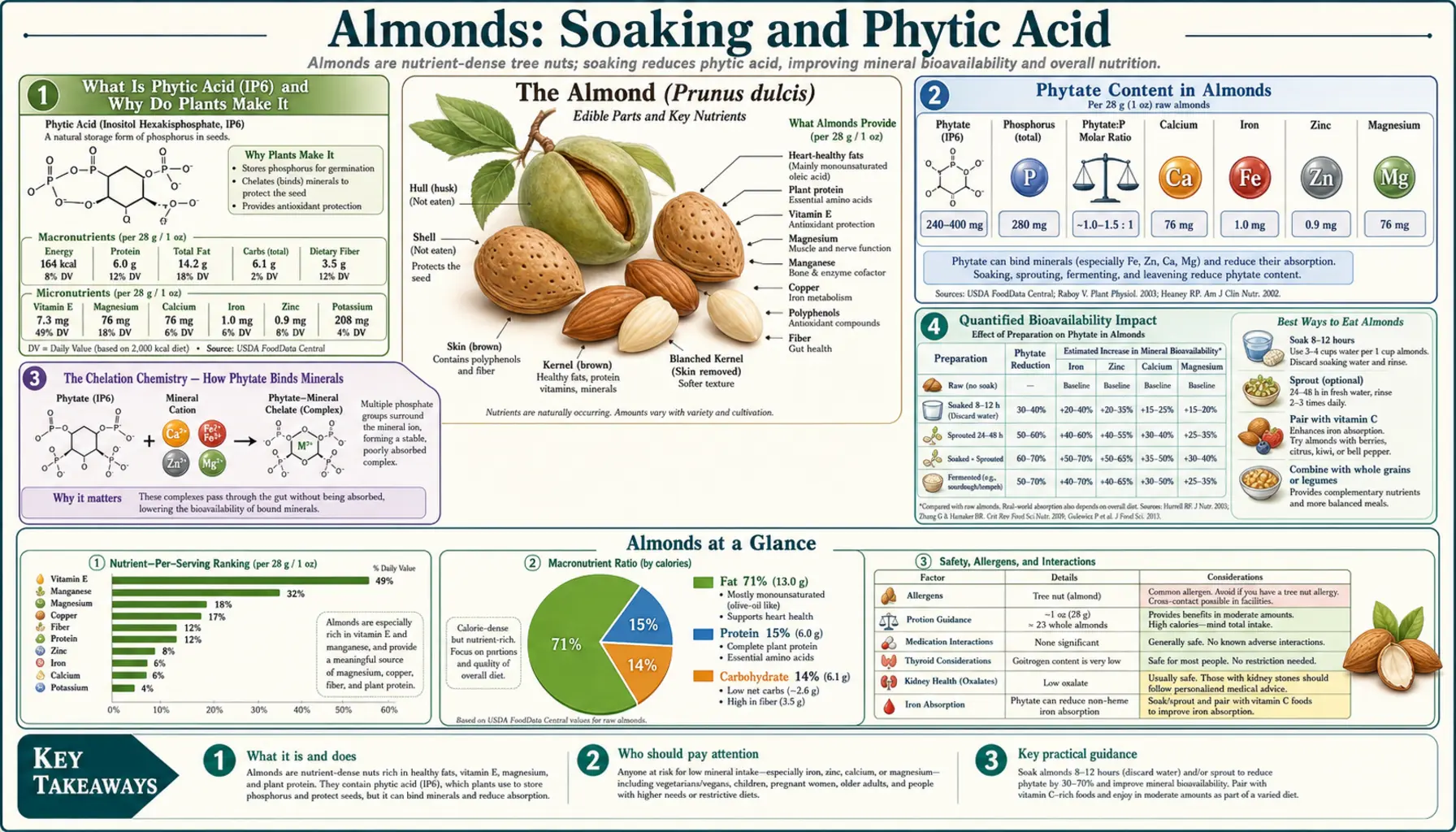
The traditional practice of soaking almonds overnight before eating them — central to Ayurvedic dietary tradition, recommended by the Weston A. Price Foundation, and widespread in the alternative-nutrition community — is rooted in legitimate biochemistry but is often oversold. Almonds contain approximately 1-2% phytic acid by dry weight (inositol hexaphosphate, IP6), a six-phosphate compound that chelates divalent and trivalent mineral cations in the gut lumen, reducing absorption of zinc, iron, calcium, and magnesium from the same meal. Soaking for 8-12 hours activates the almond's endogenous phytase enzyme and reduces phytate content modestly — typical reductions are 10-30%, far less dramatic than the 50-70% reductions achievable with sprouting or the near-complete elimination achievable with proper bread fermentation. Whether the soaking step actually matters for your health depends entirely on whether you are mineral-deficient at baseline, eat a plant-heavy diet otherwise low in mineral bioavailability, and consume large quantities (4+ ounces per day) of phytate-rich foods. For most adults eating mixed diets with adequate animal-source mineral intake, soaking is an unnecessary kitchen labor that offers minimal clinical benefit. For raw vegans, mineral-deficient individuals, and those eating tree-nut-and-seed-heavy diets, the practice has more substantial justification. This page walks through the actual phytate chemistry, the trial data on mineral bioavailability, the surprisingly contested benefits of phytic acid (which may be anticancer and antioxidant), and the practical decision tree for whether to soak.
Table of Contents
- What Is Phytic Acid (IP6) and Why Do Plants Make It
- Phytate Content in Almonds
- The Chelation Chemistry — How Phytate Binds Minerals
- Quantified Bioavailability Impact
- What Soaking Actually Does
- Sprouting versus Roasting versus Soaking
- The Weston A. Price Foundation Position
- The Other Side: Phytate as Antioxidant and Possible Anti-Cancer Agent
- Who Actually Benefits from Soaking
- The Almond Skin Question (Polyphenols vs Phytate)
- Practical Protocol — A Decision Tree
- Key Research Papers
- Connections
- Featured Videos
What Is Phytic Acid (IP6) and Why Do Plants Make It
Phytic acid (myo-inositol hexakisphosphate, IP6) is the principal phosphorus storage form in plant seeds, nuts, and grains. The molecule is a six-carbon ring (myo-inositol) with a phosphate group esterified at each carbon position, giving it 12 ionizable acidic protons and a very high negative charge density at physiologic pH. This negative charge is what gives phytate its mineral-chelating behavior.
Phytic acid serves three functions for the plant. First, it stores phosphorus in a stable, energy-dense form — up to 80% of the phosphorus in a mature seed is held as phytate, ready for mobilization when the seed germinates. Second, the mineral chelation is itself a storage system — phytate bound to potassium, magnesium, calcium, and zinc constitutes the seed's mineral reserve. Third, phytate is part of the plant's herbivory defense; it reduces the nutritional value of the seed to grazing animals and seed predators, which is presumably why selection favored its retention.
When a seed germinates, the embryonic phytase enzyme (activated by water exposure and temperature) hydrolyzes phytate into lower-phosphate forms (IP5, IP4, IP3, IP2, IP1, free inositol and free phosphate), releasing the bound minerals and phosphorus for use by the developing seedling. This is the biochemistry that the soaking practice attempts to leverage.
Common dietary phytate sources, ranked roughly by phytate content (g per 100 g dry weight): sesame seeds 5-6%, almonds 1-2%, walnuts 1.5%, Brazil nuts 1-2%, oats 0.4-1.2%, beans 0.4-1.5%, lentils 0.3-1.5%, whole wheat 0.4-1.4%, rice (brown) 0.3-1.1%, rice (white) 0.1-0.4%. Almonds are in the upper range for tree nuts but are not the most phytate-dense food in a typical diet.
Phytate Content in Almonds
Total phytate content in raw almonds is approximately 1.0-2.2 grams per 100 grams of dry weight, depending on variety, growing conditions, and analytical method. A typical one-ounce (28 g) serving therefore contains approximately 280-620 mg of phytate.
For comparison: an ounce of cashews contains approximately 530-1,000 mg phytate; an ounce of walnuts approximately 200-400 mg; an ounce of Brazil nuts approximately 350-650 mg; a typical 50 g serving of cooked oatmeal approximately 200-600 mg; a 60 g slice of whole-wheat bread approximately 100-200 mg (after yeast-driven phytate degradation during fermentation).
The phytate is concentrated in the brown skin (pellicle) and in the aleurone-like outer layer of the cotyledon. Blanched almonds (skin removed) have approximately 30-40% less phytate than whole almonds, at the cost of losing the polyphenol load that the skin also carries. Almond flour and almond meal made from whole almonds preserve full phytate content; almond flour made from blanched almonds carries less.
Phytate is heat-stable. Roasting almonds at typical commercial temperatures (140-160°C for 20-30 minutes) reduces phytate by less than 10%. Toasting in a home oven similarly has minimal effect. The thermal stability is one reason why roasting is not an effective phytate-reduction strategy compared with soaking or sprouting.
The Chelation Chemistry — How Phytate Binds Minerals
Phytic acid carries 12 ionizable phosphate protons. At physiologic gut pH (~6.5-7.5 in the small intestine), most of these protons are dissociated, leaving the molecule with a strong overall negative charge. The molecule has high affinity for divalent and trivalent cations, in roughly this order: Cu²+ > Zn²+ > Ni²+ > Co²+ > Fe³+ > Fe²+ > Mn²+ > Ca²+ > Mg²+.
When phytate-rich food meets a mineral-rich food in the same meal, the phytate complexes the minerals in the gut lumen and the resulting phytate-mineral complex is poorly absorbed across the enterocyte. The minerals are excreted in feces rather than absorbed. This is the bioavailability problem.
Phytate also has variable affinity for protein. The phytate-protein complex can reduce the digestibility of certain proteins, but this effect is modest compared with the mineral binding.
The molar ratio of phytate to a given mineral is the standard metric for predicting bioavailability impact. The accepted thresholds in the WHO/FAO mineral bioavailability framework:
- Phytate:zinc > 15: Marked zinc absorption inhibition
- Phytate:zinc 5-15: Moderate inhibition
- Phytate:zinc < 5: Minimal inhibition
- Phytate:iron > 1: Significant inhibition of non-heme iron absorption
- Phytate:iron < 0.4: Minimal inhibition
- Phytate:calcium ratios: Less well established; calcium tolerates higher ratios
For one ounce of almonds (~280-620 mg phytate, ~1 mg zinc, ~1 mg iron, ~76 mg calcium): phytate:zinc molar ratio approximately 30-65 (marked inhibition of zinc absorption from the almonds themselves); phytate:iron molar ratio similar (significant inhibition of almond iron absorption). These ratios apply specifically to minerals contained within the almonds. When almonds are eaten alongside other meal components, the phytate also depresses absorption of minerals from those other foods.
Quantified Bioavailability Impact
Quantitative trials of mineral absorption from almond-containing meals provide the most direct evidence. Hambidge et al. and others have used radioactive or stable-isotope-labeled minerals to measure absorption from controlled test meals. Key findings:
- Zinc absorption from raw almonds (without soaking): approximately 8-15% (compared with ~30-40% from animal-source zinc like beef). Net zinc contribution from a 1-oz serving: approximately 0.1-0.15 mg.
- Non-heme iron absorption from almonds: approximately 5-10%. Net iron contribution: approximately 0.05-0.1 mg per ounce.
- Calcium absorption from almonds: approximately 20-25%. Net calcium contribution: approximately 16-20 mg per ounce (the calcium content is 80 mg per ounce; absorption is acceptable).
- Magnesium absorption from almonds: approximately 30-40%. Net magnesium contribution: approximately 22-30 mg per ounce.
Two things are notable. First, the bioavailability of magnesium and calcium from almonds is acceptable — not as high as inorganic mineral salts but high enough that almonds remain a meaningful contributor to magnesium status (see the Magnesium and Bone deep-dive). Second, almonds are a poor zinc and iron source despite their listed content, because the phytate effectively inhibits absorption.
The cross-meal bioavailability effect is the practical concern. If you eat a serving of almonds alongside a meal containing iron-rich foods (a salad with iron-fortified bread, beans, or plant-source iron), the almond phytate reduces absorption of the meal's iron. The effect can be partially countered by including vitamin-C-rich foods (citrus, peppers, leafy greens) in the same meal, which enhances non-heme iron absorption through a separate mechanism.
What Soaking Actually Does
Soaking raw almonds in water at room temperature activates the endogenous phytase enzyme present in the almond itself. The phytase hydrolyzes phytate at the more accessible outer-ring phosphate positions, producing lower-phosphate inositol phosphates (IP5, IP4, IP3) that have less mineral-binding capacity. Reported phytate reductions from soaking range widely depending on conditions:
- 4-hour cold-water soak: 5-15% reduction
- 8-12 hour overnight cold-water soak: 10-30% reduction (most commonly cited range)
- 24-hour soak with water change: 20-40% reduction
- Soaking with added salt or whey: Minimal additional benefit beyond plain water (despite Weston A. Price Foundation recommendations)
- Warm-water (40°C) soak: 15-35% reduction (phytase activity increases with moderate temperature)
- Hot-water (50+°C) soak: Less effective because heat denatures the phytase before completion
The reduction is modest. A 10-30% phytate reduction in almonds containing 280-620 mg per ounce leaves approximately 200-560 mg of phytate after soaking. The phytate:zinc ratio drops from 30-65 to approximately 20-50 — still in the marked-inhibition range. Soaking does not eliminate the phytate problem; it makes a small dent in it.
Compared with grains and legumes that have higher native phytase activity, almonds are relatively phytase-poor. The reduction from soaking almonds is consistently smaller than the reduction from soaking oats (40-60%), beans (30-50% over a 12-hour soak with water change), or wheat (50-70%). Adding an external phytase source (e.g., a small quantity of phytase-rich sprouted rye flour or commercial phytase supplement) to the soaking water can substantially improve the reduction in almonds, but this is rarely done in home practice.
Soaked almonds have a softer texture, a slightly sweeter taste from partial sugar release, and shorter shelf life (must be refrigerated and used within 2-3 days, or dehydrated to restore stability). The dehydration step requires a low-temperature oven or food dehydrator (40-50°C, 12-24 hours) and is rarely worth the labor for the modest phytate reduction.
Sprouting versus Roasting versus Soaking
- Sprouting (germination): By far the most effective phytate reduction strategy for nuts and seeds. Allowing almonds to begin germination (24-72 hours in moist conditions, with periodic rinsing) reduces phytate by 50-70% or more, and produces a measurable enzymatic transformation that also increases free amino acid content, free folate, and several other nutrients. Almonds technically require pasteurization (in the US) prior to commercial sale, which kills the germ and prevents sprouting. "Sprouted almonds" sold commercially are typically imported from countries without the pasteurization requirement, or are soaked-and-dehydrated rather than truly sprouted. Home-grown raw almonds can be sprouted if available.
- Roasting: Reduces phytate by less than 10%. Roasting changes flavor, increases shelf stability, and slightly reduces vitamin E content (~5-15%) but does not meaningfully address phytate. Dry-roasting is preferable to oil-roasting (which adds calories and often uses inflammatory seed oils).
- Soaking + dehydrating: The Weston A. Price Foundation crispy nuts protocol. Soak overnight, drain, dehydrate at 40-50°C for 12-24 hours to restore shelf stability. Phytate reduction approximately 15-30%. Labor-intensive but produces a familiar crunchy texture.
- Fermentation: Not commonly applied to almonds (used heavily with whole grains in sourdough breadmaking and with legumes in fermented foods like tempeh and miso). Fermentation can achieve 80%+ phytate reduction. Some artisan almond cheese products use lactic fermentation that does reduce phytate substantially.
- Adding phytase enzyme: Commercial phytase enzyme supplements can be added to soaked nuts or to a meal containing nuts to dramatically enhance phytate hydrolysis. Used primarily in animal feed (poultry, swine) to improve mineral utilization. Rarely used by humans.
The strict ranking of effectiveness: fermentation > sprouting > soaking + added phytase > long soak (12-24 h) > short soak (4-8 h) > roasting > no preparation. The practical accessibility ranking is roughly opposite: most home cooks will do nothing or short-soak; few will sprout; almost none will ferment.
The Weston A. Price Foundation Position
The Weston A. Price Foundation (WAPF), founded in 1999 and named after the early-20th-century dentist Weston A. Price who studied "traditional diets," is the most vocal modern advocate for nut and grain soaking. The foundation's position, codified in Sally Fallon Morell's Nourishing Traditions (1999, with multiple subsequent editions), is that all nuts, seeds, grains, and legumes should be soaked in salted water (or water with added whey or lemon juice) for 7-24 hours, then dehydrated to produce "crispy nuts" before eating.
The WAPF claims for the practice include: substantial phytate reduction, neutralization of enzyme inhibitors that interfere with pancreatic digestive enzymes (specifically trypsin inhibitors and chymotrypsin inhibitors), improved digestibility, and reduced risk of mineral deficiency over chronic consumption.
The biochemistry stands on solid ground for grains and legumes (where soaking achieves 40-70% phytate reduction) but is considerably weaker for almonds specifically (where soaking achieves 10-30% reduction). The trypsin inhibitor claim is overblown for almonds, which have low baseline protease inhibitor content compared with raw legumes; protease inhibitors in raw legumes are clinically meaningful and a reason to cook beans thoroughly, but they are not a significant concern in nuts. The salt-water and whey additives have not been shown in published research to significantly improve phytate reduction beyond plain water.
For grains and legumes consumed in large quantities, the WAPF traditional preparation methods are well-supported. For occasional almond consumption in a mixed diet, the protocol is reasonable but produces modest benefit relative to the kitchen labor required.
The Other Side: Phytate as Antioxidant and Possible Anti-Cancer Agent
The framing of phytate as purely an "anti-nutrient" misses an important counterpoint. Phytate has documented antioxidant, anti-inflammatory, and potential anti-cancer properties when absorbed in modest quantities (which it is, despite claims that it is wholly indigestible). The chelation chemistry that binds iron in the gut also chelates pro-oxidant free iron in tissue compartments, potentially reducing Fenton-reaction-mediated oxidative damage.
The IP6-cancer literature is led by Abulkalam Shamsuddin (University of Maryland), who has published extensively on inositol hexaphosphate as a cancer chemopreventive agent. Animal studies show reduced incidence of induced colon, breast, prostate, lung, and skin cancers with dietary IP6 supplementation. The proposed mechanisms include reduced cell proliferation, induction of apoptosis in malignant cells, antioxidant activity, and natural killer cell activation.
Epidemiologically, populations consuming high-phytate diets (e.g., traditional Asian rice-and-legume-based diets) have lower rates of colorectal, breast, and prostate cancer than Western populations consuming low-phytate diets. The confounding is enormous (these populations differ in many ways), but the directional signal is consistent with the experimental IP6 literature.
Phytate also has documented effects on insulin sensitivity and glycemic response (binds to alpha-amylase, slowing starch digestion), kidney stone prevention (chelates calcium in urine to reduce calcium oxalate stone formation), and possible cardiovascular benefit (reduces vascular calcification).
The reasonable conclusion: phytate at the dietary intake levels typically consumed (1-2 g/day from a mixed diet) is not a clear net negative for most adults. The mineral bioavailability cost is real for individuals with marginal mineral status, but the antioxidant and anti-cancer benefits may offset that cost for most well-nourished adults.
Who Actually Benefits from Soaking
- Iron-deficient individuals: Premenopausal women with heavy menstrual losses, vegans, vegetarians, and patients with documented iron deficiency anemia should minimize concurrent phytate intake with iron-rich meals. Soaking nuts and seeds, and pairing iron-rich foods with vitamin C, both help.
- Zinc-deficient individuals: Patients with documented zinc deficiency (typically presenting with impaired wound healing, taste changes, recurrent infections, or characteristic acrodermatitis) should reduce phytate exposure. Almond soaking provides modest benefit; reducing total nut/seed/grain consumption while addressing zinc supplementation is more impactful.
- Calcium-restricted patients: Severe calcium restriction (rare) plus heavy phytate intake could marginally worsen calcium balance. Most patients in this category benefit more from calcium supplementation than from soaking practices.
- Raw vegans and high-plant-protein diets: A diet built around grains, legumes, nuts, and seeds with no animal-source minerals will accumulate substantial phytate intake (often >1.5 g/day). Soaking, sprouting, and fermenting all become more clinically relevant in this dietary pattern.
- Patients on plant-based meal replacement powders: Many pea/rice/hemp protein powders are not phytate-stripped during processing and can contribute substantial daily phytate load. Combined with a daily handful of almonds, total phytate intake can exceed 2 g/day.
- Pregnant women: Increased mineral demand during pregnancy (iron, zinc, calcium, magnesium all rise) makes phytate bioavailability impact more clinically meaningful. Moderate almond intake (1 oz/day) is fine without soaking; heavy almond/seed consumption warrants the soaking step.
- Infants and toddlers: High mineral needs per kg body weight. The pediatric literature on phytate in early childhood diets is more cautionary than for adults. Almond butter (often introduced in infancy) should be used moderately as part of a varied diet.
Most adults eating a Western mixed diet with adequate animal-source mineral intake fall outside these categories. For this majority, the marginal benefit of soaking almonds is likely smaller than the kitchen labor cost.
The Almond Skin Question (Polyphenols vs Phytate)
The brown almond skin (pellicle) contains both 90% of the nut's polyphenol content (catechins, epicatechins, quercetin glycosides, kaempferol) and a disproportionate share of its phytate. The polyphenols contribute to the cardiovascular benefit and antioxidant load discussed in the Heart Health and Vitamin E deep-dives. The phytate contributes to the mineral bioavailability concerns discussed here.
This creates a tradeoff. Removing the skin (blanching) reduces phytate by 30-40% but eliminates 90% of the polyphenols. Keeping the skin preserves polyphenols but maintains the higher phytate load. Soaking reduces phytate modestly while preserving the skin and its polyphenols, splitting the difference.
For most adults pursuing the cardiovascular and antioxidant benefits of almonds, keeping the skin intact (with or without soaking) is the better tradeoff. For adults with documented iron or zinc deficiency, blanched almonds with the skin removed may be appropriate — sacrificing some of the polyphenol benefit to reduce the bioavailability cost. For patients optimizing for a specific endpoint, the individual tradeoff should be made deliberately rather than by default.
Practical Protocol — A Decision Tree
- If you eat a typical mixed Western diet: Don't bother soaking. Eat 1-2 ounces of whole raw or dry-roasted almonds per day with skin. The phytate impact is small relative to the cardiovascular, magnesium, and vitamin E benefits.
- If you are vegetarian or vegan: Consider soaking almonds and other phytate-rich foods, especially if combined with iron-rich plant foods in the same meal. Pair iron-rich meals with vitamin C sources (citrus, peppers) to enhance absorption through a separate mechanism.
- If you have documented iron deficiency anemia: Soak nuts and seeds, eat phytate-rich foods separately from iron-rich meals (separate meals by 2+ hours), prioritize heme iron sources (red meat, organ meats, oysters) if not contraindicated by dietary preferences, and consider iron supplementation with vitamin C.
- If you have documented zinc deficiency: Same general approach as iron deficiency. Almond soaking is helpful but not transformative. Zinc supplementation (15-30 mg/day for repletion) is usually needed alongside dietary modification.
- If you are pregnant or breastfeeding: Eat almonds moderately (1 oz/day is fine without soaking; higher intake warrants consideration of soaking). Ensure adequate mineral intake through diet and prenatal vitamin.
- Soaking protocol if you choose to do it: Cover raw almonds with water + a pinch of salt (optional). Soak at room temperature 8-12 hours overnight. Drain and rinse. Eat within 2-3 days (refrigerate) or dehydrate at 40-50°C for 12-24 hours for restored shelf stability.
- Salt and whey additives: The Weston A. Price Foundation recommends salt or whey in the soaking water. Limited evidence that these additions meaningfully improve phytate reduction beyond plain water. Optional based on preference.
- Don't over-soak: Long soaks (>24 hours) increase risk of bacterial growth and don't produce proportionate additional phytate reduction.
- Don't skip protein and vitamin C: Heme iron from animal sources and vitamin C from fruits and vegetables both enhance mineral absorption independent of phytate. These dietary measures are often more impactful than soaking nuts.
- Mineral status assessment: If concerned about mineral status, consider serum ferritin (iron stores), serum zinc, and 25-hydroxyvitamin D. Address documented deficiencies through targeted supplementation; do not rely on soaking nuts alone to fix mineral problems.
Key Research Papers
- Reddy NR, Sathe SK, Salunkhe DK (1982). Phytates in legumes and cereals. Advances in Food Research. — PubMed
- Schlemmer U et al. (2009). Phytate in foods and significance for humans: food sources, intake, processing, bioavailability, protective role and analysis. Molecular Nutrition & Food Research. — PubMed
- Hurrell RF (2003). Influence of vegetable protein sources on trace element and mineral bioavailability. Journal of Nutrition. — PubMed
- Hambidge KM et al. (2010). Zinc bioavailability and homeostasis. American Journal of Clinical Nutrition. — PubMed
- Gibson RS, Bailey KB, Gibbs M, Ferguson EL (2010). A review of phytate, iron, zinc, and calcium concentrations in plant-based complementary foods used in low-income countries and implications for bioavailability. Food and Nutrition Bulletin. — PubMed
- Shamsuddin AM (2002). Anti-cancer function of phytic acid. International Journal of Food Science and Technology. — PubMed
- Vucenik I, Shamsuddin AM (2006). Protection against cancer by dietary IP6 and inositol. Nutrition and Cancer. — PubMed
- Lopez-Gonzalez AA et al. (2008). Phytate intake, health and disease: "let thy food be thy medicine and medicine be thy food." Anti-Cancer Agents in Medicinal Chemistry. — PubMed
- Sandberg AS (2002). Bioavailability of minerals in legumes. British Journal of Nutrition. — PubMed
- Egli I et al. (2002). The influence of soaking and germination on the phytase activity and phytic acid content of grains and seeds potentially useful for complementary feeding. Journal of Food Science. — PubMed
- Mandalari G et al. (2008). Bioaccessibility of pistachio polyphenols, xanthophylls, and tocopherols during simulated human digestion. Nutrition. — PubMed
- Grases F, Costa-Bauza A (2019). Key aspects of myo-inositol hexaphosphate (phytate) and pathological calcifications. Molecules. — PubMed
PubMed Topic Searches
- PubMed: Phytic acid in nuts/seeds and bioavailability
- PubMed: Soaking/sprouting and phytate reduction
- PubMed: IP6 anticancer literature
- PubMed: Phytate-zinc molar ratio
- PubMed: Almond skin polyphenols
Connections
- All Food
- Almonds Overview
- Almonds Benefits Hub
- Almonds for Heart Health & LDL
- Almonds for Magnesium & Bone
- Almonds for Vitamin E & Skin
- Zinc
- Iron
- Calcium
- Magnesium
- Vitamin C (Iron Absorption Enhancer)
- Iron Deficiency Anemia
- Ferritin (Iron Stores)
- Lentils
- Beans