Fake Milk: Adulteration, Dilution, and How Laboratories Catch It
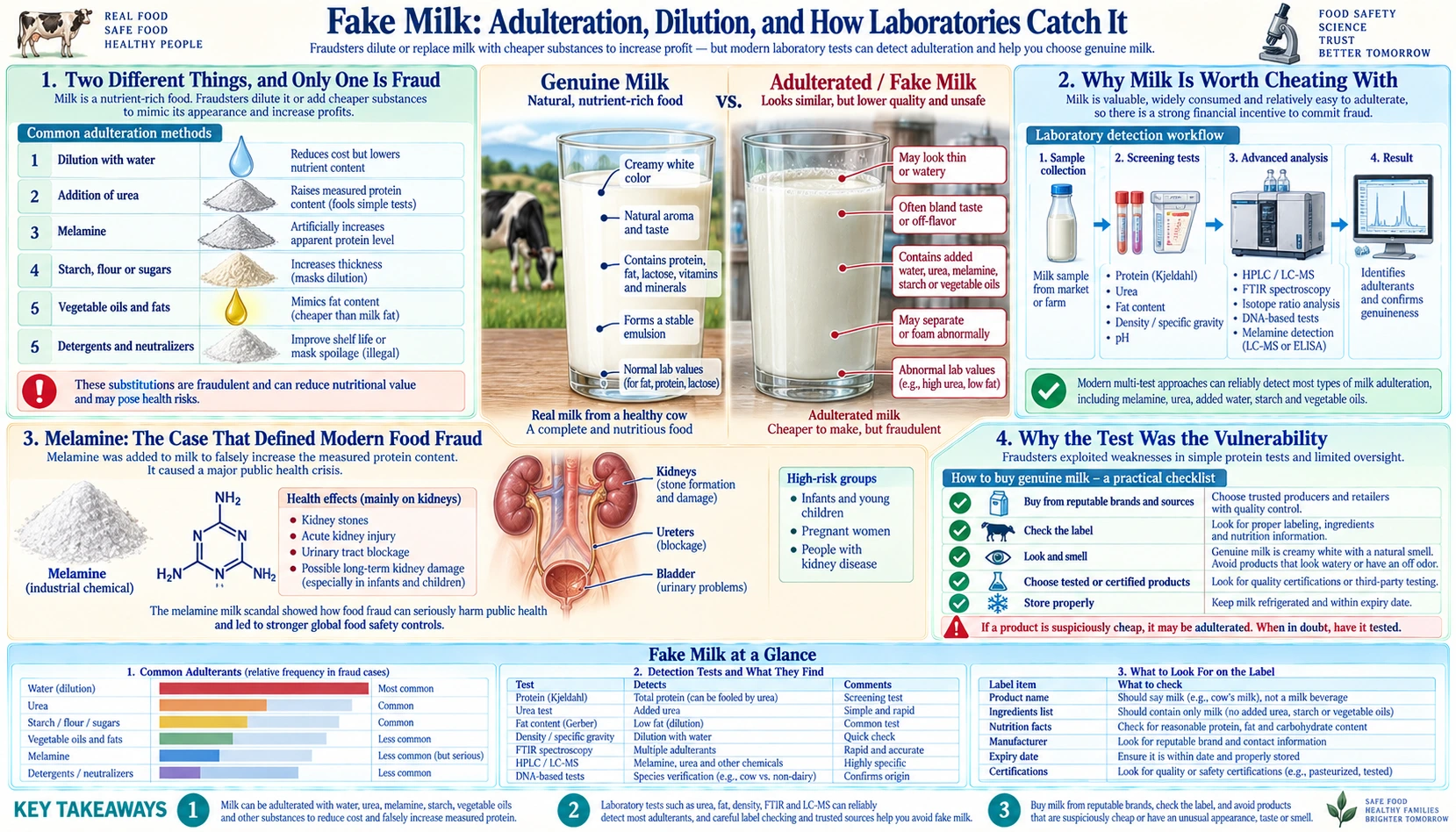
Milk is the most-adulterated liquid food in the world, and it has been for as long as anyone has kept records. The reasons are structural rather than cultural. Milk is a watery emulsion, so it accepts a filler without changing appearance. It is collected from thousands of small producers and pooled, so a cheat introduced at one farm gate is diluted into anonymity within an hour. It is paid for by measured composition — litres, fat, protein — which means there is a number to be gamed rather than a taste to be fooled. And its most vulnerable consumers are infants, who eat nothing else.
This page is about milk sold as something it is not. That is a narrower subject than it first appears, and keeping it narrow is the whole point. An honestly labelled plant-based drink is not fake milk; it is a different product that somebody chose. What follows is about deception: water sold as milk, powder sold as fresh, one species sold as another, a chemical added so a machine reports protein that is not there. It explains the mechanisms, the laboratory methods that catch each one, the blind spots in those methods, and — because this is the part most articles skip — why the single worst episode in the history of food fraud succeeded by attacking the test rather than the product.
Table of Contents
- Two Different Things, and Only One Is Fraud
- Why Milk Is Worth Cheating With
- Melamine: The Case That Defined Modern Food Fraud
- Why the Test Was the Vulnerability
- What Melamine Actually Did
- Melamine Since: What Changed and What Did Not
- Watering, Skimming and Reconstitution
- Whey, Vegetable Fat and Bulking Agents
- Species Substitution
- Residues: Antibiotics and Aflatoxin M1
- How Laboratories Actually Detect It
- What the Rules Actually Require
- Plant-Based Drinks Are Not Fake Milk
- The Nutritional Differences, Stated Plainly
- What a Shopper Can Actually Do
- Kitchen Tests: One Works, Most Do Not
- The Bottom Line
- Key Research Papers
- Connections
- Featured Videos
Two Different Things, and Only One Is Fraud
Search for “fake milk” and you will get two completely unrelated categories of thing jumbled together. Separating them is not pedantry; it changes what you should worry about and what you should do.
The first is fraud. Somebody has taken money for milk and delivered something that is partly not milk, or is milk of a lower value than the label claims. Water added and the resulting thin composition disguised. Powder reconstituted and sold as fresh. Cheap milk of one species sold as the expensive milk of another. A nitrogen-rich industrial chemical stirred in so that the protein analyser reports a figure the milk cannot support. This is illegal everywhere, it is deceptive by definition, and at its worst it has killed children. It is the subject of this page.
The second is a legitimate product with an unfortunate nickname. A drink pressed from oats, almonds, rice, coconut, cashews, hemp or peas, sold in a carton next to the dairy case and labelled as exactly what it is. Nobody is being deceived. A shopper who buys an oat drink knows perfectly well that no cow was involved. That is not adulteration, it is a purchase — and treating it as fraud is both wrong and a distraction from the real thing. These drinks are nutritionally different from dairy milk, sometimes dramatically so, and that difference is worth understanding before you swap one for the other in a child's diet. But a difference you were told about is not a deception. Two sections below set out what those differences actually are, with numbers.
Everything between here and there is about the first category.
Why Milk Is Worth Cheating With
Four properties of milk, taken together, make it unusually attractive to adulterate. None of them is about greed; all of them are about physics and market structure.
It is mostly water already
Whole cow's milk is roughly 87% water. The remaining 13% is fat, protein, lactose and minerals. Adding water to a liquid that is already seven-eighths water produces no visible change at all — no separation, no cloudiness, no settling. Compare that with adding water to honey or to oil, where the fraud announces itself.
It is pooled before anyone can trace it
A collection tanker visits many farms and mixes their output in a single compartment. By the time the milk reaches a laboratory it is a composite of dozens or hundreds of animals across many holdings. A litre of water added at one farm gate is a fraction of a percent of the tanker and is essentially untraceable. This is the same architecture that makes milk safe in other respects — pooling averages out variation — and it is exactly what a fraudster relies on.
It is paid for by numbers, not by taste
Raw milk is bought on measured composition: volume, fat percentage, protein percentage, somatic cell count, bacterial count. Nobody tastes it. Where a product is priced by a measurement, the incentive is to move the measurement, and the cheapest way to move a measurement is rarely to improve the product. This is the single most important structural fact on this page, and the melamine section is what it looks like when taken to its conclusion.
Its consumers include infants
Most food fraud is an economic crime with no health consequence — a cheaper fish, a diluted spice, a lesser grade. Milk is different because a meaningful share of it is processed into infant formula, and an infant on formula is eating one food, at a body weight of a few kilograms, several times a day. A contaminant that would be trivial in an adult's mixed diet is concentrated, repeated and undiluted. Dairy consistently ranks among the most frequently recorded product categories in the food-fraud literature, and the reviews of the sector's incident record make the same point about vulnerable end-uses (Montgomery 2020). The largest structured compilation of documented fraud records across all foods, covering 1980 to 2022, likewise places dairy among the recurring categories rather than treating it as an exotic case (Everstine 2024).
Melamine: The Case That Defined Modern Food Fraud
In September 2008 the Chinese authorities confirmed that infant formula on sale across the country had been adulterated with melamine, an industrial chemical used to make plastics, laminates, tableware and fertiliser. It had entered the supply chain upstream of the processors, at the level of milk collection and consolidation, and it was in the products of many manufacturers rather than one.
The scale is what makes the episode a permanent reference point. Roughly 300,000 children were reported as affected, more than 50,000 required hospital treatment, and six infant deaths were officially confirmed. A screening study of children under three in one affected region — the study that gave the world its first systematic clinical picture — found urinary tract stones in 8.4% of those exposed to formula containing high concentrations of melamine, against 0.2% in children who had consumed formula with no detectable melamine (Guan 2009). That is a forty-fold difference, established prospectively, in living children.
Two features of the episode are worth separating out, because they generalise far beyond milk.
It was not contamination. It was engineering.
Melamine did not fall into the milk. It was added, deliberately, by people who had worked out exactly what it would do to a specific laboratory instrument. Understanding why it worked is the single most useful thing on this page, and it has its own section below.
The warning had already been given, in another species
Eighteen months earlier, in early 2007, thousands of cats and dogs in North America developed acute kidney failure. The cause was traced to wheat gluten and rice protein concentrate imported for pet food, which had been adulterated with melamine and its analogue cyanuric acid — for precisely the same reason, to inflate an apparent protein reading in a protein concentrate sold by assayed protein content (Dobson 2008). The veterinary investigation established the combination's nephrotoxicity, described the crystals recovered from affected kidneys, and spelled out the implications for the human food supply in print (Puschner 2011). The technique, the motive and the mechanism of harm were all documented before a single infant was affected. Nothing about 2008 was unforeseeable.
That parallel has since been examined directly: a comparative analysis of the stones recovered from affected children and from affected dogs concluded that both arose from the same route — ingestion of an adulterated food product — and that the stone chemistry tells the story (Campbell 2025).
Why the Test Was the Vulnerability
This is the part that matters, and it is almost always left out.
Nobody in a dairy laboratory measures protein. Protein is a huge, varied family of molecules; counting it directly in a routine sample stream is impractical. What laboratories measure instead is nitrogen, because nitrogen is easy to measure, and because protein is the only thing in normal milk that contains much of it. The classical method is the Kjeldahl digestion, dating from 1883: destroy the sample in hot concentrated sulphuric acid, convert every nitrogen atom to ammonium, distil it off, titrate it. The modern Dumas combustion method is faster and cleaner but answers the identical question — how much nitrogen is in this sample?
The number that appears on the report is not the measurement. It is the measurement multiplied by a conversion factor: for dairy, 6.38. That factor exists because milk proteins happen to be about 15.7% nitrogen by mass, and 100 ÷ 15.7 ≈ 6.38. The whole edifice rests on one assumption, which nobody states out loud because it is normally true:
All the nitrogen in this sample came from protein.
Melamine is C3H6N6. It is 66.6% nitrogen by mass — more than four times the nitrogen density of milk protein. Run the arithmetic through the conversion factor and one gram of melamine reports as roughly 4.2 grams of “protein”. It is also cheap, a white powder, largely tasteless, and modestly soluble in water.
So the fraud is not really “adding melamine to milk.” The fraud is: add water to increase volume, which dilutes protein below the payment threshold, then add a trace of a nitrogen-rich powder to push the nitrogen number back where it needs to be. The analyser is not broken. It reports exactly what it was designed to report. It was simply asked a question — how much nitrogen? — that had stopped being a good proxy for the question anyone cared about.
Three consequences follow, and all three still apply today:
- A proxy measurement is an attack surface. Any time a product is priced on an indirect indicator, somebody can eventually move the indicator without moving the product. This is a general law of food fraud, not a fact about milk.
- Routine testing could not have found it, however often it was run. Melamine is invisible to nitrogen determination by construction. Testing more milk, more frequently, with the same method would have detected nothing. Only a method that asks a different question — what molecules are actually present? — can see it, and until 2007 nobody was routinely asking that question of milk.
- The fix is specific, and therefore incomplete. Melamine is now screened for directly, usually by liquid chromatography with tandem mass spectrometry, supported by certified reference materials developed specifically so laboratories can trust their melamine numbers (Hon 2011). That closes the melamine hole. It does not close the class of hole, because the next cheap nitrogen-rich compound is not on anybody's target list either. Non-targeted screening — asking what is in the sample rather than whether a named compound is — is the only structural answer, and it is still the exception rather than the rule.
What Melamine Actually Did
Melamine on its own is not a classical poison. Its harm is mechanical and it happens in the kidney.
Melamine is excreted largely unchanged in urine, so it concentrates in the renal tubules and collecting system. There it forms poorly soluble complexes — with uric acid, and above all with its own analogue cyanuric acid, which is present as a manufacturing impurity in technical-grade melamine. Melamine and cyanuric acid together assemble into a highly insoluble lattice held by hydrogen bonding. In animal studies the combination produces renal injury that neither compound reliably produces alone (Son 2014), and imaging mass spectrometry has mapped the resulting crystals directly within kidney tissue, showing where in the nephron they form (Kim 2010).
In the affected infants this produced stones that were unusual in two ways. They were often radiolucent — invisible on plain X-ray — so ultrasound became the diagnostic tool. And they occurred in an age group that essentially does not get kidney stones, which is why the outbreak was recognised at all. The clinical literature that followed is unusually complete: a paediatric nephrology position statement laid out what was known and what the follow-up obligations were (Langman 2009); a case series described the management of children who reached acute obstructive renal failure (Sun 2010); and a further series showed that most affected children could be managed conservatively with hydration and alkalinisation rather than surgery (Zhu 2009).
The dose question, and an honest answer
After 2008 the World Health Organization convened an expert meeting that set a tolerable daily intake for melamine of 0.2 mg per kilogram of body weight per day, and the Codex Alimentarius maximum levels that followed are 1 mg/kg in powdered infant formula, 0.15 mg/kg in liquid infant formula and 2.5 mg/kg in other foods and in feed. Those limits acknowledge that melamine migrates in trace amounts from food-contact plastics and from a permitted agricultural chemical, so zero is not an achievable target.
It would be comfortable to leave it there. The evidence does not allow it. A dose-reconstruction study of affected Chinese children concluded that the risk of melamine-induced nephrolithiasis in young children begins at a lower intake than the WHO figure implies (Li 2010), and a Bayesian reanalysis of the same outbreak reached a similar conclusion about where the true risk threshold sits (Wang 2011). More recent work has gone further and derived benchmark doses for melamine using an early marker of oxidative renal injury rather than frank stone disease, in adults with urolithiasis and in occupationally exposed workers — an approach that detects effects well below the level at which a stone becomes visible (Chen 2024).
The fair summary is this: the regulatory limits are a reasonable public-health compromise, they are not a biological threshold, and the honest position is that low-level melamine exposure is unwanted rather than proven safe. That is a different sentence from “traces of melamine will harm you,” and the difference matters.
Melamine Since: What Changed and What Did Not
The response to 2008 was genuine. Melamine went from a compound nobody screened for to one of the most-tested substances in the dairy trade, with dedicated methods, certified reference materials and mandatory testing regimes in the major importing markets. Surveillance surveys since then have generally found either non-detectable melamine or trace concentrations far below the Codex limits; a market survey of powdered and liquid milk found exactly that pattern — widespread low-level detection consistent with migration and background rather than adulteration, with the products complying with the applicable limits (Hassani 2013). A dietary-exposure assessment in a large urban adult population came to the same conclusion: melamine is measurably present in the modern food supply at low levels, traceable to food consumption patterns rather than to deliberate addition (Shi 2020).
So the specific threat was closed. What did not change is the incentive structure that produced it — raw milk is still bought on measured composition, still pooled before it can be traced, and still tested predominantly with targeted methods that answer “is compound X present?” rather than “what is present?”. The lesson of melamine is not “beware melamine.” It is that a payment system built on a proxy measurement will eventually be attacked at the proxy.
Watering, Skimming and Reconstitution
Long before anyone thought of melamine, the standard milk frauds were three, and all three are still with us.
Adding water
The oldest fraud in the food supply, and still the most common. It increases volume at no cost and reduces every measured component proportionally. It is detected not by looking for water — milk is mostly water — but by measuring a property that depends on how many dissolved particles are present.
The classical method is cryoscopy: the freezing point of milk. Milk freezes below 0 °C because of its dissolved lactose and salts, at roughly −0.52 to −0.55 °C, and that value is remarkably constant across breeds, seasons and diets, because the animal's own osmotic regulation holds it there. Add water and you dilute the dissolved solids, so the freezing point rises toward zero — by about 0.005 °C for each 1% of added water. It is a beautifully direct test: the number moves for exactly one reason.
Except that it does not. Cryoscopy has a documented blind spot, and it is instructive. If lactose in the milk is enzymatically split into glucose and galactose, the number of dissolved particles doubles for that fraction, and the freezing point falls — in the opposite direction from added water (Jeon 1982). A lactose-hydrolysed milk therefore has room to absorb added water while still reading as normal. This is the recurring shape of every section that follows: a test measures one property extremely well, and a fraud that changes a different property in the same direction walks straight past it.
Removing fat and selling as whole
The mirror image of dilution. Cream is worth more per kilogram than the milk it came from, so removing some of it and selling the remainder as full-fat milk converts a labelled composition into cash. This is not the same thing as a product honestly sold as reduced-fat; it is a whole-milk label on milk that is no longer whole. It is caught by direct fat determination, which is routine, so on its own it is a crude fraud. The sophisticated version is to remove fat and replace it with a cheaper fat, which is much harder to see.
Reconstituting powder and selling it as fresh
Milk powder is a globally traded commodity, storable for months and shipped in bulk. Dissolving it in water yields a liquid that satisfies every compositional test — the fat is right, the protein is right, the freezing point is right — because it genuinely is milk. What is being sold falsely is freshness and origin, not composition. This is the milk equivalent of the grade fraud described on the Fake Olive Oil page: nothing foreign is present, so every purity test comes back clean.
What gives it away is heat history. Spray-drying subjects milk to temperatures that fresh pasteurised milk never sees, and heat leaves permanent chemical traces — principally the early Maillard reaction products furosine and lactulose, which accumulate as a function of thermal load and do not reverse. A fresh pasteurised milk has low, characteristic levels; a reconstituted powder has high ones. The measurement is well established and is the standard tool in markets where fresh milk carries a price premium (PubMed: furosine, lactulose and reconstituted milk).
Whey, Vegetable Fat and Bulking Agents
Once you accept that a fraud has to survive a compositional test, the sophisticated versions all take the same form: replace an expensive component with a cheap one that measures the same way.
Whey standing in for milk protein
Cheese-making leaves whey, a large-volume by-product containing real milk protein at a fraction of the price of milk. Add whey to milk and the total protein figure rises. It is genuine dairy protein, from the same species, so species tests and general purity tests see nothing wrong.
The give-away is a single peptide. When rennet acts on casein during cheese-making it cleaves κ-casein and releases a fragment called caseinomacropeptide (CMP, also called glycomacropeptide). CMP is created by the cheese process and is absent from milk that has not been through it, so finding CMP in fluid milk is direct evidence of added cheese whey. It is measured by high-performance liquid chromatography, and confirmed by mass spectrometry when a prosecution is in prospect (Campos Motta 2014). Work continues on more robust CMP-derived peptide markers precisely because the single-marker approach is fragile (Parada-Suárez 2025).
And fragile it is. If the whey is produced by acid coagulation rather than rennet, no CMP is generated — and a study of milk adulterated with acidified rennet whey showed the HPLC method's detection limit degrading to the point of unreliability (de Pádua Alves 2018). Change the process and the marker disappears while the fraud does not.
Vegetable fat standing in for milk fat
Milk fat is the most valuable component by weight. Removing it and substituting a refined vegetable oil preserves the total fat percentage while pocketing the difference. Total fat determination cannot see this at all, because the total is unchanged.
What distinguishes them is molecular architecture. Milk fat has a fatty-acid profile no plant reproduces — notably short-chain acids such as butyric acid, which is essentially a dairy signature — and a characteristic distribution of triglyceride species. Gas chromatography of the fatty acid profile therefore separates milk fat from vegetable oils and from other animal fats reliably, and the method has been validated against deliberately spiked samples across the range of adulterants likely to be used (Kim 2015). Sterol analysis adds a second, independent line of evidence, since plants make phytosterols and animals make cholesterol.
Bulking, thickening and neutralising agents
Where the fraud is cruder — typically in informal supply chains with no cold chain and no laboratory — the additions are cruder too: starch or flour to restore body lost to watering; sugars to correct the solids reading; urea as another cheap nitrogen source; salt to correct conductivity; alkalis such as sodium bicarbonate to neutralise the acidity of milk that has begun to sour; and, worst of all, hydrogen peroxide or formalin as improvised preservatives for milk with no refrigeration. These are qualitatively different from the sophisticated frauds above: they are visible to a competent laboratory using simple methods, and the ones intended as preservatives are directly hazardous rather than merely dishonest. They persist because they occur in supply chains where nobody is testing.
Species Substitution
Buffalo, goat, sheep, camel and donkey milk all sell at a premium over cow's milk, sometimes a large one. Buffalo milk commands its price in mozzarella-style cheeses and in South Asian dairy; goat and sheep milk are bought by people who believe — sometimes correctly — that they tolerate them better; camel and donkey milk carry a premium of an entirely different order.
Blending cheaper cow's milk into any of these is straightforward and is invisible to composition testing, because both liquids are milk. Every general test comes back clean.
Detection is genetic or proteomic, and it is one of the areas where the technology is genuinely good:
- DNA methods. Milk carries somatic cells with the animal's DNA. Real-time PCR against species-specific sequences identifies which animals contributed, and a multiplex assay can now resolve eight animal-derived dairy ingredients in a single two-tube run (Ma 2024). Quantitative PCR takes this further and estimates how much of the cheaper milk is present rather than merely detecting it — the difference between “there is cow DNA here” and “this product is 30% cow” (Giglioti 2022).
- Protein and peptide methods. Caseins and whey proteins differ in amino acid sequence between species, so mass spectrometry can identify species-diagnostic peptides directly in the product. A decade-long review of this approach concluded that peptide biomarkers have matured from research curiosities into practical tools for species differentiation and fraud detection (Karamoutsios 2025). Their practical advantage over DNA is that proteins survive heat processing and cheese ripening, where DNA degrades.
The honest caveat is that a laboratory only finds what somebody paid it to look for. These methods are excellent and they are not applied to most of the world's milk.
Residues: Antibiotics and Aflatoxin M1
Residues are not adulteration — nobody adds them on purpose — but they belong on this page for a specific reason: the pressure to conceal them creates adulteration.
Antibiotic residues
A cow treated for mastitis excretes antibiotic in her milk for a withdrawal period afterwards, during which that milk must be discarded. Discarding milk costs money, and antibiotic-positive milk arriving at a dairy can spoil an entire tanker's worth of starter culture, so processors test for it and reject positive loads at the producer's expense. That combination — a costly test with a costly consequence — is precisely the situation that generates fraud. Historically it has generated two responses: dilution of the treated milk into a larger volume until it falls below the detection limit, and the addition of substances intended to interfere with the assay. Both are the same crime as watering, with a public-health edge, because the antibiotic is still there.
Aflatoxin M1
Aflatoxin M1 is not added to milk either. It is what a cow's liver makes of aflatoxin B1, a mould toxin that contaminates feed — particularly maize, groundnut and cottonseed stored warm and damp. Roughly 1–6% of what the cow eats appears in her milk within a day or two. It is heat-stable, so pasteurisation does not remove it, and it is a recognised human carcinogen. Because it comes from feed, it is a seasonal and climatic problem rather than a criminal one.
A global assessment covering 1990 to 2025 documented both the wide geographic variation in occurrence and the extent to which reported concentrations track feed quality and climate, and set out where dietary exposure is highest (Gamlath 2026). The link to this page is the same one as for antibiotics: regulatory limits create a commercial incentive to blend contaminated milk into clean milk until the average passes. That is adulteration, and it is why residue limits and authenticity testing are two halves of the same problem. Aflatoxins are covered in more depth under Mold & Mycotoxins.
How Laboratories Actually Detect It
There is no single “is this real milk?” test. There is a stack of methods, each answering a narrow question, and each with a documented blind spot. Understanding the stack is what lets you read a testing claim critically.
Routine composition
Mid-infrared spectroscopy of every incoming tanker gives fat, protein, lactose and total solids in seconds. It is fast, cheap and universal. It is also the layer that melamine defeated, because it reports the components it was calibrated for and nothing else.
Cryoscopy
Freezing point for added water, as described above — excellent for its one job, and blind to anything that changes dissolved-particle count in the compensating direction.
Chromatography and mass spectrometry
The reference layer. Liquid chromatography with tandem mass spectrometry identifies and quantifies specific molecules at parts-per-billion — melamine, antibiotic residues, aflatoxin M1, CMP peptides, species-diagnostic peptides. Gas chromatography handles the fatty acid and sterol profiles that expose vegetable fat. It is definitive and it is expensive, slow and targeted: it finds what it is told to look for.
DNA
PCR and quantitative PCR for species, as above. The one question milk chemistry cannot answer, answered directly.
Stable isotope ratio analysis
The ratios of heavy to light carbon, nitrogen, oxygen, hydrogen and sulphur isotopes in milk are set by what the animal ate and drank — and therefore by geography, climate and farming system. Carbon distinguishes maize-based from grass-based feeding; oxygen and hydrogen track local rainfall; nitrogen responds to fertiliser regime. Isotope analysis combined with machine-learning classification has been shown to verify origin claims on dairy products (O'Sullivan 2023a), and isolating the casein fraction first — rather than analysing whole product — makes the technique work consistently across butter, cheese and milk powder (O'Sullivan 2023b). This is the method that catches a fraud no chemistry can see: real milk, from the wrong place.
Vibrational spectroscopy and non-targeted fingerprinting
The most interesting development, and the direct answer to the melamine lesson. Instead of asking “is compound X present?”, infrared and Raman spectroscopy record the entire spectral fingerprint of a sample and ask whether it matches the pattern of authentic milk. Anything unexpected shows up as a deviation, whether or not anyone anticipated it. A comprehensive review of Raman spectroscopy for milk and milk powder sets out its performance against a wide range of adulterants and contaminants (Acharya 2026), and a parallel review of near-infrared methods covers the same ground for rapid, low-cost screening of hazardous substances (Li 2026).
The honest limitation: a fingerprint method tells you a sample is different, not what is wrong with it. It is a screening layer that flags samples for the expensive targeted methods — which is exactly the right role, and exactly what was missing in 2008.
What the Rules Actually Require
Two things are true at once, and campaigners on both sides tend to pick one.
Milk is one of the most heavily regulated foods there is. In the United States the Pasteurized Milk Ordinance governs the entire chain from the animal to the carton, with mandatory testing and a rating system for shipping between states. In the European Union, hygiene regulations set microbiological and somatic-cell criteria that milk must meet before it may be processed. Codex Alimentarius standards define what may be called milk and set the melamine and aflatoxin M1 maximum levels described above. Compositional standards define minimum fat and solids-not-fat for each named product. Unlike the situation described for olive oil, where the key United States grade standard is voluntary, the core dairy standards are mandatory and enforced.
And the routine testing regime is aimed at safety and payment, not at authenticity. Every tanker is tested for antibiotic residues, bacterial count, somatic cells, fat and protein. Almost none is tested for species substitution, isotope-verified origin, or non-targeted anomalies — because those tests are expensive and are commissioned only when there is a specific suspicion or a specific premium claim to defend. The system is very good at answering “is this milk safe and what is it worth?” and is largely silent on “is this milk what the label says it is?”.
That gap is not a scandal; it is a resource allocation. But it explains why authenticity failures are typically found by a targeted survey, an investigative report or a customs check rather than by routine surveillance, and why the interval between a fraud starting and a fraud being detected can be measured in years.
Plant-Based Drinks Are Not Fake Milk
A drink made from oats, almonds, rice, coconut, cashews, hemp or peas and sold under its own name, on a carton that says what it is, is not fake anything. Nobody is deceived, no law is broken, and no shopper who buys it believes a cow was involved. Calling these products “fake milk” conflates a legal, labelled, chosen purchase with the deliberate deception described everywhere else on this page, and that conflation does real damage: it trivialises the actual fraud, and it insults people who made an informed choice for reasons of allergy, digestion, ethics or simple preference.
The naming argument — whether the word “milk” should appear on these cartons at all — is a live regulatory dispute in several jurisdictions, with dairy producers arguing that the term is misleading and manufacturers arguing that no consumer is actually confused. It is a labelling question, not a fraud question, and this page takes no side in it.
Two genuine points do belong here, and both cut in unexpected directions.
These products have authenticity problems of their own. A drink sold as an almond product that has been quietly bulked with a cheaper nut or grain is fraud in exactly the sense this page means, and it matters more than usual because the substituted material may be an allergen the buyer is specifically avoiding. A critical review of detection technologies for plant-based milk alternatives covers precisely this — contaminants, undeclared allergens and adulterants in the category — and concludes that the analytical infrastructure for these products lags well behind what exists for dairy (Karimi 2025). The fraud risk here is not that the product is not dairy. It is that it may not be the plant on the label.
And the nutritional gap is real, unevenly distributed, and worth knowing. That is the next section.
The Nutritional Differences, Stated Plainly
Swapping dairy milk for a plant-based drink is a nutritional decision, not just a flavour one, and the size of the change depends enormously on which plant. Treating “plant-based drinks” as one category is the commonest error in this discussion — a pea-protein drink and a rice drink are further apart from each other than either is from dairy on several measures.
Protein quantity
Whole cow's milk provides roughly 3.2–3.5 g of protein per 100 mL. A systematic compositional comparison of plant-based drinks against cow's milk found the plant products spanning nearly the entire possible range: some carry comparable protein, while nut-, rice- and coconut-based drinks are often below 1 g per 100 mL, and some are close to zero (Walther 2022). A survey of dairy imitation products against their animal-based counterparts reached the same conclusion from the retail shelf and found the imitations generally lower in protein (Katidi 2023). For an adult with a varied diet this is often irrelevant. For a small child, an older adult with a poor appetite, or anyone for whom milk was a main protein source, replacing it with an almond or rice drink can quietly remove most of that protein.
Protein quality
A separate question from quantity, and less widely understood. Dairy protein contains all the indispensable amino acids in generous proportions and is highly digestible, so it scores at the top of the standard protein-quality scales. Most single plant proteins are limited in at least one amino acid — cereal proteins in lysine, several legume proteins in the sulphur-containing amino acids — and score lower. This does not mean plant protein is inadequate; a mixed diet compensates easily. It does mean that gram-for-gram substitution understates the change (PubMed: DIAAS and protein quality). See also the site's Amino Acids library.
Calcium: present by nature, or added by choice
Dairy calcium is intrinsic and comes packaged with the protein and phosphorus that help it work. Plant drinks contain very little calcium natively; what is on the label is fortification, usually a calcium salt in suspension. Two consequences follow. An unfortified plant drink — and many are — supplies almost no calcium. And a fortified one only delivers its label figure if the carton is shaken, because suspended calcium salts settle; the last glass from an unshaken carton is not the same as the first.
Vitamin B12: the important one
This is where the gap is starkest, because it is absolute rather than partial. Plants do not make vitamin B12. A plant-based drink contains none unless it has been fortified, whereas dairy milk is a meaningful natural source. A modelling study that substituted plant-based beverages for cow's milk within otherwise healthy dietary patterns found the predictable result: the swap reduces intake of the nutrients milk supplies — B12, calcium, iodine, riboflavin and high-quality protein — unless those are deliberately replaced from elsewhere (Biscotti 2024). A broad review of cow's milk in human nutrition alongside the emergence of these alternatives sets out the same nutrient-by-nutrient picture (Antunes 2023). Iodine deserves a specific mention: dairy is a major dietary iodine source in several countries largely by accident of farming practice, and plant drinks are very rarely fortified with it.
What this adds up to
Not a verdict. If you choose a plant-based drink, choose one that is fortified with B12 and calcium, shake the carton, read the protein figure rather than assuming it, and make sure the protein and iodine that milk was supplying come from somewhere. If you drink dairy, the authenticity questions on the rest of this page are yours. Neither of those is a moral position; they are two different shopping lists. More detail sits on the Milk Nutrients page and under Vitamin B12.
What a Shopper Can Actually Do
Less than the internet suggests, and more than nothing. Be suspicious of any advice that promises you can detect sophisticated adulteration at home — if it were that easy, the analytical chemistry above would not exist.
Shorten the chain
Almost every fraud on this page depends on anonymity in a long, pooled supply chain. Milk from a named farm, a small local processor, or a producer who will tell you which herd it came from is not automatically better milk, but it is milk with fewer places for a substitution to hide. This is the single most effective thing available to a shopper, and it is a structural advantage rather than a quality claim.
Read what the label actually claims
The words that carry legal weight are the ones describing composition and origin. A stated species, a stated country or region of origin, a stated production system and a stated fat content are all claims someone can be prosecuted over. Adjectives — farm-style, traditional, premium, pure — generally are not. When a package is dense with the second kind and thin on the first, that is information.
Treat an implausible price as information
Buffalo, sheep, goat and camel milk cost more to produce, in every market, for reasons that do not vary much. A premium product at a commodity price has to be explained by something, and the available explanations are a promotion, a short shelf life, or a substitution. This applies with particular force to imported milk powder, which is the most economically attractive form to adulterate: it is a dry commodity, it travels far, it is blended before use, and the shopper never sees the original liquid.
Watch the powder, not the bottle
Fluid milk in a regulated market with a cold chain is a relatively hard target — it is tested on arrival, it spoils, and the chain is short. Powder is the opposite on every count. Historically, the serious incidents have concentrated in powder and in products made from it, and that is where a cautious buyer's attention belongs.
Keep it cold and keep it dark
Not an anti-fraud measure, but the largest quality lever you actually control. Milk is degraded by warmth, by light and by time, and a bottle left on the counter loses more than any plausible adulteration would have taken from it.
Kitchen Tests: One Works, Most Do Not
A durable genre of online advice claims that household tests reveal adulterated milk. Most of these are worthless, and a few are actively misleading. Here is the honest accounting.
The drop-on-a-slope test does not work
The claim: a drop of pure milk placed on a tilted polished surface runs slowly and leaves a white trail, while watered milk runs fast and leaves nothing. What the test actually responds to is viscosity and surface tension, which vary with fat content, temperature, homogenisation and the surface itself. A cold, high-fat, unhomogenised milk and a warm, homogenised one behave differently while both being entirely genuine. It cannot distinguish 5% added water from a different but honest milk.
The iodine test finds starch, and only starch
The claim: add tincture of iodine to milk and a blue-black colour reveals adulteration. This one has a real chemical basis — iodine forms a deep blue-black complex with starch — so it genuinely detects added starch or flour. That is a crude fraud found mainly in unregulated informal supply, and if you are buying packaged milk in a regulated market you are testing for something that is almost certainly not there. It says nothing whatsoever about water, whey, vegetable fat, species substitution or melamine.
Boiling, curdling and smell tests measure freshness, not authenticity
Milk that curdles on boiling has begun to sour; milk that smells wrong has spoiled or picked up an odour. Both are useful and neither has anything to do with fraud. A perfectly adulterated milk can be perfectly fresh, and often is, since the whole point is to sell it.
What does work: your own senses, used for what they can do
Trained sensory assessment is a real analytical tool for milk, used in the industry for defect scoring. What an untrained person can genuinely detect is a narrower list: milk that is thin in the mouth relative to its stated fat content, milk with a flat or watery flavour, milk with a cooked or caramelised note suggesting a heat load it should not have had, and any off-flavour. These are worth acting on — not because they diagnose a fraud, but because they identify a product you should not have bought again.
The uncomfortable conclusion, and it is the same one the Fake Olive Oil page reaches: the frauds most likely to affect you are precisely the ones your kitchen cannot detect, and the ones your kitchen can detect are mostly not happening where you shop. Choosing a shorter supply chain does more than any test you can run.
The Bottom Line
- “Fake milk” means two unrelated things. Fraud — water, powder, whey, vegetable fat, the wrong species, an added chemical — and an honestly labelled plant-based drink, which is not fraud at all. Only the first belongs in this section.
- Melamine is the defining case, and its lesson is about testing. Protein was inferred from total nitrogen. A cheap, nitrogen-dense powder therefore read as protein. The analyser was never wrong; the proxy was.
- The harm was real and it was in children. Around 300,000 affected, more than 50,000 hospitalised, six confirmed infant deaths, and a forty-fold excess of urinary stones in the exposed against the unexposed.
- Any product priced on a measurement can be attacked at that measurement. That is the transferable lesson, and it applies to every food, not just milk.
- Every test has a blind spot, and knowing them is the skill. Cryoscopy misses water in lactose-hydrolysed milk. The whey marker vanishes if the whey was acid-set. Composition testing cannot see vegetable fat substituted for milk fat, or one species blended into another. Non-targeted fingerprinting is the structural answer and is still not routine.
- Powder is the high-risk form. Storable, tradeable, blended before use, and invisible to the person who finally drinks it.
- You cannot test milk at home. The iodine test finds starch. Everything else in that genre measures freshness, viscosity or nothing. Shorten the supply chain instead.
- If you switch to a plant-based drink, switch deliberately. Check protein, choose a version fortified with B12 and calcium, shake the carton, and replace the iodine and protein from elsewhere. That is a nutrition decision, not a fraud one.
Key Research Papers
Melamine: the outbreak and its clinical consequences
- Guan N, Fan Q, Ding J, et al. Melamine-contaminated powdered formula and urolithiasis in young children. New England Journal of Medicine. 2009;360(11):1067–1074. — the prospective screening study: 8.4% stone prevalence in high-exposure children against 0.2% in the unexposed. — PubMed PMID: 19196669
- Langman CB, Alon U, Ingelfinger J, et al. A position statement on kidney disease from powdered infant formula-based melamine exposure in Chinese infants. Pediatric Nephrology. 2009;24(7):1263–1266. — what paediatric nephrology knew, and the follow-up obligations it identified. — PubMed PMID: 19198884
- Zhu SL, Li JH, Chen L, et al. Conservative management of pediatric nephrolithiasis caused by melamine-contaminated milk powder. Pediatrics. 2009;123(6):e1099–e1102. — most affected children were managed without surgery. — PubMed PMID: 19482743
- Sun Q, Shen Y, Sun N, et al. Diagnosis, treatment and follow-up of 25 patients with melamine-induced kidney stones complicated by acute obstructive renal failure in Beijing Children's Hospital. European Journal of Pediatrics. 2010;169(4):483–489. — the severe end of the clinical spectrum. — PubMed PMID: 19841939
- Li G, Jiao S, Yin X, et al. The risk of melamine-induced nephrolithiasis in young children starts at a lower intake level than recommended by the WHO. Pediatric Nephrology. 2010;25(1):135–141. — the paper that says the tolerable daily intake is not a biological threshold. — PubMed PMID: 19727838
- Wang IJ, Chen CC, Chan CC, et al. A hierarchical Bayesian approach for risk assessment of melamine in infant formula based on cases of related nephrolithiasis in children. Food Additives & Contaminants Part A. 2011;28(4):384–395. — a reanalysis of the outbreak reaching a similar conclusion on the risk threshold. — PubMed PMID: 21337233
- Chen CC, Liu CC, Wang YH, et al. Benchmark dose of melamine exposure for a renal injury marker mediated by oxidative stress: examples in patients with urolithiasis and occupational workers. Toxics. 2024;12(8):584. — effects detectable well below the level at which a stone forms. — PubMed PMID: 39195686
Melamine: mechanism, animal evidence and the pet-food precursor
- Dobson RL, Motlagh S, Quijano M, et al. Identification and characterization of toxicity of contaminants in pet food leading to an outbreak of renal toxicity in cats and dogs. Toxicological Sciences. 2008;106(1):251–262. — the 2007 warning, in another species, eighteen months early. — PubMed PMID: 18689873
- Puschner B, Reimschuessel R. Toxicosis caused by melamine and cyanuric acid in dogs and cats: uncovering the mystery and subsequent global implications. Clinics in Laboratory Medicine. 2011;31(1):181–199. — the veterinary investigation and what it implied for human food. — PubMed PMID: 21295730
- Son JY, Kang YJ, Kim KS, et al. Evaluation of renal toxicity by combination exposure to melamine and cyanuric acid in male Sprague-Dawley rats. Toxicological Research. 2014;30(2):99–107. — the combination is what causes the injury. — PubMed PMID: 25071919
- Kim CW, Yun JW, Bae IH, et al. Determination of spatial distribution of melamine-cyanuric acid crystals in rat kidney tissue by histology and imaging matrix-assisted laser desorption/ionization quadrupole time-of-flight mass spectrometry. Chemical Research in Toxicology. 2010;23(1):220–227. — the crystals mapped where they form. — PubMed PMID: 19961162
- Campbell JA, Petersen CE. Analysis of children's kidney stones and comparison to canine kidney stones: both resulting from ingesting adulterated food products. Toxicology and Applied Pharmacology. 2025;495:117190. — the two outbreaks compared through their stone chemistry. — PubMed PMID: 39647512
- Hon PY, Chu PW, Cheng CH, et al. Development of melamine certified reference material in milk using two different isotope dilution mass spectrometry techniques. Journal of Chromatography A. 2011;1218(39):6907–6913. — the metrology that makes routine melamine testing trustworthy. — PubMed PMID: 21872867
- Hassani S, Tavakoli F, Amini M, et al. Occurrence of melamine contamination in powder and liquid milk in market of Iran. Food Additives & Contaminants Part A. 2013;30(3):413–420. — post-2008 surveillance: low-level background rather than adulteration. — PubMed PMID: 23373843
- Shi X, Dong R, Chen J, et al. An assessment of melamine exposure in Shanghai adults and its association with food consumption. Environment International. 2020;135:105363. — measurable background exposure traced to ordinary diet. — PubMed PMID: 31830728
Adulteration, authentication and analytical methods
- Karamoutsios A, Lekka P, Voidarou CC, et al. Assessing milk authenticity using protein and peptide biomarkers: a decade of progress in species differentiation and fraud detection. Foods. 2025;14(15):2588. — the proteomic toolkit, and why it survives processing that destroys DNA. — PubMed PMID: 40807525
- Acharya BS, Nair S, Abdul Salam AA. Quality analysis and detection of adulterants and contaminations in milk/milk powder by Raman spectroscopy. Comprehensive Reviews in Food Science and Food Safety. 2026;25(1):e70403. — fingerprint screening rather than a checklist of named compounds. — PubMed PMID: 41578976
- Li T, Li N, Wang R, et al. Graduate student literature review: a review on near-infrared spectroscopy for rapid detection of hazardous substances in milk and dairy products. Journal of Dairy Science. 2026;109(1):49–67. — what a fast, cheap screening layer can and cannot do. — PubMed PMID: 41130398
- Ma X, Xia H, Pan Y, et al. Double-tube multiplex TaqMan real-time PCR for the detection of eight animal-derived dairy ingredients. Journal of Agricultural and Food Chemistry. 2024;72(20):11640–11651. — eight species resolved in one run. — PubMed PMID: 38725129
- Giglioti R, Polli H, Azevedo BT, et al. Detection and quantification of adulteration in milk and dairy products: a novel and sensitive qPCR-based method. Food Chemistry: Molecular Sciences. 2022;4:100074. — not just whether the cheaper milk is there, but how much. — PubMed PMID: 35415677
- O'Sullivan R, Cama-Moncunill R, Salter-Townshend M, et al. Verifying origin claims on dairy products using stable isotope ratio analysis and random forest classification. Food Chemistry: X. 2023;19:100858. — catching real milk from the wrong place. — PubMed PMID: 37780346
- O'Sullivan R, Schmidt O, O'Sullivan M, et al. Isolation of casein for stable isotope ratio analysis of butter, cheese, and milk powder. Rapid Communications in Mass Spectrometry. 2023;37(5):e9402. — the sample preparation that makes isotope work reproducible across dairy products. — PubMed PMID: 36166281
- Campos Motta TM, Hoff RB, Barreto F, et al. Detection and confirmation of milk adulteration with cheese whey using proteomic-like sample preparation and liquid chromatography-electrospray-tandem mass spectrometry analysis. Talanta. 2014;120:498–505. — the confirmatory method for added cheese whey. — PubMed PMID: 24468402
- Parada-Suárez DA, Mendoza-Mendoza JD, Huertas-Ortiz KA, et al. Exploring new biomarkers for detecting whey adulteration in milk: synthesis and characterization of caseinomacropeptide-derived peptides. ACS Omega. 2025;10(23):24169–24180. — building a more robust marker than CMP alone. — PubMed PMID: 40547635
- de Pádua Alves É, de Alcântara ALD, Guimarães AJK, et al. Milk adulteration with acidified rennet whey: a limitation for caseinomacropeptide detection by high-performance liquid chromatography. Journal of the Science of Food and Agriculture. 2018;98(10):3994–3996. — change the whey process and the marker disappears while the fraud does not. — PubMed PMID: 29277909
- Kim JM, Kim HJ, Park JM. Determination of milk fat adulteration with vegetable oils and animal fats by gas chromatographic analysis. Journal of Food Science. 2015;80(9):C1945–C1951. — the fatty acid profile that total-fat testing cannot see. — PubMed PMID: 26265530
- Jeon IJ, Bassette R. Potential implication of the freezing point depression by enzymatic hydrolysis of lactose in milk. Journal of Food Protection. 1982;45(1):14–15. — the documented blind spot in the added-water test. — PubMed PMID: 30866346
Food fraud in general, and residues
- Everstine KD, Chin HB, Lopes FA, Moore JC. Database of food fraud records: summary of data from 1980 to 2022. Journal of Food Protection. 2024;87(3):100227. — four decades of documented incidents, categorised. — PubMed PMID: 38246523
- Montgomery H, Haughey SA, Elliott CT. Recent food safety and fraud issues within the dairy supply chain (2015–2019). Global Food Security. 2020;26:100447. — where the dairy chain is actually vulnerable, recently. — PubMed PMID: 33083214
- Gamlath CJ, Scott CK, Wu F. The global status of aflatoxin M1 in cow milk 1990–2025: an assessment of occurrence and dietary exposure. Food Research International. 2026;242(Pt 1):120164. — thirty-five years of occurrence data and where exposure is highest. — PubMed PMID: 42629098
Plant-based drinks: composition and their own authenticity problems
- Walther B, Guggisberg D, Badertscher R, et al. Comparison of nutritional composition between plant-based drinks and cow's milk. Frontiers in Nutrition. 2022;9:988707. — the systematic compositional comparison, nutrient by nutrient. — PubMed PMID: 36386959
- Katidi A, Xypolitaki K, Vlassopoulos A, Kapsokefalou M. Nutritional quality of plant-based meat and dairy imitation products and comparison with animal-based counterparts. Nutrients. 2023;15(2):401. — the same question answered from the retail shelf. — PubMed PMID: 36678272
- Biscotti P, Tucci M, Angelino D, et al. Effects of replacing cow's milk with plant-based beverages on potential nutrient intake in sustainable healthy dietary patterns: a case study. Nutrients. 2024;16(18):3083. — what the swap does to a whole diet rather than to one glass. — PubMed PMID: 39339683
- Antunes IC, Bexiga R, Pinto C, et al. Cow's milk in human nutrition and the emergence of plant-based milk alternatives. Foods. 2023;12(1):99. — a balanced overview of both product classes. — PubMed PMID: 36613315
- Karimi Z, Campbell K, Kevei Z, et al. A critical review of conventional and emerging technologies for the detection of contaminants, allergens and adulterants in plant-based milk alternatives. Current Research in Food Science. 2025;10:101067. — these products have fraud problems too, and less analytical infrastructure to catch them. — PubMed PMID: 40485902
Standards, regulations and other sources
- World Health Organization and Food and Agriculture Organization. Toxicological and Health Aspects of Melamine and Cyanuric Acid: Report of a WHO Expert Meeting, Ottawa, 1–4 December 2008. Full report — the meeting that set the 0.2 mg/kg body weight tolerable daily intake quoted above.
- Codex Alimentarius. General Standard for Contaminants and Toxins in Food and Feed (CXS 193-1995). Codex standards index — the maximum levels for melamine and for aflatoxin M1 in milk.
- United States Food and Drug Administration. Milk Guidance Documents & Regulatory Information, including the Grade “A” Pasteurized Milk Ordinance. FDA milk regulatory index — the mandatory United States framework from animal to carton.
- Regulation (EC) No 853/2004 laying down specific hygiene rules for food of animal origin. EUR-Lex — the raw-milk criteria that European milk must satisfy before processing.
- Regulation (EC) No 852/2004 on the hygiene of foodstuffs. EUR-Lex — the general hygiene framework the dairy rules sit inside.
Connections
- Fake Food — The section hub: adulteration, dilution, mislabelling and grade fraud
- Fake Olive Oil — The same economics in a bottle of oil, and the grade fraud nobody can taste
- Fake Eggs — Why the “plastic egg” story is a myth and what the real egg fraud is
- Milk — Nutrition, physiology and health effects of the genuine article
- Milk Nutrients — What is actually in a glass, nutrient by nutrient
- Milk Benefits — The evidence for what milk does, in depth
- Raw vs Pasteurized — What heat treatment changes, and what it does not
- A1 vs A2 Casein — A genuine compositional difference between herds, often oversold
- Grass-Fed and CLA — How feeding changes milk fat, and how isotopes can verify it
- Lactose Intolerance — Why lactose-hydrolysed milk exists, and what it does to the freezing point
- Yogurt — What fermentation does to the same raw material
- Vitamin B12 — The nutrient no plant makes, and the one most often missed in a swap
- Calcium — Intrinsic dairy calcium versus fortification in suspension
- Iodine — The nutrient dairy supplies almost by accident
- Amino Acids — Why protein quality is a separate question from protein quantity
- Mold & Mycotoxins — Where aflatoxin M1 comes from, and why heat will not remove it
- Food Additives — What is deliberately added to food, and under what rules
- Ultra-Processed Foods — When the processing itself is the problem
- Honey — Another of the most adulterated foods in world trade
- Lab Tests — The laboratory methods behind these detections, explained
- Food — The complete food library