Lactose Intolerance — Lactase Persistence Genetics, Threshold Dose, and Workarounds
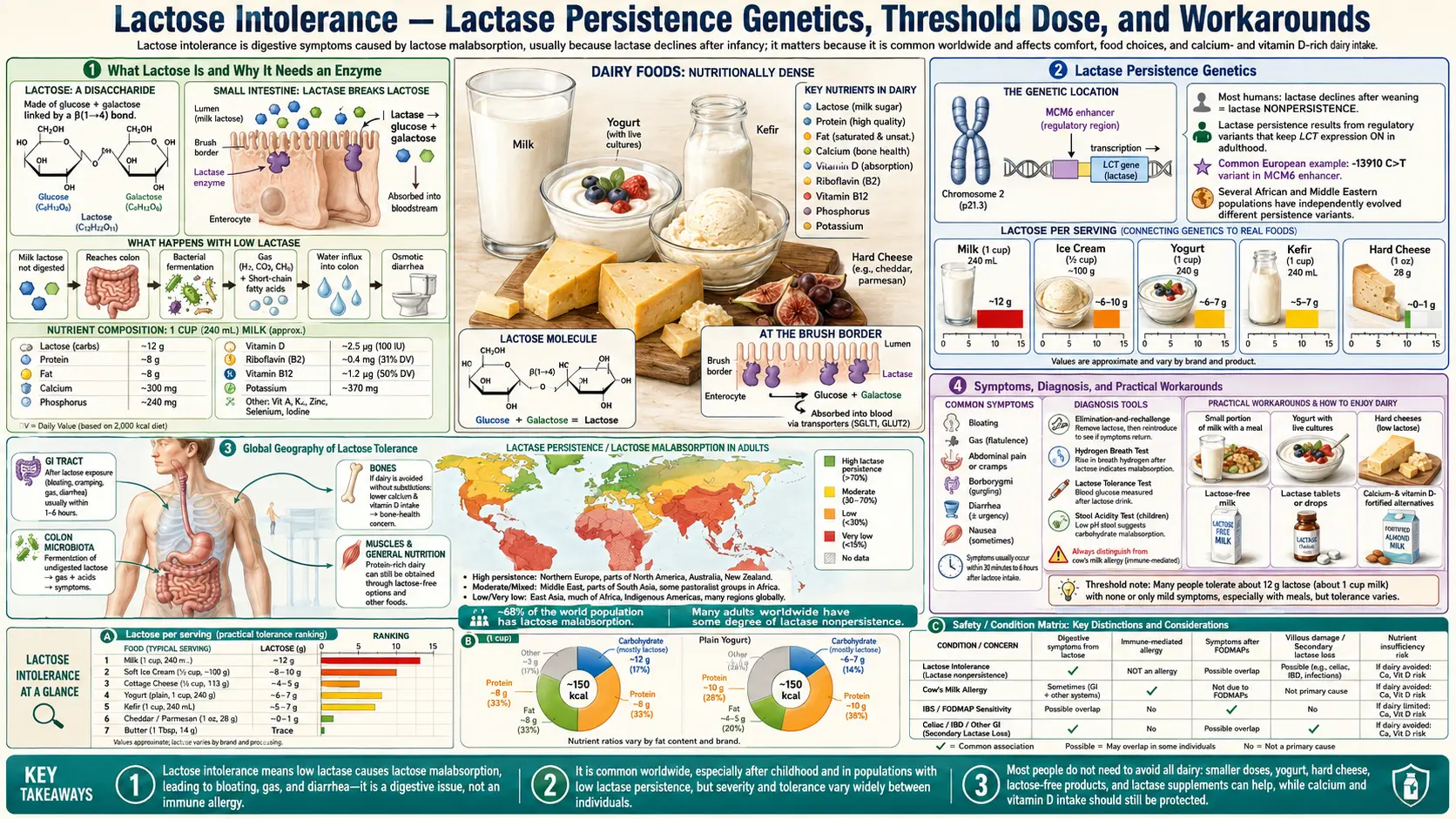
Lactose intolerance is one of the clearest examples of recent human evolution. In most mammals, and in most people, intestinal lactase — the enzyme that splits the milk sugar lactose into glucose and galactose — declines after infancy. In populations with a history of herding and milk drinking, several independent DNA variants in a regulatory region upstream of the LCT (lactase) gene keep the enzyme active into adulthood; earlier surveys summarised by Tishkoff et al. (2007) put this lactase-persistence trait at more than 90% of Swedes and Danes and about 1% of Chinese people. A systematic review of randomized trials found moderate-quality evidence that most adults with lactose intolerance or malabsorption tolerate 12 to 15 g of lactose, about one cup of milk (Shaukat et al. 2010), and trials have found the lactose in yogurt and kefir better digested than the lactose in milk.
Table of Contents
- What Lactose Is and Why It Needs an Enzyme
- Lactase Persistence Genetics
- Global Geography of Lactose Tolerance
- Symptoms and Diagnosis
- The Threshold Dose
- Fermented Dairy and Lactose Digestion
- Lactose-Free Milk, Enzyme Pills, and Adaptation
- Primary vs Secondary Lactase Deficiency
- Lactose Intolerance Is Not Milk Allergy
- Key Research Papers
- External Resources
- Connections
- Featured Videos
1. What Lactose Is and Why It Needs an Enzyme
Lactose is a disaccharide of glucose and galactose joined by a beta-1,4-glycosidic bond, and it is the main carbohydrate in the milk of humans and most other mammals. A 2019 review in Gut gives cow's milk as roughly 5 g of lactose per 100 mL — about 12.5 g in a typical 250 mL serving — and lists whole milk at 4.7 g and goat's milk at 4.5 g per 100 g (Misselwitz et al. 2019). USDA FoodData Central lists whole cow's milk at 4.81 g lactose per 100 g (Foundation, FDC ID 746782) and 5.05 g (SR Legacy, FDC ID 171265).
Like all disaccharides, lactose cannot be absorbed intact across the intestinal epithelium — the brush-border transporters that move sugars into enterocytes are specific to monosaccharides. To be useful as a nutrient, lactose must first be hydrolyzed into its constituent glucose and galactose by the enzyme lactase (also called lactase-phlorizin hydrolase, LPH, or beta-galactosidase). This enzyme spans the brush-border membrane of mature small-intestinal enterocytes, with its highest expression in the mid-jejunum. Glucose and galactose released by lactase hydrolysis are then absorbed by the SGLT1 (sodium-glucose cotransporter 1) transporter on the enterocyte apical membrane (Misselwitz et al. 2019).
If lactase is absent or insufficient, unhydrolyzed lactose passes into the colon. There it is osmotically active (drawing water into the bowel and producing watery diarrhea) and it is fermented by colonic bacteria into short-chain fatty acids and gas (hydrogen, methane, and carbon dioxide), producing the bloating, abdominal pain, and flatulence characteristic of lactose intolerance.
2. Lactase Persistence Genetics
In all mammals, including humans, the LCT gene encoding lactase is highly expressed in the small intestinal enterocyte during infancy. In most of the world's adults — an estimated 65–70% (Bayless et al. 2017) — lactase expression then falls; a 2019 review describes this lactase non-persistence as a decrease of intestinal lactase expression in the first two decades of life (Misselwitz et al. 2019).
The variants that keep lactase active sit in an enhancer region roughly 14 kilobases upstream of the LCT gene on chromosome 2, within intron 13 of the neighbouring MCM6 gene (Enattah et al. 2002; Misselwitz et al. 2019). In laboratory assays the persistence-associated alleles increase transcription from the LCT promoter (Tishkoff et al. 2007); for the Middle Eastern compound allele, the authors report that the enhancer effect is most probably mediated through binding of the transcription factor HNF1α (Enattah et al. 2008).
These variants produce the "lactase persistence" trait. The most common in Europe is the −13910*T variant (a C-to-T substitution 13,910 bases upstream of LCT), identified by Enattah et al. in 2002 (PMID 11788828). Independent lactase-persistence variants have been described in:
- Europe and western Eurasia (−13910*T): a later study found that it correlates perfectly with lactase persistence in Eurasian populations and is almost nonexistent among sub-Saharan African populations (Enattah et al. 2008).
- East Africa (−14010*C, −13915*G, −13907*G): three variants identified in 470 Tanzanians, Kenyans and Sudanese, on haplotype backgrounds different from the European variant and from each other. −14010*C was common in Nilo-Saharan-speaking groups from Tanzania (39%) and Kenya (32%) and in Afro-Asiatic-speaking Tanzanians (46%); −13907*G and −13915*G reached 5% or more only in the Beja of Sudan (21% and 12%) and in Afro-Asiatic-speaking Kenyans (5% and 9%) (Tishkoff et al. 2007).
- Arabian Peninsula (−13915*G with −3712*C): a compound allele identified in Saudis and driven to high prevalence in Middle Eastern populations, on an ancestral haplotype highly divergent from the European one; the authors suggest it may have arisen in response to camel milk consumption (Enattah et al. 2008).
- South Asia (−13910*T): in 2,284 DNA samples from across the Indian subcontinent, the −13910*T variant accounted for nearly all the variation observed in the regulatory region; it is identical by descent with the European allele, and its frequency follows a general northwest-to-southeast decline (Gallego Romero et al. 2012).
Tishkoff et al. 2007 (PMID 17159977) estimated that the East African −14010*C variant spread within roughly the last 3,000–7,000 years under strong positive selection (selection coefficients of 0.04–0.097), and described chromosomes carrying these variants as having one of the strongest genetic signatures of natural selection yet reported in humans — a marked example of convergent evolution driven by animal domestication and adult milk consumption. Enattah et al. 2008 estimated a selection coefficient of about 0.04 for both the European variant and the Arabian compound allele.
3. Global Geography of Lactose Tolerance
A 2017 meta-analysis in Lancet Gastroenterology & Hepatology (Storhaug et al., PubMed PMID: 28690131) was for several years a widely quoted source of country-by-country estimates, including a worldwide lactose-malabsorption figure of 68%. The journal issued an expression of concern in 2024 and retracted the paper in January 2025, so none of its estimates are used on this page.
Figures from earlier surveys, as summarised in the introduction of Tishkoff et al. 2007, give the share of adults with lactase persistence (the ability to keep digesting lactose):
- Swedes and Danes: more than 90%
- Spanish, French and pastoralist Arab populations: about 50%
- West African agriculturalists: about 5–20%
- Chinese: about 1%
- African pastoralists: about 90% in Tutsi, about 50% in Fulani
In Tishkoff's own East African sample, lactase persistence ranged from 88% in Beja pastoralists from Sudan to 26% in Sandawe hunter-gatherers from Tanzania. A worldwide comparison of lactase-persistence phenotype and genotype data concluded that the known variants cannot yet explain how common the trait is in much of western and southern Africa, southeastern Europe, the Middle East and parts of central and southern Asia, so further variants probably remain to be found (Itan et al. 2010).
A 2017 review describes lactase non-persistence as affecting 65–70% of the world's adult population (Bayless et al. 2017), which makes lactase persistence, not lactose intolerance, the less common condition from a global perspective.
4. Symptoms and Diagnosis
The 2019 Gut review defines lactose intolerance as abdominal symptoms such as pain, bloating and diarrhoea after lactose ingestion in a person with lactose malabsorption. The likelihood of symptoms depends on the lactose dose, lactase expression and the intestinal microbiome, and people with visceral hypersensitivity associated with anxiety or irritable bowel syndrome are at increased risk regardless of how well they digest lactose (Misselwitz et al. 2019).
The same review lists five tests — the hydrogen breath test, the lactose tolerance test, lactase activity in a duodenal biopsy, a gaxilose or urinary galactose test, and genetic testing. The three most often discussed:
- Hydrogen breath test: described in the review as the test of choice for assessing lactose malabsorption and symptoms. The 2017 North American consensus on breath testing set the lactose dose at 25 g and counted a rise in hydrogen of 20 ppm or more from baseline as positive for maldigestion (Rezaie et al. 2017). The 2019 review describes 20–25 g as possibly optimal in clinical practice and an increase of at least 20 ppm within 3 hours as diagnostic, and notes that the larger 40–50 g doses used in epidemiological studies induce symptoms even in people who tolerate the lactose in normal diets. False-negative results occur when the gut bacteria produce little hydrogen; false positives occur with small intestinal bacterial overgrowth and rapid transit.
- Lactose tolerance test (blood glucose): plasma glucose is measured at intervals (for example 0, 30, 60 and 120 minutes) after 50 g of lactose. The review notes that the multiple blood samples limit its use, and that capillary measurements with portable glucose meters do not match the diagnostic accuracy of venous blood.
- Genetic testing for the −13910*T (and related) variants: the review notes that the genetic situation is more complex in people of African or Asian heritage, where genetic tests are not currently advocated for clinical purposes, and that genetic tests do not detect secondary lactose malabsorption (see below).
The American Academy of Pediatrics review notes that children with suspected lactose intolerance can be assessed clinically by dietary lactose elimination, as well as by breath testing or intestinal biopsy (Heyman 2006). A 2015 review proposes replacing lactose tolerance tests with dairy food tolerance tests, since what matters is whether a particular dairy product, as normally eaten, gives rise to symptoms (Lukito et al. 2015). An elimination and rechallenge with milk does not by itself separate lactose intolerance from reactions to milk proteins (cow's milk allergy, or the proposed A1 beta-casein BCM-7 sensitivity).
5. The Threshold Dose
Several reviews address how much lactose people with lactose malabsorption tolerate:
- 12–15 g (about 1 cup of milk): a systematic review of randomized trials, published alongside the 2010 NIH consensus statement on lactose intolerance (Suchy et al. 2010, PMID 20404261), found moderate-quality evidence that this amount is well tolerated by most adults with lactose intolerance or malabsorption (Shaukat et al. 2010).
- Blinded trials at meal-sized doses: a meta-analysis of 21 masked, placebo-controlled studies using 7–25 g of lactose found no significant difference from placebo for bloating, abdominal pain or flatulence; diarrhoea was significantly more frequent, but the effect was very small. The authors concluded that lactose is not a major cause of symptoms in lactose maldigesters after usual intakes of dairy foods, that is, 1 cup (Savaiano et al. 2006).
- With food, or spread over the day: the 2019 Gut review states that most people with lactose malabsorption tolerate at least 12 g (250 mL of milk) without problems and that larger doses may be tolerated if consumed with food or spread over a whole day (Misselwitz et al. 2019). A 2015 review states that up to 25 g of lactose at any one time can usually be consumed by a lactase non-persistent person, with meal pattern, gut microbes, age and other factors altering tolerance (Lukito et al. 2015).
- Large test doses: the 40–50 g doses used in some breath-test studies induce symptoms even in people who tolerate the lactose in normal diets (Misselwitz et al. 2019).
On this basis the 2019 review states that, unlike coeliac disease or food allergy, lactose intolerance does not require a strict lactose-free diet. A 2017 review notes that some lactose-intolerant people without coexisting irritable bowel syndrome can drink a glass of milk with a meal with no or minor symptoms (Bayless et al. 2017).
Colonic adaptation has also been studied. In blinded crossover studies by Hertzler & Savaiano (1996, PubMed PMID: 8694025), fecal beta-galactosidase activity rose threefold after 16 days of lactose feeding in nine lactose maldigesters; in a second study of 20 maldigesters, after 10 days of daily lactose (compared with dextrose), flatus frequency and severity after a lactose challenge fell by 50% and breath hydrogen was significantly lower. The 2010 systematic review, which found two trials of incremental lactose for colonic adaptation, judged the evidence insufficient (Shaukat et al. 2010).
6. Fermented Dairy and Lactose Digestion
Yogurt, kefir and aged cheese contain less lactose than milk, and trials have found the lactose in yogurt and kefir better digested than the lactose in milk:
- Lower lactose content: the 2019 Gut review states that yogurt contains about 50% of the lactose of unprocessed milk (Misselwitz et al. 2019). USDA FoodData Central lists plain whole-milk yogurt at 3.35 g lactose per 100 g (Foundation, FDC ID 2259793) and plain whole-milk Greek yogurt at 2.61 g (FDC ID 2259794).
- Live cultures carry their own lactase: Savaiano's 2014 review (PubMed PMID: 24695892) explains that the lactose in yogurt is digested more efficiently than other dairy sources of lactose because the bacterial lactase of Lactobacillus bulgaricus and Streptococcus thermophilus survives the acid of the stomach — apparently protected inside the bacterial cells and by the buffering capacity of yogurt — and becomes active in the small intestine. In an earlier study in nine lactase-deficient adults, pasteurizing yogurt eliminated the enhanced lactose digestion and cut its lactase activity 10-fold and its cell counts 100-fold, although all subjects fed pasteurized yogurt were symptom-free (Savaiano et al. 1984). The European Food Safety Authority assessed a health claim linking live yogurt cultures with improved lactose digestion in 2010 (EFSA 2010); a 2021 consensus statement notes that the claim is approved in Europe on the basis of the lactase enzyme in these two yogurt cultures (Marco et al. 2021).
- Aged hard cheese: the 2019 review lists hard cheeses such as cheddar and gruyere at 0.1 g lactose per 100 g and less than 0.1 g per typical serving (Misselwitz et al. 2019). USDA FoodData Central lists cheddar at 0.16 g lactose per 100 g (Foundation, FDC ID 328637), and Swiss cheese (Foundation, FDC ID 746767) and grated parmesan (Foundation, FDC ID 325036) at 0 g.
Kefir was tested in a randomized trial of 15 adults with lactose maldigestion given 20 g lactose portions of milk, plain or flavored kefir, or plain or flavored yogurt. Breath hydrogen was significantly lower after plain kefir and both yogurts than after milk, flavored kefir gave an intermediate response, and all four fermented products reduced the perceived severity of flatulence by 54–71% relative to milk (Hertzler & Clancy 2003).
7. Lactose-Free Milk, Enzyme Pills, and Adaptation
Three approaches have been studied in people with lactose intolerance who eat dairy:
- Lactose-free milk: milk to which a lactase enzyme has been added, splitting the lactose into glucose and galactose. The 2019 Gut review describes such products as widely available and considered safe, although allergic reactions have been reported; lactase treatment increases sweetness, and residual protein-splitting activity of the enzyme can degrade casein and impair taste, especially after long storage. The review's table lists lactose-free milk at less than 0.1 g lactose per 100 g (Misselwitz et al. 2019). The 2010 systematic review found the evidence insufficient that lactose-reduced milk (0–2 g lactose) reduced symptoms compared with milk containing more than 12 g (Shaukat et al. 2010).
- Lactase enzyme supplements: tablets or drops of microbial beta-galactosidase taken with dairy. The 2019 review states that lactase tablets improve both lactose digestion and symptoms, although the effects are modest (Misselwitz et al. 2019). In a double-blind, placebo-controlled crossover trial in 30 lactose malabsorbers with intolerance, a lactase from the yeast Kluyveromyces lactis added to 400 mL of milk either 10 hours or 5 minutes before drinking significantly reduced peak breath hydrogen and symptom scores compared with placebo (Montalto et al. 2005). In 96 consecutive patients with a positive breath test, a standard oral dose of beta-galactosidase turned the test negative in 21.88%, lowered peak hydrogen while the test stayed positive in 17.71%, and left peak levels similar to baseline in 60.41%; the authors concluded that the response varies significantly (Ibba et al. 2014).
- Gradual reintroduction / colonic adaptation: daily lactose feeding raised fecal (colonic bacterial) beta-galactosidase activity and reduced flatulence after a lactose challenge in the Hertzler & Savaiano trials described above. The 2010 systematic review judged the evidence for colonic adaptation, and for probiotics, insufficient (Shaukat et al. 2010).
Rice, nut, soy and oat beverages contain no lactose (Misselwitz et al. 2019); their nutrient content differs from that of cow's milk. The American Academy of Pediatrics review states that if dairy products are eliminated, other dietary sources of calcium or calcium supplements need to be provided (Heyman 2006).
8. Primary vs Secondary Lactase Deficiency
Primary lactase deficiency is the genetic condition described above — the decline of lactase expression after infancy in people without a lactase-persistence variant. The 2019 Gut review identifies it as the most common cause of lactose malabsorption in adolescents and adults (Misselwitz et al. 2019).
Secondary lactase deficiency is acquired. Lactase sits at the tip of the intestinal villi and new, immature enterocytes are lactase deficient, so the enzyme is vulnerable to injury of the small-bowel lining. The 2019 review lists:
- Infectious gastroenteritis — the resulting malabsorption is often transitory and can be clinically relevant, especially in infants for whom milk is the staple food
- Coeliac disease — patients with a new diagnosis often have a positive lactose breath test, but many recover the ability to digest lactose after 6–12 months on a gluten-free diet
- Inflammatory bowel disease — in a meta-analysis the overall odds ratio for lactose malabsorption was 1.6, highest in Crohn's disease affecting the small bowel
- Systemic sclerosis
- Environmental enteric dysfunction — intestinal atrophy with enzyme deficiencies, malabsorption and malnutrition, seen mainly in children in low-resource settings
The review also lists rapid small-intestinal transit and small intestinal bacterial overgrowth as other causes of lactose malabsorption. Genetic tests do not detect secondary malabsorption; breath, blood-glucose, biopsy and gaxilose tests can (Misselwitz et al. 2019).
Congenital lactase deficiency is a very rare genetic disorder, typically caused by frameshift mutations, in which lactase is not expressed; it causes severe symptoms immediately after birth and failure to thrive in infants (Misselwitz et al. 2019).
9. Lactose Intolerance Is Not Milk Allergy
An important and frequently confused distinction: lactose intolerance is a digestive enzyme deficiency causing osmotic and fermentative GI symptoms; cow's milk protein allergy (CMPA) is an immune-mediated reaction to milk proteins (casein or whey proteins).
- Lactose intolerance: symptoms are confined to the GI tract (bloating, gas, diarrhea), are dose-dependent and generally mild, and most people with lactose malabsorption tolerate small amounts of lactose (see the threshold section above).
- Cow's milk protein allergy: IgE-mediated cow's milk allergy is one of the most common food allergies in infants and young children and can cause anaphylactic reactions (Flom & Sicherer 2019). A 2002 review put its incidence at about 2–3% in infancy in developed countries; about 50–60% of affected infants had skin symptoms, 50–60% gastrointestinal symptoms and 20–30% respiratory symptoms, reactions came within 1 hour of milk or later, and remission reached about 85–90% by age 3 (Høst 2002).
- Non-IgE-mediated reactions: non-IgE and mixed (IgE and non-IgE) immune reactions to cow's milk also occur, which complicates estimates of milk allergy (Flom & Sicherer 2019).
- A1 beta-casein BCM-7 sensitivity: a proposed further category whose symptoms overlap with lactose intolerance; the trials are covered on the A1 vs A2 page.
Høst notes that cow's milk allergy has to be confirmed by controlled elimination and challenge, since symptoms suggestive of it are seen in about 5–15% of infants (Høst 2002). Sorting out which explanation fits a given person's symptoms is a clinical question; decisions about testing and diet belong with a clinician.
Key Research Papers
- Enattah NS et al., Identification of a variant associated with adult-type hypolactasia (Nat Genet 2002;30:233-237) — PubMed PMID: 11788828
- Tishkoff SA et al., Convergent adaptation of human lactase persistence in Africa and Europe (Nat Genet 2007;39:31-40) — PubMed PMID: 17159977
- Suchy FJ et al., NIH consensus development conference statement: lactose intolerance and health (Ann Intern Med 2010;152:792-796) — PubMed PMID: 20404261
- Savaiano DA, Lactose digestion from yogurt: mechanism and relevance (Am J Clin Nutr 2014;99:1251S-1255S) — PubMed PMID: 24695892
- Misselwitz B, Butter M, Verbeke K, Fox MR, Update on lactose malabsorption and intolerance: pathogenesis, diagnosis and clinical management (Gut 2019;68:2080-2091) — PubMed PMID: 31427404
- Storhaug CL, Fosse SK, Fadnes LT, Country, regional, and global estimates for lactose malabsorption in adults: a systematic review and meta-analysis (Lancet Gastroenterol Hepatol 2017;2:738-746) — PubMed PMID: 28690131 (Retracted by the journal in 2025 after a 2024 expression of concern; both notices are listed next. No figure on this page rests on this paper.)
- The Editors of The Lancet Gastroenterology & Hepatology, Expression of concern — Country, regional, and global estimates for lactose malabsorption in adults: a systematic review and meta-analysis (Lancet Gastroenterol Hepatol 2024;9:784) — PubMed PMID: 39127069
- The Editors of The Lancet Gastroenterology & Hepatology, Retraction — Country, regional, and global estimates for lactose malabsorption in adults: a systematic review and meta-analysis (Lancet Gastroenterol Hepatol 2025;10:13) — PubMed PMID: 39674208
- Hertzler SR, Savaiano DA, Colonic adaptation to daily lactose feeding in lactose maldigesters reduces lactose intolerance (Am J Clin Nutr 1996;64:232-236) — PubMed PMID: 8694025
- Hertzler SR, Clancy SM, Kefir improves lactose digestion and tolerance in adults with lactose maldigestion (J Am Diet Assoc 2003;103:582-587) — PubMed PMID: 12728216
- Lukito W, Malik SG, Surono IS, Wahlqvist ML, From 'lactose intolerance' to 'lactose nutrition' (Asia Pac J Clin Nutr 2015;24 Suppl 1:S1-8) — PubMed PMID: 26715078
- Itan Y et al., A worldwide correlation of lactase persistence phenotype and genotypes (BMC Evol Biol 2010;10:36) — PubMed PMID: 20144208
- Heyman MB, Lactose intolerance in infants, children, and adolescents (Pediatrics 2006;118:1279-1286) — PubMed PMID: 16951027
- Shaukat A, Levitt MD, Taylor BC, et al., Systematic review: effective management strategies for lactose intolerance (Ann Intern Med 2010;152:797-803) — PubMed PMID: 20404262
- Savaiano DA, Boushey CJ, McCabe GP, Lactose intolerance symptoms assessed by meta-analysis: a grain of truth that leads to exaggeration (J Nutr 2006;136:1107-1113) — PubMed PMID: 16549489
- Bayless TM, Brown E, Paige DM, Lactase non-persistence and lactose intolerance (Curr Gastroenterol Rep 2017;19:23) — PubMed PMID: 28421381
- Rezaie A, Buresi M, Lembo A, et al., Hydrogen and methane-based breath testing in gastrointestinal disorders: the North American consensus (Am J Gastroenterol 2017;112:775-784) — PubMed PMID: 28323273
- Savaiano DA, AbouElAnouar A, Smith DE, Levitt MD, Lactose malabsorption from yogurt, pasteurized yogurt, sweet acidophilus milk, and cultured milk in lactase-deficient individuals (Am J Clin Nutr 1984;40:1219-1223) — PubMed PMID: 6439026
- Montalto M, Nucera G, Santoro L, et al., Effect of exogenous beta-galactosidase in patients with lactose malabsorption and intolerance: a crossover double-blind placebo-controlled study (Eur J Clin Nutr 2005;59:489-493) — PubMed PMID: 15674309
- Ibba I, Gilli A, Boi MF, Usai P, Effects of exogenous lactase administration on hydrogen breath excretion and intestinal symptoms in patients presenting lactose malabsorption and intolerance (Biomed Res Int 2014;2014:680196) — PubMed PMID: 24967391
- Enattah NS, Jensen TG, Nielsen M, et al., Independent introduction of two lactase-persistence alleles into human populations reflects different history of adaptation to milk culture (Am J Hum Genet 2008;82:57-72) — PubMed PMID: 18179885
- Gallego Romero I, Basu Mallick C, Liebert A, et al., Herders of Indian and European cattle share their predominant allele for lactase persistence (Mol Biol Evol 2012;29:249-260) — PubMed PMID: 21836184
- Høst A, Frequency of cow's milk allergy in childhood (Ann Allergy Asthma Immunol 2002;89(6 Suppl 1):33-37) — PubMed PMID: 12487202
- Flom JD, Sicherer SH, Epidemiology of cow's milk allergy (Nutrients 2019;11:1051) — PubMed PMID: 31083388
- Marco ML, Sanders ME, Gänzle M, et al., The International Scientific Association for Probiotics and Prebiotics (ISAPP) consensus statement on fermented foods (Nat Rev Gastroenterol Hepatol 2021;18:196-208) — PubMed PMID: 33398112
- EFSA Panel on Dietetic Products, Nutrition and Allergies (NDA), Scientific opinion on the substantiation of health claims related to live yoghurt cultures and improved lactose digestion (ID 1143, 2976) pursuant to Article 13(1) of Regulation (EC) No 1924/2006 (EFSA Journal 2010;8(10):1763) — doi:10.2903/j.efsa.2010.1763
PubMed Topic Searches
- Lactase enzyme supplement efficacy in randomized trials PubMed: Lactase supplement RCTs
11. External Resources
12. Connections
- Milk Benefits Hub
- A1 vs A2 Casein
- Raw vs Pasteurized
- Grass-Fed and CLA
- Milk (Main Page)
- Yogurt
- Gastroenterology
- Irritable Bowel Syndrome
- SIBO
- Calcium
- Vitamin D3
- Vitamin B12
- All Foods
- Lactose Intolerance — the full clinical page on diagnosis and management.
- History
- Nutrients