Raw vs Pasteurized Milk — Pathogen Risk, Nutrient Retention, and the Evidence
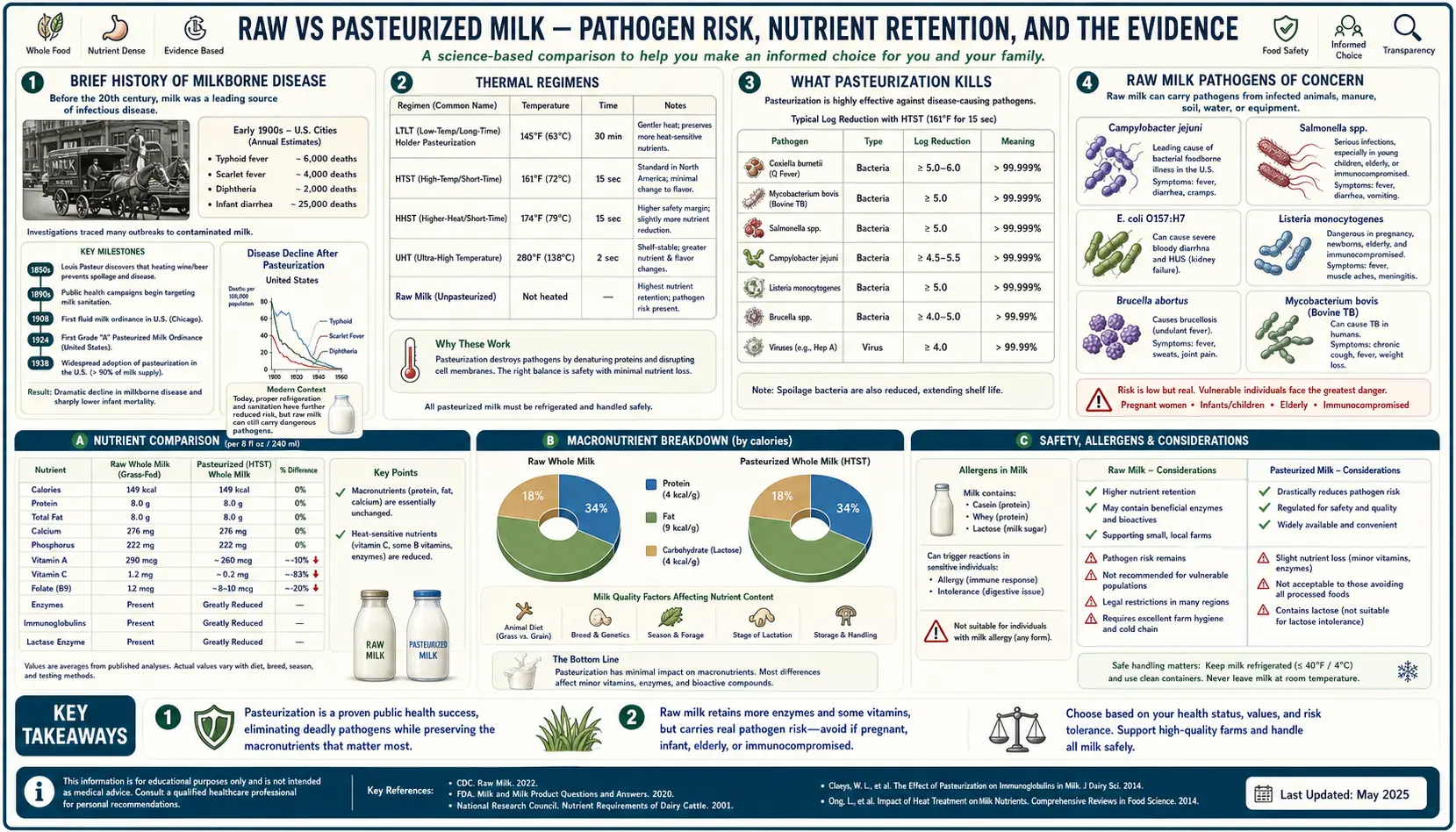
Pasteurization heats every particle of milk to a set temperature for a set time; the most common US regimen is 72°C (161°F) for 15 seconds. The CDC states that since the early 1900s pasteurization has greatly reduced milk-borne illness, and a CDC analysis of US dairy outbreaks from 1993 to 2006 estimated that nonpasteurized products caused about 150 times more outbreaks per unit consumed than pasteurized ones. On the other side of the ledger, large European farm-child studies have repeatedly found that children who drank unprocessed farm milk had less asthma, hay fever and early-life respiratory infection — observational findings whose authors describe the goal as a milk that keeps the protective components without the pathogens. This page sets out what each body of evidence reports.
Table of Contents
- A Brief History of Milkborne Disease
- The Thermal Regimens
- What Pasteurization Kills
- Raw Milk Pathogens of Concern
- US Outbreak Data
- Nutrient Effects of Heat Treatment
- Enzyme and Immunoglobulin Claims
- Farm-Milk Cohorts on Asthma, Allergy and Infections
- What Agencies and Reviews Report
- Key Research Papers
- External Resources
- Connections
- Featured Videos
1. A Brief History of Milkborne Disease
A 2015 review of raw milk's risks and benefits (Lucey 2015, PubMed PMID: 27340300) gives this history. In 1908 Chicago became the first US city to write cow's-milk pasteurization into municipal law (with an exception for cows certified free of tuberculosis), although full adoption took another eight years. By 1900, as many as 10% of human tuberculosis cases were estimated to have come from milk, and between 1912 and 1937 about 65,000 people in England and Wales are estimated to have died of tuberculosis of bovine origin. In 1924 the US Public Health Service issued the Standard Milk Ordinance for voluntary adoption by state and local agencies; it is now the Grade "A" Pasteurized Milk Ordinance. In 1938, milkborne outbreaks were estimated at 25% of all US disease outbreaks linked to food or water; today milk and fluid milk products account for less than 1% of such outbreaks. The review describes tuberculosis as a forgotten disease in the United States because of eradication programs and pasteurization.
Michigan enacted the first statewide requirement that dairy products be pasteurized in 1948, and in 1987 the FDA prohibited the interstate sale or distribution of nonpasteurized milk; sale within a state is set by each state's own law (Mungai et al. 2015, PubMed PMID: 25531403). The federal rule is codified at 21 CFR 1240.61. The FDA describes pasteurization, first developed by Louis Pasteur in 1864, as killing the organisms responsible for listeriosis, typhoid fever, tuberculosis, diphtheria, Q fever and brucellosis.
2. The Thermal Regimens
US federal regulations (21 CFR 1240.61 and the standard of identity in 21 CFR 131.3) define pasteurization as heating every particle of the milk in properly operated equipment to one of a set of temperatures and holding it there for at least the matching time:
- Vat (batch) pasteurization: 63°C (145°F) for 30 minutes.
- High-temperature short-time (HTST): 72°C (161°F) for 15 seconds — the most common pasteurization treatment, according to Lucey 2015.
- Higher-heat, shorter-time options: 89°C (191°F) for 1 second, and shorter holds at 90–100°C, down to 100°C (212°F) for 0.01 second.
- Ultra-pasteurized: at or above 280°F (138°C) for at least 2 seconds, giving an extended shelf life under refrigeration (21 CFR 131.3).
- UHT (ultra-high-temperature): Lucey 2015 describes ultra heat treatment (for example 138°C for 2–4 seconds) followed by aseptic packaging, which lets the milk be stored at room temperature.
For products with 10% fat or more, or with added sweeteners, the regulations raise each pasteurization temperature by 5°F (3°C).
3. What Pasteurization Kills
Milk pasteurization standards, mostly based on Codex Alimentarius recommendations, treat Coxiella burnetii (the cause of Q fever) as the most heat-resistant non-spore-forming bacterial pathogen in milk and require at least a 5-log10 reduction of it. A 2022 pilot-plant study of field isolates confirmed that the established HTST regimen achieves that reduction and suggested a lower temperature might suffice; the authors note that the original inactivation data were more than 60 years old (Wittwer et al. 2022, PubMed PMID: 35069465). A 2006 paper questioned whether C. burnetii is a significant foodborne pathogen at all, and so whether pasteurization parameters need to rest on its heat resistance (Cerf and Condron 2006, PubMed PMID: 16492321).
Pasteurized milk is not risk-free. A review of pathogens on dairy farms lists the ways contamination can still reach consumers: pasteurization may not destroy all foodborne pathogens, inadequate or faulty pasteurization will not, and Listeria monocytogenes can survive and grow in post-pasteurization processing environments and recontaminate products (Oliver et al. 2005, PubMed PMID: 15992306). In a 2004 CDC outbreak investigation, multidrug-resistant Salmonella Typhimurium infections in Pennsylvania and New Jersey were traced to pasteurized milk, and an inspection showed the potential for contamination after pasteurization (Olsen et al. 2004, PubMed PMID: 15200835).
4. Raw Milk Pathogens of Concern
The CDC lists Campylobacter, Cryptosporidium, E. coli, Listeria, Brucella and Salmonella among the germs raw milk can carry. Surveys in several countries have found these pathogens in raw milk at prevalence levels as high as 13% for Campylobacter jejuni and Listeria monocytogenes, and in some studies almost a third of samples carried at least one pathogen, including milk from clinically healthy animals and milk with a low total bacteria count (Lucey 2015). In the US outbreak reviews:
- 1993–2006: all 73 outbreaks from nonpasteurized dairy were bacterial. Of the 72 with a single cause, 54% were Campylobacter, 22% Salmonella, 13% Shiga toxin–producing E. coli (STEC), 4% Brucella, 4% Listeria and 3% Shigella (Langer et al. 2012, PubMed PMID: 22377202).
- 2007–2012 (nonpasteurized fluid milk only): of 78 single-cause outbreaks, Campylobacter caused 62 (81%), STEC 13 (17%), Salmonella Typhimurium 2 (3%) and Coxiella burnetii 1 (Mungai et al. 2015).
The CDC states that most illness from raw milk causes diarrhea, stomach cramping and vomiting, but that in some cases Guillain-Barré syndrome or hemolytic uremic syndrome can follow, potentially leading to paralysis, kidney failure, stroke or death. For listeriosis, the WHO reports that the invasive form, which affects pregnant women, people treated for cancer, HIV or organ transplants, elderly people and infants, carries a mortality rate of 20–30%; pregnant women are about 20 times more likely than other healthy adults to contract it, and infection can cause miscarriage or stillbirth. The WHO lists unpasteurized milk among the dairy foods involved in past listeriosis outbreaks.
5. US Outbreak Data
The CDC's review of dairy-associated outbreaks reported in 1993–2006 found 121 outbreaks whose product pasteurization status was known; 73 (60%) involved nonpasteurized products, with 1,571 illnesses, 202 hospitalizations and 2 deaths, while the 48 pasteurized-product outbreaks caused 2,842 illnesses, 37 hospitalizations and 1 death. The hospitalization rate was 13% in nonpasteurized-product outbreaks and 1% in pasteurized-product outbreaks. Most pasteurized-product illnesses came from a few large fluid-milk outbreaks (2,098 illnesses from 10 outbreaks); the leading cause of pasteurized-product outbreaks was norovirus, and at least 4 of the 7 with a known contamination source probably came from an infected food handler after pasteurization. In surveys cited by the authors, under 1% of milk drinkers reported usually drinking nonpasteurized milk, so the share of dairy consumed nonpasteurized is probably under 1%. Assuming 1%, the authors estimated that the incidence of outbreaks was about 150 times greater per unit of nonpasteurized product consumed than for pasteurized products. Patients in nonpasteurized-product outbreaks were younger: 60% were under 20 years of age, against 23% in pasteurized-product outbreaks (Langer et al. 2012).
An updated CDC analysis of outbreaks from nonpasteurized fluid milk found 81 outbreaks in 26 states during 2007–2012, with 979 illnesses, 73 hospitalizations and no deaths. Outbreaks rose from 30 in 2007–2009 to 51 in 2010–2012, and at least one child under 5 years of age was involved in 59% of outbreaks (Mungai et al. 2015). An earlier CDC review of 1973–1992 counted 46 raw milk–associated outbreaks (Headrick et al. 1998, PubMed PMID: 9702153).
State law and outbreaks: in 1973–1992, 40 of the 46 outbreaks (87%) occurred in states where intrastate sale of raw milk was legal (Headrick et al. 1998). In 1993–2006, 55 of 71 nonpasteurized-product outbreaks (77%) occurred in states that allowed sale; the rate of outbreaks from nonpasteurized fluid milk was more than twice as high in those states (incidence density ratio 2.20), while the difference in outbreak-associated illnesses was not statistically significant (Langer et al. 2012). In 2007–2012, 81% of outbreaks came from states where sale was legal in some form; the number of states prohibiting sale fell from 28 in 2004 to 20 in 2011 (Mungai et al. 2015).
6. Nutrient Effects of Heat Treatment
A 2011 systematic review and meta-analysis examined claims that pasteurization destroys important vitamins (Macdonald et al. 2011, PubMed PMID: 22054181). It found 40 studies on vitamin levels. Pooled analysis showed lower concentrations of vitamins B1, B2, C and folate after pasteurization and no significant change in vitamin B6; in a qualitative summary, vitamins B12 and E decreased and vitamin A increased. The authors judged the effect on milk's nutritive value minimal, because many of these vitamins occur in milk at relatively low levels, but noted that milk is an important dietary source of vitamin B2 and that the effect of heat treatment on it merits further study. They cautioned that many included studies reported their methods poorly.
The 2015 review by Lucey reports no significant change in milk's nutritional quality with pasteurization: no change in protein quality (whey-protein denaturation under 7%, with no effect on protein nutritional value) or minerals, very minor losses (under 10%) of vitamin C, folate, B12, B6 and thiamine, and no change in riboflavin or vitamins A and E. Of those vitamins, the review notes, milk is an excellent source only of B12. It adds that packaging, light exposure and storage time and temperature have much larger effects on vitamin losses, that the cow's feed (such as pasture grazing) can greatly change milk composition, and that ultra-pasteurization and UHT have only a minor impact on nutritional quality. The CDC states that pasteurized milk offers the same nutritional benefits as raw milk. The two sources differ on riboflavin, B6 and vitamin E, and neither gives separate loss figures for UHT milk.
7. Enzyme and Immunoglobulin Claims
Raw milk is often promoted for its native enzymes and antimicrobial proteins. The Lucey review reports that raw milk contains low levels of some proteases and lipases with no demonstrated physiological role in human digestion; the native proteinase (plasmin) and lipase (lipoprotein lipase) are relatively heat stable, so little of their activity is lost in pasteurization, and milk enzymes are likely broken down in human digestion. Of milk's antimicrobial systems, lactoperoxidase and lysozyme retain 70% or more of their activity after pasteurization, while lactoferrin, bovine immunoglobulin, bacteriocins, oligosaccharides and xanthine oxidase retain all of it; together these systems do not prevent pathogen growth in raw milk.
On lactose intolerance, the review notes that raw milk contains no beta-galactosidase (lactase) enzyme. In a randomized crossover pilot trial in 16 adults with lactose malabsorption confirmed by breath testing, raw milk did not reduce lactose malabsorption or symptoms compared with pasteurized milk (Mummah et al. 2014, PubMed PMID: 24615309), and the 2011 meta-analysis found no association between raw milk and lactose intolerance in the one study available (Macdonald et al. 2011).
8. Farm-Milk Cohorts on Asthma, Allergy and Infections
The research that most consistently favors unprocessed milk comes from European farm-child studies. All are observational.
- ALEX (2001): in a cross-sectional survey in rural Austria, Germany and Switzerland, exposure before age 1 to stables and farm milk was associated with lower frequencies of asthma (1% vs 11%), hay fever (3% vs 13%) and atopic sensitization (12% vs 29%) compared with exposure starting at ages 1–5. Stables and milk were studied together (Riedler et al. 2001, PubMed PMID: 11597666).
- PARSIFAL (2007): among 14,893 children aged 5–13 in five European countries, ever drinking farm milk was associated with less asthma (adjusted odds ratio 0.74) and rhinoconjunctivitis (0.56), independent of other farm exposures. The authors called for research toward a safe product for prevention (Waser et al. 2007, PubMed PMID: 17456213).
- GABRIELA (2011): among 8,334 school-aged children in rural Germany, Austria and Switzerland, reported raw-milk consumption was associated with less asthma (adjusted odds ratio 0.59), atopy (0.74) and hay fever (0.51), independent of other farm exposures. Boiled farm milk showed no protective association. In 800 milk samples, bacterial counts and fat content were not related to asthma, but higher levels of the whey proteins BSA, alpha-lactalbumin and beta-lactoglobulin were (Loss et al. 2011, PubMed PMID: 21875744).
- PASTURE (2015): in a birth cohort of 983 rural infants in five countries, raw milk compared with UHT milk was associated with less rhinitis (adjusted odds ratio 0.71), respiratory tract infection (0.77), otitis (0.14) and fever (0.69, 95% CI 0.47–1.01). The authors wrote that if the health hazards of raw milk could be overcome, minimally processed but pathogen-free milk could have a large public-health impact (Loss et al. 2015, PubMed PMID: 25441645).
Reviews read this evidence differently. The 2011 meta-analysis found that raw milk may have a protective association with allergy development (six studies), possibly confounded by other farming-related factors (Macdonald et al. 2011). The Lucey review states that a variety of environmental factors may be involved and that there is no direct evidence that raw milk itself is responsible, and it notes the ethical concerns of exposing infants to raw milk given that human pathogens are routinely found in it (Lucey 2015).
9. What Agencies and Reviews Report
The CDC names children under 5, adults over 65, pregnant women and people with weakened immune systems as at higher risk of serious illness from the germs in raw milk. The FDA adds transplant patients and people with HIV/AIDS, cancer and diabetes, states that foodborne illness from raw milk especially affects children and teenagers, and warns that Listeria in raw milk can cause miscarriage or illness or death of the newborn even when the pregnant woman does not feel sick. The FDA also states that both raw and pasteurized milk can cause allergic reactions in people sensitive to milk proteins.
The Lucey review notes that testing does not settle the question for a given batch: contamination can be sporadic, pathogens are unevenly distributed and may be below detection limits yet still infectious, and results take days. It describes on-farm steps — limiting fecal contamination and keeping storage temperatures low — as reducing pathogen numbers, and concludes that raw milk is not inherently safe. Survey data from Minnesota cited in the review suggest that reported outbreaks capture only a small share of raw-milk illness. The farm-milk cohort authors, for their part, frame the open research question as whether the protective components can be kept in a pathogen-free milk. Decisions about any food for a person in a high-risk group belong with a clinician.
Key Research Papers
- Lucey JA, Raw milk consumption: risks and benefits (Nutr Today 2015;50:189-193) — PubMed PMID: 27340300
- Mungai EA, Behravesh CB, Gould LH, Increased outbreaks associated with nonpasteurized milk, United States, 2007-2012 (Emerg Infect Dis 2015;21:119-122) — PubMed PMID: 25531403
- Macdonald LE et al., A systematic review and meta-analysis of the effects of pasteurization on milk vitamins, and evidence for raw milk consumption and other health-related outcomes (J Food Prot 2011;74:1814-1832) — PubMed PMID: 22054181
- Headrick ML et al., The epidemiology of raw milk-associated foodborne disease outbreaks reported in the United States, 1973 through 1992 (Am J Public Health 1998;88:1219-1221) — PubMed PMID: 9702153
- Loss G et al., Consumption of unprocessed cow's milk protects infants from common respiratory infections (J Allergy Clin Immunol 2015;135:56-62, PASTURE cohort) — PubMed PMID: 25441645
- Riedler J et al., Exposure to farming in early life and development of asthma and allergy: a cross-sectional survey (Lancet 2001;358:1129-1133, ALEX study) — PubMed PMID: 11597666
- Langer AJ et al., Nonpasteurized dairy products, disease outbreaks, and state laws — United States, 1993-2006 (Emerg Infect Dis 2012;18:385-391) — PubMed PMID: 22377202
- Olsen SJ et al., Multidrug-resistant Salmonella Typhimurium infection from milk contaminated after pasteurization (Emerg Infect Dis 2004;10:932-935) — PubMed PMID: 15200835
- Oliver SP, Jayarao BM, Almeida RA, Foodborne pathogens in milk and the dairy farm environment: food safety and public health implications (Foodborne Pathog Dis 2005;2:115-129) — PubMed PMID: 15992306
- Loss G et al., The protective effect of farm milk consumption on childhood asthma and atopy: the GABRIELA study (J Allergy Clin Immunol 2011;128:766-773) — PubMed PMID: 21875744
- Waser M et al., Inverse association of farm milk consumption with asthma and allergy in rural and suburban populations across Europe (Clin Exp Allergy 2007;37:661-670, PARSIFAL study) — PubMed PMID: 17456213
- Mummah S, Oelrich B, Hope J, Vu Q, Gardner CD, Effect of raw milk on lactose intolerance: a randomized controlled pilot study (Ann Fam Med 2014;12:134-141) — PubMed PMID: 24615309
- Wittwer M et al., Inactivation kinetics of Coxiella burnetii during high-temperature short-time pasteurization of milk (Front Microbiol 2022;12:753871) — PubMed PMID: 35069465
- Cerf O, Condron R, Coxiella burnetii and milk pasteurization: an early application of the precautionary principle? (Epidemiol Infect 2006;134:946-951) — PubMed PMID: 16492321
PubMed Topic Searches
- Vitamin retention in heat-treated milk PubMed: Vitamin retention review
- Whey protein denaturation kinetics in HTST and UHT milk processing PubMed: Whey denaturation kinetics
- Listeria monocytogenes outbreaks linked to raw milk and raw-milk cheese PubMed: Listeria raw dairy
11. External Resources
- CDC — Raw Milk Q&A and Outbreak Data
- FDA — The Dangers of Raw Milk
- foodsafety.gov — Raw Milk Risks
- WHO — Listeriosis Fact Sheet
- US Code of Federal Regulations — 21 CFR 1240.61 (mandatory pasteurization in interstate commerce)
- US Code of Federal Regulations — 21 CFR 131.3 (definitions of pasteurized and ultra-pasteurized)
- PubMed — All raw milk vs pasteurization research