Grass-Fed Milk and CLA — Omega-3, Conjugated Linoleic Acid, and the Pasture Difference
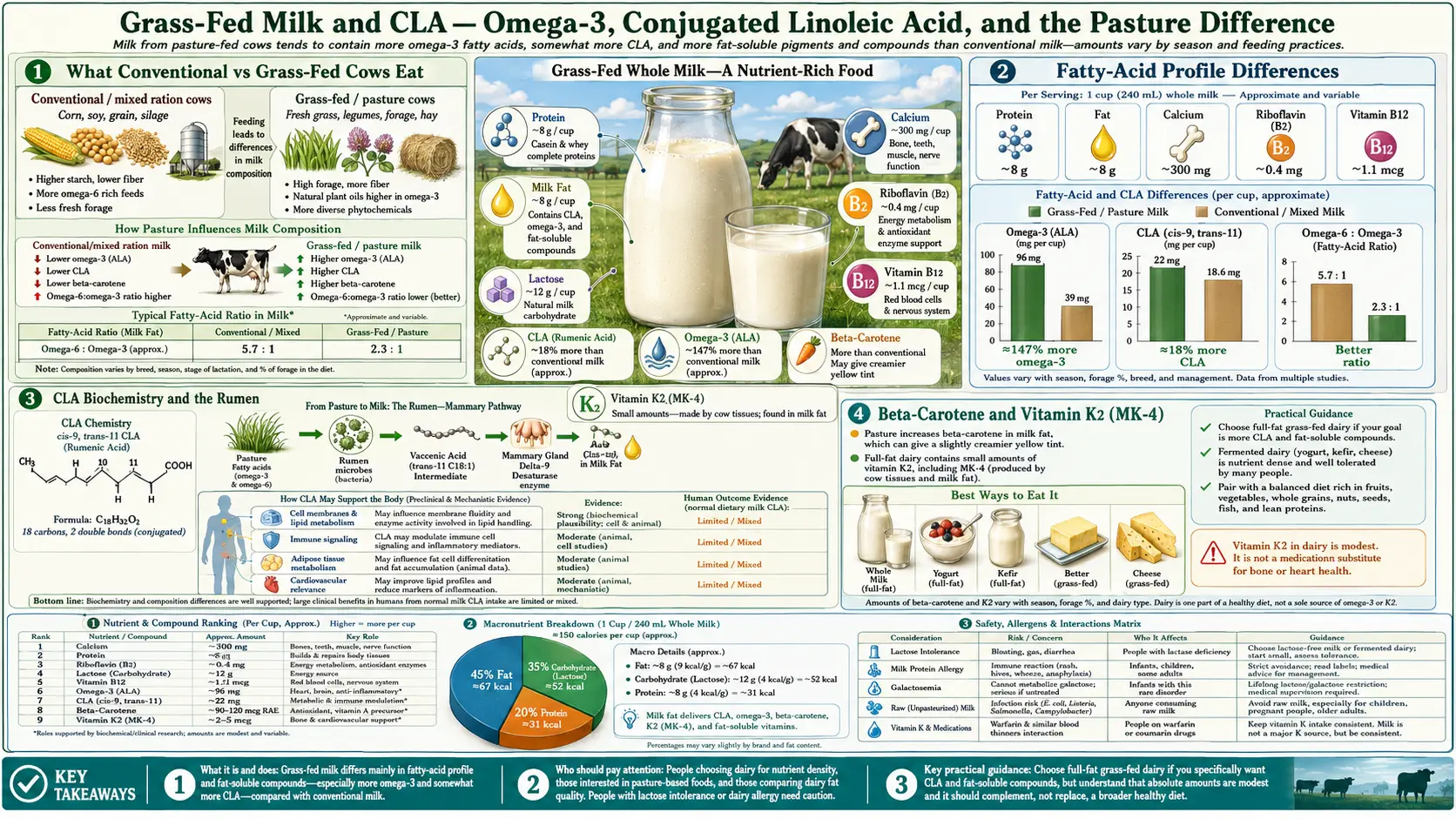
Milk fat composition reflects what the cow ate. In a US study of 1,163 milk samples from cows fed a nearly 100% forage-based diet ("grassmilk"), compared with earlier nationwide samples of conventional and organic milk, the omega-6:omega-3 ratio was 5.77 in conventional milk, 2.28 in organic milk and 0.95 in grassmilk, and total omega-3 and conjugated linoleic acid (CLA) were markedly higher in grassmilk (Benbrook et al. 2018). Fresh grass also raises the beta-carotene content of milk fat, which gives pasture butter and cheese a yellower color. Because these compounds are carried in the fat, the differences apply to whole milk, butter, cream and full-fat cheese. Human evidence on health outcomes comes mainly from observational studies and from trials of CLA supplements, whose isomer mix differs from dairy CLA; randomized trials of grass-fed versus conventional dairy in people are scarce.
Table of Contents
- What Conventional vs Grass-Fed Cows Eat
- Fatty-Acid Profile Differences
- CLA Biochemistry and the Rumen
- Beta-Carotene and Vitamin K2 (MK-4)
- Human Trial Evidence
- CLA Supplements vs Dairy CLA
- Labeling and Certification
- Cost, Availability, and Fat Content
- Key Research Papers
- External Resources
- Connections
- Featured Videos
1. What Conventional vs Grass-Fed Cows Eat
Much of US milk comes from cows fed a "total mixed ration" (TMR): a blended feed typically built on corn silage and grain, with alfalfa or other forages, protein meals such as soybean meal or distillers' grains, and vitamin and mineral premixes. The proportions vary from farm to farm, and many confinement operations provide little or no pasture access.
Grass-fed dairy standards differ. Some third-party "100% grass-fed" programs require a forage-only diet with no grain; the grassmilk in the Benbrook et al. 2018 study described below came from cows fed a nearly 100% forage-based diet. Pasture-based systems, such as those common in Ireland and New Zealand, keep cows grazing for much of the year with modest supplemental concentrates.
Between these extremes is a wide range of intermediate practices — cows on pasture for half the year and on TMR for the other half, cows with limited daily turnout, cows on a forage-heavy but not exclusive diet. The milk fatty-acid profile responds rapidly to changes in the cow's diet (Schwendel et al. 2015, PubMed PMID: 25497795), so a bottle of "pasture-raised" milk may or may not carry the full grass-fed fatty-acid signature, depending on the season and the herd's management.
2. Fatty-Acid Profile Differences
The Benbrook et al. 2018 study in Food Science & Nutrition (PubMed PMID: 29876120) measured fatty acids in 1,163 milk samples collected over 3 years from US farms whose cows were fed a nearly 100% forage-based diet ("grassmilk"), and compared them with conventional and organic retail milk from an earlier nationwide study by the same group. Because the raw grassmilk was higher in fat, the authors adjusted its values to the same total fatty-acid content as the retail milks. Results in grams per 100 g of milk (conventional / organic / adjusted grassmilk), with the percentage differences the authors report:
- Total omega-3: 0.020 / 0.032 / 0.049 — 147% higher in grassmilk than in conventional milk
- Alpha-linolenic acid (ALA, the plant-source omega-3 in grass leaves): 0.016 / 0.026 / 0.038 — 140% higher than conventional
- Total omega-6 and linoleic acid (LA): total omega-6 52% lower and LA 55% lower in grassmilk than in conventional milk
- Omega-6:omega-3 ratio: 5.77 in conventional, 2.28 in organic, 0.95 in grassmilk
- Total conjugated linoleic acid (CLA): 0.019 / 0.023 / 0.043 — 125% higher than conventional
- Eicosapentaenoic acid (EPA): 0.0025 / 0.0033 / 0.0036
- Total trans fatty acids (a group that includes vaccenic acid and CLA): 31% higher in grassmilk than in conventional milk
The paper discloses that several of its authors had employment or funding ties to the dairy cooperative that markets the grassmilk studied.
Controlled feeding studies show the same direction. Dhiman et al. 1999 (PubMed PMID: 10531600) found milk CLA of 8.9, 14.3 and 22.1 mg per g of milk fatty acids when pasture supplied one-third, two-thirds or all of the cows' feed, and cows grazing pasture with no supplemental feed had 500% more CLA in milk fat than cows fed a typical diet of 55% alfalfa silage and 45% grain. Couvreur et al. 2006 (PubMed PMID: 16702259) fed 8 cows diets in which 0, 30, 60 or 100% of the forage was fresh grass and found linear relationships: per 10% of fresh grass in the diet, vaccenic acid rose 0.38 points, rumenic acid (cis-9, trans-11 CLA) 0.12 points and ALA 0.05 points, while palmitic acid fell 0.69 points.
For organic milk, a 2016 meta-analysis of 170 studies (Średnicka-Tober et al., British Journal of Nutrition, PubMed PMID: 26878105) found organic milk higher than conventional in total n-3 PUFA by an estimated 56%, ALA by 69% and CLA by 41%, with no significant difference in total n-6 PUFA or linoleic acid; a redundancy analysis of a European milk survey pointed to higher grazing and conserved-forage intakes in organic systems as the main reason. A 2015 review (Schwendel et al., PubMed PMID: 25497795) concluded that feeding practice (high-input vs low-input) rather than the organic label itself determines the milk fatty-acid profile, with similar results seen in low-input organic and low-input conventional milk.
3. CLA Biochemistry and the Rumen
Conjugated linoleic acid (CLA) is the collective term for a family of geometric and positional isomers of linoleic acid (18:2). Milk contains over 20 CLA isomers; the predominant one is rumenic acid, cis-9, trans-11 CLA, at 75-90% of total CLA (Lock and Bauman 2004, PubMed PMID: 15736916). In an analysis of Portuguese ruminant foods, the second most represented isomer was trans-7, cis-9 CLA (Martins et al. 2007, PubMed PMID: 17640417). The trans-10, cis-12 isomer that dominates the body-fat research is a minor isomer in milk.
CLA in ruminant milk has two origins. First, dietary linoleic acid is biohydrogenated by rumen bacteria (such as Butyrivibrio fibrisolvens) in a multi-step pathway that passes through cis-9, trans-11 CLA and then vaccenic acid (trans-11 18:1) on the way to stearic acid (18:0). Cis-9, trans-11 CLA is an intermediate of linoleic acid biohydrogenation but not of alpha-linolenic acid biohydrogenation, and it is only a transient intermediate, so relatively little reaches the milk directly.
Second — and more importantly — vaccenic acid, which the rumen produces from both linoleic and alpha-linolenic acid, is absorbed and desaturated to rumenic acid by the enzyme delta-9-desaturase (stearoyl-CoA desaturase) in the mammary gland and other tissues. Lock and Bauman (2004) describe this endogenous synthesis as the major source of milk-fat CLA, and report that diet formulation can routinely achieve several-fold increases in milk-fat CLA. Benbrook et al. (2018) link the CLA increase in grassmilk to the high ALA content of forage grasses.
The same desaturation occurs in people. In a controlled feeding study of 30 healthy adults given 1.5, 3.0 or 4.5 g of vaccenic acid a day for 9 days (Turpeinen et al. 2002, PubMed PMID: 12197992), serum rumenic acid rose linearly with intake, and the average conversion rate of vaccenic acid to rumenic acid was 19%, with significant differences between individuals. Vaccenic acid was also present in partially hydrogenated vegetable oils, which have since been largely removed from the US food supply. Rumenic acid in adipose tissue has been measured in epidemiologic research as an exposure marker, as in the Costa Rican study described below.
4. Beta-Carotene and Vitamin K2 (MK-4)
Beta-carotene is an orange pigment present in green leaves (masked by chlorophyll). Cows eating fresh or ensiled grass pass part of it into milk fat, where it gives pasture butter and cheese their yellower color. In one feeding study (Nozière et al. 2006, PubMed PMID: 16772583), milk beta-carotene at the end of the trial was 0.17 µg/mL in cows kept on grass silage versus 0.07 µg/mL in cows switched to late-cut hay, and the drop occurred within about 2 weeks of the switch. Cheddar cheese made from the milk of pasture-fed cows was yellower and higher in beta-carotene than Cheddar from cows on an indoor TMR (O'Callaghan et al. 2017, PubMed PMID: 28624283).
Vitamin K2 is a family of menaquinones. Menaquinone-4 (MK-4) is made in animal tissues from vitamin K1 (phylloquinone, the form abundant in green leaves); in humans the enzyme responsible was identified in 2010 as UBIAD1 (Nakagawa et al., PubMed PMID: 20953171). A 2017 analysis of US dairy foods (Fu et al., PubMed PMID: 29955705) found that full-fat dairy contains menaquinones mainly as MK-9, MK-10 and MK-11, with modest amounts of MK-4, and that vitamin K content is proportional to fat: whole milk (4% fat) had 38.1 µg total vitamin K per 100 g versus 7.7 µg in nonfat milk, and reduced-fat or fat-free products held about 5-22% of the vitamin K of their full-fat equivalents. Published data comparing the MK-4 content of pasture-fed and grain-fed milk are limited, and no figure is given here.
Vitamin K is needed to activate vitamin K-dependent proteins, including osteocalcin in bone and matrix Gla protein in blood-vessel walls (see the NIH Office of Dietary Supplements fact sheet under External Resources).
5. Human Trial Evidence
Most of the human evidence on dairy CLA, omega-3 and vitamin K2 comes from observational studies and from trials of supplements rather than of grass-fed dairy itself. The principal findings:
Cardiovascular outcomes: Smit et al. 2010 in American Journal of Clinical Nutrition (PubMed PMID: 20463040) studied 1,813 people with a first non-fatal heart attack and 1,813 matched controls in Costa Rica, a country that uses traditional pasture grazing for dairy cows. Higher cis-9, trans-11 CLA in adipose tissue was associated with lower risk: the odds ratio for the highest versus the lowest quintile was 0.51 (95% CI 0.36-0.71), P for trend <0.0001. Dairy intake itself was not associated with heart-attack risk. As a case-control study it shows an association, not cause and effect; the authors concluded that this CLA "might offset" the adverse effect of the saturated fat in dairy products.
Body composition: In animals, the body-fat effects of CLA are attributed mainly to the trans-10, cis-12 isomer. A meta-analysis of 18 randomized, placebo-controlled human trials of CLA supplements (Whigham et al. 2007, PubMed PMID: 17490954) found that at the median dose of 3.2 g/day, CLA produced a modest fat loss of about 0.09 kg per week compared with placebo. Dietary CLA intake is far lower than these supplement doses: an estimate for Portugal put average total CLA intake at 73.7 mg/day, with milk and cheese the largest contributors (Martins et al. 2007, PubMed PMID: 17640417).
Cancer: Ip et al. 1994 (PubMed PMID: 8118808) found that dietary CLA at 0.05-0.5% of the diet produced a dose-dependent reduction in chemically induced mammary tumors in rats. This was an animal study, and an effect on human cancer outcomes has not been established. Belury's 2002 review (PubMed PMID: 12055356) summarizes the animal and mechanistic evidence.
Inflammation and insulin sensitivity: Randomized trials directly comparing grass-fed with conventional dairy fat in people are scarce, so effects of grass-fed dairy specifically on inflammatory markers or insulin sensitivity have not been established. The supplement trials in the next section concern isolated CLA, not milk.
6. CLA Supplements vs Dairy CLA
Commercial CLA supplements are industrially produced isomer mixtures with a large share of trans-10, cis-12 CLA, unlike the predominantly cis-9, trans-11 CLA of milk. In a 12-week randomized, double-blind trial in 60 abdominally obese men with signs of the metabolic syndrome (Risérus et al. 2002, Diabetes Care, PubMed PMID: 12196420), 3.4 g/day of purified trans-10, cis-12 CLA increased insulin resistance by 19% and glycemia by 4% and lowered HDL cholesterol by 4% compared with placebo; a commercial CLA isomer mixture at the same dose did not change glucose metabolism, body composition or weight, but lowered HDL cholesterol by 2%. In the same trial population, trans-10, cis-12 CLA raised the oxidative-stress marker 8-iso-PGF2α by 578% and C-reactive protein by 110% compared with placebo (Risérus et al. 2002, Circulation, PubMed PMID: 12370214).
Dairy CLA is consumed in much smaller amounts, is mainly the cis-9, trans-11 isomer, and comes within milk fat alongside vaccenic acid, beta-carotene, vitamin K and many other fatty acids. Results from high-dose supplement trials therefore do not transfer directly to milk.
7. Labeling and Certification
The USDA withdrew its voluntary grass-fed marketing claim standard in 2016, so "grass-fed" on a US dairy label does not by itself indicate a single defined standard. Several private third-party programs certify 100% grass-fed (forage-only) dairy; their rules differ, and typically address grain feeding and pasture access during the grazing season.
USDA Organic certification alone does not require 100% grass feeding (it requires that organic dairy cows receive at least 30% of their dry-matter intake from pasture during the grazing season), so organic milk and grass-fed milk are not synonymous. In the Benbrook 2018 comparison, organic milk lay between conventional milk and grassmilk in CLA and omega-3 content.
8. Cost, Availability, and Fat Content
100% grass-fed milk generally sells at a higher retail price than conventional milk and is less widely available.
The fatty-acid, beta-carotene and vitamin K differences described above are carried in the milk fat. Whole milk, butter, cream and full-fat cheese carry them; skim and 1% milk carry little of them because most of the fat has been removed, while protein and lactose are similar across fat levels.
Butter and cheese from pasture-based dairy systems carry the same fat-borne differences in concentrated form. In the O'Callaghan et al. 2017 study, Cheddar made from the milk of pasture-fed cows had more than twice the vaccenic acid and cis-9, trans-11 CLA of Cheddar from cows on an indoor TMR.
Breed is a separate question from diet: whether milk carries A1 or A2 beta-casein depends on the cow's genetics rather than its feed, and is covered on the A2 beta-casein page.
Key Research Papers
- Benbrook CM et al., Enhancing the fatty acid profile of milk through forage-based rations, with nutrition modeling of diet outcomes (Food Sci Nutr 2018;6(3):681-700) — PubMed PMID: 29876120
- Couvreur S et al., The linear relationship between the proportion of fresh grass in the cow diet, milk fatty acid composition, and butter properties (J Dairy Sci 2006;89:1956-1969) — PubMed PMID: 16702259
- Dewhurst RJ et al., Increasing the concentrations of beneficial polyunsaturated fatty acids in milk produced by dairy cows in high-forage systems (Anim Feed Sci Technol 2006;131:168-206) — doi:10.1016/j.anifeedsci.2006.04.016
- Ip C, Singh M, Thompson HJ, Scimeca JA, Conjugated linoleic acid suppresses mammary carcinogenesis and proliferative activity of the mammary gland in the rat (Cancer Res 1994;54:1212-1215) — PubMed PMID: 8118808
- Belury MA, Dietary conjugated linoleic acid in health: physiological effects and mechanisms of action (Annu Rev Nutr 2002;22:505-531) — PubMed PMID: 12055356
- Smit LA et al., Conjugated linoleic acid in adipose tissue and risk of myocardial infarction (Am J Clin Nutr 2010;92:34-40) — PubMed PMID: 20463040
- Lock AL, Bauman DE, Modifying milk fat composition of dairy cows to enhance fatty acids beneficial to human health (Lipids 2004;39:1197-1206) — PubMed PMID: 15736916
- Whigham LD, Watras AC, Schoeller DA, Efficacy of conjugated linoleic acid for reducing fat mass: a meta-analysis in humans (Am J Clin Nutr 2007;85:1203-1211) — PubMed PMID: 17490954
- Riserus U et al., Treatment with dietary trans-10 cis-12 conjugated linoleic acid causes isomer-specific insulin resistance in obese men with the metabolic syndrome (Diabetes Care 2002;25(9):1516-1521) — PubMed PMID: 12196420
- Schwendel BH et al., Invited review: organic and conventionally produced milk — an evaluation of factors influencing milk composition (J Dairy Sci 2015;98:721-746) — PubMed PMID: 25497795
- Daley CA et al., A review of fatty acid profiles and antioxidant content in grass-fed and grain-fed beef (Nutr J 2010;9:10) — PubMed PMID: 20219103
- Średnicka-Tober D et al., Higher PUFA and n-3 PUFA, conjugated linoleic acid, α-tocopherol and iron, but lower iodine and selenium concentrations in organic milk: a systematic literature review and meta- and redundancy analyses (Br J Nutr 2016;115(6):1043-1060) — PubMed PMID: 26878105
- Dhiman TR, Anand GR, Satter LD, Pariza MW, Conjugated linoleic acid content of milk from cows fed different diets (J Dairy Sci 1999;82(10):2146-2156) — PubMed PMID: 10531600
- Turpeinen AM et al., Bioconversion of vaccenic acid to conjugated linoleic acid in humans (Am J Clin Nutr 2002;76(3):504-510) — PubMed PMID: 12197992
- Risérus U et al., Supplementation with conjugated linoleic acid causes isomer-dependent oxidative stress and elevated C-reactive protein: a potential link to fatty acid-induced insulin resistance (Circulation 2002;106(15):1925-1929) — PubMed PMID: 12370214
- Martins SV et al., Contents of conjugated linoleic acid isomers in ruminant-derived foods and estimation of their contribution to daily intake in Portugal (Br J Nutr 2007;98(6):1206-1213) — PubMed PMID: 17640417
- Nozière P et al., Variations in carotenoids, fat-soluble micronutrients, and color in cows' plasma and milk following changes in forage and feeding level (J Dairy Sci 2006;89(7):2634-2648) — PubMed PMID: 16772583
- O'Callaghan TF et al., Effect of pasture versus indoor feeding systems on quality characteristics, nutritional composition, and sensory and volatile properties of full-fat Cheddar cheese (J Dairy Sci 2017;100(8):6053-6073) — PubMed PMID: 28624283
- Fu X et al., Multiple vitamin K forms exist in dairy foods (Curr Dev Nutr 2017;1(6):e000638) — PubMed PMID: 29955705
- Nakagawa K et al., Identification of UBIAD1 as a novel human menaquinone-4 biosynthetic enzyme (Nature 2010;468:117-121) — PubMed PMID: 20953171