Milk: Nutrient Profile
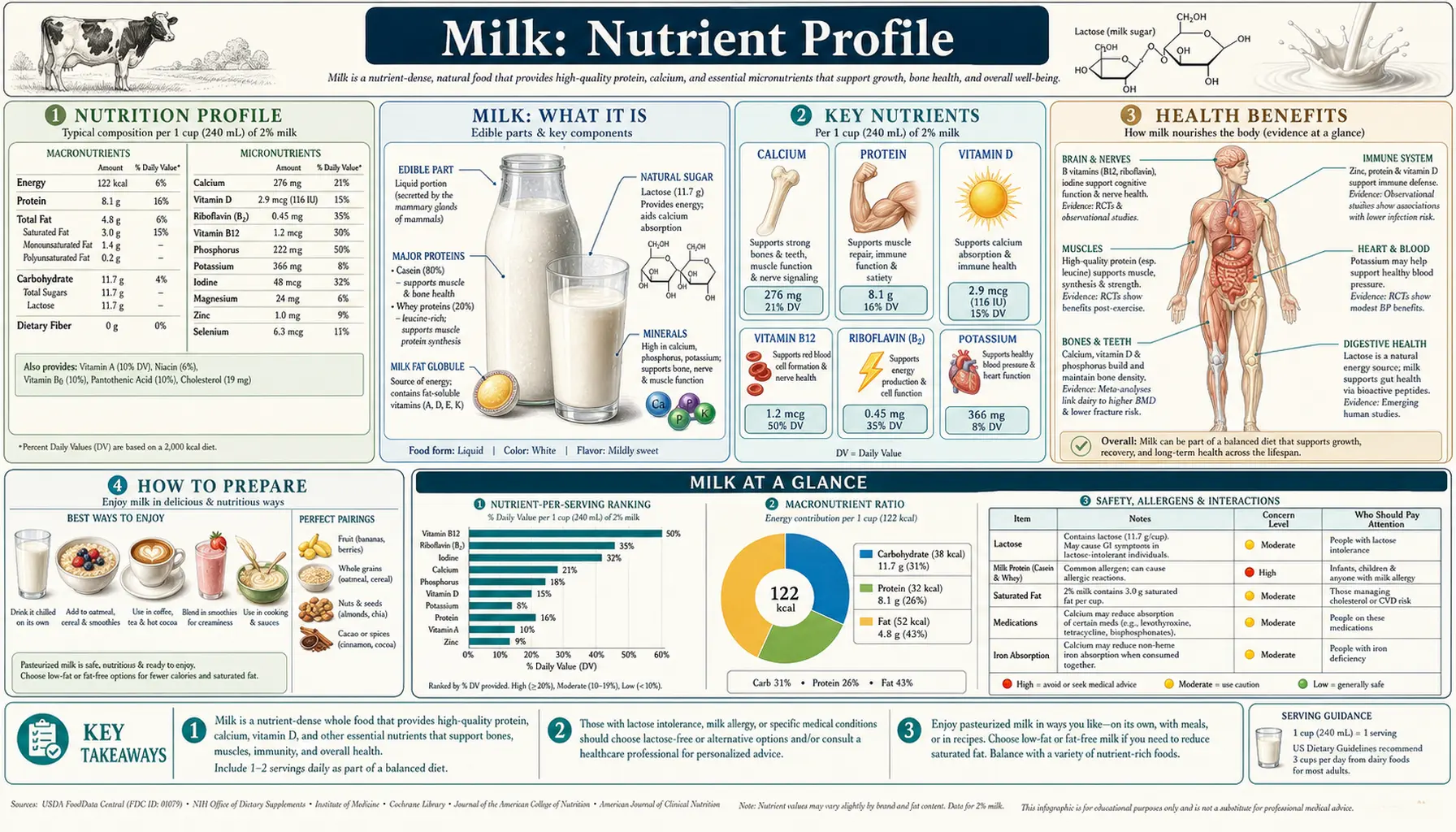
What is Milk richest in? Below are the vitamins, minerals and amino acids that 100 g of Milk delivers in the highest amounts. Vitamins and minerals appear in the table only when they reach at least 10% of the Daily Value per 100 g, so the list is not everything milk contains. Each one links to that nutrient’s own page listing the best foods to get it from.
| Milk: Richest Nutrients (per 100 g) | ||||
|---|---|---|---|---|
| Rank | Nutrient | Per 100 g | %DV / 100g | Purpose |
| Vitamins | ||||
| 1 | Vitamin B12 | 0.5 mcg | 🟡 19% | Nerves & red blood cells |
| 2 | Vitamin B2 (Riboflavin) | 0.2 mg | 🟡 13% | Energy & cell health |
| Amino Acids — ranked by amount (no Daily Value) | ||||
| 1 | Glutamic acid | 0.7 g | 🟢 | Brain signaling (glutamate) |
| 2 | Proline | 0.3 g | 🟡 | Collagen & joints |
| 3 | Leucine | 0.3 g | 🟡 | Builds muscle (branched-chain amino acid, BCAA) |
| 4 | Aspartic acid | 0.3 g | 🟡 | Cellular energy & detox |
| 5 | Lysine | 0.3 g | 🟡 | Collagen & immunity |
| 6 | Valine | 0.2 g | 🟡 | Muscle & energy (branched-chain amino acid) |
| 7 | Serine | 0.2 g | 🟡 | Cell membranes & brain |
| 8 | Isoleucine | 0.2 g | 🟡 | Muscle & energy (branched-chain amino acid) |
| 9 | Phenylalanine | 0.2 g | 🟡 | Dopamine & focus |
| 10 | Tyrosine | 0.2 g | 🟡 | Dopamine & thyroid |
| 11 | Threonine | 0.1 g | 🟡 | Collagen & gut lining |
| 12 | Alanine | 0.1 g | 🟡 | Energy (glucose cycle) |
| 13 | Histidine | 0.1 g | 🟡 | Histamine & blood |
| 14 | Arginine | 0.1 g | 🟡 | Blood flow (nitric oxide) |
Values are per 100 g of the U.S. Department of Agriculture (USDA) FoodData Central record FDC 171265, “Milk, whole, 3.25% milkfat, with added vitamin D” (SR Legacy). %DV is the amount per 100 g divided by the adult Daily Value in 21 CFR 101.9.
Calcium, the nutrient most readers look for in milk, falls under the table’s cut-off. The same USDA record lists 113 mg of calcium per 100 g, with 84 mg of phosphorus, 132 mg of potassium, 3.7 mcg of selenium, 46 mcg of vitamin A (RAE), 1.3 mcg of vitamin D and 14.3 mg of choline.