A1 vs A2 Beta-Casein — Genetics, BCM-7, and the Clinical Evidence
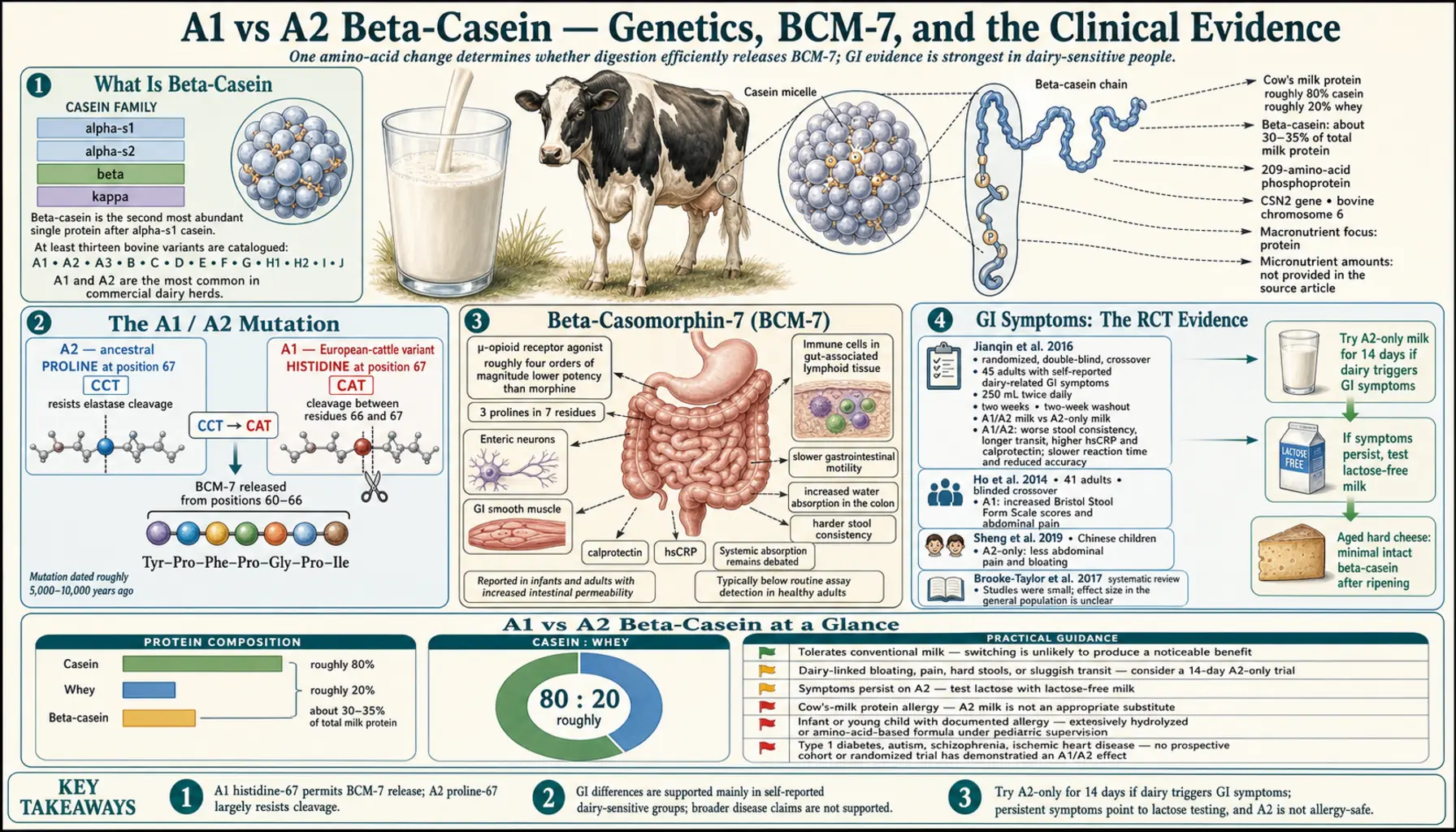
A single amino-acid difference at position 67 of the 209-amino-acid bovine beta-casein chain — histidine in A1, proline in A2 — affects whether digestion releases beta-casomorphin-7 (BCM-7), a seven-amino-acid peptide with opioid activity. Reviews describe A2 as the original form: the A1 variant arose from a point mutation in some European herds an estimated 5,000–10,000 years ago, human beta-casein is of the A2 type, and goat and sheep milk carry A2-like beta-casein. Three small blinded crossover trials, all industry-funded, report digestive differences between conventional (A1-containing) and A2-only milk, while reviews of the broader claims about type 1 diabetes and heart disease found no convincing evidence.
Table of Contents
1. What Is Beta-Casein
Beta-casein makes up roughly 30% of the total protein in cow's milk, according to a 2015 review by Pal and colleagues (PubMed PMID: 26404362), and a 2012 review letter describes it as the second most abundant milk protein (Sodhi et al., PubMed PMID: 23087884). It is a 209-amino-acid protein (Brooke-Taylor et al. 2017, PubMed PMID: 28916574).
Bovine beta-casein exists in several genetic variants. The Sodhi letter counts 12, of which A1 and A2 are the most common. Pal and colleagues describe A1 and A2 as two "families" covering at least 10 sub-variants: B, C, D, F and G in the A1 family, and A3, E, H1, H2 and I in the A2 family. The Brooke-Taylor review notes that the most important minor variant, type B, carries histidine at position 67 like A1, and that most studies do not report the minor variants and refer only to "A1" or "A2".
2. The A1 / A2 Mutation
A1 beta-casein carries histidine at position 67 and A2 carries proline. The difference is a single nucleotide: CAT (histidine) in A1 and CCT (proline) in A2 (Sodhi et al.).
According to the Brooke-Taylor review, histidine-67 in A1 is susceptible to proteolytic cleavage while proline-67 in A2 is not, so A1 has the potential to release short beta-casomorphin peptides during digestion, including BCM-7 — beta-casein positions 60–66, Tyr-Pro-Phe-Pro-Gly-Pro-Ile. Pal and colleagues state that A2 beta-casein releases much less, probably minimal, BCM-7 under normal gut conditions. In a laboratory study of milk from cows of different genotypes, the highest amounts of BCM-7 released from hydrolysed and processed milk were linked to the A1 allele; the traces found in A2 milk were attributed by the authors to acid hydrolysis during pepsin digestion (Cieślińska et al. 2012, PubMed PMID: 22080615). A 2007 review reports BCM-7 levels 4-fold higher in hydrolysed milk with the A1 variant than in A2 milk (Kamiński et al., PubMed PMID: 17666771).
Pal and colleagues place the proline-to-histidine mutation in some European herds about 5,000–10,000 years ago, which is why A2 is described as the original variant. The Brooke-Taylor review places the mutation in the ancestors of modern European-type cattle and describes native Asian and African breeds as a source of A1-free milk. Human beta-casein is of the A2 type, with proline at the equivalent position, and goat and sheep milk contain A2-like beta-casein (Pal et al.).
3. Beta-Casomorphin-7 (BCM-7)
Opioid activity in digested cow's milk was first reported in laboratory work in 1979, and the active peptide was later identified as BCM-7, which acts on μ-opioid receptors (as summarized in the Brooke-Taylor review). Pal and colleagues describe these receptors as expressed throughout the gastrointestinal tract and body.
In rodents, milk containing A1 beta-casein increased gastrointestinal transit time, dipeptidyl peptidase-4 and the inflammatory marker myeloperoxidase compared with A2 milk, and the opioid blocker naloxone blocked the myeloperoxidase and motility effects (Pal et al.). In humans, the Brooke-Taylor review found evidence from a limited number of studies: delayed intestinal transit in 1 clinical study and looser — not harder — stool consistency in 2. The reviewers describe the softer stools as counterintuitive given the slower transit and state that further replication is appropriate.
Whether BCM-7 reaches the bloodstream has been debated. Pal and colleagues report that bovine BCM-7 has been identified in human jejunal contents after milk-protein feeding, in the blood of human infants and in the urine of children. The European Food Safety Authority's 2009 conclusion (section 5) rested partly on BCM-7 not having been detected in human blood after milk or casein intake.
4. GI Symptoms: The RCT Evidence
The largest of the blinded trials is Jianqin et al. 2016, published in Nutrition Journal (PubMed PMID: 27039383). It was a double-blind, randomized 2 × 2 crossover trial in 45 Han Chinese adults with self-reported lactose intolerance. Participants drank 250 mL of milk after two meals a day for 14 days per period, with a 14-day washout at baseline and between periods. The conventional milk had an A1:A2 beta-casein ratio of about 40:60; the comparison milk contained only A2. With the conventional milk, the trial reported significantly greater post-dairy digestive discomfort, higher inflammation-related biomarkers (serum interleukin-4 and immunoglobulins IgG, IgE and IgG1) and BCM-7, longer colonic transit (by 6.6 hours) and whole-gut transit (by 6.3 hours) measured with a swallowed smart pill, lower faecal short-chain fatty acids, and longer response times and more errors on a cognitive test. Serum hs-CRP did not differ significantly (P = 0.0608). The trial was industry-funded.
The Ho et al. 2014 pilot study (PubMed PMID: 24986816) was a double-blind, randomized 8-week crossover in 41 adults (women and men). After a 2-week dairy washout on rice milk, participants drank 750 mL a day of milk containing either A1 or A2 beta-casein for 2 weeks, then had a second washout and 2 weeks of the other milk. The A1 milk produced significantly higher Bristol Stool Scale values (looser stools) than the A2 milk. Abdominal pain correlated with stool consistency on the A1 milk (r = 0.520, P = 0.001) but not on the A2 milk (r = −0.13, P = 0.43). Some individuals had higher faecal calprotectin on A1, though the Brooke-Taylor review notes no overall difference in faecal calprotectin between the A1 and A2 stages. The authors described the results as preliminary and requiring confirmation in a larger study. The trial was industry-funded.
The Sheng et al. 2019 trial (PubMed PMID: 31305326) was a randomized, double-blind crossover in Chinese preschool children aged 5–6 with mild-to-moderate milk intolerance; 80 children were enrolled, 68 of them confirmed lactase deficient. The children drank 150 mL twice a day for 5 days in each period. With A2-only milk the children had significantly less severe gastrointestinal symptoms on visual analog scales (which covered bloating, abdominal pain, flatulence and a heavy or full stomach), reduced stool frequency and improved stool consistency compared with conventional milk. Conventional milk was followed by increases from baseline in serum interleukin-4, immunoglobulins G, E and G1 and BCM-7, with lower glutathione. The trial was industry-funded, and the funder had input into drafting the manuscript.
The Brooke-Taylor et al. 2017 systematic review (PubMed PMID: 28916574) covered 39 in vitro and in vivo studies published through April 2017, excluding cheese and fermented milk products. It found that A1 delays intestinal transit in rodents through an opioid-mediated mechanism; that human evidence came from a limited number of studies (delayed transit in 1, looser stools in 2); and that digestive discomfort correlated with inflammatory markers in humans for A1 but not A2. The reviewers state that further research is required in different populations and dietary settings. The authors disclosed consulting work for the industry.
Limits of this evidence: three trials, each small and short (5 days to 2 weeks per period), all industry-funded. Two enrolled people with self-reported milk or lactose intolerance (Jianqin, Sheng). In the Ho trial, Pal and colleagues report that the stool difference remained significant when participants who reported milk intolerance before the trial were excluded.
5. Broader Claims vs Evidence
Claims about A1 beta-casein extend beyond digestion. The 2007 Kamiński review lists epidemiological claims linking A1 to ischaemic heart disease mortality and type 1 diabetes, a suggested role in sudden infant death syndrome, and suggested associations with autism and schizophrenia. The diabetes hypothesis rests largely on between-country correlations: Elliott and colleagues (1999) compared type 1 diabetes incidence in children aged 0–14 in 10 countries or areas with national milk protein consumption and found that total protein consumption did not correlate with incidence (r = +0.402) while A1 beta-casein consumption did (r = +0.726) (PubMed PMID: 10096780). A heart-disease link was later proposed from between-country correlations of coronary heart disease mortality with estimated A1 consumption.
The Truswell 2005 critical review (PubMed PMID: 15867940) found the between-country correlation method unreliable for both diabetes and heart disease, negated by recalculation with more countries and by prospective studies in individuals; the rodent experiments supporting the diabetes hypothesis were not confirmed by larger, better standardised multicentre experiments. It concluded that there was no convincing or even probable evidence that A1 beta-casein has any adverse effect in humans. That review predates the digestive trials in section 4.
The European Food Safety Authority's 2009 review (as summarized by Pal and colleagues) recognized that BCM-7 has biological activities such as regulatory effects on gastrointestinal motility and on gastric and pancreatic secretions, but concluded that a cause-and-effect relationship could not be established between dietary intake of BCM-7 and the non-communicable diseases it assessed, which included type 1 diabetes, heart disease and autistic spectrum disorders. EFSA did not examine intolerance or gastrointestinal effects (Pal et al.; Brooke-Taylor et al.).
In summary, the digestive differences rest on a few small industry-funded trials, and the disease claims were not supported by the Truswell review or by EFSA.
6. Which Breeds Produce A1 vs A2
The Kamiński review reports the A1 allele as most frequent in Holstein-Friesian (frequency 0.310–0.660), Ayrshire (0.432–0.720) and Red (0.710) cattle, and a high A2 frequency in Guernsey (0.880–0.970) and Jersey (0.490–0.721) cattle. Pal and colleagues add that Northern European breeds generally carry more A1 than Southern European breeds, that Guernsey and Fleckvieh are considered particularly high in A2, that breed category is not a reliable guide to any specific herd, and that in the herds of many Western countries the A1:A2 ratio is approximately 1:1.
Milk sold as A2 comes from genetically selected herds of European-type cattle certified free of the histidine-67 mutation (Brooke-Taylor et al.). Pal and colleagues report that herd testing by DNA analysis is available commercially in some countries, and that converting a herd by selective breeding can be done within 4 years with intensive selection including sex-selected semen, but more typically takes 5–8 years or longer. In the Jianqin trial, the conventional and A2-only milks were described as nearly identical in composition apart from the beta-casein.
7. A2 Herds and Other A2-Type Milks
The Brooke-Taylor review lists the ways A1 can be absent from dairy: goat, sheep and buffalo milk, milk from native Asian and African cattle breeds, and milk from genetically selected herds of European-type cattle certified free of the histidine-67 mutation.
On cheese and yoghurt, Pal and colleagues report evidence that BCM-7 is released from yoghurt and cheese as well as milk, with modest release during cheese- and yoghurt-making, and that certain yoghurt bacteria can hydrolyse BCM-7; whether those bacteria have the same effect inside the human gut is unknown. A 2010 laboratory study by De Noni and Cattaneo measured beta-casomorphins 5 and 7 in commercial dairy products and in their digests after simulated digestion (see Key Research Papers). The Brooke-Taylor review excluded cheese and fermented products.
8. What the Trials Do and Do Not Show
The trials compared conventional and A2-only milk for 5 days to 2 weeks per period; none tested longer use, and all were funded by the industry. In the Jianqin trial, whose participants all reported intolerance, conventional milk worsened symptoms relative to baseline in both the lactose-tolerant and the lactose-intolerant participants (lactose status confirmed by urinary galactose testing), while A2-only milk did not.
Pal and colleagues describe true lactose intolerance (symptoms from lactose malabsorption) as less common than widely perceived and as only one potential cause of cows' milk intolerance, with A1 beta-casein increasingly associated with it as well.
The trials do not address milk allergy: the Sheng trial excluded children with known allergies to dairy products. Decisions about diet and digestive symptoms belong with a clinician.
Key Research Papers
- Jianqin S et al., Effects of milk containing only A2 beta-casein versus milk containing both A1 and A2 beta-casein on gastrointestinal physiology, symptoms of discomfort, and cognitive behavior of people with self-reported intolerance to traditional cows' milk (Nutr J 2016;15:35) — PubMed PMID: 27039383
- Ho S et al., Comparative effects of A1 versus A2 beta-casein on gastrointestinal measures: a blinded randomized cross-over pilot study (Eur J Clin Nutr 2014;68:994-1000) — PubMed PMID: 24986816
- Sheng X et al., Effects of conventional milk versus milk containing only A2 beta-casein on digestion in Chinese children: a randomized study (J Pediatr Gastroenterol Nutr 2019;69:375-382) — PubMed PMID: 31305326
- Brooke-Taylor S et al., Systematic review of the gastrointestinal effects of A1 compared with A2 beta-casein (Adv Nutr 2017;8:739-748) — PubMed PMID: 28916574
- Kamiński S et al., Polymorphism of bovine beta-casein and its potential effect on human health (J Appl Genet 2007;48:189-198) — PubMed PMID: 17666771
- Truswell AS, The A2 milk case: a critical review (Eur J Clin Nutr 2005;59:623-631) — PubMed PMID: 15867940
- Pal S et al., Milk intolerance, beta-casein and lactose (Nutrients 2015;7:7285-7297) — PubMed PMID: 26404362
- Cieślińska A et al., Milk from cows of different β-casein genotypes as a source of β-casomorphin-7 (Int J Food Sci Nutr 2012;63:426-430) — PubMed PMID: 22080615
- Elliott RB et al., Type I (insulin-dependent) diabetes mellitus and cow milk: casein variant consumption (Diabetologia 1999;42:292-296) — PubMed PMID: 10096780
- Sodhi M et al., Milk proteins and human health: A1/A2 milk hypothesis (Indian J Endocrinol Metab 2012;16:856) — PubMed PMID: 23087884
- European Food Safety Authority (EFSA), Review of the potential health impact of beta-casomorphins and related peptides (EFSA Scientific Report 2009;231) — doi:10.2903/j.efsa.2009.231r
- De Noni I, Cattaneo S, Occurrence of β-casomorphins 5 and 7 in commercial dairy products and in their digests following in vitro simulated gastro-intestinal digestion (Food Chem 2010;119:560-566) — doi:10.1016/j.foodchem.2009.06.058