Leishmania Treatment: Regional Protocols and WHO Guidelines
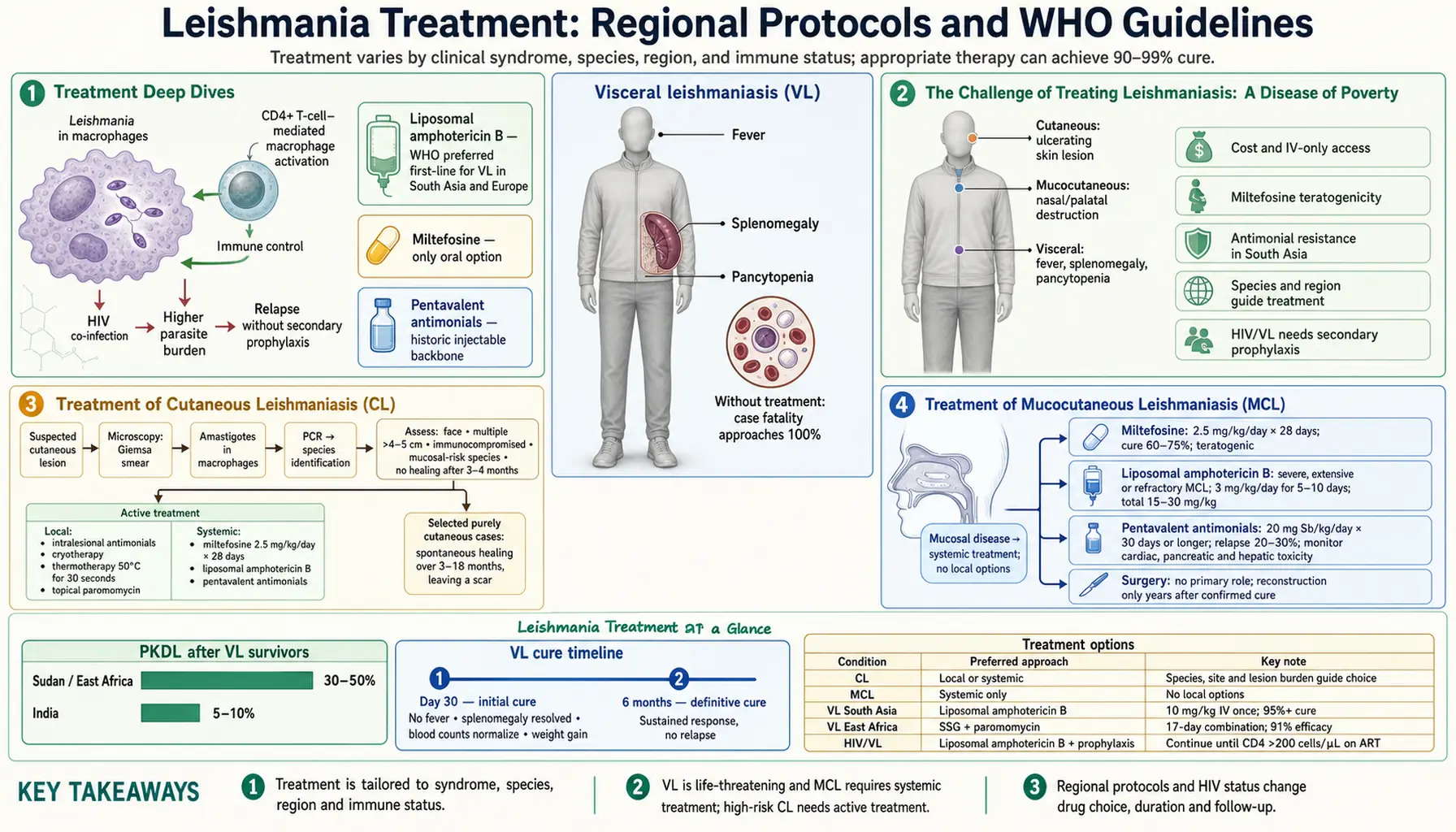
Treatment of leishmaniasis is not one-size-fits-all. It varies by (1) clinical syndrome — cutaneous (CL), mucocutaneous (MCL), or visceral (VL); (2) the Leishmania species responsible; (3) geographic region, because drug resistance and efficacy differ dramatically between South Asia, East Africa, the Mediterranean, and the Americas; and (4) the immune status of the patient, with HIV co-infection fundamentally changing outcomes and requiring secondary prophylaxis. WHO prioritizes liposomal amphotericin B as first-line for VL in South Asia; pentavalent antimonials remain first-line in East Africa where resistance is low; miltefosine provides the only oral option; and combination regimens are gaining ground as a strategy to shorten treatment courses and reduce the risk of resistance developing to any single drug.
Symptoms Hub
Overview of all three clinical forms of Leishmaniasis — cutaneous, mucocutaneous, and visceral.
Read the deep dive →Cutaneous & Mucosal Leishmaniasis
The ulcerating skin lesion, espundia (mucocutaneous destruction), and Old vs. New World species.
Read the deep dive →Visceral Leishmaniasis (Kala-Azar)
The "black fever" — massive splenomegaly, pancytopenia, and near-100% mortality if untreated.
Read the deep dive →Diagnosis: Microscopy & PCR
Giemsa smear amastigotes in macrophages, rK39 rapid test, PCR species ID, and splenic aspirate.
Read the deep dive →Treatments Hub
WHO first-line regimens — liposomal AmphoB, miltefosine, antimonials, and regional protocols.
Read the deep dive →Liposomal Amphotericin B
WHO first-line VL treatment — dosing, efficacy, nephrotoxicity reduction, and HIV co-infection.
Read the deep dive →Miltefosine & Antimonials
The first oral VL drug, pentavalent antimonials, resistance crisis in South Asia, and combination therapies.
Read the deep dive →Prevention & Vector Control
Sandfly control, fine-mesh nets, reservoir management, and the search for a human vaccine.
Read the deep dive →Table of Contents
- Treatment Deep Dives
- The Challenge of Treating Leishmaniasis
- Treatment of Cutaneous Leishmaniasis
- Treatment of Mucocutaneous Leishmaniasis
- Treatment of Visceral Leishmaniasis: WHO First-Line
- Regional Variations in VL Treatment Protocols
- Combination Therapies: Shorter Courses, Less Resistance
- Treatment in HIV Co-infected Patients
- Treatment of Post-Kala-Azar Dermal Leishmaniasis (PKDL)
- Key Research Papers
- Connections
- Featured Videos
1. Treatment Deep Dives
The three sub-articles below cover the major antileishmanial treatment strategies in clinical depth, including mechanisms, regimens, adverse effects, resistance patterns, and special populations. The hub article on this page provides the strategic overview; the sub-articles provide the detail needed to understand why different regimens are used in different clinical contexts.
- Liposomal Amphotericin B — the WHO preferred first-line for VL in South Asia and Europe
- Miltefosine and Antimonials — the only oral option and the historic injectable backbone
- Prevention and Vector Control — sandfly control, insecticide-treated nets, reservoir management, and vaccines
2. The Challenge of Treating Leishmaniasis: A Disease of Poverty
Leishmaniasis is classified by the World Health Organization as a neglected tropical disease — and the label is apt. The infection strikes overwhelmingly in low-income countries and marginalized communities: subsistence farmers in Bihar (India), displaced populations in Sudan and Syria, indigenous communities in the Amazon basin, and rural villages in East Africa where access to a clinic may require a day's journey on foot. The irony is that the drugs to treat it exist and are effective — cure rates of 90–99% are achievable — yet the disease kills tens of thousands of people annually because those drugs either cost too much, require intravenous administration that is logistically impossible in remote settings, or cause severe side effects that demand medical supervision.
The treatment landscape has also been complicated by the emergence of drug resistance, most dramatically in the Indian state of Bihar, where the parasite Leishmania donovani developed near-universal resistance to pentavalent antimonials — the drugs that had been the global standard of care for decades — forcing a rapid shift to newer, more expensive alternatives. Resistance is not a theoretical concern: it reshaped the treatment algorithms of an entire region, affecting millions of people.
The major challenges shaping treatment choices today are: (1) the cost and IV-only route of the most effective drug (liposomal amphotericin B), (2) teratogenicity of the only oral drug (miltefosine), (3) existing resistance of L. donovani in South Asia to antimonials, (4) the need for individualized treatment by species and region, and (5) the special complexity of VL in HIV-co-infected patients who require lifelong secondary prophylaxis.
3. Treatment of Cutaneous Leishmaniasis (CL)
Treatment decisions for CL depend heavily on the infecting species, lesion number and size, and whether the patient is immunocompromised or infected with a species at risk for mucosal spread. Many cases of CL caused by species that are purely cutaneous (such as L. major in the Middle East or L. tropica in urban Central Asia) will heal spontaneously over 3–18 months, leaving a scar. Whether to treat or watch depends on the clinical context.
Indications for active treatment in CL: lesions on the face (where scarring is most disfiguring), multiple lesions, large lesions (>4–5 cm), immunocompromised host, infection with a species known to carry mucosal risk (especially L. braziliensis and related Viannia subgenus species in Latin America), or failure to show spontaneous healing after 3–4 months.
Local treatment options for uncomplicated CL:
- Intralesional antimonials: injection of meglumine antimoniate or sodium stibogluconate directly into the lesion; effective for small, localized lesions caused by non-mucosal species; avoids systemic side effects; requires repeated injections over several weeks
- Cryotherapy: liquid nitrogen applied to the lesion; sometimes combined with intralesional antimonials; a 2010 Cochrane review found combination superior to either alone for L. tropica CL
- Thermotherapy: local heat applied at 50°C for 30 seconds (delivered by a radio-frequency device); effective for Old World CL; well-tolerated; not widely available
- Topical paromomycin ointment: available for L. major CL; variable efficacy; used primarily when systemic treatment is contraindicated
Systemic treatment for CL: miltefosine orally (2.5 mg/kg/day × 28 days; first-line for New World CL in the Americas), liposomal amphotericin B IV (for refractory or mucosal-risk disease), or pentavalent antimonials IM/IV (in regions where effective). Species identification by PCR guides selection.
4. Treatment of Mucocutaneous Leishmaniasis (MCL)
MCL requires systemic treatment — there are no local options once the disease has spread to mucous membranes. Historically, pentavalent antimonials (sodium stibogluconate or meglumine antimoniate, 20 mg Sb/kg/day × 30 days or longer) were the primary treatment for MCL, but response rates are lower than for VL, relapse is common (20–30%), and the drugs are toxic. A common complication is paradoxical worsening due to immune reconstitution when treatment begins.
Current approach for MCL:
- Miltefosine (2.5 mg/kg/day × 28 days, sometimes extended to two cycles): evidence from South American studies supports efficacy for L. braziliensis MCL; cure rates 60–75%; easier to administer than IV antimonials; teratogenicity is a major concern in women of childbearing age
- Liposomal amphotericin B: increasingly preferred for severe MCL, extensive nasal/palatal involvement, or disease refractory to antimonials; typical course 3 mg/kg/day for 5–10 days (total 15–30 mg/kg); better tolerability than antimonials
- Pentavalent antimonials: remain in use in many settings where alternatives are unavailable or unaffordable; 30-day courses required; monitor cardiac, pancreatic, and hepatic toxicity closely
- Surgery: has no primary role; reconstructive procedures may be considered years after documented cure to address severe nasal/palatal deformity, but only once parasitologic cure is confirmed
A clinical challenge of MCL is that it can present years after a CL episode that may have been subclinical or forgotten, making the diagnosis easy to miss in non-endemic countries. Ear, nose, and throat specialists in Europe and North America sometimes see advanced MCL in patients who traveled to Latin America years earlier.
5. Treatment of Visceral Leishmaniasis: WHO First-Line
Visceral leishmaniasis is life-threatening and always requires systemic treatment. Without it, case fatality approaches 100%. With appropriate treatment initiated before end-organ complications, cure rates of 90–99% are achievable. WHO treatment guidelines for VL reflect the recognition that no single regimen is universally appropriate, and recommendations are region-stratified.
WHO current first-line treatment by region:
- South Asia (India, Nepal, Bangladesh): liposomal amphotericin B (AmBisome) — single-dose 10 mg/kg IV is recommended and achieves 95%+ cure rates; alternatively, 3 mg/kg/day × 5 days + day 10 (total 18 mg/kg); the single-dose regimen dramatically simplifies logistics and reduces hospitalization costs; miltefosine 28-day course is an alternative especially where AmBisome is unavailable
- East Africa (Ethiopia, Sudan, Kenya, Uganda): sodium stibogluconate (SSG) 20 mg Sb/kg/day IM × 30 days PLUS paromomycin 15 mg/kg/day IM × 17 days (combination); the SSG+paromomycin combination was validated in a landmark East Africa trial, reducing treatment duration vs. SSG monotherapy while maintaining 91% efficacy; liposomal AmphoB is an alternative where available
- Mediterranean Europe and Latin America (L. infantum/chagasi): liposomal amphotericin B (multi-dose: 3–4 mg/kg/day for 5–10 doses, total 20–40 mg/kg); antimonials are an alternative but cardiac monitoring is required
Cure criteria for VL: initial cure is defined as absence of fever, resolution of splenomegaly, normalization of blood counts, and weight gain by day 30 of follow-up. Definitive cure requires sustained response at 6 months post-treatment without relapse.
6. Regional Variations in VL Treatment Protocols
Why do treatment protocols differ so dramatically by region? Three factors drive the variation: (1) drug resistance patterns, (2) species-specific drug sensitivities, and (3) health system capacity.
The Bihar resistance crisis: In Bihar state, India — historically one of the highest-burden VL areas in the world — pentavalent antimonials (SSG, Glucantime) developed near-universal resistance in L. donovani by the early 2000s. Clinical failure rates exceeded 60–65%. This forced WHO and national health authorities to rapidly pivot to liposomal AmphoB and miltefosine as alternatives. The resistance crisis illustrates the fragility of relying on a single drug class for a disease of this scale.
East Africa resistance profile: L. donovani in East Africa (Ethiopia, Sudan) remains largely sensitive to antimonials. Resistance has been documented but is not yet the treatment-ending phenomenon it became in South Asia. The SSG+paromomycin combination exploits this sensitivity while reducing the duration of each drug's monotherapy exposure, which may slow resistance development.
Mediterranean: L. infantum in Mediterranean Europe causes both zoonotic VL (especially in children and immunosuppressed adults in southern Europe) and canine leishmaniasis. Liposomal AmphoB is well-established here because European healthcare systems can support IV therapy and because drug prices (while high) are more affordable within European health systems than in low-income countries.
Americas: L. infantum/chagasi causes VL in Brazil and neighboring countries; antimonials (meglumine antimoniate) have been first-line in Brazil but liposomal AmphoB is now preferred where available given superior safety. Miltefosine is approved and used. Species diversity is greater in the Americas, requiring PCR-based species identification for optimal treatment selection.
7. Combination Therapies: Shorter Courses, Less Resistance
The rationale for combination therapy in leishmaniasis parallels the logic behind combination treatment in tuberculosis and HIV: combining two drugs with different mechanisms reduces the chance that a single mutation can confer resistance to both, shortens the treatment course (improving compliance and reducing toxicity exposure), and may allow lower doses of each drug individually. WHO has recommended combination regimens for VL in South Asia since 2010.
Validated combination regimens for VL:
- Liposomal AmphoB (single dose 5 mg/kg) + Miltefosine (7 days): South Asian trial data showed this combination achieved 97.5% initial cure at day 30 — comparable to 28-day miltefosine monotherapy but far shorter and logistically simpler; validated in India, Nepal, and Bangladesh; now WHO recommended for South Asia
- Liposomal AmphoB (single dose 5 mg/kg) + Paromomycin (10 days IM): studied in India and East Africa; efficacy 95%+ in South Asia; East African data slightly lower efficacy but acceptable
- Miltefosine (10 days) + Paromomycin (10 days IM): all-outpatient combination with no IV requirement; studied in India; initial cure rates 97.3% in controlled trial; logistically attractive for resource-limited settings
- SSG + Paromomycin (East Africa): the established first-line combination in East Africa; 17-day course of both drugs combined is non-inferior to 30-day SSG monotherapy with equivalent efficacy and shorter hospital stay
The clinical implication is that a patient with VL in South Asia can now be treated with a single IV infusion plus 7–10 days of oral medication — a remarkable simplification from the 30-day IM/IV antimonial courses that were standard a generation ago.
8. Treatment in HIV Co-infected Patients
VL in the context of HIV infection is a distinct clinical entity that demands a different treatment strategy. HIV depresses precisely the immune mechanisms — CD4+ T cell-mediated macrophage activation — that control Leishmania infection. The result is higher parasite burdens, atypical presentations (gastrointestinal or pulmonary involvement not seen in immunocompetent patients), lower cure rates, and near-universal relapse without secondary prophylaxis.
Initial treatment: liposomal amphotericin B is strongly preferred for HIV/VL co-infection regardless of region. Standard regimens use higher total doses than for immunocompetent patients: typically 3–5 mg/kg/day for 10 days (total 30–50 mg/kg) or WHO regimen of 4 mg/kg on days 1–5, 10, 17, 24, 31, 38 (total 40 mg/kg). Initial cure rates are 70–85%, lower than in immunocompetent patients.
Secondary prophylaxis: without secondary prophylaxis, relapse rates within 12 months reach 60–80%. WHO recommends secondary prophylaxis with liposomal AmphoB 3–5 mg/kg IV every 3–4 weeks until CD4 count recovers to >200 cells/μL on antiretroviral therapy (ART). ART is itself treatment — immune reconstitution is the only sustainable way to control VL in an HIV-co-infected person.
Antiretroviral interactions: miltefosine has no known pharmacokinetic interactions with current ART regimens. Amphotericin B adds nephrotoxic risk to tenofovir-based regimens; creatinine and electrolytes require close monitoring. Antimonials have cardiac toxicity risks that may be compounded by HIV-related cardiomyopathy.
9. Treatment of Post-Kala-Azar Dermal Leishmaniasis (PKDL)
Post-kala-azar dermal leishmaniasis (PKDL) is a late complication of VL that occurs in a subset of patients after apparently successful treatment of visceral disease. In India, PKDL appears in 5–10% of VL survivors, typically 6 months to 3 years after treatment. In Sudan and East Africa, rates are higher (30–50%) and the rash may appear sooner (during or shortly after VL treatment) and often resolves spontaneously within months.
The clinical importance of PKDL extends beyond cosmetic concern: the skin lesions contain viable Leishmania parasites that can infect sandflies, making PKDL patients a reservoir for ongoing transmission. The WHO South Asian VL elimination program regards PKDL as a significant obstacle because it sustains transmission even as case counts fall.
PKDL treatment options:
- Miltefosine (2.5 mg/kg/day × 12 weeks): the preferred regimen for Indian PKDL; longer course than for VL because skin penetration is slower and parasite density lower; 90%+ cure rates in trials; teratogenicity limits use in women of childbearing age
- Liposomal AmphoB: used for miltefosine-refractory PKDL or in women who cannot take miltefosine; multi-dose regimens required; efficacy data more limited than for VL
- Antimonials: historically used for PKDL but resistance in India limits utility; still used in East Africa where antimonial-sensitive species predominate and PKDL often resolves spontaneously without treatment
- Observation without treatment (Sudan/East Africa PKDL): given the high spontaneous resolution rate in East African PKDL, immediate treatment is often deferred unless disease is extensive or prolonged
Key Research Papers
Peer-reviewed clinical trials and systematic reviews on antileishmanial treatment strategies across regions and clinical forms. DOI and PMID links open the full citation.
- Sundar S, Chakravarty J, Agarwal D, et al. Single-dose liposomal amphotericin B for visceral leishmaniasis in India. N Engl J Med. 2010;362(6):504–512. — Search PubMed
- Alvar J, Vélez ID, Bern C, et al. Leishmaniasis worldwide and global estimates of its incidence. PLoS ONE. 2012;7(5):e35671. — Search PubMed
- Olliaro PL, Shamsuzzaman TAK, Manica M, et al. Combination treatments for visceral leishmaniasis in East Africa. Lancet Infect Dis. 2015;15(9):1012–1018. — Search PubMed
- Sundar S, Singh A, Rai M, et al. Efficacy of miltefosine in the treatment of visceral leishmaniasis in India after a decade of use. Clin Infect Dis. 2012;55(4):543–550. — Search PubMed
- Dorlo TPC, Balasegaram M, Beijnen JH, de Vries PJ. Miltefosine: a review of its pharmacology and therapeutic efficacy in the treatment of leishmaniasis. J Antimicrob Chemother. 2012;67(11):2576–2597. — Search PubMed
- Sundar S, Sinha PK, Rai M, et al. Comparison of short-course multidrug treatment with standard therapy for visceral leishmaniasis in India. Bull World Health Organ. 2011;89(10):726–734. — PubMed PMID: 21255828
- Mondal D, Hasnain MG, Hossain MS, et al. Study on drug efficacy for visceral leishmaniasis in Bangladesh. Trans R Soc Trop Med Hyg. 2019;113(9):556–564. — Search PubMed
- Musa AM, Mbui J, Khalil EA, et al. Efficacy and safety of liposomal amphotericin B versus miltefosine for treatment of post-kala-azar dermal leishmaniasis in Sudan and India. PLoS Negl Trop Dis. 2019;13(8):e0007673. — Search PubMed
- Chappuis F, Sundar S, Hailu A, et al. Visceral leishmaniasis: what are the needs for diagnosis, treatment and control? Nat Rev Microbiol. 2007;5(11 Suppl):S7–S16. — PubMed PMID: 17938629
- Cota GF, de Sousa MR, Fereguetti TO, et al. The cure rate after placebo or no therapy in American cutaneous leishmaniasis. PLoS Negl Trop Dis. 2016;10(2):e0004361. — Search PubMed
PubMed Topic Searches
Each link opens a live PubMed query for current literature.
- PubMed: VL treatment WHO guidelines
- PubMed: Liposomal AmphoB VL trial
- PubMed: Miltefosine VL resistance
- PubMed: CL treatment and cryotherapy
- PubMed: MCL amphotericin treatment
- PubMed: Leishmaniasis HIV co-infection
- PubMed: Post-kala-azar dermal leishmaniasis
- PubMed: Leishmaniasis combination therapy
Connections
- All Parasites
- Leishmania: Leishmaniasis Overview
- Symptoms Hub
- Cutaneous & Mucosal Leishmaniasis
- Visceral Leishmaniasis (Kala-Azar)
- Diagnosis: Microscopy & PCR
- Liposomal Amphotericin B
- Miltefosine and Antimonials
- Prevention and Vector Control
- Malaria
- Trypanosoma (Sleeping Sickness)
- Acanthamoeba
- Infectious Disease
- All Conditions
- Leishmaniasis (Infectious Disease Overview) — the disease itself across its cutaneous, mucocutaneous, and visceral forms.