Diagnosing Leishmaniasis: Microscopy, PCR, and Rapid Tests
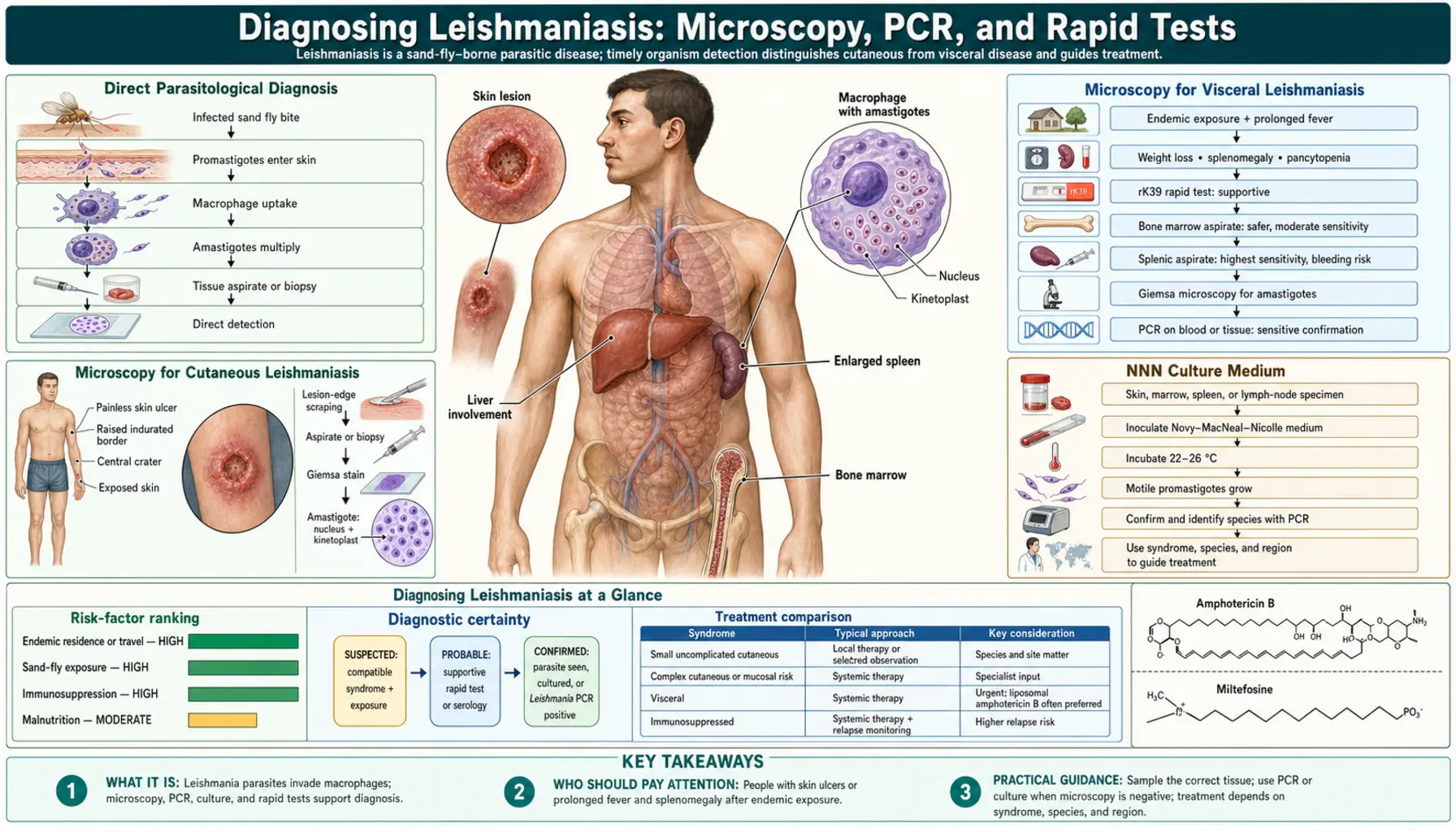
Diagnosing leishmaniasis requires matching clinical suspicion with the right laboratory test for the right clinical form. Direct microscopy (Giemsa smear for amastigotes in macrophages) remains the bedrock in resource-limited settings. The rK39 rapid diagnostic test has transformed visceral leishmaniasis diagnosis in the field. PCR provides the highest sensitivity, identifies species, and enables treatment monitoring. Getting the diagnosis right before treatment — particularly identifying species in cutaneous disease — can be the difference between a brief outpatient course and years of inadequate therapy.
Table of Contents
- Direct Parasitological Diagnosis
- Microscopy for Cutaneous Leishmaniasis
- Microscopy for Visceral Leishmaniasis
- NNN Culture Medium
- PCR: Gold Standard for Sensitivity and Species ID
- rK39 Rapid Diagnostic Test
- Other Serological Tests
- Why Species Identification Matters
- Complete Blood Count in VL
- Serology Failures in HIV/Immunocompromised Patients
- Post-Treatment Monitoring
- Key Research Papers
- Featured Videos
1. Direct Parasitological Diagnosis
Direct parasitological methods — those that physically demonstrate the parasite in patient tissue — are the traditional gold standard of leishmaniasis diagnosis. They require the examiner to see amastigotes: the small, oval, intracellular form of Leishmania (2–4 micrometers in diameter) that lives inside macrophages in the infected host. The amastigote is identified by two internal structures visible under Giemsa staining: the nucleus (a large, round, reddish-purple structure) and the kinetoplast (a small, rod-shaped dark dot at a right angle to the nucleus, representing the mitochondrial DNA). Finding amastigotes within macrophages on a properly stained smear is diagnostic of leishmaniasis.
The sensitivity of direct microscopy depends heavily on the parasite burden in the sampled tissue, the experience of the microscopist, and the quality of the stain preparation. Sensitivity ranges from as low as 40–50% (in CL lesions of long duration with few parasites remaining) to as high as 93–98% (splenic aspirate in active VL). A negative smear never definitively rules out leishmaniasis; a positive smear always confirms it.
2. Microscopy for Cutaneous Leishmaniasis
For cutaneous leishmaniasis, the two main sampling techniques are the slit-skin smear and the punch biopsy. The site of sampling is critically important: material must come from the active edge of the ulcer, not the necrotic center. The center of a CL ulcer contains dead, degenerating tissue with few viable parasites; the raised, indurated rim at the periphery of the ulcer contains the most active parasite-laden macrophages.
The slit-skin smear is a quick, inexpensive technique suited to field conditions. After cleansing the ulcer edge, the clinician pinches the skin firmly to express blood from the capillaries (reducing blood contamination of the smear), then makes a small superficial incision with a scalpel and scrapes tissue juice from the cut surface. The material is spread on a glass slide, air-dried, fixed with methanol, and stained with Giemsa stain. The slide is then examined under oil immersion at 1000x magnification for amastigotes inside macrophages. An experienced microscopist examining multiple slides from the same lesion can achieve sensitivity of 50–80% in active CL.
Sensitivity of CL smears falls significantly as lesions age. A fresh CL ulcer (less than 2–3 months old) in an immunocompetent patient typically has a robust parasite burden and gives a positive smear in experienced hands. An older ulcer (6+ months), particularly one in the healing phase, may have very few parasites remaining — the same Th1 immune response that is killing parasites and healing the lesion also reduces parasite density to below the detection threshold of microscopy. This is when PCR becomes essential.
A punch biopsy (typically 3–4 mm) taken from the ulcer edge provides material for both microscopy and PCR simultaneously, and also allows histopathological examination showing the characteristic granulomatous inflammation with macrophages containing amastigotes. Touch imprints from the biopsy surface (pressing the cut biopsy onto a glass slide before fixing the tissue in formalin) provide additional material for smear microscopy without sacrificing the specimen for culture or PCR.
3. Microscopy for Visceral Leishmaniasis
For visceral leishmaniasis, the traditional gold standard has been aspiration of the spleen or bone marrow for Giemsa-stained smear and culture. The choice between these two sites involves a direct tradeoff between sensitivity and safety.
Splenic aspirate is the most sensitive parasitological test for VL — sensitivity of 93–98% in expert hands. The spleen in active VL is engorged with parasitized macrophages, and aspiration of a small volume of splenic pulp yields abundant amastigotes. The procedure is performed with a fine needle (21–22 gauge) inserted into the enlarged spleen under ultrasound guidance and connected to a syringe that applies gentle suction. However, the spleen in VL is both massively enlarged and highly vascular, and thrombocytopenic VL patients have impaired clotting. The risk of life-threatening splenic hemorrhage is real and can be fatal: case fatality rates from splenic aspirate in VL have been reported at 0.1–0.5% even in experienced centers. Splenic aspirate is therefore performed only in centers with immediate surgical capability and should not be attempted when platelet counts are below 40,000–60,000/μL. Most clinical guidelines now recommend bone marrow aspirate as the default invasive test for VL in low-resource settings.
Bone marrow aspirate from the posterior iliac crest or sternum is safer than splenic aspirate and has a sensitivity of 70–80% for VL — lower than splenic aspirate but adequate in most cases. The bone marrow biopsy trephine (a core biopsy rather than aspirate) may have slightly higher sensitivity because it samples a larger volume of marrow tissue. In practice, bone marrow aspirate is the default invasive diagnostic procedure for VL in most centers, with splenic aspirate reserved for cases where bone marrow is negative and high clinical suspicion remains, in centers with full surgical backup.
4. NNN Culture Medium
Novy-MacNeal-Nicolle (NNN) medium is the traditional culture medium for Leishmania. It consists of defibrinated rabbit blood incorporated into an agar base with an aqueous overlay. When tissue biopsy material or aspirated fluid is inoculated onto NNN medium, Leishmania amastigotes transform into promastigotes and begin to multiply in the aqueous phase, becoming visible as motile organisms within 1–4 weeks when examined under a microscope.
The advantages of culture include: confirmation of a positive diagnosis, the ability to establish living parasite lines for further testing, and the possibility of drug susceptibility testing — which is becoming increasingly important as antimonial resistance has spread. The main disadvantages are the long turnaround time (up to 4 weeks before a result), the requirement for specialized culture media and CO2-enriched incubators, and the high contamination rate in samples from heavily colonized wounds (common in tropical CL). False-negative cultures are common because: the sample may have been improperly stored or transported (amastigotes are labile outside the host); the parasite burden may be too low; or the culture became overgrown with bacterial contaminants before promastigotes could grow.
In routine clinical practice, culture is increasingly used as a supplement to PCR rather than as a primary diagnostic tool, because PCR gives results within 24–48 hours with higher sensitivity. Culture retains an important role in research settings, drug development, and the growing effort to characterize the drug susceptibility of circulating Leishmania strains.
5. PCR: Gold Standard for Sensitivity and Species ID
Polymerase chain reaction (PCR) targeting Leishmania DNA has become the most sensitive and informative single diagnostic test for all three forms of leishmaniasis where it is available. It detects tiny quantities of parasite DNA in clinical specimens, identifies the species (enabling treatment decisions), and provides quantitative information on parasite burden for monitoring treatment response.
The most commonly used PCR target is kinetoplast DNA (kDNA) — the parasite's mitochondrial DNA, which exists in thousands of copies per cell (compared to one or two copies of most nuclear genes). This high copy number means kDNA-PCR can detect as few as 0.001 parasites per milliliter of blood or 0.1 amastigotes per smear-equivalent of tissue — a sensitivity far beyond any microscopic or cultural method.
For cutaneous leishmaniasis, PCR is performed on a punch biopsy of the ulcer edge or on material from a slit-skin smear. It remains positive even in healing lesions with parasite densities below the threshold of microscopic detection. Critically, PCR can be designed to identify the species by sequencing the PCR product — distinguishing L. braziliensis (requiring aggressive systemic treatment and long-term mucosal surveillance) from L. major (often self-limiting, possible local treatment) or L. tropica (needs systemic treatment but lower MCL risk). This species-level information changes clinical management.
For visceral leishmaniasis, PCR on peripheral blood achieves sensitivity of 85–95% compared to splenic aspirate as reference standard in immunocompetent patients. PCR on buffy coat (the white cell layer after centrifugation) is more sensitive than whole blood PCR. Quantitative PCR (qPCR) measures the absolute parasite burden before treatment and follows its decline during treatment, providing an objective endpoint of parasitological cure. Patients with persistent detectable parasite DNA after treatment are at higher risk of clinical relapse.
PCR's main limitations are cost and infrastructure: it requires a molecular laboratory, trained personnel, and equipment not available in most rural primary health settings in endemic countries. Point-of-care PCR platforms (e.g., loop-mediated isothermal amplification, LAMP) are in development and may eventually bridge this gap.
6. rK39 Rapid Diagnostic Test
The rK39 rapid diagnostic test (RDT) is an immunochromatographic strip test that detects IgG antibodies against the recombinant antigen rK39, a 39-amino-acid repeat unit of a kinesin-like protein found in the L. donovani complex. It requires only a finger-prick of blood and gives a result in 10–15 minutes, with no laboratory equipment beyond the test strip itself. This simplicity has made it transformative for field diagnosis of VL in South Asia and East Africa.
The performance characteristics of rK39 RDT depend substantially on the geographic setting. In South Asia (India, Bangladesh, Nepal), where VL is caused by L. donovani, the rK39 RDT has sensitivity of 93–100% and specificity of 95–99% in symptomatic VL patients. These are exceptional performance characteristics for a point-of-care rapid test. They are the basis for WHO-endorsed diagnostic algorithms in which a compatible clinical presentation (prolonged fever + splenomegaly + residence in endemic area) plus a positive rK39 RDT is sufficient to initiate VL treatment without further testing.
In East Africa (Sudan, Ethiopia), performance is lower: sensitivity 70–85%, specificity 88–95%. This reflects differences in host immune response and possibly the L. donovani strains circulating in Africa. In the Mediterranean basin and Latin America, where VL is caused by L. infantum/chagasi, rK39 sensitivity falls further (60–80%), limiting its utility in those settings.
An important caution: the rK39 test detects antibody, which persists for months to years after successful VL treatment. A positive rK39 in a treated patient does not indicate active disease. Conversely, immunocompromised patients (particularly those with HIV and CD4 counts below 200 cells/μL) may be antibody-negative despite active VL because their immune systems cannot mount an IgG response. In these patients, PCR or bone marrow microscopy is required for diagnosis.
Asymptomatic seropositivity is also common in highly endemic areas: surveys in Bihar, India, have found rK39 positivity rates of 5–15% in individuals without clinical VL. A positive rK39 in an asymptomatic person does not require treatment, but these individuals should be monitored for clinical evolution.
7. Other Serological Tests
Before the rK39 RDT became widely available, several other serological methods were used for VL diagnosis. Some remain in use in specific settings:
The Direct Agglutination Test (DAT) uses formalin-fixed, trypsin-treated Leishmania promastigotes as the antigen. A blood sample is serially diluted and incubated with the antigen; agglutination at a titer of 1:3200 or higher is considered diagnostic for VL. DAT has sensitivity of 90%+ and is more economical than rK39 RDT in terms of reagent cost per test, making it valuable for large-scale screening programs. Its disadvantages are the requirement for cold-chain storage of reagents and the skill needed to read agglutination patterns accurately.
The Indirect Fluorescent Antibody Test (IFAT) measures IgG antibody titers against fixed Leishmania promastigotes using fluorescein-labeled anti-human IgG. A titer of 1:64 or higher is used as a diagnostic threshold in most laboratories. IFAT has good sensitivity for VL caused by both L. donovani and L. infantum, but requires a fluorescence microscope and is performed only in reference laboratories. Cross-reactivity with Trypanosoma cruzi (Chagas disease) in Latin American settings can produce false positives.
The Montenegro skin test (leishmanin skin test) is an intradermal test analogous to the tuberculin test. A small volume of killed Leishmania antigen is injected intradermally; a positive result (induration >5 mm at 48–72 hours) indicates prior exposure and cell-mediated immunity. It is positive in healed CL and in healthy people in endemic areas who have had subclinical infection. Crucially, it is negative in active VL (because VL patients are anergic — their Th1 response is suppressed) and typically becomes positive only after successful VL treatment. The Montenegro test is therefore useful for epidemiological surveys and confirming prior leishmaniasis exposure, but not for diagnosing active VL.
8. Why Species Identification Matters
Knowing which Leishmania species is causing a cutaneous lesion is not academic curiosity — it directly determines how the patient is treated and how they are followed. The key clinical implications of species identification include:
Risk of mucocutaneous progression: Leishmania braziliensis and other Viannia subgenus species carry a 1–5% risk of MCL even after CL healing. All L. braziliensis CL patients require systemic antileishmanial treatment and prolonged follow-up of the nasopharyngeal mucosa to detect early MCL. In contrast, L. major CL in immunocompetent patients is self-limiting and may not require systemic treatment, especially when lesions are small and not on cosmetically or functionally important sites.
Drug resistance: Leishmania donovani in Bihar state, India, and parts of Nepal has developed high-level resistance to pentavalent antimonials (sodium stibogluconate, meglumine antimoniate). Use of antimonials to treat VL in this region would be clinically ineffective and exposes patients to significant drug toxicity with no benefit. Identifying VL as caused by this drug-resistant strain directs treatment to liposomal amphotericin B or miltefosine. Similarly, L. guyanensis in parts of the Amazon has intrinsic reduced susceptibility to antimonials, affecting treatment choice for CL in that region.
Treatment duration: Different species may require different treatment durations even with the same drug. VL caused by L. infantum in HIV co-infected patients in the Mediterranean has higher relapse rates than South Asian VL and may require secondary prophylaxis regimens not used in immunocompetent patients.
PCR with sequencing (or restriction fragment length polymorphism analysis of PCR products) is currently the most practical method of species identification. Many reference laboratories in Europe, the Americas, and major tropical medicine centers can perform species-level PCR identification within days of receiving a clinical specimen.
9. Complete Blood Count in VL
The complete blood count (CBC) in active visceral leishmaniasis shows a characteristic pattern of pancytopenia that, while not specific enough to diagnose VL alone, strongly supports the diagnosis in the right clinical context and directs urgency of investigation.
Anemia is nearly universal: hemoglobin commonly falls to 6–9 g/dL (normal 12–16 g/dL in adults). The anemia is normocytic (mean corpuscular volume 80–100 fL) and normochromic, reflecting suppressed erythropoiesis from marrow invasion rather than nutritional deficiency. The reticulocyte count is relatively low for the degree of anemia (the bone marrow is too suppressed to mount an appropriate compensatory response). There may be a component of hemolysis from hypersplenism (the enlarged spleen destroys red cells more rapidly than normal), but marrow suppression is the dominant mechanism.
Leukopenia, particularly neutropenia, is characteristic. The total white cell count may fall below 2,000 cells/μL, with the absolute neutrophil count often below 1,000 cells/μL. Lymphocytes may be relatively preserved, giving the differential a lymphocyte-predominant pattern that can resemble viral infection. Monocyte counts may be elevated (reflecting macrophage activation) or normal. Eosinophilia is absent (helpful in distinguishing VL from some helminth infections). The leukopenia reflects both marrow failure and hypersplenism.
Thrombocytopenia is present in essentially all active VL patients by the time they present clinically. Platelet counts below 100,000/μL are common; counts below 50,000/μL are seen in severe disease. Thrombocytopenia is an important practical consideration because many diagnostic procedures (splenic aspirate, even bone marrow biopsy) carry bleeding risks proportional to the platelet count, and initial treatment of VL may temporarily worsen thrombocytopenia before the bone marrow recovers.
Beyond the CBC, the chemistry panel in VL shows the inverted albumin/globulin ratio (hypoalbuminemia + polyclonal hypergammaglobulinemia), elevated liver enzymes, and often elevated serum ferritin (sometimes strikingly elevated to 10,000–50,000 ng/mL, reflecting macrophage activation). Elevated ESR and CRP confirm systemic inflammation but are non-specific.
10. Serology Failures in HIV/Immunocompromised Patients
Serological tests for VL — including the rK39 RDT and DAT — rely on the patient mounting an IgG antibody response against Leishmania antigens. This antibody response requires intact B-cell function driven by CD4+ T-helper cells. In patients with advanced HIV infection (CD4 count below 200 cells/μL), severely malnourished patients, and patients on high-dose immunosuppressive therapy (including organ transplant recipients and patients on chemotherapy), the antibody response to Leishmania may be severely blunted or absent.
In HIV/VL co-infected patients in European cohorts, rK39 sensitivity falls to as low as 40–60%, with false-negative rates that make the test unreliable as a stand-alone test. Patients with active VL and negative rK39 have been documented at CD4 counts below 100 cells/μL. Similarly, DAT and IFAT may be negative in these patients.
For immunocompromised patients with suspected VL, PCR on peripheral blood is the recommended initial diagnostic test because it detects parasite DNA rather than relying on the host's immune response. If PCR is unavailable, bone marrow aspirate for microscopy is the fallback. The high parasite burden in HIV/VL co-infected patients (paradoxically, because of poor immune containment) actually makes microscopy more likely to be positive in these patients than in immunocompetent patients — the anergic state that makes serology fail is associated with very high parasite loads that are visible on smear.
11. Post-Treatment Monitoring
After completing treatment for visceral leishmaniasis, the primary goals of monitoring are: confirming cure, detecting relapse early, and (where relevant) assessing PKDL development. Different monitoring tools have different roles:
Clinical response is the most important and immediately accessible indicator. Fever should resolve within 1–2 weeks of starting effective VL treatment. Spleen size should decrease progressively over weeks to months after treatment. Weight gain begins within the first month. Normalization of blood counts (particularly hemoglobin and platelet recovery) typically occurs over 4–12 weeks after treatment completion as the bone marrow recovers. Clinical cure (defined as fever resolution + spleen shrinkage + no relapse at 6 months) is the standard endpoint in most VL treatment trials.
PCR negativity in peripheral blood correlates strongly with sustained cure in VL. Persistent parasite DNA detectable by qPCR at the end of treatment is a risk factor for relapse, particularly in HIV co-infected patients. Quantitative PCR monitoring at 1, 3, and 6 months post-treatment is used in research settings and increasingly in HIV/VL patients to guide secondary prophylaxis decisions. A rising parasite PCR signal after an initial decline should prompt evaluation for clinical relapse before the patient becomes overtly symptomatic.
Serology (rK39, DAT, IFAT) remains positive for months to years after successful VL treatment and is not useful for monitoring treatment response in the short term. Serial serological titers falling over 12+ months are consistent with successful treatment, but a still-positive rK39 at 6 months does not indicate failure. In PKDL monitoring, parasitological confirmation (PCR or microscopy of skin lesion biopsy) is needed to confirm active disease versus post-VL antibody persistence.
Key Research Papers
Peer-reviewed studies on leishmaniasis diagnostics, test performance, species identification, and monitoring. PMID links open the abstract on PubMed.
- Reithinger R, et al. Cutaneous Leishmaniasis. Lancet Infect Dis. 2007. — Search PubMed
- Chappuis F, et al. Visceral Leishmaniasis: What Are the Needs for Diagnosis, Treatment and Control? Nat Rev Microbiol. 2007. — Search PubMed
- Alvar J, et al. Leishmaniasis Worldwide and Global Estimates of Its Incidence. PLoS ONE. 2012. — Search PubMed
- Schriefer A, et al. Mucosal Leishmaniasis in Immunocompetent Patients. Clin Infect Dis. 2009. — Search PubMed
- Bern C. Visceral Leishmaniasis. N Engl J Med. 2015. — Search PubMed
- Sundar S, Singh A. Recent Developments in the Treatment of Visceral Leishmaniasis. Ther Adv Infect Dis. 2016. — Search PubMed
- van Griensven J, Diro E. Visceral Leishmaniasis. Infect Dis Clin North Am. 2019. — Search PubMed
- Monge-Maillo B, Lopez-Velez R. Therapeutic Options for Visceral Leishmaniasis. Drugs. 2013. — Search PubMed
- Bhatt S, et al. The global distribution and burden of leishmaniasis. Lancet. 2019. — Search PubMed
- Sundar S, Chakravarty J. Leishmaniasis: an Update of Current Pharmacotherapy. Expert Opin Pharmacother. 2013. — Search PubMed
Live PubMed Searches
- Leishmaniasis PCR kDNA diagnosis
- rK39 rapid diagnostic test VL
- Splenic aspirate vs bone marrow VL
- Leishmania species identification PCR
- Direct agglutination test (DAT) kala-azar
- VL HIV serology failure PCR
Connections
- All Parasites
- Leishmania Overview
- Leishmania: Symptoms Hub
- Cutaneous & Mucosal Leishmaniasis
- Visceral Leishmaniasis (Kala-Azar)
- Treatments Hub
- Liposomal Amphotericin B
- Miltefosine & Antimonials
- Prevention & Vector Control
- Lab Tests
- Infectious Disease
- Malaria
- Immunology
- All Conditions
- Leishmaniasis — the disease overview: transmission, clinical forms, and global distribution.