Castor Oil and Acanthamoeba — Separating Folk Remedy From Evidence
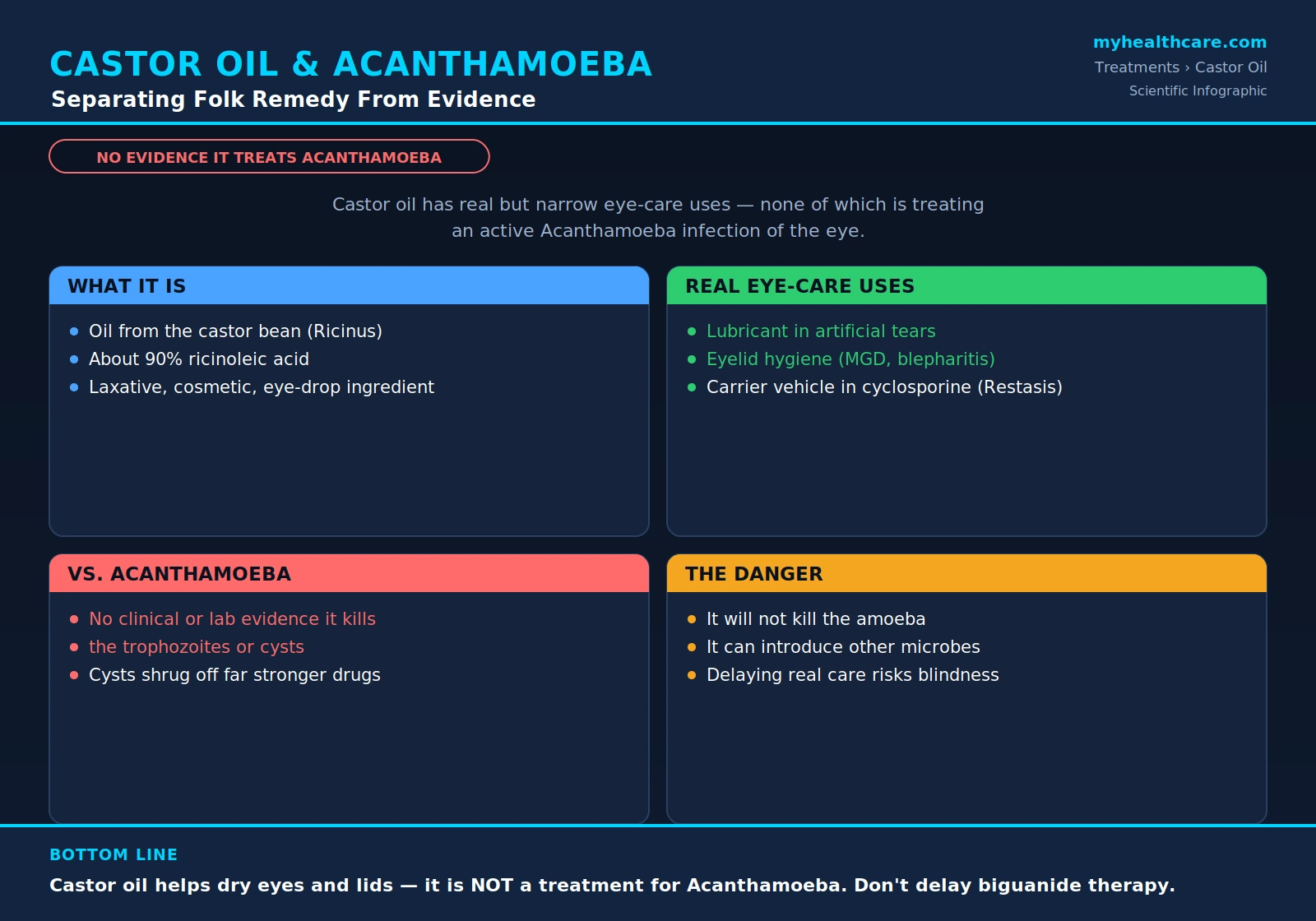
Table of Contents
- Why Castor Oil Comes Up
- What Castor Oil Actually Is
- Castor Oil's Real Place in Eye Care
- Is There Any Evidence Against Acanthamoeba?
- The Danger of Self-Treating
- If You Prefer Natural Approaches
- Bottom Line
- Key Research Papers
- Featured Videos
1. Why Castor Oil Comes Up
Castor oil has a long folk reputation as a healing oil for skin, hair, and eyes, and — unlike most kitchen remedies — it genuinely turns up in real eye products on pharmacy shelves. It is a listed ingredient in some lubricating eye drops and eyelid-cleansing wipes, and it is even the carrier liquid inside a widely prescribed dry-eye medication. So when someone is diagnosed with an Acanthamoeba eye infection and starts searching for help, it is completely understandable that castor oil shows up as a candidate. If it is "good for eyes," surely it might fight an eye infection?
Here is the short answer, stated plainly up front: castor oil has real but very narrow uses in eye care — lubricating a dry eye and helping clean inflamed eyelids — and none of those uses is treating Acanthamoeba. There is no evidence that castor oil kills this parasite, and using it in place of proven treatment is dangerous. This page lays out exactly what castor oil can and cannot do, so you can separate the genuine folk uses from the false hope.
2. What Castor Oil Actually Is
Castor oil is a vegetable oil pressed from the seeds (often called beans) of the castor plant, Ricinus communis. What makes it chemically unusual is that roughly 90 percent of its fatty-acid content is a single, uncommon fatty acid called ricinoleic acid. Most cooking oils are mixtures of several fatty acids in smaller proportions; castor oil's heavy dominance by ricinoleic acid is what gives it its thick, sticky texture and its distinctive biological effects.
In everyday life, castor oil shows up in three main roles:
- A stimulant laxative. Taken by mouth, ricinoleic acid is released in the small intestine and stimulates the gut wall, producing the strong laxative effect castor oil has been known for over centuries.
- A cosmetic oil. Its thick, moisturizing character makes it a common ingredient in skin balms, lip products, and lash and brow serums.
- An eye-care ingredient. In a purified, pharmaceutical-grade form it is used as a lubricant and emollient in certain artificial-tear formulations, eyelid-hygiene products, and at least one prescription dry-eye drug.
That third role is the one that fuels the Acanthamoeba question, so it deserves a careful look — which is the next section.
3. Castor Oil's Real Place in Eye Care
Castor oil's place in eye care is genuine, and it is worth being honest about so the contrast with infection treatment is clear. Its recognized roles are about lubrication and eyelid care, not about killing microbes.
An emollient in artificial tears
Because it is an oily, non-evaporating liquid, castor oil is used in some lubricant eye drops as an emollient that helps stabilize the oily outer layer of the tear film. The major international dry-eye guideline, the TFOS DEWS II Management and Therapy Report, catalogs castor-oil-containing lubricants among the options for tear-film support. Their job is to keep the eye surface comfortable and slow tear evaporation — not to attack an organism.
Eyelid hygiene for meibomian gland problems, blepharitis, and dry eye
The small oil glands along the eyelid margin (the meibomian glands) can become blocked or inflamed, a condition called meibomian gland dysfunction (MGD), which overlaps with dry eye disease and the eyelid inflammation called blepharitis. A clinical study by Goto and colleagues found that low-concentration castor oil eye drops improved tear-film stability and symptoms in people with non-inflamed obstructive MGD. Castor oil is also used in eyelid-cleansing products to soften crusting and support eyelid hygiene. Again, the role here is softening, soothing, and lubricating an irritated lid margin — not treating a corneal infection.
The carrier in a prescription dry-eye drug
Castor oil is the oily carrier (vehicle) of the prescription dry-eye medication cyclosporine ophthalmic emulsion (brand name Restasis). It is important to understand what that means: the active medicine is cyclosporine, an anti-inflammatory drug, and castor oil is simply the emulsion base that carries it. The benefit comes from the cyclosporine, not from any antimicrobial action of the oil. The pivotal trials of that emulsion measured improvement in moderate-to-severe dry eye, not treatment of any infection.
So castor oil's honest eye-care resume is: lubrication, eyelid hygiene, and serving as a drug carrier. None of these is an antimicrobial cure, and none of them is a treatment for an active infection of the cornea. For more on the oil itself, see the Castor Oil reference page.
4. Is There Any Evidence Against Acanthamoeba?
This is the heart of the matter, so let us be direct: there is no published clinical or laboratory evidence that castor oil, or its main fatty acid ricinoleic acid, kills Acanthamoeba trophozoites or cysts. No randomized trial, no case series, and no in-vitro (test-tube) study supports castor oil as an anti-Acanthamoeba agent. It is simply not part of the evidence base for this infection.
It is true that ricinoleic acid and some of its derivatives have shown some antimicrobial activity in laboratory studies — against certain bacteria and fungi, and ricinoleic acid also has measurable anti-inflammatory effects in animal models. That is real, but it is not the same thing. Activity against ordinary bacteria or fungi does not transfer to Acanthamoeba, which is a completely different kind of organism: a free-living amoeba, not a bacterium and not a fungus. Most importantly, Acanthamoeba can shift into a dormant cyst with a tough, double-walled coat that resists drying, disinfectants, and even purpose-built drugs. That is exactly why this infection is so hard to treat.
Consider the contrast. The drugs that actually work against Acanthamoeba are the biguanide antiseptics — polyhexamethylene biguanide (PHMB) and chlorhexidine — sometimes combined with a diamidine. These are potent, purpose-made anti-amoebic agents, and even they must be applied intensively, often hourly at first, for weeks to months, precisely because the cysts are so resistant. The standard-of-care reviews of Acanthamoeba keratitis make this plainly clear. A simple plant oil that struggles against the easier targets has no plausible path to clearing an organism that shrugs off far stronger, dedicated drugs.
5. The Danger of Self-Treating
Acanthamoeba keratitis is an eye emergency. It is not something to experiment on with home remedies. Putting castor oil — or any oil — into an actively infected eye carries real risks:
- It will not kill the amoeba. As above, there is no evidence it has any effect on Acanthamoeba, and strong reasons to expect it does not.
- It can introduce other microbes. A non-sterile oil dripped onto an already-damaged cornea can seed a bacterial or fungal co-infection on top of the amoebic one, making a bad situation worse.
- Most dangerously, it delays the only proven treatment. Every day spent on a remedy that does nothing is a day the amoeba keeps invading deeper into the cornea.
That last point is the one that costs people their sight. Acanthamoeba keratitis is notorious for being misdiagnosed and under-treated early, and the published reviews make clear that outcomes are dramatically better when intensive biguanide therapy starts early, before the infection invades deep into the cornea or reaches the nerves. Losing even a few weeks to the wrong remedy can be the difference between a cornea that recovers and one that scars permanently — sometimes ending in the need for a corneal transplant or in permanent blindness. If you have an eye that is painful, red, light-sensitive, and watering — especially if you wear contact lenses — treat it as urgent and see an eye specialist now, not after trying oils. (See Acanthamoeba keratitis for how this infection presents and progresses.)
6. If You Prefer Natural Approaches
If your instinct is toward natural, gentle, do-it-yourself care, that instinct is not wrong — it just needs to be pointed at the part of this problem where it actually helps: prevention and hygiene. With Acanthamoeba, the genuinely powerful "natural" steps are about keeping the amoeba away from your eyes in the first place, because the amoeba lives in water and soil and most infections are linked to contact lenses and water exposure. The steps that matter:
- Keep all water away from your contact lenses. Never rinse or store lenses in tap water, distilled water, or homemade saline. Use only fresh, commercial contact-lens disinfecting solution, every time.
- Do not swim, shower, or use a hot tub in your lenses, and never sleep in lenses that are not specifically approved for it.
- Replace lenses and cases on schedule, let cases air-dry face-down, and replace cases regularly.
- See a corneal specialist promptly at the first sign of a painful, red, light-sensitive eye — early diagnosis is the single biggest factor in saving vision.
What natural enthusiasm must not do is substitute castor oil — or any home remedy — for the biguanide therapy that actually clears the infection. By all means use castor oil for what it is genuinely good at: lubricating dry eyes and helping with eyelid hygiene in calm, uninfected eyes. But once an infection is suspected, the natural-care mindset is best expressed as getting to proven medical treatment fast. The page on conventional medical treatment explains what that care involves.
7. Bottom Line
Castor oil has a real, honest place in eye care: it lubricates dry eyes, supports eyelid hygiene in meibomian gland dysfunction and blepharitis, and serves as the carrier for a prescription dry-eye drug. Those uses are legitimate and worth respecting.
But castor oil is not a treatment for Acanthamoeba. There is no evidence it kills the parasite, there are good reasons to expect it cannot, and using it on an infected eye risks introducing new microbes and — far worse — delaying the biguanide therapy that is the only proven cure. If you are dealing with an Acanthamoeba eye infection, castor oil must never replace or postpone proper medical care. Keep castor oil for the dry, calm, uninfected eye; bring an infected eye to a corneal specialist without delay.
Key Research Papers
The references below document what castor oil and ricinoleic acid actually do (laxative action, mild antimicrobial activity in the lab, anti-inflammatory effects, and genuine dry-eye and eyelid roles) alongside the standard-of-care literature for Acanthamoeba keratitis, so the two can be compared honestly. Note that none of the castor-oil studies concerns Acanthamoeba, and none of the Acanthamoeba studies involves castor oil — that gap is itself the point. Each citation links to the full text via DOI.
- Vieira C, Evangelista S, Cirillo R, Lippi A, Maggi CA, Manzini S. Effect of Ricinoleic Acid in Acute and Subchronic Experimental Models of Inflammation. Mediators of Inflammation. 2000;9(5):223–228.
- Novak AF, Clark GC, Dupuy HP. Antimicrobial Activity of Some Ricinoleic Acid and Oleic Acid Derivatives. Journal of the American Oil Chemists' Society. 1961;38(6):321–324.
- Goto E, Shimazaki J, Monden Y, Takano Y, Yagi Y, Shimmura S, Tsubota K. Low-Concentration Homogenized Castor Oil Eye Drops for Noninflamed Obstructive Meibomian Gland Dysfunction. Ophthalmology. 2002;109(11):2030–2035.
- Stevenson D, Tauber J, Reis BL. Efficacy and Safety of Cyclosporin A Ophthalmic Emulsion in the Treatment of Moderate-to-Severe Dry Eye Disease. Ophthalmology. 2000;107(5):967–974.
- Jones L, Downie LE, Korb D, et al. TFOS DEWS II Management and Therapy Report. The Ocular Surface. 2017;15(3):575–628.
- Lorenzo-Morales J, Khan NA, Walochnik J. An Update on Acanthamoeba Keratitis: Diagnosis, Pathogenesis and Treatment. Parasite. 2015;22:10.
- Marciano-Cabral F, Cabral G. Acanthamoeba spp. as Agents of Disease in Humans. Clinical Microbiology Reviews. 2003;16(2):273–307.
- Larkin DFP, Kilvington S, Dart JKG. Treatment of Acanthamoeba Keratitis with Polyhexamethylene Biguanide. Ophthalmology. 1992;99(2):185–191.
- Seal D, Hay J, Kirkness C, et al. Successful Medical Therapy of Acanthamoeba Keratitis with Topical Chlorhexidine and Propamidine. Eye. 1996;10(4):413–421.
- Lim N, Goh D, Bunce C, et al. Comparison of Polyhexamethylene Biguanide and Chlorhexidine as Monotherapy Agents in the Treatment of Acanthamoeba Keratitis. American Journal of Ophthalmology. 2008;145(1):130–135.
Live PubMed Searches
Each link opens a live PubMed query so results stay current as new papers are indexed.
- Castor oil eye drops meibomian gland dysfunction
- Ricinoleic acid antimicrobial activity
- Acanthamoeba keratitis treatment
- Polyhexamethylene biguanide Acanthamoeba
- Castor oil dry eye and blepharitis
- Acanthamoeba cyst drug susceptibility
- Contact lens Acanthamoeba keratitis risk
- Cyclosporine ophthalmic emulsion dry eye
Connections
- All Parasites
- Acanthamoeba
- Acanthamoeba Treatments
- Conventional Medical Treatment
- Ivermectin
- Dry Eye Disease
- Castor Oil (Remedies)
- Ophthalmology
- Remedies
- All Conditions
- Oregano
- Garlic
- Food
- Herbs