Castor Oil
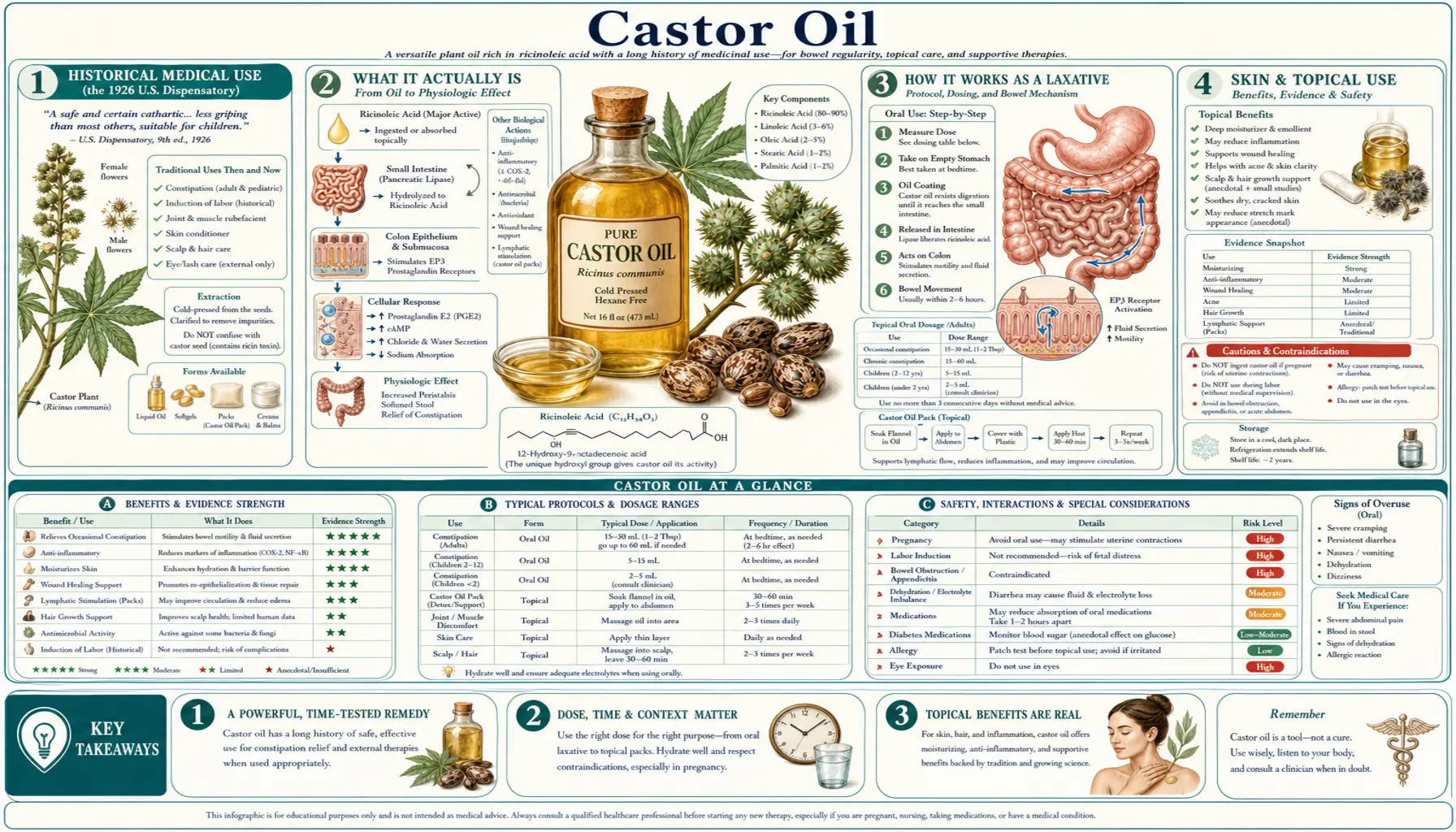
Castor oil is one of the oldest remedies in the medicine cabinet — a thick, pale-yellow oil pressed from the seeds of the castor plant, used for centuries to "move the bowels" and to soothe irritated skin. In the 1926 U.S. Dispensatory — the authoritative American drug reference of its day — castor oil was a standard laxative and a topical dressing for skin complaints. A lot of what your great-grandparents believed about it turns out to be roughly right, which is unusual for an old folk remedy: the active compound, ricinoleic acid, really does stimulate the gut, and it really is a decent skin emollient. But castor oil has also collected a layer of modern marketing — "castor oil packs" that "pull toxins," "liver flushes," daily eyelid and belly-button routines — that runs well ahead of the evidence. This page separates the genuine pharmacology from the folklore, and it spells out the safety cautions that the cheerful internet videos usually leave out.
Table of Contents
- Historical Medical Use (the 1926 U.S. Dispensatory)
- What It Actually Is
- How It Works as a Laxative
- Skin & Topical Use
- Castor Oil Packs (an Honest Look)
- Castor Oil & Labor Induction
- How It's Used Today
- Safety, Cautions & Myths
- The Ricin Question (Seed vs. Refined Oil)
- Key Research Papers
- Connections
- Featured Videos
Historical Medical Use (the 1926 U.S. Dispensatory)
By 1926, castor oil had already been in the Western pharmacopeia for generations and was one of the most widely used drugs in America. The U.S. Dispensatory listed it primarily as a laxative — and not a gentle one. Physicians reached for it when they wanted a reliable, fairly prompt bowel movement: to clear the gut before surgery, to treat constipation, and, in the medical thinking of the time, to "purge" the system in cases of poisoning or fever. A typical adult dose was a tablespoon or more, often disguised in juice or coffee because of its famously unpleasant, slippery texture. Generations of children remember being made to swallow it.
The Dispensatory of that era described it as a mild laxative, but by modern classification that label is not quite right: castor oil is a stimulant laxative — it works by actively driving the muscular contractions of the intestine (peristalsis), which is a stronger and more forceful mechanism than the gentle "mild" framing suggested. It was valued precisely because it worked when milder measures did not.
Castor oil's second 1926 role was topical: as a soothing oil applied to the skin for irritation, dermatitis, minor wounds, and as a base for ointments and dressings. It was a common ingredient in skin and eye preparations and was prized as a bland, non-irritating carrier oil that helped keep dressings from sticking and kept skin supple.
How to read this history: the 1926 uses were laxative and skin-soothing — and, remarkably for an old remedy, both have a real basis in the chemistry we now understand. What has not aged well are the surrounding ideas: the "purge the poisons" rationale (an echo of humoral medicine) and, more recently, the elaborate "detox pack" and "liver flush" claims that grew up around castor oil long after 1926. Those are addressed honestly below.
What It Actually Is
Castor oil is a vegetable oil cold-pressed (and then usually refined) from the seeds — the "beans" — of Ricinus communis, the castor plant, which is native to Africa and the Mediterranean and now grown around the world. India is the world's largest producer.
What makes castor oil chemically unusual is its fatty-acid makeup. Most vegetable oils are blends of several fatty acids; castor oil is roughly 90% ricinoleic acid, a single fatty acid found in very few other oils. Ricinoleic acid carries an extra hydroxyl (–OH) group on its carbon chain, and that one structural quirk is responsible for nearly everything castor oil does — its thick, syrupy texture, its solubility behavior, and its biological effects on the gut and skin. The remaining ~10% is a mix of more ordinary fatty acids (oleic, linoleic, and others).
That high ricinoleic-acid content also makes castor oil valuable far beyond medicine. It is a major industrial feedstock — used in lubricants, coatings, plastics, cosmetics, and as the raw material for nylon-type polymers. The pharmaceutical and cosmetic grades you'd take or rub on your skin are the same plant oil, purified and refined for that purpose.
One important point that the safety section returns to: the active oil and the toxic part of the seed are not the same substance. The notorious poison ricin is a protein that stays behind in the leftover seed pulp (the "mash" or "cake") after pressing — it does not dissolve into the oil, and the refining process removes any traces. Refined castor oil is ricin-free.
How It Works as a Laxative
For most of history, exactly how castor oil moved the bowels was a mystery. That was solved relatively recently, and the answer is elegant. When you swallow castor oil, enzymes (lipases) in the small intestine split it apart and release its main fatty acid, ricinoleic acid. In 2012, researchers showed that ricinoleic acid then binds to a specific receptor in the gut wall — the prostaglandin EP3 receptor — on the smooth-muscle cells of the intestine. Activating that receptor makes the intestinal muscle contract more vigorously, which is exactly what a stimulant laxative does: it speeds up the wave-like squeezing (peristalsis) that pushes contents through and out. The same study showed ricinoleic acid acts on the same receptor in the uterus — which is why the labor-induction folklore (covered below) is not entirely baseless, and why castor oil is unsafe in pregnancy.
This puts castor oil firmly in the stimulant laxative family — the same broad category as senna and bisacodyl — rather than the gentler "bulk-forming" laxatives (like psyllium) or the "osmotic" ones (like magnesium or polyethylene glycol). The U.S. Food and Drug Administration recognizes castor oil as an over-the-counter stimulant laxative; it is a legitimate, regulated drug for that purpose, not merely a folk remedy.
Practically, this means it works — usually within a few hours — but it works forcefully. Stimulant laxatives are the bluntest instrument in the laxative toolbox. For an occasional, deliberate clear-out (the kind of thing the 1926 doctors used it for) it does the job. But because it can cause strong cramping and because forceful, repeated bowel stimulation isn't gentle on the gut, modern practice reserves it for short-term, occasional use and generally prefers milder laxatives for everyday constipation. (See Natural Constipation Relief for the gentler-first approach.)
Skin & Topical Use
The 1926 use of castor oil as a skin-soothing oil also holds up reasonably well, though for more modest reasons than enthusiasts claim. Castor oil is a genuine emollient — an oil that softens and smooths skin and helps it hold moisture by forming an occlusive film that slows water loss. Its thick texture makes it a good barrier oil, which is why it has long appeared in lip balms, ointments, and cosmetics, and why it's used as a carrier for other active ingredients.
There is also some laboratory and animal evidence that ricinoleic acid has anti-inflammatory activity. In experimental models of inflammation, ricinoleic acid applied to the skin reduced swelling and inflammatory pain, with effects that researchers compared to capsaicin-type mechanisms. This gives a plausible scientific footing to the traditional use for irritated, inflamed skin — but it's important to be clear about the level of evidence: this is mostly preclinical (lab and animal) work, not large human trials. It supports castor oil as a reasonable, soothing emollient; it does not establish it as a proven treatment for any specific skin disease.
Castor oil shows up in a few specific modern niches. Ricinoleic-acid–containing moisturizers are used for dry skin. In eye care, castor oil is an ingredient in some lubricating eye drops and is used (often combined with eyelid hygiene) in the management of certain eyelid and tear-film problems such as meibomian gland dysfunction and blepharitis, where its film-forming and possible anti-inflammatory properties may help. As for the popular claim that castor oil grows hair, eyelashes, or eyebrows: there is no good clinical evidence that it does. It can make hair look thicker and shinier by coating it (a cosmetic, not a growth, effect), but it is not a proven hair-growth treatment.
Castor Oil Packs (an Honest Look)
A "castor oil pack" is a traditional home practice: a cloth soaked in castor oil is laid over the skin — usually the abdomen, over the liver or lower belly — often with a heat source on top, and left in place for an hour or so. The practice was popularized in the 20th century (notably by the writings of Edgar Cayce) and is widely promoted today for "liver detox," "reducing inflammation," easing constipation, menstrual cramps, and a long list of other complaints.
Here is the honest assessment. Castor oil packs are traditional, low-risk for most people, and supported by very thin scientific evidence. The strongest piece of human research is a small study in nursing-home residents which found that castor oil packs helped relieve constipation symptoms (such as straining and the feeling of incomplete emptying) in elderly patients, though it did not significantly change how often they had bowel movements. That's a real, if modest, finding for one specific use — and notably, much of the benefit of any warm pack likely comes from the warmth and the relaxing ritual as much as from the oil itself.
What there is no credible evidence for is the headline marketing claim: that a castor oil pack on your belly "detoxes the liver," "pulls toxins out through the skin," "cleanses the lymph," or dissolves anything internal. Skin is a barrier; you do not absorb meaningful amounts of castor oil through an intact abdominal wall, and your liver and kidneys — not a cloth on your stomach — are what actually clear waste from your body. If a warm castor oil pack feels soothing and helps you relax or eases mild abdominal discomfort or cramps, that's a perfectly reasonable reason to use it. Just don't expect it to "detox" anything, and don't substitute it for medical care for a real problem. (For the broader picture, see Liver Cleansing and Detox Protocols.)
Castor Oil & Labor Induction
One of castor oil's oldest folk uses is to bring on labor in pregnant women at or past their due date — and unlike the "detox" claims, this one has a real mechanistic basis. Recall that ricinoleic acid activates EP3 prostaglandin receptors not only in the intestine but also in the uterus, where they trigger muscle contractions. So the traditional idea isn't pharmacological nonsense.
The clinical evidence, however, is limited and mixed. A long-standing Cochrane systematic review found only a small amount of low-quality data and concluded the evidence was insufficient to recommend castor oil for inducing labor, while noting that essentially all the women who took it experienced nausea. A more recent systematic review and meta-analysis suggested castor oil may increase the likelihood of going into labor within 24 hours and of cervical "ripening," but the studies were small and of variable quality, so the finding is far from settled.
The crucial safety point: precisely because it stimulates the uterus, castor oil is not safe to take during pregnancy except possibly at full term under direct medical supervision. Self-dosing castor oil to start labor can cause violent diarrhea, dehydration, painful uterine cramping, and distress for the baby. This is not a do-it-yourself remedy — any decision to use it near a due date belongs to a midwife or obstetrician, not to a YouTube video.
How It's Used Today
Castor oil remains a legitimate, inexpensive, widely available product with a few evidence-based and several traditional uses:
- Occasional constipation. Sold over the counter as a stimulant laxative. Typical adult doses are on the order of 1–2 tablespoons (roughly 15–30 mL), taken on an empty stomach, working within about 2–6 hours. It is meant for occasional use only — not a daily habit. Children's dosing is lower and should follow a pediatrician's or pharmacist's guidance; very young children should not be given it without medical advice.
- Bowel preparation. Historically used to empty the bowel before procedures; today largely replaced by gentler, better-tolerated modern preps, though it still appears in some protocols.
- Skin emollient. As a moisturizing, barrier oil in balms, ointments, and cosmetics, and as a soothing oil for dry or irritated skin.
- Eye care. As an ingredient in some lubricating eye drops and in the management of certain eyelid/tear-film conditions, usually under an eye-care professional's direction.
- Castor oil packs. As a traditional warm compress for comfort, with the honest caveats above.
- Cosmetics and hair/skin care. As a conditioning, shine-adding oil — a cosmetic effect, not a medical one.
A sensible modern stance: castor oil is fine as an occasional laxative and a pleasant emollient. It is not a daily supplement, a detox tool, or a cure for chronic conditions, and it should not be used to push through real constipation that keeps coming back — recurring constipation deserves a proper look at diet, fluids, fiber, activity, and, if needed, gentler long-term measures.
Safety, Cautions & Myths
Castor oil is generally safe for healthy adults when used occasionally and as directed — but it is a real drug with real downsides, and the breezy online videos rarely mention them. Take these seriously.
- Cramping and diarrhea. As a forceful stimulant laxative, castor oil commonly causes abdominal cramps, urgency, and loose or watery stools. That's the mechanism working, but it's unpleasant and easy to overdo.
- Dehydration and electrolyte loss. Strong, repeated bowel evacuation can flush out water and electrolytes (especially potassium). Over-using any stimulant laxative can lead to dehydration and electrolyte imbalances, which in turn can cause weakness, irregular heartbeat, and — paradoxically — a sluggish, "lazy" bowel. This is the single biggest reason not to use it chronically.
- Do not use in pregnancy. Castor oil stimulates the uterus (via the EP3 mechanism above) and can provoke contractions. Avoid it during pregnancy. Any use at full term to encourage labor must be a clinical decision made with a midwife or obstetrician — never a self-experiment.
- Do not use with a bowel obstruction or acute abdomen. Never take a stimulant laxative if you have, or might have, a blockage in the gut, unexplained severe abdominal pain, nausea and vomiting, appendicitis, or undiagnosed rectal bleeding. Forcing peristalsis against a blockage is dangerous. Seek medical care for these.
- Not for chronic, daily use. Stimulant laxatives are short-term tools. Daily long-term use can worsen the very problem they're meant to fix and cause electrolyte and dependence issues. If you "need" a laxative most days, that's a signal to see a clinician, not to keep dosing.
- Caution with certain conditions and medicines. People with kidney or heart disease are more vulnerable to fluid and electrolyte shifts. Laxative-driven changes (especially potassium loss) can be risky for anyone taking digoxin, diuretics, or other medications affected by electrolytes; check with a pharmacist. The fast gut transit can also reduce absorption of other oral medicines taken around the same time.
- Allergy and skin sensitivity. Topical castor oil is usually well tolerated, but some people develop contact dermatitis. Patch-test before using it widely on the skin.
Myths worth correcting:
- "Castor oil packs detox your liver / pull out toxins through the skin." No. You don't absorb meaningful castor oil through intact abdominal skin, and a topical pack does not cleanse the liver, lymph, or blood. Your liver and kidneys do that work. A warm pack can be soothing — that's the legitimate benefit.
- "Castor oil is poisonous because it comes from the same plant as ricin." See the next section — the refined oil is ricin-free.
- "Castor oil regrows hair, eyelashes, and eyebrows." There's no solid clinical evidence for hair growth; the effect is cosmetic coating, not regrowth.
- "It's a gentle, everyday laxative." It's a stimulant laxative — effective but forceful, and meant for occasional use, not daily reliance.
The Ricin Question (Seed vs. Refined Oil)
Because castor oil comes from castor beans, and because ricin — one of the most notorious plant poisons — also comes from castor beans, people understandably worry. Here is the honest, reassuring truth, with the nuance intact.
Ricin is a protein (a toxin called a lectin) concentrated in the seed. It is genuinely dangerous: chewing raw castor seeds, or being exposed to purified ricin, can be lethal. But two things make refined castor oil safe. First, ricin is water-soluble and does not dissolve into the oil — when the seeds are pressed, the ricin stays behind in the leftover solid pulp (the "mash" or "cake"), not in the expressed oil. Second, the heat and refining steps used to produce pharmaceutical and food-grade castor oil deactivate and remove any residual protein. The result is that commercial, refined castor oil is ricin-free and has been used safely as a medicine and food additive for well over a century.
So: the raw seed and its press-cake are toxic; the refined oil is not. Don't ever eat raw castor beans (they are a real poisoning hazard, especially to children and pets), but you don't need to fear a bottle of properly refined castor oil from the pharmacy. As always, use a reputable, clearly food/pharmaceutical-grade product.
Key Research Papers
- Tunaru S, Althoff TF, Nüsing RM, Diener M, Offermanns S. (2012). Castor oil induces laxation and uterus contraction via ricinoleic acid activating prostaglandin EP3 receptors. Proceedings of the National Academy of Sciences, 109(23):9179–9184. — The landmark mechanism paper: it identified ricinoleic acid as the active agent and showed it triggers both intestinal (laxative) and uterine contractions through the EP3 prostaglandin receptor. (PMID: 22615395)
- Vieira C, Evangelista S, Cirillo R, Lippi A, Maggi CA, Manzini S. (2000). Effect of ricinoleic acid in acute and subchronic experimental models of inflammation. Mediators of Inflammation, 9(5):223–228. — Experimental evidence that ricinoleic acid (castor oil's main fatty acid) has anti-inflammatory and analgesic activity when applied topically, supporting the traditional skin use — though this is preclinical, not human-trial, evidence. (PMID: 11200362)
- Arslan GG, Eşer İ. (2011). An examination of the effect of castor oil packs on constipation in the elderly. Complementary Therapies in Clinical Practice, 17(1):58–62. — A small study in nursing-home residents finding that castor oil packs reduced constipation symptoms (straining, sense of incomplete emptying) without significantly changing stool frequency — the best human evidence for packs, and a modest result. (PMID: 21168117)
- Kelly AJ, Kavanagh J, Thomas J. (2001). Castor oil, bath and/or enema for cervical priming and induction of labour. Cochrane Database of Systematic Reviews, (2):CD003099. — A systematic review concluding the evidence was insufficient to recommend castor oil for inducing labor and noting that all women who took it reported nausea — an honest counterweight to the labor-induction folklore. (PMID: 11406072)
- Moradi M, Niazi A, Mazloumi E, Lopez V. (2022). Effect of Castor Oil on Cervical Ripening and Labor Induction: a systematic review and meta-analysis. Journal of Pharmacopuncture, 25(2):71–78. — A more recent meta-analysis suggesting castor oil may increase labor onset within 24 hours and cervical ripening, while cautioning that the underlying studies were small and of variable quality. (PMID: 35837143)
Live PubMed Searches
For the latest studies, browse these live searches (each opens PubMed in a new tab):
- Ricinoleic acid & intestinal motility
- Castor oil as a laxative
- Castor oil packs
- Castor oil & labor induction
- Castor oil & skin
- Ricin & castor seed toxicity
Connections
- All Remedies
- Castor Oil & Acanthamoeba
- Acanthamoeba
- Natural Constipation Relief
- Liver Cleansing
- Liver Detox
- Detox Protocols
- Gut Healing
- Gut-Brain Axis
- Olive Oil
- Castor Oil Packs — the topical abdominal pack technique, its EP3 mechanism, and the randomized data.