Chickenpox (Varicella)
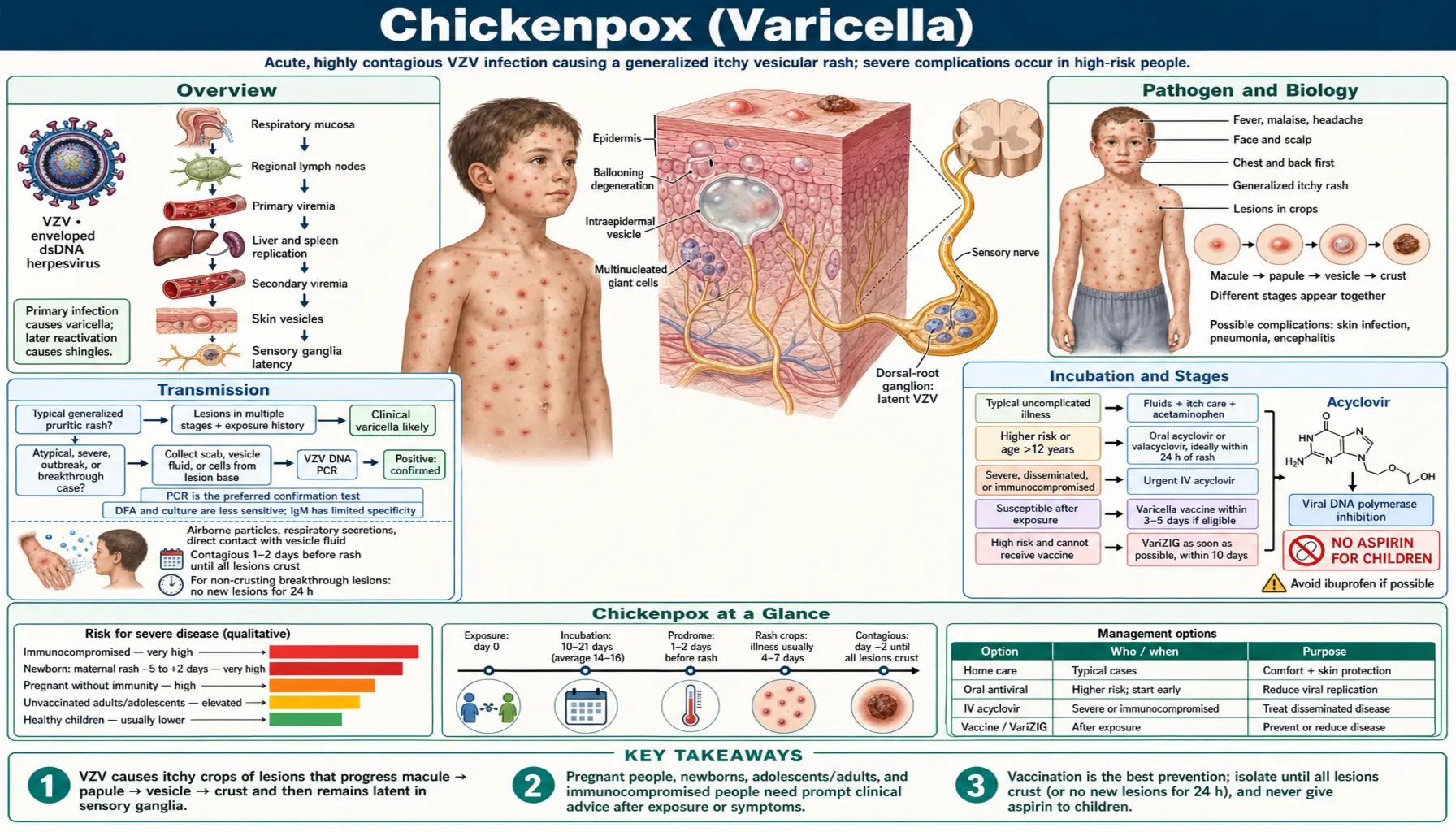
Table of Contents
- Overview
- Pathogen and Biology
- Transmission
- Incubation and Stages
- Symptoms and Clinical Presentation
- Diagnosis
- Treatment
- Home Care
- Complications
- Prevention and Vaccines
- Key Research Papers
- PubMed Searches
- Connections
- Featured Videos
1. Overview
Chickenpox (varicella) is a highly contagious acute illness caused by primary infection with Varicella-Zoster Virus (VZV), also designated Human Herpesvirus 3 (HHV-3). It is characterized by a generalized pruritic vesicular rash, fever, and malaise. Before the introduction of the varicella vaccine in the United States in 1995, chickenpox infected approximately 4 million Americans annually, causing around 11,000 hospitalizations and 100 deaths each year.
VZV belongs to the Alphaherpesvirinae subfamily and shares the herpesvirus family's defining characteristic: after primary infection resolves, the virus establishes lifelong latency in sensory nerve ganglia (dorsal root ganglia and cranial nerve ganglia). Decades later, waning cell-mediated immunity — from aging, illness, or immunosuppression — can allow the virus to reactivate and travel down sensory nerve axons to cause herpes zoster (shingles). Every person who has had chickenpox carries this latent VZV and carries some lifetime risk of shingles.
Chickenpox is predominantly a childhood disease in unvaccinated populations, but primary VZV infection in adolescents, adults, pregnant women, and immunocompromised individuals carries substantially higher risk of severe disease and complications.
2. Pathogen and Biology
Varicella-Zoster Virus is a double-stranded DNA virus with an icosahedral capsid, tegument, and lipid envelope. Its 125-kilobase genome encodes approximately 70 open reading frames. Key features of VZV biology:
- Envelope glycoproteins: gB, gC, gE, gH, gI, gK, and gL mediate viral attachment, entry, and cell-to-cell spread. gE is the most abundant and is the primary target for subunit vaccine development.
- Cell-associated virus: VZV is highly cell-associated in culture, making it difficult to isolate free virus — a factor that historically complicated vaccine production and contributes to incomplete understanding of viremia kinetics.
- Tropism: VZV infects respiratory epithelium, T lymphocytes (mediating viremic dissemination), skin keratinocytes (causing the rash), and neurons (establishing latency in sensory ganglia).
- Immune evasion: VZV downregulates MHC class I expression, inhibits interferon signaling via ORF63/ORF61, and evades complement via gC binding of C3b. The virus exploits T-cell trafficking to reach the skin — infected T lymphocytes migrate to dermal sites where the virus transfers to keratinocytes.
- Latency: After primary infection, VZV establishes latency in sensory neurons of dorsal root ganglia (particularly thoracic and trigeminal ganglia), where viral genomes persist as non-integrated episomes. Latent transcripts (VLTs, viral latency-associated transcripts) are expressed but are non-productive. Reactivation produces shingles.
3. Transmission
VZV is one of the most contagious respiratory pathogens known, with a secondary attack rate of 65–86% among susceptible household contacts:
- Respiratory droplet and airborne route: The primary transmission route. VZV is aerosolized from respiratory secretions of infected individuals. Because the virus is airborne, it can spread across rooms without direct contact — a critical distinction from diseases transmitted only by large droplets.
- Direct contact: Contact with vesicle fluid (from rash lesions) also transmits the virus, though this is a secondary route compared to respiratory spread.
- Contagious period: Infected individuals are contagious from 1–2 days before rash onset until all skin lesions have crusted over (typically 5–7 days after rash onset). The pre-rash contagious period explains rapid community spread before any cases are identified.
- Shingles as a source: VZV shed from shingles lesions can cause primary chickenpox in VZV-naive contacts, but shingles is significantly less contagious than chickenpox because shingles lacks the respiratory component.
- Susceptibility: Any person without prior VZV infection or vaccination is susceptible. In the pre-vaccine era, over 90% of Americans had been infected by age 15.
4. Incubation and Stages
Incubation Period
The incubation period is 10–21 days (most commonly 14–16 days) from exposure to rash onset. During this period, the virus undergoes initial replication in nasopharyngeal lymphoid tissue, followed by a primary viremia (4–6 days after infection) that seeds the reticuloendothelial system, then a secondary viremia (approximately days 14–16) that disseminates VZV-infected T lymphocytes to skin.
Prodrome (1–2 days before rash)
Low-grade fever (38–39°C), malaise, headache, and loss of appetite. In young children, the prodrome may be mild or absent; in adolescents and adults the prodrome is typically more prominent.
Exanthem Stage (Days 1–7)
The characteristic rash appears in successive crops over 2–4 days, with all stages of lesion evolution (macule → papule → vesicle → pustule → crust) present simultaneously — the hallmark of chickenpox. New crops typically appear on the trunk first, then spread centripetally to the face and scalp. The extremities are less affected, and the palms and soles are classically spared. Distribution is described as centripetal (concentrated on the trunk) in contrast to smallpox, which shows centrifugal distribution (concentrated on extremities and face).
Resolution
All lesions crust within 5–7 days of rash onset. The patient is no longer contagious once all lesions are fully crusted. Crusts fall off over 1–3 weeks, sometimes leaving temporary hypopigmentation or, if scratched, permanent scars.
5. Symptoms and Clinical Presentation
The Classic Rash — “Dew Drop on a Rose Petal”
The pathognomonic skin lesion of chickenpox is a thin-walled vesicle on an erythematous base — classically described as a “dew drop on a rose petal.” Each vesicle is 2–4 mm in diameter, filled with clear fluid that becomes turbid within 24–48 hours as inflammatory cells enter the lesion. The vesicular roof is fragile and ruptures easily, producing a superficial erosion that then crusts.
The simultaneous presence of lesions at multiple stages of evolution — macules, papules, vesicles, pustules, and crusts in the same region — strongly distinguishes varicella from other vesicular rashes (monkeypox, smallpox, hand-foot-mouth disease).
Distribution
- Trunk (thorax, abdomen, back): Most heavily affected; the rash begins here.
- Face and scalp: Commonly involved, including the hairline.
- Mucous membranes: Enanthem (oral, pharyngeal, vaginal) in many patients; shallow ulcers.
- Extremities: Less severely affected than trunk.
- Palms and soles: Classically spared (though may occasionally have a few lesions).
Total Lesion Count
Immunocompetent children typically develop 250–500 lesions total. Adolescents and adults often develop more lesions (up to several thousand), experience more severe systemic symptoms, and have higher rates of complications including pneumonia.
Systemic Symptoms
- Fever (38–40°C), highest during the first 3–4 days of rash
- Intense pruritus (itching) — the dominant symptom driving scratching and secondary bacterial infection risk
- Malaise, fatigue, anorexia
- Headache
- Abdominal pain (from visceral VZV or anticipatory anxiety)
6. Diagnosis
In immunocompetent patients with classic presentation in an endemic or outbreak context, chickenpox is a clinical diagnosis. Laboratory confirmation is needed in unusual presentations, severe disease, immunocompromised patients, and public health investigations.
Clinical Diagnosis
The combination of pruritic generalized vesicular rash with multi-stage lesions simultaneously present, centripetal distribution, and appropriate epidemiology (exposure, unvaccinated status, community outbreak) is sufficient for clinical diagnosis.
Tzanck Smear
Scraping of a fresh vesicle base, stained with Wright-Giemsa or Tzanck stain, reveals multinucleated giant cells — a finding common to all human herpesvirus skin infections (VZV and HSV). Tzanck smear is rapid and inexpensive but cannot distinguish VZV from HSV and has variable sensitivity.
Direct Fluorescent Antibody (DFA) Test
DFA on vesicle scraping using VZV-specific monoclonal antibodies provides rapid, sensitive, and specific diagnosis. Preferred over Tzanck for definitive confirmation when available.
PCR
VZV PCR on vesicle swab, vesicle fluid, crust material, or cerebrospinal fluid (for neurologic complications) is the most sensitive and specific test available. PCR also distinguishes wild-type VZV from vaccine-strain VZV (important for rash investigations post-vaccination). PCR on CSF is the test of choice for VZV encephalitis or meningitis.
Serology
IgG antibody to VZV confirms immunity (prior infection or vaccination) rather than diagnoses acute disease. Acute IgM is not reliably detected in primary VZV infection using standard assays. A 4-fold or greater rise in VZV IgG titers between acute and convalescent sera (drawn 2–3 weeks apart) can confirm acute infection retrospectively.
7. Treatment
Antiviral Therapy
Acyclovir (a nucleoside analogue that inhibits VZV DNA polymerase) is the primary antiviral for chickenpox. VZV thymidine kinase phosphorylates acyclovir preferentially in infected cells, conferring selectivity. Key principles:
- Timing is critical: Acyclovir must be started within 24 hours of rash onset to meaningfully reduce lesion count, fever duration, and symptom severity. Treatment started after 72 hours provides minimal benefit in uncomplicated disease.
- Who gets treated: Oral acyclovir is recommended for non-pregnant adolescents (≥13 years), adults, secondary household cases (tend to have more severe disease than index cases), and persons with chronic skin or lung conditions. Healthy children under 12 with uncomplicated chickenpox generally do not require antiviral treatment (disease is mild and self-limited), though it shortens symptom duration by about 1 day.
- Immunocompromised patients: IV acyclovir (10–12 mg/kg every 8 hours) is mandatory for immunocompromised individuals with primary VZV infection due to high risk of dissemination, visceral disease, and death.
- Pregnant women: Oral acyclovir is recommended for pregnant women with chickenpox (especially those >20 weeks gestation) given increased risk of VZV pneumonia. IV acyclovir for severe disease.
- Oral dosing: Acyclovir 800 mg 5 times daily for 5–7 days (adults); valacyclovir (the prodrug with better bioavailability) 1,000 mg three times daily for 5 days is an acceptable alternative.
Reye’s Syndrome Warning: Do Not Give Aspirin
Aspirin and aspirin-containing products (including bismuth subsalicylate) are absolutely contraindicated in chickenpox in children and teenagers. Aspirin use during varicella (and influenza) infection is strongly associated with Reye’s syndrome — a rare but life-threatening hepatic and encephalopathic illness. The mechanism involves mitochondrial dysfunction exacerbated by salicylate metabolism during viral infection. Fever should be managed with acetaminophen or ibuprofen instead.
Symptomatic Treatment
- Pruritus: Oral antihistamines (diphenhydramine, hydroxyzine) reduce itching and sedation helps prevent scratching during sleep. Calamine lotion provides topical relief. Oatmeal baths (colloidal oatmeal) soothe inflamed skin.
- Fever: Acetaminophen (paracetamol) or ibuprofen for fever and discomfort. Avoid aspirin.
- Secondary bacterial infection: If vesicles become secondarily infected (increasing redness, warmth, purulent discharge, fever after initial improvement), topical mupirocin or oral antibiotics (covering Staphylococcus aureus and Streptococcus pyogenes) are indicated.
8. Home Care
- Isolation: Keep the infected person at home until all lesions are fully crusted (generally day 5–7 after rash onset). Notify school, daycare, and contacts who may be susceptible or immunocompromised.
- Scratch prevention: Keep fingernails short and clean. Use cotton gloves at night for young children to minimize scratching during sleep. Scratching introduces bacteria and causes scars.
- Skin care: Lukewarm baths (not hot — heat intensifies itching) with colloidal oatmeal. Pat dry gently; do not rub. Light, loose, breathable clothing minimizes skin irritation.
- Hydration: Oral fluid intake especially important if fever is present. Encourage ice pops and cool fluids if oral sores reduce appetite in young children.
- Avoid: Scratching (scarring, impetigo risk), aspirin-containing products, exposing the infected person to immunocompromised contacts, newborns, or pregnant women who are VZV-naive.
- When to seek emergency care: Difficulty breathing or chest pain (pneumonia); severe headache, stiff neck, confusion, seizures (encephalitis); bacterial superinfection signs; rash that is very red, warm, or has red streaks (cellulitis or necrotizing fasciitis); lesions near eyes.
9. Complications
The vast majority of immunocompetent children recover fully from chickenpox without complications. However, complications do occur, more frequently in specific risk groups:
Secondary Bacterial Superinfection
The most common complication. Scratched or ruptured vesicles become colonized with skin flora, most commonly Staphylococcus aureus and Streptococcus pyogenes (Group A Strep). This can cause impetigo, cellulitis, or rarely invasive Group A Streptococcal disease (necrotizing fasciitis, bacteremia, toxic shock syndrome — GAS invasive disease complicating varicella was responsible for a cluster of pediatric deaths in the early 1990s).
Varicella Pneumonia
The most serious complication in adults. Occurs in approximately 1 in 400 adult cases, presenting 3–5 days after rash onset with cough, dyspnea, tachypnea, and chest X-ray showing diffuse bilateral nodular infiltrates. Risk is markedly elevated in pregnant women (especially third trimester) and smokers. Mortality without treatment is 10–30%; IV acyclovir reduces this substantially.
Neurologic Complications
- Acute cerebellar ataxia: Most common neurologic complication in immunocompetent children. Typically appears 2–3 weeks after rash onset; characterized by sudden onset ataxia, nystagmus, dysarthria. Usually self-limiting with complete recovery over weeks.
- VZV encephalitis: Rare but serious. Presents with altered consciousness, seizures, focal neurologic deficits. VZV PCR on CSF is the diagnostic test of choice. Treated with IV acyclovir.
- Reye’s syndrome: Hepatic encephalopathy associated with aspirin use during varicella or influenza. Now rare due to aspirin avoidance guidelines, but historically a leading cause of childhood encephalopathy in the US.
- Transverse myelitis, optic neuritis: Rare VZV-mediated vasculopathic/inflammatory complications.
Neonatal Varicella
If a mother develops chickenpox within 5 days before to 2 days after delivery, the newborn is exposed to high-titer maternal viremia without protective maternal IgG antibodies (which take several days to form). Neonatal varicella in this setting can cause disseminated disease with 20–30% mortality without treatment. These newborns should receive varicella-zoster immune globulin (VariZIG) and IV acyclovir.
Congenital Varicella Syndrome
Primary VZV infection in the first 20 weeks of pregnancy can cause fetal varicella syndrome (congenital varicella syndrome, CVS) in approximately 0.5–2% of exposed fetuses: skin scarring in dermatomal distribution, limb hypoplasia, eye defects (cataracts, chorioretinitis), neurologic defects (cortical atrophy, microcephaly), and autonomic dysfunction. Highest risk with infection at 8–20 weeks gestation.
Lifetime VZV Latency and Shingles
Every person who has had chickenpox carries latent VZV in sensory ganglia for the remainder of their life. Approximately 1 in 3 people will develop herpes zoster (shingles) at some point. The recombinant shingles vaccine (Shingrix) reduces shingles risk by approximately 90% and is recommended for adults 50 and older regardless of prior shingles history.
Disseminated VZV in Immunocompromised Patients
Immunocompromised individuals (HIV/AIDS, organ transplant recipients, those on high-dose corticosteroids, chemotherapy) are at risk for disseminated VZV affecting lungs, liver, brain, and other visceral organs — a potentially fatal complication requiring urgent IV acyclovir.
10. Prevention and Vaccines
Varicella Vaccine (Oka Strain)
The varicella vaccine contains a live attenuated VZV strain originally isolated from a Japanese child named Oka in 1972 and developed by Michiaki Takahashi. The Oka strain was passaged in human embryonic lung cells and guinea pig embryo fibroblasts to attenuate its virulence while retaining immunogenicity.
The varicella vaccine has been licensed in the US since 1995. Key facts:
- Schedule: Two doses recommended for children: first dose at 12–15 months, second dose at 4–6 years. Two doses are also recommended for susceptible adults (separated by at least 28 days).
- Efficacy: Two-dose regimen is greater than 90% effective against any varicella and greater than 98% effective against severe disease. Breakthrough varicella (in vaccinated individuals) occurs in approximately 1–3% of vaccine recipients per year of exposure; breakthrough cases are uniformly mild (<50 lesions, low fever, rapid recovery).
- Combination vaccines: MMRV (measles-mumps-rubella-varicella, ProQuad) combines all four vaccines. Associated with slightly higher risk of febrile seizure (approximately 1 extra seizure per 2,500 first doses) compared to MMR + separate varicella, which is why MMRV is not routinely recommended for the first dose in the US.
- Vaccine-strain shingles: Vaccine-strain VZV also establishes latency and can rarely reactivate as shingles, but at a substantially lower rate than natural infection. Vaccine-strain shingles is also milder than wild-type shingles.
Varicella-Zoster Immune Globulin (VariZIG)
Post-exposure prophylaxis for high-risk VZV-susceptible contacts (immunocompromised, pregnant women, neonates). VariZIG should be given within 10 days of exposure (preferably within 96 hours). It reduces the severity of disease if infection occurs; it does not reliably prevent infection.
Natural Immunity vs. Vaccine Immunity and Shingles Risk
Both natural infection and vaccination confer VZV latency in sensory ganglia. However, natural infection establishes higher viral load in ganglia and therefore a higher lifetime risk of shingles reactivation compared to vaccine-strain VZV. Additionally, frequent re-exposure to chickenpox (e.g., parents of young children) provided natural immune boosting that reduced shingles risk in adults. The varicella vaccination program has reduced the natural circulation of VZV, potentially reducing this natural boosting effect and shifting the population burden of shingles — an epidemiologic effect that continues to be studied. The Shingrix recombinant vaccine effectively counteracts shingles risk in vaccinated and naturally-infected adults alike.
11. Key Research Papers
- Takahashi M, Otsuka T, Okuno Y, Asano Y, Yazaki T. Live vaccine used to prevent the spread of varicella in children in hospital. Lancet. 1974;2(7892):1288–1290. PMID 4139526.
- Marin M, Guris D, Chaves SS, Schmid S, Seward JF; Advisory Committee on Immunization Practices. Prevention of varicella: recommendations of the Advisory Committee on Immunization Practices (ACIP). MMWR Recomm Rep. 2007;56(RR-4):1–40. PMID 17585291.
- Whitley R, Gnann JW. Acyclovir: a decade later. N Engl J Med. 1992;327(11):782–789. PMID 1294230.
- Balfour HH Jr, Kelly JM, Suarez CS, et al. Acyclovir treatment of varicella in otherwise healthy adolescents. J Pediatr. 1992;120(4 Pt 1):627–633. PMID 1552402.
- Prober CG, Kirk LE, Keeney RE. Acyclovir therapy of chickenpox in immunosuppressed children — a collaborative study. J Pediatr. 1982;101(4):622–625. PMID 6128966.
- Zerr DM, Alexander ER, Duchin JS, Koutsky LA, Rubens CE. A case-control study of necrotizing fasciitis during primary varicella. Pediatrics. 1999;103(4):783–790. PMID 10103299.
- Seward JF, Watson BM, Peterson CL, et al. Varicella disease after introduction of varicella vaccine in the United States, 1995–2000. JAMA. 2002;287(5):606–611. PMID 11829699.
- Hambleton S, Gershon AA. Preventing varicella-zoster disease. Clin Microbiol Rev. 2005;18(1):70–80. PMID 15653819.
- Kuter BJ, Weibel RE, Guess HA, et al. Oka/Merck varicella vaccine in healthy children: final report of a 2-year efficacy study and 7-year follow-up studies. Vaccine. 1991;9(9):643–647. PMID 1659186.
- Gnann JW Jr. Varicella-zoster virus: atypical presentations and unusual complications. J Infect Dis. 2002;186 Suppl 1:S91–S98. PMID 12353189.
- Nikkels AF, Pierard GE. Treatment of mucocutaneous presentations of herpes simplex virus infections. Am J Clin Dermatol. 2002;3(1):9–23. PMID 11817968.
- Brisson M, Gay NJ, Edmunds WJ, Andrews NJ. Exposure to varicella boosts immunity to herpes-zoster: implications for mass vaccination against chickenpox. Vaccine. 2002;20(19–20):2500–2507. PMID 12057605.
PubMed Searches
Live PubMed queries for current peer-reviewed literature on Chickenpox and Varicella:
- Varicella-zoster virus review
- Chickenpox acyclovir treatment
- Varicella vaccine efficacy
- Varicella complications pneumonia
- Varicella encephalitis children
- Congenital varicella syndrome
- Reye syndrome aspirin varicella
- VZV latency reactivation shingles
- Neonatal varicella maternal
- Varicella immunocompromised disseminated
Connections
- Infectious Disease
- Shingles (Herpes Zoster)
- Measles
- Herpes Simplex
- Cellulitis
- Sepsis
- HIV/AIDS
- Meningitis
- Hepatitis B
- Tuberculosis
- Lyme Disease
- Malaria
- Vitamin A
- Immune Boosting
- West Nile Virus
- Rocky Mountain Spotted Fever