Sulforaphane for Brain and Cognitive Health
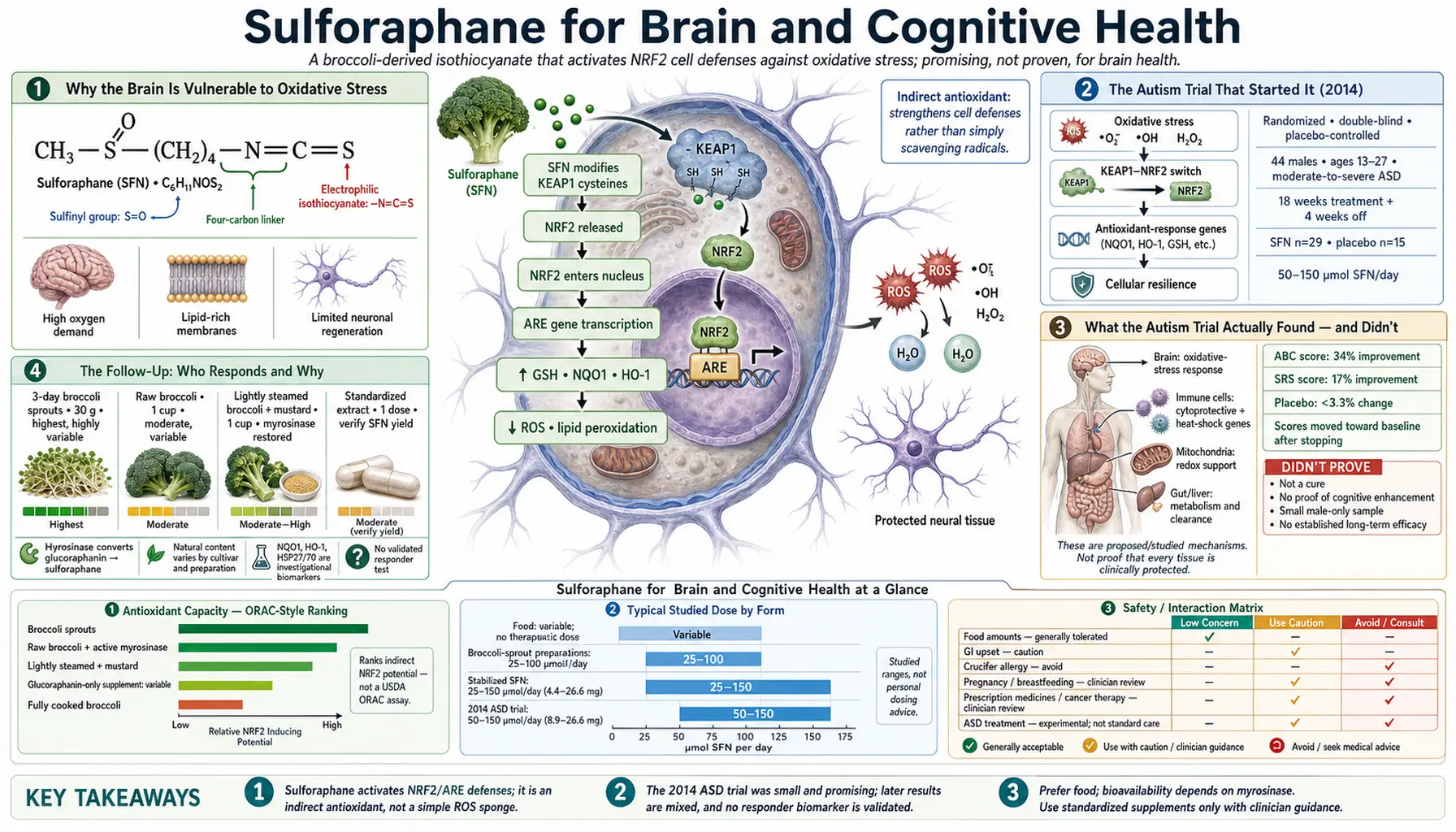
Sulforaphane's brain research is genuinely interesting — and genuinely preliminary. A 2014 randomized trial from Johns Hopkins and Massachusetts General Hospital reported behavioral improvements in young men with autism, a follow-up study found urinary chemical signatures that tracked who responded, a human imaging pilot showed sulforaphane can raise glutathione levels inside the living brain, and a small open-label study explored schizophrenia. The underlying logic is coherent: the brain is unusually vulnerable to oxidative stress and inflammation, and sulforaphane raises the brain's antioxidant defenses. But every one of these studies is small, early, and in need of replication. This page lays out exactly what was found and, just as importantly, what was not — because the autism field in particular has been plagued by overhyped and even dangerous "treatments," and families deserve a clear-eyed summary rather than a sales pitch.
Interactive Visualization Free Radicals & Your Antioxidant Network Follow one superoxide radical down the whole relay — SOD, catalase, glutathione, vitamin E, vitamin C, NADPH — then release free iron and watch a membrane tear itself apart. Launch →
Table of Contents
- Why the Brain Is Vulnerable to Oxidative Stress
- The Autism Trial That Started It (2014)
- What the Autism Trial Actually Found — and Didn't
- The Follow-Up: Who Responds and Why
- Does Sulforaphane Reach the Brain? Glutathione Imaging
- Schizophrenia: An Early Open-Label Signal
- Neurodegeneration Research (Preclinical)
- How to Read This Evidence Honestly
- Practical Notes for Families Considering It
- Cautions
- Key Research Papers
- Connections
- Featured Videos
Why the Brain Is Vulnerable to Oxidative Stress
The brain is a natural target for an Nrf2-activating antioxidant for several structural reasons. It consumes about 20% of the body's oxygen despite being only 2% of its weight, so it generates a large volume of reactive oxygen species. It is rich in polyunsaturated fatty acids, which are especially prone to oxidative damage. And its own antioxidant defenses — particularly glutathione — are comparatively modest relative to that oxidative load. Add neuroinflammation, driven by activated microglia releasing inflammatory cytokines, and you have the two exact processes sulforaphane is best at countering: oxidative stress (via Nrf2 induction) and inflammation (via NF-κB suppression), both described on the Antioxidant & Cellular Protection page.
Oxidative stress and neuroinflammation are documented features of a wide range of neurological and neurodevelopmental conditions, including autism spectrum disorder, schizophrenia, and the major neurodegenerative diseases. That shared biology is why a single compound has been investigated across such different-looking conditions — the common denominator is redox and inflammatory imbalance in brain tissue.
The Autism Trial That Started It (2014)
The study that put sulforaphane on the neuroscience map was published in PNAS in 2014 by Kanwaljit Singh, Andrew Zimmerman, and colleagues at Johns Hopkins and Massachusetts General Hospital. It was a randomized, double-blind, placebo-controlled trial — the gold-standard design — in 44 young men (aged 13–27) with moderate-to-severe autism spectrum disorder. Participants received a daily dose of sulforaphane (derived from broccoli-sprout extract, roughly 50–150 µmol depending on body weight) or placebo for 18 weeks.
The rationale was specific. A subset of children with autism had been observed to show temporary behavioral improvement during febrile illness (the "fever effect"), and the researchers hypothesized this reflected a heat-shock and stress-response mechanism that sulforaphane, as an Nrf2 and heat-shock-protein inducer, might mimic pharmacologically. It was a mechanistically motivated experiment, not a shot in the dark.
What the Autism Trial Actually Found — and Didn't
Behavior was rated by clinicians and caregivers using standard instruments (the Aberrant Behavior Checklist, the Social Responsiveness Scale, and clinical global impression scales). The results:
- The sulforaphane group showed statistically significant improvements versus placebo in measures of aberrant behavior, social interaction, and verbal communication over the 18 weeks.
- A meaningful fraction of the treated group were rated as "much" or "very much" improved by clinicians, versus few on placebo.
- The effect was not universal — many participants did not respond, and the study was small (44 people).
- The improvements reversed after sulforaphane was stopped, with scores drifting back toward baseline — consistent with a symptomatic, not curative, effect.
- Sulforaphane was well tolerated, with no serious adverse events attributable to it.
What the trial did not show is equally important. It did not show that sulforaphane cures or reverses autism. It did not change the underlying neurodevelopmental condition. It did not test children (participants were adolescents and young adults). And with only 44 participants at a single research program, it needs independent replication in larger, more diverse groups before any firm clinical conclusion can be drawn. It is a promising proof-of-concept, nothing more and nothing less.
The Follow-Up: Who Responds and Why
A key weakness of the original trial was that no one could predict in advance who would respond. Stephen Bent and colleagues addressed this in a 2018 study in Molecular Autism, analyzing urine samples from sulforaphane-treated children with autism. They identified a set of urinary metabolites — markers of oxidative stress, amino-acid metabolism, and gut-microbial activity — that correlated with the degree of clinical improvement.
The practical hope is a future ability to identify, from a simple urine test, the subgroup of individuals whose biology makes them likely to benefit — moving from "sulforaphane helps some people with autism, we don't know who" toward "sulforaphane helps people with this specific metabolic signature." That biomarker-guided precision approach is still in the research phase and is not clinically available, but it is the sensible scientific direction and it reinforces a recurring theme: sulforaphane response is highly individual.
Does Sulforaphane Reach the Brain? Glutathione Imaging
An obvious skeptical question is whether an orally eaten broccoli compound even reaches the brain in a way that changes brain chemistry. Thomas Sedlak and colleagues addressed this directly in a 2018 human pilot study using magnetic resonance spectroscopy (MRS), an imaging method that measures the concentration of specific chemicals inside living brain tissue non-invasively.
After healthy volunteers took sulforaphane, MRS detected a measurable increase in glutathione in brain regions including the cortex — direct in-human evidence that oral sulforaphane engages its central target and raises the brain's master antioxidant. This is an important bridge: it shows the mechanism proposed for the behavioral trials is physically plausible, because the compound demonstrably alters brain redox chemistry rather than acting only in the periphery. It does not, by itself, prove clinical benefit — but it removes the "it can't even get there" objection.
Schizophrenia: An Early Open-Label Signal
Because oxidative stress and glutathione deficits are implicated in schizophrenia, the same logic has been extended there. Shiina and colleagues ran a small open-label study in 2015 giving sulforaphane-rich broccoli-sprout extract to patients with schizophrenia, and reported modest improvement in some cognitive measures. This was an open-label study — no placebo group, everyone knew they were getting the active compound — which is the weakest trial design and highly prone to expectation effects. It is best read as a hypothesis-generating pilot that justifies a proper randomized trial, not as evidence that sulforaphane treats schizophrenia. See our Psychiatry section for context on the condition.
Neurodegeneration Research (Preclinical)
Sulforaphane has been widely studied in cell and animal models of neurodegenerative disease, reviewed by Tarozzi and colleagues. In these preclinical models, Nrf2 activation protects neurons against the oxidative and inflammatory damage central to Alzheimer's disease and Parkinson's disease — reducing markers of protein aggregation, mitochondrial dysfunction, and microglial inflammation, and preserving cognitive or motor performance in treated animals.
These are genuinely encouraging mechanistic results, but the caveat is large and familiar: the vast majority of this evidence is preclinical. Countless compounds protect neurons in a mouse and then fail in human trials. Sulforaphane has not been shown in adequate human trials to prevent, slow, or treat any neurodegenerative disease. It represents a plausible research direction supported by strong mechanism and animal data, awaiting the human outcome trials that would be needed to make any clinical claim. See our Neurology section.
How to Read This Evidence Honestly
A fair summary of the whole brain literature on sulforaphane:
- Mechanism: strong and coherent — the brain has exactly the oxidative/inflammatory vulnerabilities sulforaphane addresses, and imaging confirms sulforaphane raises brain glutathione in humans.
- Autism: one small, well-designed randomized trial with a positive but non-curative, reversible, and non-universal effect, plus biomarker follow-up work — promising, unreplicated at scale, not an established treatment.
- Schizophrenia and neurodegeneration: early open-label or preclinical only — hypothesis-generating, not clinically actionable.
The responsible stance is neither dismissal nor hype. Sulforaphane is one of the more scientifically credible dietary compounds being investigated for brain health, and that investigation deserves to continue — but "under active study" is not "proven," and families should not be sold the latter as if it were the former.
Practical Notes for Families Considering It
Families of people with autism or other neurological conditions understandably read the headlines and wonder whether to try broccoli-sprout extract. A few honest, practical points:
- Talk to the treating clinician first. Anyone considering sulforaphane for a neurological or psychiatric condition should discuss it with the physician or specialist managing that condition, especially for a child or someone on medication.
- It is a possible adjunct, never a replacement. Sulforaphane is not a substitute for evidence-based autism support (behavioral, educational, speech, and occupational therapies) or for prescribed psychiatric care. Beware anyone selling it as one.
- Dosing in trials came from concentrated, standardized extracts. The autism trial used carefully quantified sulforaphane (tied to body weight), not a handful of grocery-store sprouts. Ordinary dietary sprouts are healthy food but deliver variable, generally lower doses.
- Response is individual and reversible. Even in the positive trial, many did not respond, and benefits faded when treatment stopped. Set expectations accordingly and monitor objectively.
- Food first is always safe. Regular cruciferous vegetables and sprouts are a sound, low-risk part of a healthy diet for the whole family, independent of any specific neurological hope.
Cautions
- Not an approved treatment. Sulforaphane is not an approved therapy for autism, schizophrenia, Alzheimer's, Parkinson's, or any neurological condition. Research is preliminary.
- Supervision for vulnerable groups. Use in children or people with serious medical conditions should be clinician-supervised.
- Well tolerated but not risk-free. Trials report good tolerability (mild gastrointestinal effects), but long-term high-dose safety data in neurological populations are limited.
- Avoid the quackery trap. The autism field attracts unproven and sometimes harmful "cures." Sulforaphane's modest legitimate research should not be inflated into miracle claims, and it should never justify abandoning proven supports.
- Raw-sprout hygiene. Immunocompromised individuals should prefer lightly cooked broccoli to raw sprouts — see the Sources & Bioavailability page.
Key Research Papers
- Singh K, et al. (2014). Sulforaphane treatment of autism spectrum disorder (ASD). PNAS. — PubMed PMID: 25313065
- Bent S, et al. (2018). Identification of urinary metabolites that correlate with clinical improvements in children with autism treated with sulforaphane from broccoli. Molecular Autism. — PubMed PMID: 29854372
- Sedlak TW, et al. (2018). Sulforaphane Augments Glutathione and Influences Brain Metabolites in Human Subjects: A Clinical Pilot Study. Molecular Neuropsychiatry. — PubMed PMID: 29888232
- Shiina A, et al. (2015). An Open Study of Sulforaphane-rich Broccoli Sprout Extract in Patients with Schizophrenia. Clinical Psychopharmacology and Neuroscience. — PubMed PMID: 25912539
- Tarozzi A, et al. (2013). Sulforaphane as a potential protective phytochemical against neurodegenerative diseases. Oxidative Medicine and Cellular Longevity. — PubMed PMID: 23983898
- Dinkova-Kostova AT, Fahey JW, Kostov RV, Kensler TW (2017). KEAP1 and Done? Targeting the NRF2 Pathway with Sulforaphane. Trends in Food Science & Technology. — PubMed PMID: 29242678
- Houghton CA, Fassett RG, Coombes JS (2016). Sulforaphane and Other Nutrigenomic Nrf2 Activators: Can the Clinician's Expectation Be Matched by the Reality? Oxidative Medicine and Cellular Longevity. — PubMed PMID: 26881038
- Vanduchova A, Anzenbacher P, Anzenbacherova E (2019). Isothiocyanate from Broccoli, Sulforaphane, and Its Properties. Journal of Medicinal Food. — PubMed PMID: 30372361
- Dinkova-Kostova AT, et al. (2002). Direct evidence that sulfhydryl groups of Keap1 are the sensors regulating induction of phase 2 enzymes. PNAS. — PubMed PMID: 12193649
- Zhang Y, Talalay P, Cho CG, Posner GH (1992). A major inducer of anticarcinogenic protective enzymes from broccoli: isolation and elucidation of structure. PNAS. — PubMed PMID: 1549603
PubMed Topic Searches
- PubMed: Sulforaphane & autism spectrum disorder
- PubMed: Sulforaphane & brain glutathione imaging
- PubMed: Sulforaphane neuroprotection & Nrf2
- PubMed: Sulforaphane & schizophrenia
- PubMed: Sulforaphane & neurodegeneration
External Authoritative Resources
- Linus Pauling Institute — Isothiocyanates
- NIH NICHD — Autism Spectrum Disorder
- ClinicalTrials.gov — Sulforaphane & autism trials
Connections
- Free Radicals & Your Antioxidant Network — interactive animation
- Sulforaphane (Main Page)
- Sulforaphane Benefits Hub
- Antioxidant & Cellular Protection
- Detoxification & Nrf2
- Glutathione
- Melatonin
- Ergothioneine
- Autism
- Autism Spectrum Disorder (Pediatrics)
- Alzheimer's Disease
- Parkinson's Disease
- Psychiatry
- Neurology
- All Antioxidants