Sulforaphane: Sources and Bioavailability
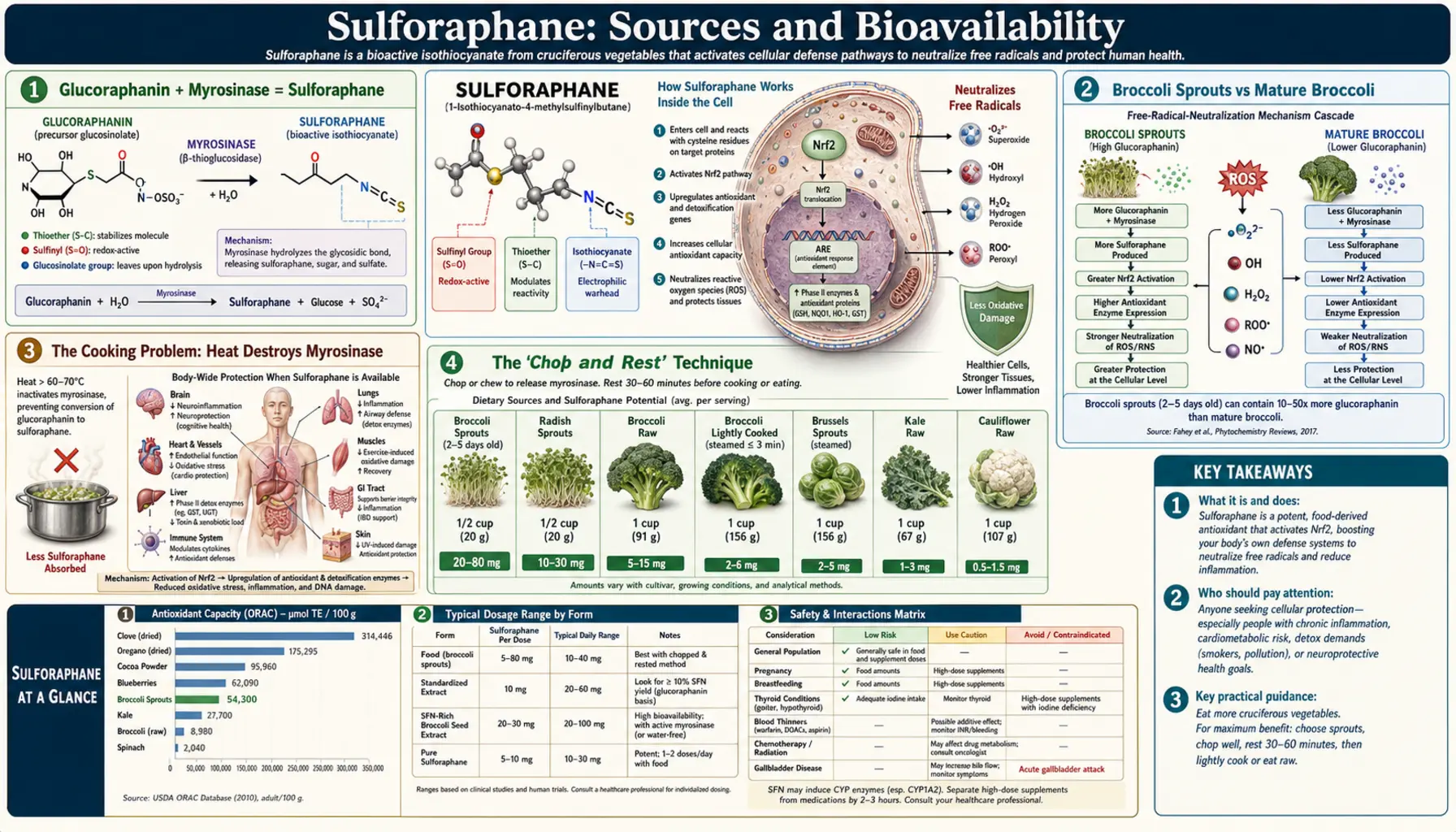
This is the page that decides whether all the biology on the other three actually happens in your body. Here is the catch that trips up most people: broccoli does not contain sulforaphane. It contains an inert precursor, glucoraphanin, and a separate enzyme, myrosinase, that must meet the precursor to make sulforaphane — and boiling broccoli destroys that enzyme, so you can eat a whole head and get almost none. Young broccoli sprouts contain 10 to 100 times more precursor than mature broccoli, which is why they are the premier source. This page covers everything practical: sprouts versus mature broccoli, the cooking problem and how to beat it (the "chop and rest" wait, light steaming, and adding raw mustard powder as an enzyme source), how to grow sprouts safely at home, how to read a supplement label, and why bioavailability varies so much from person to person.
Interactive Visualization Free Radicals & Your Antioxidant Network Follow one superoxide radical down the whole relay — SOD, catalase, glutathione, vitamin E, vitamin C, NADPH — then release free iron and watch a membrane tear itself apart. Launch →
Table of Contents
- Glucoraphanin + Myrosinase = Sulforaphane
- Broccoli Sprouts vs Mature Broccoli
- The Cooking Problem: Heat Destroys Myrosinase
- The "Chop and Rest" Technique
- The Mustard-Seed Enzyme Trick
- Growing Your Own Broccoli Sprouts
- Supplement Forms: What to Look For
- Bioavailability and the Gut Microbiome
- How Much, How Often, and What to Expect
- Food Sources Beyond Broccoli
- Cautions
- Key Research Papers
- Connections
- Featured Videos
Glucoraphanin + Myrosinase = Sulforaphane
Sulforaphane is not stored ready-made in the plant. Cruciferous vegetables keep a loaded two-part system that fires only when the plant tissue is damaged — a chemical defense against being eaten by insects:
- Glucoraphanin — the inert, water-soluble precursor (a glucosinolate). It is stable, survives cooking, and is stored in the plant's cells. On its own it does nothing in your body.
- Myrosinase — the enzyme, kept physically separate from glucoraphanin inside the intact plant, in different cell compartments.
When you chew, chop, blend, or an insect bites the plant, the cell walls rupture and the two finally meet. Myrosinase cleaves glucoraphanin and, after a spontaneous rearrangement, the product is sulforaphane. This is why a whole, intact broccoli floret has essentially no sulforaphane until it is physically broken. The entire practical challenge of getting sulforaphane comes down to one question: did glucoraphanin and active myrosinase actually get to meet? Everything below is a variation on protecting or supplying that reaction.
Broccoli Sprouts vs Mature Broccoli
The single most important sourcing fact was established by Fahey, Zhang, and Talalay in 1997: 3-day-old broccoli sprouts contain 10 to 100 times more glucoraphanin per gram than mature broccoli. A young seedling concentrates its chemical defenses because it cannot afford to lose its first leaves; that defensive stockpile is exactly the glucoraphanin we want.
In concrete terms, a small serving of broccoli sprouts (roughly 1 ounce / 30 grams) can supply as much glucoraphanin as one to two pounds of mature broccoli. This is why virtually every clinical trial — from the Qidong detox studies to the autism trial — used sprouts or standardized sprout extracts rather than ordinary broccoli. Mature broccoli is still a genuinely healthy vegetable with real glucoraphanin, and eating it regularly is worthwhile; sprouts are simply the concentrated source. For a deeper food-level comparison see our companion page on Broccoli: Sprouts vs Mature and the main Broccoli page.
Note that broccoli sprouts (3–5 days old, tiny with yellow-green leaves) are different from broccoli microgreens (7–14 days, larger) and from mature broccoli. Sprouts are the peak-glucoraphanin stage.
The Cooking Problem: Heat Destroys Myrosinase
Here is where most people unknowingly waste their broccoli. Glucoraphanin is heat-stable, but myrosinase — the enzyme that converts it — is a protein and is destroyed by heat. Boil or thoroughly cook broccoli and you denature the myrosinase completely. The glucoraphanin survives, but with no active enzyme to convert it, little or no sulforaphane forms. Vermeulen and colleagues measured this directly in humans: sulforaphane bioavailability from raw broccoli was roughly three times higher than from cooked broccoli, and cooking shifted absorption to a slower, lower route. Conaway and colleagues found the same pattern comparing steamed versus fresh broccoli.
The temperature thresholds matter:
- Boiling — the worst option. It destroys myrosinase and also leaches water-soluble glucoraphanin into the discarded cooking water. Sulforaphane yield can fall close to zero.
- Heavy steaming or long cooking — also inactivates most myrosinase.
- Light steaming (about 3–4 minutes, to bright green and just tender) — a useful sweet spot. Matusheski and colleagues showed that gentle heating around 60–70 °C actually increases sulforaphane formation by destroying a competing protein (epithiospecifier protein, or ESP) that otherwise diverts the reaction toward inactive sulforaphane nitrile — while still sparing enough myrosinase to work. Brief, gentle heat can therefore beat both raw and heavily cooked.
- Raw — preserves myrosinase fully, so raw broccoli and especially raw sprouts convert well.
The "Chop and Rest" Technique
If you are going to cook broccoli, the simplest trick to rescue sulforaphane is chop and rest (sometimes called "hack and hold"): chop the broccoli finely and let it sit for 40 minutes or more before heating.
The logic follows directly from the two-part system. Chopping ruptures the cells so glucoraphanin and myrosinase meet; the resting period gives the still-active raw enzyme time to do its work and generate sulforaphane before any heat arrives to destroy it. Once the sulforaphane has formed, it is far more heat-stable than the enzyme, so subsequent light cooking does not undo it. Chop finely, wait at least 40 minutes (longer is fine), then cook briefly if desired. This single habit can be the difference between a meaningful dose and almost none.
The Mustard-Seed Enzyme Trick
What if the broccoli is already cooked — a frozen bag, restaurant broccoli, or a batch you boiled? The elegant fix is to supply myrosinase from another source. Many other raw cruciferous foods are rich in active myrosinase, and mustard is the classic. Ghawi and colleagues demonstrated that sprinkling a small amount of raw mustard powder (or mustard seed) onto cooked broccoli substantially restores sulforaphane formation, because the mustard's heat-untouched myrosinase converts the broccoli's intact, heat-stable glucoraphanin.
Practical enzyme "donors" you can add to cooked crucifers:
- Mustard powder or mustard seed — the best-studied; even a quarter to half a teaspoon of raw powder helps.
- Fresh raw radish, daikon, or horseradish — also myrosinase-rich.
- A handful of fresh raw broccoli sprouts or arugula stirred into the finished dish.
- Wasabi — another crucifer with active enzyme.
Add the raw enzyme source after cooking (once the food has cooled below scalding), so the enzyme survives to do its job.
Growing Your Own Broccoli Sprouts
Broccoli sprouts are inexpensive and easy to grow at home, which is why many people who use sulforaphane seriously grow their own for freshness and cost. The basic method:
- Use seed sold for sprouting. Buy broccoli sprouting seed from a reputable supplier that tests for pathogens; do not use garden seed, which may be chemically treated.
- Soak about 1–2 tablespoons of seed overnight in cool water in a clean wide-mouth jar with a mesh lid.
- Drain and rinse thoroughly two to three times a day, draining fully each time so the seeds stay moist but never sit in water. Keep the jar tilted, mesh-side down, out of direct sun.
- Harvest at 3–5 days, when they have small yellow-green leaves. A brief exposure to light greens them up. Rinse well and refrigerate; use within a few days.
Food-safety note: because sprouts grow warm and moist, they can harbor bacteria if contaminated. Use pathogen-tested seed, keep everything scrupulously clean, rinse often, and refrigerate promptly. Immunocompromised people, pregnant women, young children, and the elderly should prefer lightly cooked broccoli (with the chop-and-rest or mustard trick) over raw home-grown sprouts.
Supplement Forms: What to Look For
Supplements are convenient but vary enormously in whether they actually deliver sulforaphane. The key distinctions:
- Glucoraphanin-only ("broccoli extract") without active myrosinase — the most common and often the weakest. With no enzyme in the capsule, conversion depends entirely on your gut bacteria, which is highly variable person to person (see bioavailability below). Many such products deliver disappointing sulforaphane.
- Glucoraphanin + active myrosinase — a better design. Products that combine the precursor with a preserved, active myrosinase source (for example, added active broccoli-seed enzyme) convert reliably. Check that the label specifies active myrosinase, not just "broccoli."
- Pre-formed / stabilized sulforaphane — delivers sulforaphane directly, bypassing the conversion problem. Sulforaphane is chemically unstable, so this requires proper stabilization; Fahey and colleagues (2017) specifically studied the delivery efficiency of stabilized sulforaphane for clinical use.
Because supplement quality is inconsistent and doses are not standardized across brands, many researchers still regard fresh sprouts or a well-designed sprout extract as the most dependable option. Look for third-party testing and a stated sulforaphane (not just glucoraphanin) yield.
Bioavailability and the Gut Microbiome
Even with a good source, how much sulforaphane reaches your bloodstream varies widely. Shapiro and colleagues showed that when people eat glucoraphanin without active myrosinase (for example, cooked broccoli or glucoraphanin-only supplements), conversion falls to the gut bacteria — and human gut microbiomes differ enormously in their myrosinase-like activity. Some people are efficient converters; others convert very little. This is the likely explanation for why, in the Qidong trials, only the "good converters" showed the clearest protective signal.
Key bioavailability points:
- Pre-converted sulforaphane is far more bioavailable than unconverted glucoraphanin. Eating raw sprouts (active myrosinase present) gives fast, high absorption; relying on gut bacteria to convert cooked precursor gives slow, low, and variable absorption.
- Absorption is rapid when myrosinase is present — sulforaphane appears in blood and urine within a few hours, peaks the same day, and its detox effects persist for one to three days.
- Interconversion with erucin. Clarke and colleagues showed sulforaphane and a related isothiocyanate, erucin, interconvert in the body, so total isothiocyanate exposure matters.
- Antibiotics and gut health can transiently reduce the microbial conversion route — another reason to prefer sources with the enzyme already active.
How Much, How Often, and What to Expect
- Typical study doses: human trials generally used the equivalent of roughly 20–60 mg sulforaphane per day, or about 100–200 µmol of glucoraphanin from a properly converting source.
- Food equivalent: a modest daily serving of fresh broccoli sprouts (about 1 ounce / 20–40 grams), eaten raw or lightly used, is a reasonable everyday target.
- Frequency beats size. Because the induced enzymes last one to three days, eating sprouts or well-prepared crucifers every two to three days keeps detox capacity continuously elevated — steady and regular beats occasional and large.
- Pair with a little healthy fat and chew thoroughly; both support absorption and conversion.
- Set realistic expectations. Sulforaphane is not a stimulant or a drug with an obvious acute "feel." Its benefits are the quiet, cumulative ones of raising the body's own antioxidant and detox capacity over time.
Food Sources Beyond Broccoli
Broccoli and its sprouts are the richest common source, but the whole cruciferous (Brassica) family supplies glucoraphanin or related glucosinolates and their converting enzymes:
- Broccoli sprouts — the richest by a wide margin.
- Mature broccoli — solid everyday source; use chop-and-rest or add raw mustard if cooking.
- Kale, cabbage, Brussels sprouts, cauliflower, bok choy, collards — contribute glucosinolates and myrosinase.
- Mustard greens, radish, daikon, horseradish, wasabi, arugula, watercress — pungent crucifers rich in active myrosinase; excellent enzyme "donors" to pair with cooked broccoli.
A diet with a variety of these vegetables, some eaten raw, supplies both the precursor and the enzyme naturally. See the full Food section and the Antioxidants hub for related compounds.
Cautions
- Raw-sprout food safety. Raw sprouts carry a small risk of bacterial contamination. Use pathogen-tested seed, keep equipment clean, and rinse well. Immunocompromised people, pregnant women, young children, and the elderly should favor lightly cooked broccoli.
- Thyroid and iodine. Very large intakes of raw cruciferous vegetables contribute goitrogenic compounds; iodine-deficient individuals and those with thyroid disease should ensure adequate iodine and moderate very large raw quantities.
- Supplement variability. Products differ hugely in real sulforaphane yield; prefer those with active myrosinase or stabilized sulforaphane and third-party testing.
- Digestive effects. Large amounts of crucifers can cause gas and bloating; increase intake gradually.
- Not a substitute for medical care. Sulforaphane-rich foods support normal physiology; they do not treat diagnosed disease.
Key Research Papers
- Fahey JW, Zhang Y, Talalay P (1997). Broccoli sprouts: an exceptionally rich source of inducers of enzymes that protect against chemical carcinogens. PNAS. — PubMed PMID: 9294217
- Shapiro TA, Fahey JW, Wade KL, Stephenson KK, Talalay P (2001). Chemoprotective glucosinolates and isothiocyanates of broccoli sprouts: metabolism and excretion in humans. Cancer Epidemiology Biomarkers & Prevention. — PubMed PMID: 11352861
- Conaway CC, et al. (2000). Disposition of glucosinolates and sulforaphane in humans after ingestion of steamed and fresh broccoli. Nutrition and Cancer. — PubMed PMID: 11525594
- Vermeulen M, et al. (2008). Bioavailability and kinetics of sulforaphane in humans after consumption of cooked versus raw broccoli. Journal of Agricultural and Food Chemistry. — PubMed PMID: 18950181
- Matusheski NV, Juvik JA, Jeffery EH (2004). Heating decreases epithiospecifier protein activity and increases sulforaphane formation in broccoli. Phytochemistry. — PubMed PMID: 15184012
- Ghawi SK, Methven L, Niranjan K (2013). The potential to intensify sulforaphane formation in cooked broccoli using mustard seeds as a source of myrosinase. Food Chemistry. — PubMed PMID: 23411305
- Egner PA, et al. (2011). Bioavailability of Sulforaphane from two broccoli sprout beverages: results of a short-term, cross-over clinical trial in Qidong, China. Cancer Prevention Research. — PubMed PMID: 21372038
- Clarke JD, et al. (2011). Bioavailability and inter-conversion of sulforaphane and erucin in human subjects consuming broccoli sprouts or broccoli supplement in a cross-over study design. Pharmacological Research. — PubMed PMID: 21816223
- Fahey JW, et al. (2017). Stabilized sulforaphane for clinical use: Phytochemical delivery efficiency. Molecular Nutrition & Food Research. — PubMed PMID: 27935214
- Vanduchova A, Anzenbacher P, Anzenbacherova E (2019). Isothiocyanate from Broccoli, Sulforaphane, and Its Properties. Journal of Medicinal Food. — PubMed PMID: 30372361
- Egner PA, et al. (2014). Rapid and sustainable detoxication of airborne pollutants by broccoli sprout beverage: results of a randomized clinical trial in China. Cancer Prevention Research. — PubMed PMID: 24913818
PubMed Topic Searches
- PubMed: Broccoli sprouts & glucoraphanin content
- PubMed: Myrosinase, cooking & sulforaphane
- PubMed: Sulforaphane bioavailability raw vs cooked
- PubMed: Mustard-seed myrosinase & sulforaphane
- PubMed: Gut-microbiome conversion of glucoraphanin
External Authoritative Resources
- Linus Pauling Institute — Isothiocyanates (sources & bioavailability)
- USDA FoodData Central — Broccoli & broccoli sprouts
- FDA — Sprout & produce food-safety guidance
Connections
- Free Radicals & Your Antioxidant Network — interactive animation
- Sulforaphane (Main Page)
- Sulforaphane Benefits Hub
- Detoxification & Nrf2
- Antioxidant & Cellular Protection
- Broccoli
- Broccoli: Sprouts vs Mature
- Kale
- Cabbage
- All Foods
- Glutathione
- NAC
- All Antioxidants