Sulforaphane — Benefits Deep Dive
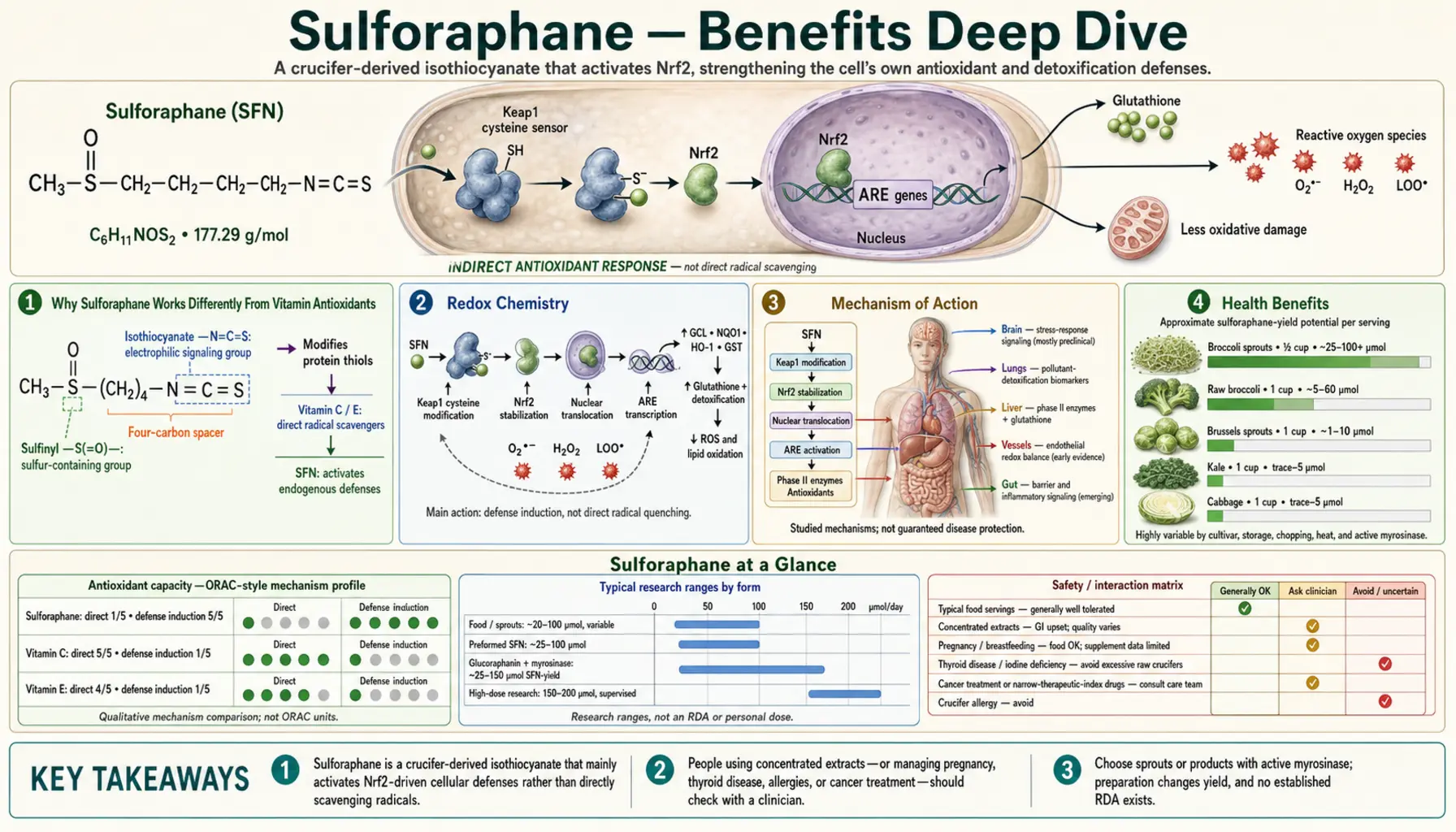
Sulforaphane is an isothiocyanate concentrated in cruciferous vegetables — and richest by far in young broccoli sprouts — that behaves unlike any vitamin antioxidant. Rather than neutralizing one free radical and being spent, it switches on Nrf2, the master transcription factor that turns on the body's own family of cytoprotective and detoxification enzymes. A single dose triggers days of elevated glutathione, NQO1, and glutathione S-transferase activity, making sulforaphane an indirect, catalytic, long-lasting antioxidant. That mechanism is the thread running through more than two decades of research at Johns Hopkins (Talalay, Fahey, Kensler) and a widening set of clinical trials in detoxification, cancer chemoprevention, cardiometabolic health, and neurodevelopment. The four deep dives below walk through the best-understood story (Nrf2 and phase-II detox), the broader antioxidant and chemoprevention research, the early brain and autism trials, and — most practically — how to actually get sulforaphane from your food.
Deep-Dive Articles
Detoxification & Nrf2
The signature mechanism. How sulforaphane modifies cysteine sensors on the KEAP1 protein, releases Nrf2 to the nucleus, and induces the phase-II detoxification battery — glutathione synthesis, NQO1, glutathione S-transferases, and heme oxygenase-1. The Qidong, China trials showing accelerated urinary excretion of airborne benzene and acrolein conjugates and reduced aflatoxin-DNA adducts.
Antioxidant & Cellular Protection
Why an "indirect" antioxidant that never touches a radical directly outlasts vitamins C and E. Anti-inflammatory signaling through NF-κB suppression, the large preclinical and epidemiologic cancer-chemoprevention literature (presented as research, not therapy), the Helicobacter pylori gastritis trials, and cardiometabolic findings including the type-2-diabetes glucose-control study.
Brain & Cognitive Health
The neuroscience frontier, told honestly. The 2014 Johns Hopkins/MassGeneral randomized autism trial, the follow-up urinary-metabolite work, a small schizophrenia open-label study, and the human pilot showing sulforaphane raises brain glutathione on MRS imaging. These are small, early, preliminary trials — promising signals, not established treatments.
Sources & Bioavailability
The practical page. Broccoli sprouts versus mature broccoli (a 10–100× difference in glucoraphanin), the myrosinase problem — boiling destroys the enzyme that makes sulforaphane — and the fixes: the "chop and rest" wait, light steaming, and adding raw mustard powder as an enzyme source. Supplement forms, why glucoraphanin-only pills underperform, and absorption kinetics.
Interactive Visualization Free Radicals & Your Antioxidant Network Follow one superoxide radical down the whole relay — SOD, catalase, glutathione, vitamin E, vitamin C, NADPH — then release free iron and watch a membrane tear itself apart. Launch →
Table of Contents
- Deep-Dive Articles
- Why Sulforaphane Works Differently From Vitamin Antioxidants
- Research Papers: Nrf2 & Detoxification
- Research Papers: Antioxidant, Anti-Inflammatory & Chemoprevention
- Research Papers: Cardiometabolic Health
- Research Papers: Brain & Cognitive Health
- Research Papers: Sources, Cooking & Bioavailability
- External Authoritative Resources
- Connections
- Featured Videos
Why Sulforaphane Works Differently From Vitamin Antioxidants
Most dietary antioxidants are direct (or "sacrificial") antioxidants. A molecule of vitamin C or vitamin E meets a free radical, donates an electron to neutralize it, and is itself oxidized and consumed. The protection is real but stoichiometric and short-lived: one molecule quenches roughly one radical, and the supply must be continuously replenished from the diet.
Sulforaphane works by a fundamentally different logic. It is an indirect antioxidant — it never neutralizes a radical directly. Instead, it acts as a signaling molecule that switches on the cell's own genetic program of defense. The target is the KEAP1–Nrf2 pathway:
- KEAP1 is a sensor. Under normal conditions the protein KEAP1 grabs the transcription factor Nrf2 and marks it for continuous destruction, keeping antioxidant genes quiet. KEAP1 is studded with reactive cysteine residues that act as chemical tripwires.
- Sulforaphane trips the sensor. The isothiocyanate group of sulforaphane reacts covalently with specific KEAP1 cysteines (notably Cys151). This modification changes KEAP1's shape so it can no longer hand Nrf2 off for destruction.
- Nrf2 is released and acts. Freed Nrf2 accumulates, moves into the nucleus, binds the antioxidant response element (ARE) in the promoters of hundreds of cytoprotective genes, and turns them on.
- The cell makes its own antioxidants and detox enzymes. The induced genes include glutathione synthesis machinery, NAD(P)H quinone oxidoreductase 1 (NQO1), the glutathione S-transferase (GST) family, heme oxygenase-1 (HO-1), and thioredoxin reductase.
The consequences of this catalytic mechanism are what make sulforaphane distinctive: the effect is amplifying (one sulforaphane molecule triggers the synthesis of many defensive enzyme molecules, each of which can process many radicals or toxins) and long-lasting (the induced enzymes persist for one to three days after a single dose, long after the sulforaphane itself has been cleared). This is why a serving of broccoli sprouts can measurably elevate detoxification capacity for days, and why the research community describes sulforaphane as a nutrigenomic agent rather than a simple antioxidant. The four deep-dive pages below explore where that mechanism has been tested: the best-understood detox and Nrf2 story, the broader cellular-protection and chemoprevention research, the early brain and autism trials, and the all-important question of how to actually get it from food.
Research Papers: Nrf2 & Detoxification
- Zhang Y, Talalay P, Cho CG, Posner GH (1992). A major inducer of anticarcinogenic protective enzymes from broccoli: isolation and elucidation of structure. PNAS. — PubMed PMID: 1549603
- Dinkova-Kostova AT, Holtzclaw WD, et al. (2002). Direct evidence that sulfhydryl groups of Keap1 are the sensors regulating induction of phase 2 enzymes. PNAS. — PubMed PMID: 12193649
- Thimmulappa RK, et al. (2002). Identification of Nrf2-regulated genes induced by the chemopreventive agent sulforaphane by oligonucleotide microarray. Cancer Research. — PubMed PMID: 12234984
- Dinkova-Kostova AT, Fahey JW, Kostov RV, Kensler TW (2017). KEAP1 and Done? Targeting the NRF2 Pathway with Sulforaphane. Trends in Food Science & Technology. — PubMed PMID: 29242678
- Egner PA, et al. (2014). Rapid and sustainable detoxication of airborne pollutants by broccoli sprout beverage: results of a randomized clinical trial in China. Cancer Prevention Research. — PubMed PMID: 24913818
- Kensler TW, et al. (2005). Effects of glucosinolate-rich broccoli sprouts on urinary levels of aflatoxin-DNA adducts and phenanthrene tetraols in a randomized clinical trial in Qidong, China. Cancer Epidemiology Biomarkers & Prevention. — PubMed PMID: 16284385
- Riedl MA, Saxon A, Diaz-Sanchez D (2009). Oral sulforaphane increases Phase II antioxidant enzymes in the human upper airway. Clinical Immunology. — PubMed PMID: 19028145
- Houghton CA, Fassett RG, Coombes JS (2016). Sulforaphane and Other Nutrigenomic Nrf2 Activators: Can the Clinician's Expectation Be Matched by the Reality? Oxidative Medicine and Cellular Longevity. — PubMed PMID: 26881038
Research Papers: Antioxidant, Anti-Inflammatory & Chemoprevention
- Zhang Y, Kensler TW, Cho CG, Posner GH, Talalay P (1994). Anticarcinogenic activities of sulforaphane and structurally related synthetic norbornyl isothiocyanates. PNAS. — PubMed PMID: 8159717
- Clarke JD, Dashwood RH, Ho E (2008). Multi-targeted prevention of cancer by sulforaphane. Cancer Letters. — PubMed PMID: 18504070
- Cornblatt BS, et al. (2007). Preclinical and clinical evaluation of sulforaphane for chemoprevention in the breast. Carcinogenesis. — PubMed PMID: 17347138
- Fahey JW, et al. (2002). Sulforaphane inhibits extracellular, intracellular, and antibiotic-resistant strains of Helicobacter pylori and prevents benzo[a]pyrene-induced stomach tumors. PNAS. — PubMed PMID: 12032331
- Yanaka A, et al. (2009). Dietary sulforaphane-rich broccoli sprouts reduce colonization and attenuate gastritis in Helicobacter pylori-infected mice and humans. Cancer Prevention Research. — PubMed PMID: 19349290
- Vanduchova A, Anzenbacher P, Anzenbacherova E (2019). Isothiocyanate from Broccoli, Sulforaphane, and Its Properties. Journal of Medicinal Food. — PubMed PMID: 30372361
Research Papers: Cardiometabolic Health
- Axelsson AS, et al. (2017). Sulforaphane reduces hepatic glucose production and improves glucose control in patients with type 2 diabetes. Science Translational Medicine. — PubMed PMID: 28615356
- Bahadoran Z, et al. (2012). Broccoli sprouts powder could improve serum triglyceride and oxidized LDL/LDL-cholesterol ratio in type 2 diabetic patients. Diabetes Research and Clinical Practice. — PubMed PMID: 22325157
- Bai Y, et al. (2015). Sulforaphane Protects against Cardiovascular Disease via Nrf2 Activation. Oxidative Medicine and Cellular Longevity. — PubMed PMID: 26583056
Research Papers: Brain & Cognitive Health
- Singh K, et al. (2014). Sulforaphane treatment of autism spectrum disorder (ASD). PNAS. — PubMed PMID: 25313065
- Bent S, et al. (2018). Identification of urinary metabolites that correlate with clinical improvements in children with autism treated with sulforaphane from broccoli. Molecular Autism. — PubMed PMID: 29854372
- Sedlak TW, et al. (2018). Sulforaphane Augments Glutathione and Influences Brain Metabolites in Human Subjects: A Clinical Pilot Study. Molecular Neuropsychiatry. — PubMed PMID: 29888232
- Shiina A, et al. (2015). An Open Study of Sulforaphane-rich Broccoli Sprout Extract in Patients with Schizophrenia. Clinical Psychopharmacology and Neuroscience. — PubMed PMID: 25912539
- Tarozzi A, et al. (2013). Sulforaphane as a potential protective phytochemical against neurodegenerative diseases. Oxidative Medicine and Cellular Longevity. — PubMed PMID: 23983898
Research Papers: Sources, Cooking & Bioavailability
- Fahey JW, Zhang Y, Talalay P (1997). Broccoli sprouts: an exceptionally rich source of inducers of enzymes that protect against chemical carcinogens. PNAS. — PubMed PMID: 9294217
- Shapiro TA, Fahey JW, Wade KL, Stephenson KK, Talalay P (2001). Chemoprotective glucosinolates and isothiocyanates of broccoli sprouts: metabolism and excretion in humans. Cancer Epidemiology Biomarkers & Prevention. — PubMed PMID: 11352861
- Vermeulen M, et al. (2008). Bioavailability and kinetics of sulforaphane in humans after consumption of cooked versus raw broccoli. Journal of Agricultural and Food Chemistry. — PubMed PMID: 18950181
- Ghawi SK, Methven L, Niranjan K (2013). The potential to intensify sulforaphane formation in cooked broccoli using mustard seeds as a source of myrosinase. Food Chemistry. — PubMed PMID: 23411305
- Fahey JW, et al. (2017). Stabilized sulforaphane for clinical use: Phytochemical delivery efficiency. Molecular Nutrition & Food Research. — PubMed PMID: 27935214
External Authoritative Resources
- Linus Pauling Institute — Isothiocyanates (Sulforaphane) — the most authoritative, regularly updated scientific summary of isothiocyanate biology
- PubMed — All research on Sulforaphane (thousands of papers)
- PubChem — Sulforaphane compound record (structure, properties, safety data)
- NIH Office of Dietary Supplements — Fact Sheet index
- ClinicalTrials.gov — Registered sulforaphane trials
Connections
- Free Radicals & Your Antioxidant Network — interactive animation
- Sulforaphane (Main Page)
- Detoxification & Nrf2
- Antioxidant & Cellular Protection
- Brain & Cognitive Health
- Sources & Bioavailability
- All Antioxidants
- Glutathione
- NAC
- Curcumin
- Quercetin
- Broccoli
- Broccoli: Sprouts vs Mature
- Kale
- Cabbage
- Helicobacter pylori
- Autism