Rutin: Antioxidant and Anti-Inflammatory Actions
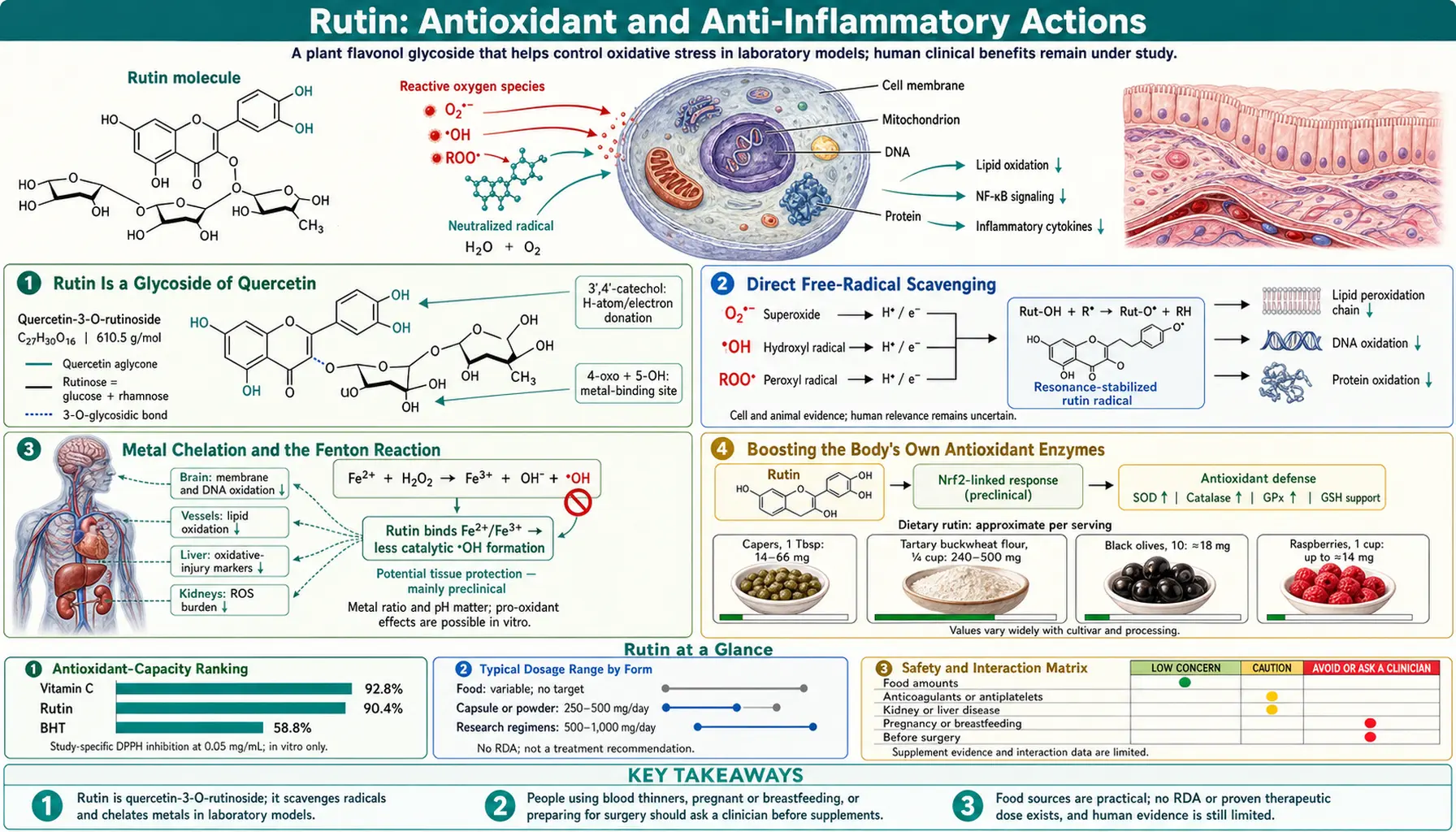
Rutin is a genuinely capable antioxidant, and this is the part of its biology with the deepest laboratory support. Chemically it is quercetin-3-O-rutinoside — the antioxidant flavonol quercetin carrying a sugar tail — so much of what rutin does traces back to quercetin's catechol chemistry. Rutin scavenges free radicals directly, chelates the iron and copper that would otherwise manufacture the most damaging radicals, supports the body's own antioxidant enzymes, and calms the NF-κB inflammatory switch. The honest caveat: the great majority of this evidence is from test-tube and animal studies, with human clinical confirmation still thin.
Table of Contents
- Rutin Is a Glycoside of Quercetin
- Direct Free-Radical Scavenging
- Metal Chelation and the Fenton Reaction
- Boosting the Body's Own Enzymes
- Calming Inflammation: NF-κB and Cytokines
- Evidence from Inflammation Models
- The Pro-Oxidant Caveat and Dose
- Rutin vs Free Quercetin
- What Is Strong and What Is Preliminary
- Key Research Papers
- External Resources
- Connections
- Featured Videos
Rutin Is a Glycoside of Quercetin
The single most useful fact for understanding rutin's antioxidant behavior is its structure. Rutin is quercetin with the disaccharide rutinose (rhamnose plus glucose) attached at the 3-position of quercetin's C-ring. Its formula is C27H30O16 (about 610 g/mol), versus quercetin's smaller C15H10O7.
That sugar tail matters two ways. It makes rutin more water-soluble and more chemically stable than free quercetin, so rutin is the storage-and-transport form plants favor. But it also blocks the 3-hydroxyl group, one of the sites that contributes to quercetin's radical-quenching power. The net result is that intact rutin is a somewhat milder direct antioxidant than free quercetin molecule-for-molecule — but it is more stable, and in the body it is slowly converted back to quercetin by gut bacteria, delivering quercetin's activity gradually rather than in a burst.
So "rutin's antioxidant effect" is really two effects layered together: the intact molecule acting at cell membranes and in the vessel wall before any sugar is removed, plus the free quercetin (and its phenolic-acid breakdown products) released downstream. General flavonoid reviews such as Panche and colleagues (2016) place both in the broader family of plant polyphenols that share this catechol-based chemistry.
Direct Free-Radical Scavenging
Rutin's flavonol backbone carries several hydroxyl groups, including the catechol (two adjacent hydroxyls) arrangement on the B-ring. These groups can donate a hydrogen atom or an electron to a reactive oxygen species, neutralizing it and leaving behind a comparatively stable, low-reactivity rutin radical. Through this mechanism rutin quenches superoxide, hydroxyl radicals, peroxyl radicals, and peroxynitrite in laboratory assays.
This is the same fundamental chemistry that powers most plant flavonols, and it is why rutin performs well in the standard test-tube antioxidant panels (DPPH, ABTS, FRAP, ORAC). A 2018 review by Enogieru and colleagues catalogued rutin's radical-scavenging profile in the context of neurodegenerative-disease models, where oxidative stress is a central driver. The important interpretive point is that strong test-tube antioxidant numbers do not automatically translate into clinical benefit in people — absorption, distribution, and metabolism all intervene — but they do establish that the underlying chemistry is real and potent.
Metal Chelation and the Fenton Reaction
Rutin's most distinctive antioxidant contribution is metal chelation, and this is where it arguably outshines simple radical scavengers. Free iron and copper ions are dangerous because they catalyze the Fenton reaction, which turns ordinary hydrogen peroxide into the hydroxyl radical — the single most destructive reactive oxygen species, capable of damaging DNA, protein, and membrane lipids indiscriminately.
Rutin binds these transition metals and locks them into inert complexes that can no longer drive the Fenton reaction. In effect it shuts off radical production at the source rather than only mopping up radicals after they form. A classic 1989 study by Afanas'ev and colleagues compared rutin and quercetin directly in iron-dependent lipid peroxidation and found that, while both worked, the chelation mechanism mattered more for rutin than for quercetin — and, intriguingly, that the iron–flavonoid complexes retained radical-scavenging activity of their own.
So rutin fights oxidative stress on three fronts at once: it intercepts existing radicals, it suppresses the manufacture of new hydroxyl radicals by sequestering catalytic metals, and it protects membrane lipids from the chain reaction of peroxidation. Later work, such as Ostrakhovitch and Afanas'ev (2001) in rheumatoid-arthritis leukocytes, extended this chelation-plus-scavenging picture to inflamed human cells.
Boosting the Body's Own Antioxidant Enzymes
Beyond acting as a sacrificial antioxidant itself, rutin appears to strengthen the body's endogenous antioxidant defenses — the enzymes cells use to detoxify reactive oxygen species. Across animal studies, rutin raises the activity of superoxide dismutase (SOD), catalase (CAT), and glutathione peroxidase (GPx), and increases levels of reduced glutathione, the cell's master antioxidant.
Encouragingly, one of the few human trials points the same way. The 2023 randomized, placebo-controlled study by Bazyar and colleagues gave adults with type 2 diabetes 1 gram of rutin daily for three months and measured rises in serum SOD, catalase, and glutathione peroxidase alongside improved quality-of-life scores. This enzyme-induction effect — sometimes described as an indirect or "hormetic" antioxidant action — may matter more in living organisms than raw radical-scavenging, because it upgrades the cell's standing defenses rather than being consumed in a single reaction.
Calming Inflammation: NF-κB, TNF, and the Cytokines
Oxidative stress and inflammation are tightly linked: reactive oxygen species help switch on NF-κB, the master transcription factor that turns up dozens of inflammatory genes. By reducing oxidative stress and by acting on the pathway more directly, rutin downregulates NF-κB signaling in laboratory and animal models, which in turn lowers the output of pro-inflammatory messengers.
Specifically, rutin has been shown to reduce tumor necrosis factor-alpha (TNF-α), interleukin-6 (IL-6), interleukin-1beta (IL-1β), and cyclooxygenase-2 (COX-2) — the same mediators targeted by many anti-inflammatory drugs. A comprehensive 2022 review by Muvhulawa and colleagues in Pharmacological Research synthesized this literature and connected rutin's anti-inflammatory action to improvements in metabolic measures such as blood sugar and lipids across preclinical studies.
Evidence from Inflammation Models
Rutin's anti-inflammatory effect is not just a signaling story on paper; it shows up in whole-animal models of inflammation:
- Paw edema. Selloum and colleagues (2003) showed rutin reduced carrageenan-induced rat paw swelling and blunted neutrophil chemotaxis and degranulation — two engines of acute inflammation.
- Adjuvant arthritis. Guardia and colleagues (2001) compared rutin, quercetin, and hesperidin in a rat model of chronic arthritis and found rutin among the more effective at the chronic phase.
- Gastric protection. La Casa and colleagues (2000) found rutin protected the stomach lining against ethanol-induced lesions, an effect attributed to its combined antioxidant and anti-inflammatory action.
These are consistent, reproducible signals in animals. They justify continued interest and explain rutin's traditional use for inflammatory complaints — while still falling short of the randomized human trials that would let a clinician recommend it as a treatment for a specific inflammatory disease.
The Pro-Oxidant Caveat and Dose
An honest antioxidant page has to mention the flip side. Like many polyphenols, flavonoids including rutin can behave as pro-oxidants under certain conditions — particularly at high concentrations and in the presence of free transition metals, where the flavonoid–metal interaction can, paradoxically, generate rather than quench radicals. Kessler and colleagues (2003) mapped exactly this dual anti- and pro-oxidant behavior for rutin and quercetin derivatives.
The practical implication is modest but real: more is not automatically better with antioxidants, and megadoses are not obviously safer or more effective than the amounts tested in studies. It is one more reason the sensible approach is food-first intake plus, if desired, standardized supplement doses in the studied range — not open-ended high dosing on the assumption that "antioxidant" means "harmless in any amount."
Rutin vs Free Quercetin: Which Does What
Because rutin is largely a delivery form of quercetin, people reasonably ask which to take. A few distinctions help:
- For a stable, gentle, gut-released antioxidant with a long safety history, rutin is a fine choice; its sugar tail buffers absorption and it is very well tolerated.
- For higher systemic quercetin levels, an absorbable quercetin form (such as a phytosome or quercetin aglycone) delivers more free quercetin more quickly; see the quercetin page.
- For the vessel-wall / venous effect, the intact-molecule rutosides are what the clinical trials used — see Veins & Capillaries.
They are close relatives, not interchangeable twins. Rutin's chelation and membrane-stabilizing behavior are somewhat its own; quercetin's faster, stronger direct scavenging is its own. Related dietary flavonoids — hesperidin, luteolin, apigenin, and the anthocyanins — round out the same antioxidant polyphenol family.
What Is Strong and What Is Preliminary
To keep the claims honest, here is the evidence graded plainly:
- Strong (biochemistry). Rutin is a real antioxidant and metal chelator; the mechanisms are well characterized in vitro.
- Moderate (animal models). Anti-inflammatory, tissue-protective, and enzyme-boosting effects are reproducible across many animal studies.
- Preliminary (humans). Direct clinical outcome data are limited; the diabetes blood-pressure/antioxidant trial is promising but singular, not a confirmatory body of evidence.
None of that makes rutin uninteresting — it makes it a well-founded antioxidant with strong mechanistic credentials and encouraging but early human data. That is exactly how it should be described, and it is why the oxidative-stress literature treats rutin as a promising dietary compound rather than an established therapy.
Key Research Papers
Peer-reviewed references behind the antioxidant and anti-inflammatory claims on this page. Each links to its PubMed record by PMID.
- Afanas'ev IB, Dorozhko AI, Brodskii AV, Kostyuk VA, et al (1989). Chelating and free radical scavenging mechanisms of inhibitory action of rutin and quercetin in lipid peroxidation. Biochemical Pharmacology. — PubMed PMID: 2735934
- Enogieru AB, Haylett W, Hiss DC, Bardien S, et al (2018). Rutin as a potent antioxidant: implications for neurodegenerative disorders. Oxidative Medicine and Cellular Longevity. — PubMed PMID: 30050657
- Muvhulawa N, Dludla PV, Ziqubu K, Mthembu SXH, et al (2022). Rutin ameliorates inflammation and improves metabolic function: a comprehensive analysis of scientific literature. Pharmacological Research. — PubMed PMID: 35257898
- Kessler M, Ubeaud G, Jung L (2003). Anti- and pro-oxidant activity of rutin and quercetin derivatives. The Journal of Pharmacy and Pharmacology. — PubMed PMID: 12625877
- Ostrakhovitch EA, Afanas'ev IB (2001). Oxidative stress in rheumatoid arthritis leukocytes: suppression by rutin and other antioxidants and chelators. Biochemical Pharmacology. — PubMed PMID: 11551519
- Selloum L, Bouriche H, Tigrine C, Boudoukha C (2003). Anti-inflammatory effect of rutin on rat paw oedema, and on neutrophils chemotaxis and degranulation. Experimental and Toxicologic Pathology. — PubMed PMID: 12710715
- Guardia T, Rotelli AE, Juarez AO, Pelzer LE (2001). Anti-inflammatory properties of plant flavonoids. Effects of rutin, quercetin and hesperidin on adjuvant arthritis in rat. Il Farmaco. — PubMed PMID: 11680812
- La Casa C, Villegas I, Alarcón de la Lastra C, Motilva V, et al (2000). Evidence for protective and antioxidant properties of rutin, a natural flavone, against ethanol induced gastric lesions. Journal of Ethnopharmacology. — PubMed PMID: 10904145
- Ganeshpurkar A, Saluja AK (2017). The pharmacological potential of rutin. Saudi Pharmaceutical Journal. — PubMed PMID: 28344465
- Panche AN, Diwan AD, Chandra SR (2016). Flavonoids: an overview. Journal of Nutritional Science. — Search PubMed
- Aherne SA, O'Brien NM (2002). Dietary flavonols: chemistry, food content, and metabolism. Nutrition. — PubMed PMID: 11827770
PubMed Topic Searches
- Rutin, iron chelation, and lipid peroxidation
- Rutin as antioxidant (mechanisms)
- Rutin, NF-κB, and inflammatory cytokines
- Rutin and antioxidant enzymes (SOD, catalase, GPx)
- Flavonoid anti- and pro-oxidant activity
External Resources
- Linus Pauling Institute — Flavonoids
- PubChem — Rutin (Compound Summary)
- Drugs.com — Rutin
- PubMed — Rutin antioxidant research
Connections
- Rutin Benefits Hub
- Rutin (Main Page)
- Rutin for Veins & Capillaries
- Rutin, Blood & Circulation
- Rutin: Food Sources
- Quercetin
- Hesperidin
- Luteolin
- Apigenin
- Anthocyanins
- EGCG
- Vitamin C
- Oxidative Stress
- Green Tea
- Antioxidants