Rutin: Food Sources and Supplement Forms
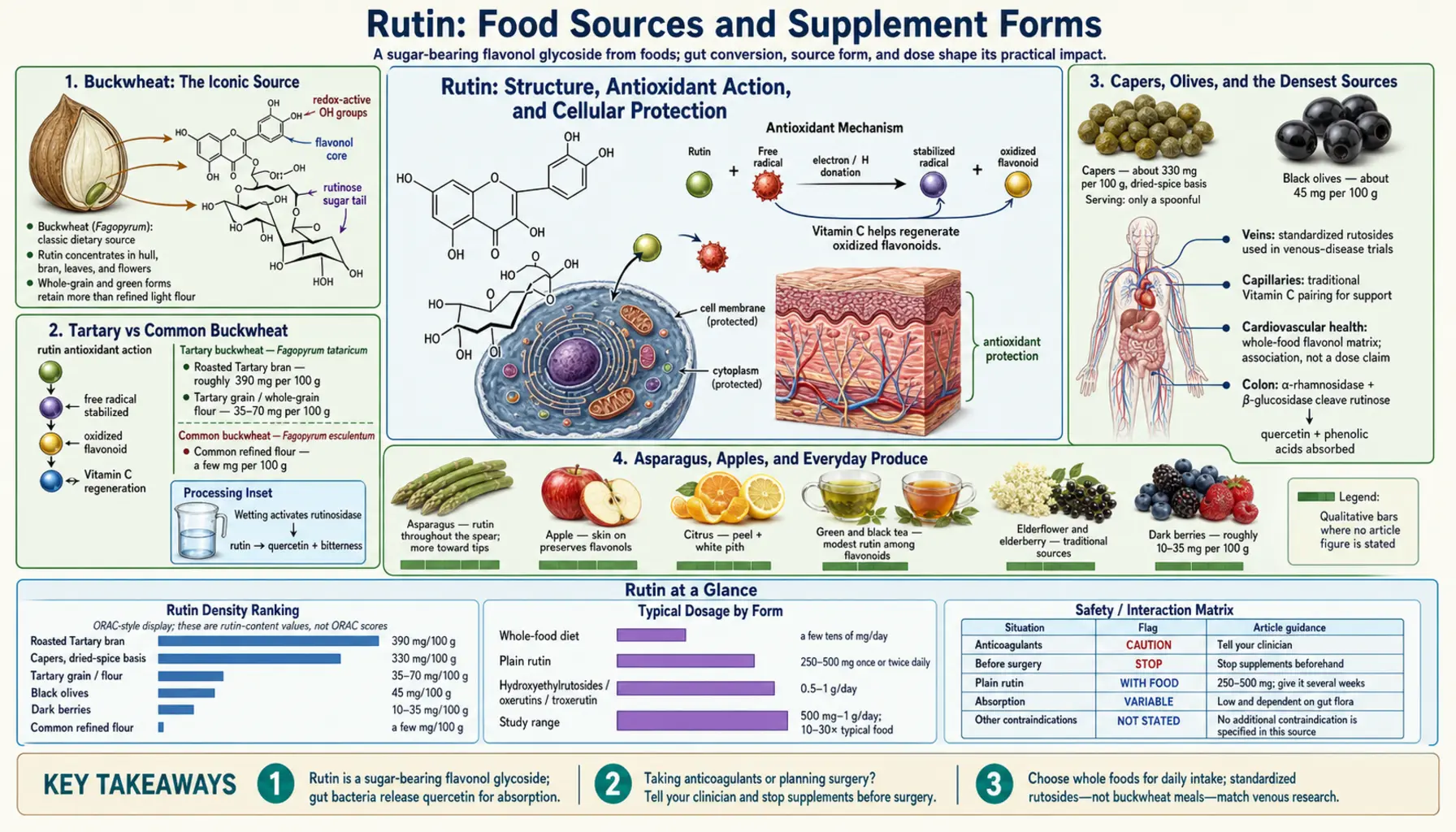
If one food defines rutin, it is buckwheat — essentially the only common staple that carries meaningful amounts, and the reason buckwheat earned its old folk reputation as a "vessel" food. Beyond buckwheat, rutin turns up in capers, olives, asparagus, apple peel, citrus pith, elderflower, and tea, but almost always in the parts we tend to discard. A generous whole-food diet still supplies only a few tens of milligrams a day — far below the standardized doses used in the clinical studies — which is why supplements and rutoside derivatives, not buckwheat porridge, are what most of the research actually tests.
Table of Contents
- Buckwheat: The Iconic Source
- Tartary vs Common Buckwheat
- Capers, Olives, and the Densest Sources
- Asparagus, Apples, and Everyday Produce
- Citrus, Tea, and Elderflower
- Cooking, Processing, and What Survives
- Why Food Rarely Matches Study Doses
- The Bioavailability Problem
- Supplement Forms
- Practical Choices
- Key Research Papers
- External Resources
- Connections
- Featured Videos
Buckwheat: The Iconic Source
Buckwheat (Fagopyrum) is the classic dietary source of rutin. Despite the name, it is not a wheat or even a grass — it is a broadleaf plant related to rhubarb and sorrel, and its triangular seeds are eaten like a grain (a "pseudocereal"). Rutin gives buckwheat its faint greenish tint and underlies the long tradition, especially across Eastern Europe and East Asia, of eating buckwheat for "strong blood vessels."
Rutin is concentrated in the outer layers — the hull and bran — and in the leaves and flowers, which is why buckwheat greens and whole-grain buckwheat products carry more than refined light buckwheat flour. Foods made from whole buckwheat include kasha (roasted groats), soba noodles, buckwheat pancakes and porridge, and buckwheat honey and tea. Kreft and colleagues (1999) developed a capillary-electrophoresis method specifically to measure rutin in buckwheat seeds, underscoring how central buckwheat is to the rutin story.
Tartary vs Common Buckwheat
Two species matter, and the difference is large. Common buckwheat (Fagopyrum esculentum) is the familiar culinary type. Tartary buckwheat (Fagopyrum tataricum), sometimes sold as "bitter buckwheat," contains far more rutin — often many times more.
Fabjan and colleagues (2003) documented tartary buckwheat as an especially rich dietary source of rutin and quercitrin, which is why tartary-buckwheat products (tea, flour, sprouts) are marketed specifically for their flavonoid content. Representative reported figures give a sense of the range:
- Roasted tartary-buckwheat bran — roughly 390 mg per 100 g, among the densest food sources of rutin known.
- Tartary-buckwheat grain / whole-grain flour — on the order of 35–70 mg per 100 g.
- Common buckwheat grain — substantially lower, typically a few milligrams per 100 g in the refined flour, more in whole-grain and green (unroasted) forms.
One caveat with tartary buckwheat: its seeds also carry the enzyme rutinosidase, which can convert rutin to quercetin (and a bitter taste) when the flour is wetted, so processing conditions affect the final rutin content of the food you actually eat.
Capers, Olives, and the Densest Sources
Weight-for-weight, a couple of non-buckwheat foods are surprisingly rutin-dense, though we eat them in tiny amounts:
- Capers — about 330 mg per 100 g on a dried-spice basis. Capers are one of the most flavonoid-concentrated foods by weight, but a serving is only a spoonful, so the real-world contribution is small.
- Black olives — on the order of 45 mg per 100 g.
These illustrate an important nuance of food-composition tables: a high milligrams-per-100-grams figure does not mean a high daily intake unless you actually eat 100 grams of the food. For rutin, the foods you can eat in quantity — buckwheat dishes, asparagus, apples with the skin — matter more to your total intake than the ultra-concentrated garnishes.
Asparagus, Apples, and Everyday Produce
Two everyday foods are worth singling out because you can eat them in meaningful portions:
- Asparagus is one of the better common-vegetable sources of rutin, carrying it throughout the spear (with more toward the tips). It is a practical, everyday way to add rutin along with folate and fiber.
- Apples carry rutin and related flavonols concentrated in the skin. This is the recurring theme of rutin in food: it hides in the peel. Eating apples with the skin on — rather than peeled — preserves the flavonol content, which is largely lost when apples are peeled or juiced without the skin.
Other everyday contributors in the roughly 10–35 mg-per-100-g range include black raspberries and other dark berries. General dietary-flavonol reviews such as Aherne and O'Brien (2002) map how these foods fit into total flavonol intake.
Citrus, Tea, and Elderflower
Rutin was first popularized as part of the citrus "bioflavonoid" complex, and citrus remains a familiar source — but, once again, the flavonoids concentrate in the parts most people throw away:
- Citrus — rutin sits mainly in the peel and the white pith, not the juicy segments, alongside its citrus cousin hesperidin. Whole-fruit and marmalade-type preparations retain more than strained juice.
- Green and black tea — a tea infusion contributes modest amounts of rutin among a wider mix of flavonoids; see green tea and its signature catechin EGCG.
- Elderflower and elderberry — traditional herbal sources of rutin, part of why elder preparations were historically used for circulation and colds.
Cooking, Processing, and What Survives
How a food is prepared changes how much rutin reaches your plate:
- Refining strips it. Because rutin lives in bran, peel, and pith, milling grain to white flour, peeling fruit, and juicing without the skin all remove much of it. Whole-grain and whole-fruit forms retain more.
- Heat is a mixed bag. Rutin is reasonably heat-stable, but prolonged cooking and boiling can leach it into cooking water (which you then discard) and can allow enzymes to convert rutin to quercetin.
- Wetting tartary buckwheat activates rutinosidase, converting rutin to quercetin and generating bitterness; food scientists manage this with heat treatment or specific processing to preserve rutin.
The simple rule of thumb: the less a rutin food is refined and the more of its skin, bran, or pith you eat, the more rutin you get.
Why Food Alone Rarely Matches Study Doses
Here is the reality check that ties the food story to the clinical story. Even a generous, deliberately rutin-rich diet supplies only a few tens of milligrams of rutin per day. By contrast, the venous-disease and blood-pressure studies used standardized doses of roughly 500 mg to 1 gram per day — ten to thirty times more than food typically provides.
That gap is the central reason the clinical literature tests supplements and rutoside derivatives rather than buckwheat meals. It does not mean dietary rutin is pointless — whole foods rich in flavonols are associated with better cardiovascular health overall, and they deliver a whole matrix of beneficial compounds, not just rutin. It does mean that if you are chasing the specific, studied venous or metabolic effects, diet alone is unlikely to reach the tested dose.
The Bioavailability Problem
Rutin has a built-in absorption obstacle: its sugar tail. As a large, sugar-bearing glycoside, rutin is poorly absorbed intact from the small intestine. Instead it travels to the colon, where bacterial enzymes (α-rhamnosidase and β-glucosidase) cleave off the rutinose and release free quercetin, which — together with bacterial breakdown products such as phenolic acids — is then absorbed.
Two consequences follow. First, absorption of plain rutin is both low and variable, depending heavily on an individual's gut flora. Second, much of rutin's systemic activity is really quercetin's activity, delivered slowly. Broad human bioavailability reviews — Hollman and Katan (1997) and Manach and colleagues (2005) — document how flavonol glycosides like rutin are handled, and why the sugar attached to a flavonol strongly influences how much of it you absorb.
Supplement Forms: Rutin, Rutosides, and Vitamin C Pairings
Supplement and pharmaceutical forms exist largely to work around that absorption problem or to target specific uses:
- Plain rutin (rutoside) — widely sold as a stand-alone or buckwheat-derived supplement, commonly 250–500 mg once or twice daily; absorption is modest and variable.
- Hydroxyethylrutosides / oxerutins / troxerutin (Venoruton, Paroven) — semisynthetic, more water-soluble derivatives used specifically for venous disease, typically around 0.5–1 g/day. These, not plain rutin, are what the venous trials actually used — see Veins & Capillaries.
- Rutin with vitamin C — the classic "C-bioflavonoid complex." Vitamin C helps regenerate oxidized flavonoids, and the two have traditionally been paired for capillary support.
- Quercetin instead of rutin — because rutin is largely a quercetin pro-form, people seeking systemic quercetin effects sometimes choose an absorbable quercetin form directly. Sharma and colleagues (2013) reviewed the drug-delivery approaches developed to improve rutin's bioavailability.
Practical Choices
Putting the food and supplement pictures together:
- For everyday intake, favor whole-food sources: whole-grain or tartary buckwheat, asparagus, apples with the skin, and dark berries. You get rutin plus a broader flavonoid and fiber matrix.
- For a specific venous effect, a standardized rutoside is what the trials support — not a buckwheat meal.
- For general antioxidant support, plain rutin 250–500 mg with food is reasonable and very well tolerated; give it several weeks.
- Mind the bleeding caution (see Blood & Circulation): tell your clinician if you take anticoagulants, and stop supplements before surgery.
Key Research Papers
Peer-reviewed references behind the food-source, content, and bioavailability claims on this page. Each links to its PubMed record by PMID.
- Kreft S, Knapp M, Kreft I (1999). Extraction of rutin from buckwheat (Fagopyrum esculentum Moench) seeds and determination by capillary electrophoresis. Journal of Agricultural and Food Chemistry. — PubMed PMID: 10552865
- Fabjan N, Rode J, Kosir IJ, Wang Z, et al (2003). Tartary buckwheat (Fagopyrum tataricum Gaertn.) as a source of dietary rutin and quercitrin. Journal of Agricultural and Food Chemistry. — PubMed PMID: 14558761
- Manach C, Williamson G, Morand C, Scalbert A, et al (2005). Bioavailability and bioefficacy of polyphenols in humans. I. Review of 97 bioavailability studies. The American Journal of Clinical Nutrition. — Search PubMed
- Hollman PC, Katan MB (1997). Absorption, metabolism and health effects of dietary flavonoids in man. Biomedicine & Pharmacotherapy. — PubMed PMID: 9436520
- Aherne SA, O'Brien NM (2002). Dietary flavonols: chemistry, food content, and metabolism. Nutrition. — PubMed PMID: 11827770
- Sharma S, Ali A, Ali J, Sahni JK, et al (2013). Rutin: therapeutic potential and recent advances in drug delivery. Expert Opinion on Investigational Drugs. — PubMed PMID: 23795677
- Ganeshpurkar A, Saluja AK (2017). The pharmacological potential of rutin. Saudi Pharmaceutical Journal. — PubMed PMID: 28344465
- Panche AN, Diwan AD, Chandra SR (2016). Flavonoids: an overview. Journal of Nutritional Science. — Search PubMed
- Enogieru AB, Haylett W, Hiss DC, Bardien S, et al (2018). Rutin as a potent antioxidant: implications for neurodegenerative disorders. Oxidative Medicine and Cellular Longevity. — PubMed PMID: 30050657
PubMed Topic Searches
- Buckwheat rutin content and food sources
- Tartary buckwheat rutin and quercitrin
- Rutin bioavailability and absorption
- Flavonol glycosides food content and metabolism
- Rutin drug delivery and formulation
External Resources
- USDA FoodData Central
- Linus Pauling Institute — Flavonoids
- PubChem — Rutin (Compound Summary)
- Drugs.com — Rutin
- PubMed — Buckwheat rutin research
Connections
- Rutin Benefits Hub
- Rutin (Main Page)
- Rutin for Veins & Capillaries
- Rutin: Antioxidant & Anti-Inflammatory
- Rutin, Blood & Circulation
- Quercetin
- Hesperidin
- EGCG
- Apples
- Green Tea
- Vitamin C
- Foods (All)
- Bilberry
- Grape Seed Extract
- Antioxidants