⚠ Evidence warning: Clinical trials or other evidence do not support the claim that spermidine lowers blood pressure, improves blood-vessel function and protects the ageing heart in people. This page keeps it as a report of what people, websites or other media say.
Spermidine for Cardiovascular Aging
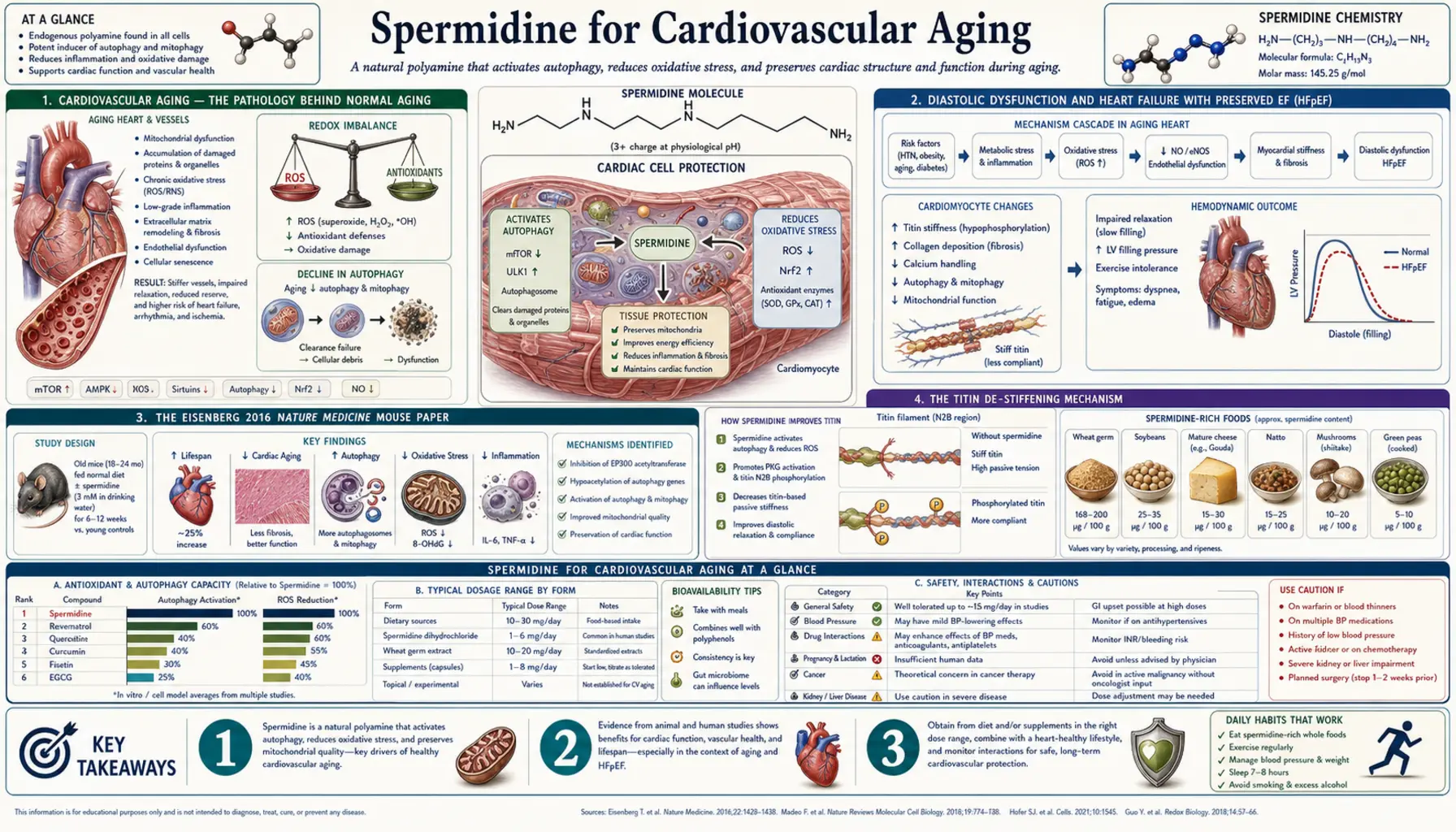
The cardiovascular case for spermidine rests on two pillars built two years apart. In 2016, Tobias Eisenberg, Mahmoud Abdellatif, Frank Madeo, and an international consortium published a paper in Nature Medicine showing that dietary spermidine, given to aged mice late in life, reduced cardiac hypertrophy, preserved diastolic function, and extended median lifespan by approximately 10%; in salt-sensitive rats on a high-salt diet it also lowered blood pressure. In 2018, Stefan Kiechl, Raimund Pechlaner, and colleagues at Innsbruck Medical University followed 829 adults of the Bruneck Study (a prospective population cohort in northern Italy) from 1995 to 2015 and found that deaths from all causes fell across thirds of increasing dietary spermidine intake, from 40.5 to 23.7 to 15.1 per 1,000 person-years. The two studies anchor a coherent story — spermidine reduces cardiac aging in animal models and is associated with lower cardiovascular mortality in human cohorts, with a mechanistically plausible pathway through cardiomyocyte autophagy, mitochondrial preservation, titin de-stiffening, and endothelial protection. This page walks through the cardiovascular biology, the 2016 mouse paper in detail, the Kiechl Bruneck cohort, the diastolic dysfunction and HFpEF connection, the blood pressure and endothelial function data, the atherosclerosis evidence, and the practical question of whether human cardiovascular benefit is achievable through dietary intake alone.
Table of Contents
- Cardiovascular Aging — The Pathology Behind “Normal Aging”
- Diastolic Dysfunction and Heart Failure with Preserved Ejection Fraction
- The Eisenberg 2016 Nature Medicine Mouse Paper
- The Titin De-Stiffening Mechanism
- Cardiomyocyte Mitochondrial Preservation
- The Kiechl 2018 Bruneck Cohort
- Blood Pressure and Hypertension
- Endothelial Function and Vascular Aging
- Atherosclerosis Progression
- Combination with Standard Cardiovascular Care
- What Human Trials Are Testing Now
- Key Research Papers
- Connections
- Featured Videos
Cardiovascular Aging — The Pathology Behind “Normal Aging”
The aging cardiovascular system undergoes a stereotyped set of structural and functional changes even in the absence of overt disease. The arteries stiffen as elastin degrades and collagen accumulates; pulse-wave velocity rises and isolated systolic hypertension emerges. The left ventricular wall thickens (mild concentric hypertrophy) as a compensatory response to the increased afterload. The ventricular myocardium itself stiffens through several mechanisms simultaneously — increased collagen cross-linking, titin protein hyperphosphorylation that raises passive stiffness, accumulation of damaged mitochondria producing fewer adenosine triphosphate (ATP) units per oxygen molecule consumed, and accumulation of damaged proteins that autophagy is no longer adequately clearing.
The clinical consequence of this multi-system aging process is the steady age-associated rise in heart failure with preserved ejection fraction (HFpEF), which is now the dominant heart failure phenotype in adults over 65. Unlike heart failure with reduced ejection fraction (HFrEF), which has well-validated pharmacotherapy (angiotensin-converting enzyme inhibitors (ACE inhibitors), beta-blockers, mineralocorticoid antagonists, angiotensin receptor-neprilysin inhibitors (ARNI)), HFpEF has historically been poorly responsive to those same drugs because the underlying biology is fundamentally different. HFpEF is an aging biology disease, and the recent therapeutic progress (sodium-glucose cotransporter-2 (SGLT2) inhibitors showing morbidity reduction in HFpEF) reflects engagement with aging-biology pathways rather than the contractile-failure pathways of HFrEF.
This is the clinical context in which the spermidine cardiac data takes on practical significance. If a dietary intervention can engage the upstream aging biology — cardiomyocyte autophagy, mitochondrial preservation, titin de-stiffening — then it potentially addresses HFpEF at a level that the conventional HFrEF drug classes do not. The animal model evidence supports this; the human cohort evidence is consistent with it; the formal randomized cardiovascular outcome trials in older adults are still to come.
For background on the broader cardiovascular aging story and where spermidine fits, see Heart Failure and the Cardiology category page.
Diastolic Dysfunction and Heart Failure with Preserved Ejection Fraction
Diastole is the relaxation phase of the cardiac cycle — the period during which the left ventricle relaxes, untwists, and fills passively with blood returning from the lungs. Diastolic function depends on three properties: the active relaxation of the ventricular myocardium (an energy-requiring process driven by sarcoplasmic reticulum calcium re-uptake), the passive compliance of the ventricular wall (how much it gives in response to filling pressure), and the elastic recoil of the ventricle from its end-systolic configuration. All three properties deteriorate with age.
The dominant cellular drivers of age-associated diastolic dysfunction are the stiffening of the giant sarcomeric protein titin (which acts as a molecular spring within each sarcomere and contributes directly to passive ventricular compliance), the accumulation of cross-linked collagen in the interstitium, and the failure of cardiomyocyte mitochondria to supply enough adenosine triphosphate for vigorous active relaxation. Each of these is independently age-associated, and each is mechanistically modifiable by spermidine.
The Eisenberg 2016 mouse paper measured diastolic function directly. Aged mice (24 months, equivalent to ~75-year-old humans) on standard chow showed measurable diastolic dysfunction by echocardiography — prolonged isovolumic relaxation time, reduced early diastolic mitral inflow velocity, and elevated end-diastolic pressure. The same aged mice fed spermidine-supplemented diet for the last several months of life showed significant improvement on all three measures, approaching the values seen in young mice. The improvement was not seen in autophagy-deficient mice (cardiomyocyte-specific deletion of ATG5), confirming that the cardiac-aging effect of spermidine is autophagy-mediated rather than a direct mechanical or electrophysiological effect.
For the link to HFpEF, see the Heart Failure page for the broader clinical syndrome and the sodium-glucose cotransporter-2 inhibitor data.
The Eisenberg 2016 Nature Medicine Mouse Paper
The Eisenberg, Abdellatif, Schroeder, Madeo paper published in Nature Medicine in December 2016 is the most consequential single piece of pre-clinical cardiac evidence for spermidine. The design used aged C57BL/6 mice randomized late in life to standard chow versus spermidine-supplemented drinking water (3 mM). Outcomes measured included echocardiographic cardiac function, blood pressure, exercise capacity, biochemical markers of cardiac aging, autophagic flux markers, and median lifespan.
The principal findings:
- Reduced cardiac hypertrophy — the spermidine-fed aged mice had measurably smaller heart weight per body weight ratios than the chow controls. Hypertrophy is a stereotyped age-associated change driven by chronic increased afterload and by failure of cardiomyocyte autophagy to clear damaged protein.
- Preserved diastolic function — significant improvement on multiple echocardiographic measures of diastolic relaxation and compliance, as described above.
- Lower blood pressure — in rats, not in the aged mice — in the aged mice spermidine did not change systolic or diastolic blood pressure, so the heart benefits there did not depend on blood pressure. The blood-pressure result came from Dahl salt-sensitive rats fed a high-salt diet (a model of high-blood-pressure heart failure), in which spermidine reduced systemic blood pressure and delayed its rise by 4 weeks.
- Increased cardiomyocyte autophagy — LC3 lipidation, autophagosome counts on electron microscopy, and other autophagic flux markers were elevated in cardiac tissue.
- Median lifespan extension of approximately 10% — comparable to the magnitude seen with rapamycin in similar late-life intervention designs.
- Autophagy-dependence — the benefits were abolished in mice with cardiomyocyte-specific autophagy gene deletion, confirming the mechanistic causation.
The paper also included a smaller human-observational component, an early version of the cohort analysis that Kiechl would complete more fully two years later in the Bruneck study, showing a dose-response association between dietary spermidine intake and lower cardiovascular event rates. The combination of the mechanistic mouse data and the directional human cohort data is what made the 2016 paper landmark cardiovascular nutrition science.
Put plainly, the paper's results came from three different groups, and it matters which result belongs to which. In old mice, spermidine reduced heart thickening, preserved diastolic function, increased cardiac autophagy, mitophagy and mitochondrial respiration, made heart-muscle cells more flexible, and lengthened life; it did not change their blood pressure. In salt-sensitive rats on a high-salt diet, it lowered blood pressure, prevented heart thickening and the decline in diastolic function, and delayed the progression to heart failure. In people, higher spermidine intake, as assessed from food questionnaires, correlated with lower blood pressure and a lower rate of cardiovascular disease — an association, not a test of supplements.
The Titin De-Stiffening Mechanism
Titin is the largest protein in the human body, a sarcomeric “ruler” that spans from the Z-disc to the M-line of each cardiac and skeletal muscle sarcomere. Titin acts as a molecular spring, contributing directly to the passive elastic properties of the muscle. Titin's stiffness is regulated post-translationally by phosphorylation state — phosphorylation of its N2-B unique sequence (N2-Bus) by cGMP-dependent protein kinase (PKG) or cAMP-dependent protein kinase (PKA) lowers titin stiffness, whereas phosphorylation of a different region, the PEVK domain, by protein kinase C (PKC) raises it (Kötter 2013). The net stiffness state of the titin pool determines the passive compliance of the ventricular wall.
In aging, the balance of these phosphorylation marks shifts toward the stiffening direction, and the cardiac titin pool becomes progressively stiffer. The Eisenberg 2016 paper showed that spermidine partially reversed this shift — spermidine-fed aged mice had a more youthful titin phosphorylation pattern and correspondingly more compliant titin springs in their cardiac sarcomeres. The mechanism appears to involve restored cardiomyocyte autophagy plus some direct effect on the phosphorylation cycle itself.
The titin de-stiffening effect is mechanistically attractive because it operates at the molecular level closest to the actual contractile failure of the aging heart. The aged heart has a stiff ventricular wall, the stiff wall does not fill well during diastole, the inadequate diastolic filling produces the symptoms of HFpEF (exertional dyspnea, exercise intolerance, fluid retention). De-stiffening the titin springs that contribute to that wall stiffness directly addresses the proximal cellular cause of the HFpEF phenotype.
Cardiomyocyte Mitochondrial Preservation
Cardiomyocytes are the most mitochondria-dense cell type in the body — approximately 30% of cardiomyocyte volume is mitochondria, compared to 5-10% for most other cell types. The heart contracts continuously over a 75-year human lifespan, and the adenosine triphosphate demand is met almost entirely by mitochondrial oxidative phosphorylation. Mitochondrial failure in cardiomyocytes is therefore mechanistically central to cardiac aging.
The Eisenberg 2016 paper measured cardiac mitochondrial parameters and found that spermidine-fed aged mice had more cardiac mitophagy, a larger mitochondrial volume in their heart-muscle cells, and better mitochondrial respiration through respiratory chain complex I. The mechanism includes both the direct hypusinated eIF5A pathway (mitochondrial proteins with polyproline stretches are disproportionately affected by spermidine status) and the indirect effect of mitophagy (selective autophagic clearance of damaged mitochondria, allowing fresh ones to take their place through mitochondrial biogenesis).
The Hofer 2021 paper in Autophagy summarised two companion studies of the hypusinated-eIF5A arm of this story — in the brain, not the heart: they explored how dietary spermidine enhances eIF5A hypusination, mitochondrial function in the brain and cognition in aging fruit flies and mice.
For more on the autophagy and hypusinated-eIF5A mechanisms, see Autophagy Induction. For broader mitochondrial protection strategies, see nicotinamide adenine dinucleotide (NAD+) and nicotinamide mononucleotide (NMN) and Oxidative Stress.
The Kiechl 2018 Bruneck Cohort
The Bruneck Study is a prospective population cohort in the South Tyrol region of northern Italy, recruited in 1990 with sequential follow-up examinations every five years. Stefan Kiechl, Raimund Pechlaner, and Peter Willeit used food-frequency questionnaires, repeated by dietitians in 1995, 2000, 2005 and 2010, to estimate dietary spermidine intake in 829 participants aged 45-84, who were followed from 1995 to 2015; 341 of them died during that time.
The headline findings, published in the American Journal of Clinical Nutrition in 2018:
- Tertile comparison — deaths from all causes fell across thirds of increasing spermidine intake, from 40.5 to 23.7 to 15.1 per 1,000 person-years; the age-, sex- and calorie-adjusted 20-year cumulative death rates were 0.48, 0.41 and 0.38. Each 1-standard-deviation higher intake carried a hazard ratio for death of 0.74 (95% CI 0.66-0.83), and 0.76 (0.67-0.86) after further adjustment for lifestyle, established predictors of death and other dietary features. A second cohort, the SAPHIR study, gave a similar result (hazard ratio 0.71). The abstract reports all-cause deaths, not a separate cardiovascular-death figure.
- Effect-size comparison — the difference in death risk between the top and bottom thirds of spermidine intake was similar to that associated with being 5.7 years younger (95% CI 3.6-8.1 years). In other words, eating in the high-spermidine tertile was associated with the survival outcomes of someone almost six years younger.
- Dose-response — the protective association was monotonic, with intermediate intake levels showing intermediate benefit. There was no evidence of a J-shaped or U-shaped curve.
- Independence from other dietary factors — the association persisted after adjustment for total energy intake, Mediterranean diet score, smoking, hypertension, diabetes, and other major confounders. Spermidine intake was not simply a marker of healthy Mediterranean eating; the polyamine itself appeared to be doing measurable work.
The major sources of spermidine in the Bruneck cohort diet were whole grains (particularly the local Tyrolean breads made with whole-wheat flour), legumes, mature cheeses (the high-spermidine aged Italian hard cheeses are regional staples), and mushrooms. The cohort's natural dietary variation in spermidine intake from these foods provided the analytical leverage to detect the dose-response association.
The Bruneck data does not establish causation — it is observational, and the usual caveats about residual confounding apply — but it is one of the strongest single pieces of human evidence for the cardiovascular benefit of dietary polyamines. The best-known randomized spermidine trial, SmartAge, was not a heart trial and was not prompted by the Bruneck result: it ran from January 2017 to May 2020 and tested memory in 100 adults aged 60 to 90 with subjective cognitive decline, who took a wheat-germ supplement giving 0.9 mg of spermidine a day or a placebo for 12 months; memory performance did not change compared with placebo. The first randomized trial built to test spermidine on the heart, POLYCAD, is described below.
Two later, larger cohorts point the same way, and like Bruneck they are observational. In a US study of 23,894 adults from the National Health and Nutrition Examination Survey (NHANES, 2003-2014), people in the highest quarter of total dietary spermidine intake had a lower risk of death from cardiovascular disease (hazard ratio 0.68, 95% CI 0.51-0.91) and from all causes (hazard ratio 0.70, 95% CI 0.60-0.82) than those in the lowest quarter; spermidine from vegetables, cereals, legumes, nuts and cheese each showed the same pattern. In the UK Biobank (184,732 adults without heart disease at the start, median follow-up 11.5 years), total dietary polyamine intake showed a non-linear link: compared with the lowest fifth (17.4 mg/day or less), the risk of death was lowest in the second fifth (more than 17.4 to 22.3 mg/day; hazard ratio 0.82, 95% CI 0.76-0.88) and the risk of new cardiovascular disease lowest in the fourth fifth (more than 27.1 to 33.5 mg/day; hazard ratio 0.86, 95% CI 0.82-0.92). The authors described an optimal range of intake rather than a simple more-is-better pattern.
Blood Pressure and Hypertension
Modest blood pressure reduction was one of the consistent findings across the Eisenberg 2016 mouse study and several earlier rodent studies of spermidine. In that paper the blood-pressure result came from Dahl salt-sensitive rats fed a high-salt diet, in which spermidine delayed the rise in blood pressure by 4 weeks; in the aged mice, spermidine did not change blood pressure. The mechanism is multifactorial — preserved endothelial function, lower vascular stiffness, reduced sympathetic tone, and partial mitochondrial restoration in the vascular smooth muscle.
Human data on blood pressure and spermidine come from diet questionnaires: in the Bruneck cohort, higher spermidine intake went with lower blood pressure. No completed randomized trial has yet reported the effect of spermidine supplements on blood pressure; POLYCAD, the first heart trial (see below), measures 24-hour blood pressure as a secondary outcome.
No study has tested spermidine as a replacement for blood-pressure medicine. In the Eisenberg 2016 study, the heart benefits in old mice came without any change in their blood pressure, which suggests that the cardiac effects of spermidine seen in animals operate through several mechanisms at once rather than primarily through blood pressure.
Endothelial Function and Vascular Aging
The vascular endothelium — the single-cell layer lining all blood vessels — deteriorates measurably with age. Endothelial nitric oxide synthase (eNOS) becomes uncoupled, producing superoxide instead of nitric oxide; the protective vasodilator nitric oxide pool falls; the artery loses its ability to dilate appropriately in response to flow demand (flow-mediated dilation, the standard non-invasive measure of endothelial function, declines progressively with age). The endothelial dysfunction is mechanistically upstream of essentially all atherosclerotic cardiovascular disease.
Spermidine preserves endothelial function in aged mouse models through preservation of eNOS coupling, restoration of cardiomyocyte and endothelial mitochondrial function, and reduction of the oxidative stress that drives eNOS uncoupling. In old mice (LaRocca 2013), spermidine supplementation normalized aortic stiffness and restored nitric-oxide-mediated dilation of the arteries. No human trial of spermidine on flow-mediated dilation has been published.
The vascular benefits of spermidine sit conceptually alongside other interventions that improve endothelial function — regular aerobic exercise, beetroot juice (which raises plasma nitric oxide via the dietary nitrate pathway), L-citrulline supplementation, and the Mediterranean diet pattern broadly. None of these is standalone curative for vascular aging; they accumulate marginal benefit when stacked.
Atherosclerosis Progression
Atherosclerosis is the progressive deposition of cholesterol-laden plaque in arterial walls, driven by a combination of low-density lipoprotein (LDL) particle infiltration, oxidative modification, macrophage foam-cell formation, and a chronic low-grade inflammation cycle. Atherosclerosis is the proximal cause of myocardial infarction, ischemic stroke, and peripheral arterial disease, and is mechanistically distinct from the diastolic-dysfunction story of HFpEF.
Spermidine has been studied in atherosclerosis-prone mouse models (ApoE knockout, LDLR knockout) with results that are encouraging but more modest than the cardiac-aging effects. The 2017-2020 wave of papers showed that spermidine supplementation reduced plaque burden, reduced macrophage foam-cell accumulation, and improved plaque stability in these models. The mechanism appears to involve macrophage autophagy (which supports cholesterol efflux from foam cells) plus reduced oxidized-LDL-driven inflammation.
The Bruneck cohort association between spermidine intake and cardiovascular mortality includes atherosclerotic events, so the human data is broadly consistent with an atherosclerosis benefit. The relative contribution of the atherosclerosis-prevention arm versus the HFpEF-prevention arm to the overall mortality benefit cannot be cleanly disentangled from the cohort data alone; both contribute.
Combination with Standard Cardiovascular Care
For patients with established cardiovascular disease or significant cardiovascular risk factors, the practical question is how spermidine fits with the standard evidence-based regimens of statins, antihypertensives, antiplatelet therapy, and the lifestyle interventions of regular exercise, Mediterranean dietary pattern, and stress management. The relevant considerations:
- Statins — no known interaction. Statins lower low-density lipoprotein cholesterol through HMG-CoA reductase inhibition, a mechanism orthogonal to spermidine's autophagic and titin-de-stiffening effects. The two are complementary.
- Antihypertensives (angiotensin-converting enzyme inhibitors, angiotensin receptor blockers (ARBs), calcium channel blockers, beta blockers, diuretics) — no known interaction. The modest blood pressure reduction from spermidine is additive to pharmacological antihypertensive effect.
- Antiplatelet therapy (aspirin, P2Y12 inhibitors) — no known interaction with spermidine itself. Polyamines do have some antiplatelet activity in vitro at high concentrations, but the dietary doses associated with cohort benefit are far below the in-vitro thresholds. No study has tested spermidine together with antiplatelet drugs; the in-vitro antiplatelet activity is the only basis for any concern.
- Sodium-glucose cotransporter-2 inhibitors — the sodium-glucose cotransporter-2 inhibitors (empagliflozin, dapagliflozin) are emerging as effective in HFpEF through what appears to be partly an aging-biology mechanism (some autophagy effects, some mitochondrial preservation). Spermidine and sodium-glucose cotransporter-2 inhibitors may be mechanistically complementary; no known interaction.
- Mediterranean diet pattern — spermidine intake is naturally elevated in the traditional Mediterranean diet pattern through aged cheeses, legumes, whole grains, and mushrooms. A diligent Mediterranean diet already provides much of the spermidine benefit; deliberate wheat germ or natto addition pushes the intake toward the higher end of the Bruneck cohort range.
- Regular aerobic exercise — mechanistically complementary. Exercise raises endogenous spermidine biosynthesis through AMP-activated protein kinase (AMPK) and peroxisome proliferator-activated receptor gamma coactivator 1-alpha (PGC-1α) activation.
For comprehensive cardiovascular disease management, see the Cardiology category page. For the broader longevity-stacking framework, see Longevity Protocols.
What Human Trials Are Testing Now
No completed randomized trial has yet tested spermidine on heart or blood-vessel outcomes in people. The first, POLYCAD, is a randomised, double-blind, placebo-controlled trial at Aarhus University Hospital in Denmark. It has randomised 187 patients aged 65 or over with coronary artery disease (a past heart attack or a procedure to reopen the heart arteries) and a preserved pumping fraction (left ventricular ejection fraction above 40%) to 24 mg/day of spermidine or placebo for 48 weeks. Its four co-primary endpoints are left ventricular mass on cardiac magnetic resonance imaging, peak oxygen consumption, appendicular lean mass (muscle in the arms and legs) and high-sensitivity C-reactive protein (a marker of inflammation); secondary outcomes include 24-hour blood pressure and arterial stiffness. Completion is anticipated in August 2026.
Two small randomized trials found that spermidine supplements barely change blood levels of spermidine itself. In 12 healthy adults, 15 mg/day for 5 days raised plasma spermine but not spermidine or putrescine, compared with placebo; the authors concluded that it is “rather unlikely” that spermidine supplements with doses below 15 mg/day exert any short-term effects. In 37 healthy men aged 50-70, 40 mg/day of a high-purity spermidine supplement for 28 days caused no substantial change in serum or urine polyamine levels and no significant change in clinical, lipid, chemistry or blood-count measures compared with placebo.
Key Research Papers
- Eisenberg T, Abdellatif M, Schroeder S, Primessnig U, Stekovic S, Pendl T, et al. (2016). Cardioprotection and lifespan extension by the natural polyamine spermidine. Nature Medicine 22(12):1428-1438. — PubMed PMID: 27841876
- Kiechl S, Pechlaner R, Willeit P, Notdurfter M, Paulweber B, Willeit K, et al. (2018). Higher spermidine intake is linked to lower mortality: a prospective population-based study. American Journal of Clinical Nutrition 108(2):371-380. — PubMed PMID: 29955838
- Madeo F, Eisenberg T, Pietrocola F, Kroemer G (2018). Spermidine in health and disease. Science 359(6374):eaan2788. — PubMed PMID: 29371440
- Hofer SJ, Liang Y, Zimmermann A, Schroeder S, Dengjel J, Kroemer G, et al. (2021). Spermidine-induced hypusination preserves mitochondrial and cognitive function during aging. Autophagy 17(8):2037-2039. — PubMed PMID: 34105442
- Madeo F, Bauer MA, Carmona-Gutierrez D, Kroemer G (2019). Spermidine: a physiological autophagy inducer acting as an anti-aging vitamin in humans? Autophagy 15(1):165-168. — PubMed PMID: 30306826
- Pekar T, Wendzel A, Flak W, Kremer A, Pauschenwein-Frantsich S, Gschaider A, et al. (2020). Spermidine in dementia: relation to age and memory performance. Wiener Klinische Wochenschrift 132(1-2):42-46. — PubMed PMID: 31832773
- LaRocca TJ, Gioscia-Ryan RA, Hearon CM, Seals DR (2013). The autophagy enhancer spermidine reverses arterial aging. Mechanisms of Ageing and Development 134(7-8):314-320. — PubMed PMID: 23612189
- Michiels CF, Kurdi A, Timmermans JP, De Meyer GRY, Martinet W (2016). Spermidine reduces lipid accumulation and necrotic core formation in atherosclerotic plaques via induction of autophagy. Atherosclerosis 251:319-327. — PubMed PMID: 27450786
- de Cabo R, Carmona-Gutierrez D, Bernier M, Hall MN, Madeo F (2014). The search for antiaging interventions: from elixirs to fasting regimens. Cell 157(7):1515-1526. — PubMed PMID: 24949965
- Wu H, Wang J, Jiang H, Liu X, Sun X, Chen Y, et al. (2022). The association of dietary spermidine with all-cause mortality and CVD mortality: The U.S. National Health and Nutrition Examination Survey, 2003 to 2014. Frontiers in Public Health 10:949170. — PubMed PMID: 36249217
- Pietrocola F, Castoldi F, Markaki M, Lachkar S, Chen G, Enot DP, et al. (2018). Aspirin recapitulates features of caloric restriction. Cell Reports 22(9):2395-2407. — PubMed PMID: 29490275
- Abdellatif M, Sedej S, Carmona-Gutierrez D, Madeo F, Kroemer G (2018). Autophagy in cardiovascular aging. Circulation Research 123(7):803-824. — PubMed PMID: 30355077
- Han S, Qian M, Zhang N, Zhang R, Liu M, Wang J, et al. (2024). The Association of Dietary Polyamines with Mortality and the Risk of Cardiovascular Disease: A Prospective Study in UK Biobank. Nutrients 16(24):4335. — PubMed PMID: 39770955
- Schwarz C, Benson GS, Horn N, Wurdack K, Grittner U, Schilling R, et al. (2022). Effects of Spermidine Supplementation on Cognition and Biomarkers in Older Adults With Subjective Cognitive Decline: A Randomized Clinical Trial. JAMA Network Open 5(5):e2213875. — PubMed PMID: 35616942
- Thorup CV, Jeppesen CNA, Jensen TH, Tinggaard AB, Hvas CL, Rud CL, et al. (2025). POLYamine treatment in elderly patients with Coronary Artery Disease (POLYCAD): study protocol for a Danish randomised, double-blind, placebo-controlled trial of spermidine treatment versus placebo. Trials 26(1):452. — PubMed PMID: 41168834
- Senekowitsch S, Wietkamp E, Grimm M, Schmelter F, Schick P, Kordowski A, et al. (2023). High-Dose Spermidine Supplementation Does Not Increase Spermidine Levels in Blood Plasma and Saliva of Healthy Adults: A Randomized Placebo-Controlled Pharmacokinetic and Metabolomic Study. Nutrients 15(8):1852. — PubMed PMID: 37111071
- Keohane P, Everett JR, Pereira R, Cook CM, Blonquist TM, Mah E (2024). Supplementation of spermidine at 40 mg/day has minimal effects on circulating polyamines: An exploratory double-blind randomized controlled trial in older men. Nutrition Research 132:1-14. — PubMed PMID: 39405978
- Kötter S, Gout L, Von Frieling-Salewsky M, Müller AE, Helling S, Marcus K, et al. (2013). Differential changes in titin domain phosphorylation increase myofilament stiffness in failing human hearts. Cardiovascular Research 99(4):648-56. — PubMed PMID: 23764881
PubMed Topic Searches
Connections
- Spermidine Overview
- Spermidine Benefits Hub
- Spermidine Autophagy Induction
- Spermidine for Cognitive Function
- Spermidine Food Sources & Dosing
- Cardiology
- Heart Failure
- Hypertension
- Stroke
- Fisetin
- Quercetin
- Longevity Protocols
- Rapamycin
- Nicotinamide Adenine Dinucleotide and Nicotinamide Mononucleotide
- Mushrooms (Polyamine Source)
- History