Spermidine for Autophagy Induction
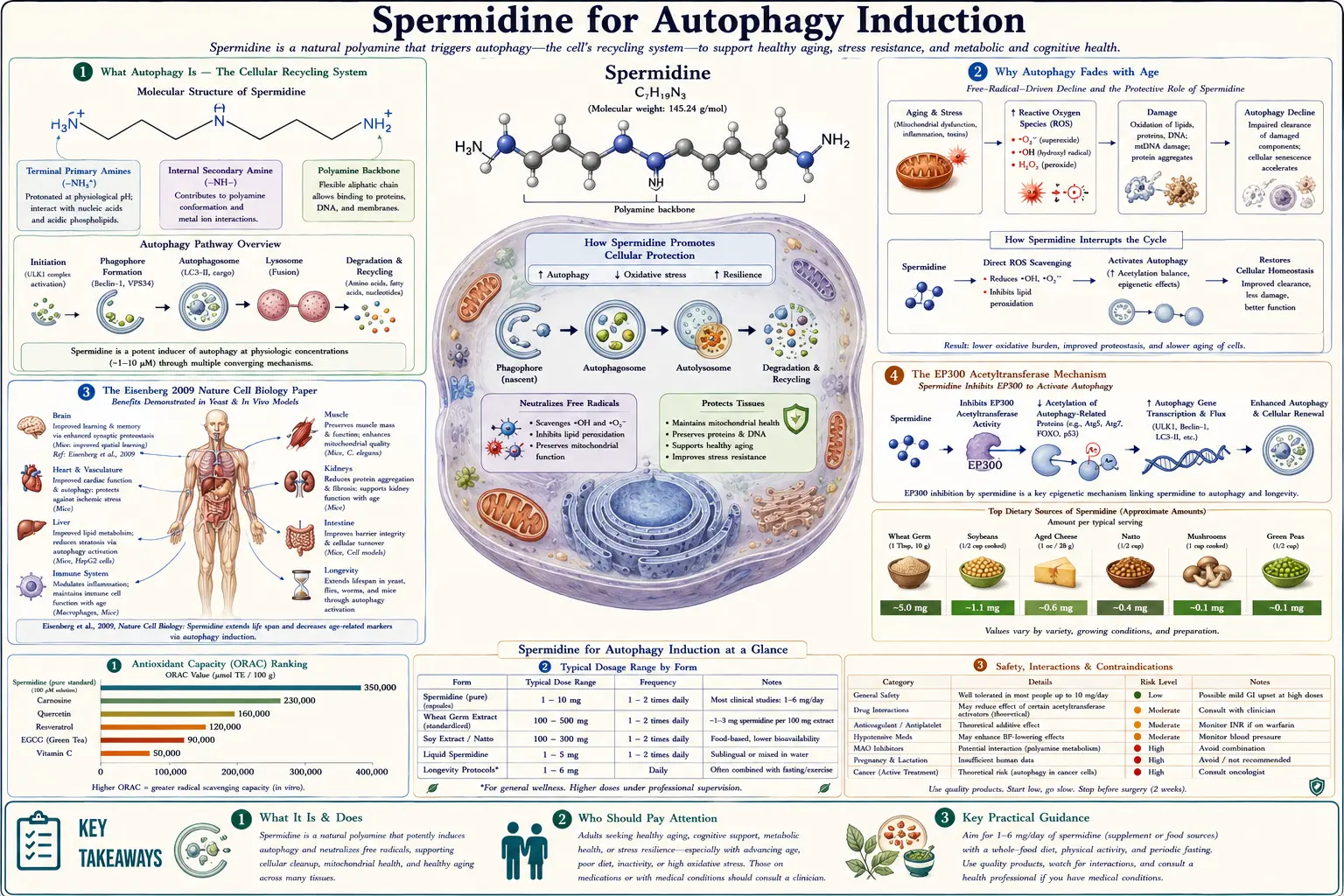
In October 2009, the Eisenberg-Madeo-Kroemer paper in Nature Cell Biology showed that spermidine, a small triamine that the body makes endogenously and that every meal supplies in proportion to the quantity of fresh, fermented, and germinated food on the plate, induces autophagy in yeast, flies, worms, and cultured human immune cells — and that the autophagic response is causally responsible for spermidine's lifespan-extending effect. Subsequent mechanistic work by Pietrocola, Madeo, Kroemer, and colleagues pinpointed the molecular target as EP300, a histone and protein acetyltransferase that normally adds inhibitory acetyl groups to ATG (autophagy-related) proteins. Spermidine inhibits EP300, the ATG proteins are deacetylated and active, and autophagy — the lysosomal degradation pathway that recycles damaged organelles, misfolded proteins, and aggregated material — runs more vigorously. A parallel mechanism centers on the unique modification of eukaryotic initiation factor 5A (eIF5A) by spermidine's aminobutyl chain (called hypusination), which is essential for translation of proteins with stretches of consecutive proline residues, a category that disproportionately includes mitochondrial and autophagy proteins. The autophagy pathway induced by spermidine is linked to the one rapamycin uses rather than separate from it: in cultured human cells, spermidine's autophagy effect came with lower activity of mechanistic target of rapamycin complex 1 (mTORC1), and in laboratory studies rapamycin's own autophagy effect depends on a rise in spermidine. This deep-dive page walks through autophagy itself, the EP300 mechanism, the hypusinated-eIF5A pathway, the 2009 paper and its follow-up studies, the conceptual relationship to caloric restriction and rapamycin, and the practical implications of the mechanism for patients considering dietary or supplemental spermidine.
Table of Contents
- What Autophagy Is — The Cellular Recycling System
- Why Autophagy Fades with Age
- The Eisenberg 2009 Nature Cell Biology Paper
- The EP300 Acetyltransferase Mechanism
- Hypusinated eIF5A — The Other Spermidine-Dependent Switch
- Spermidine and the Mechanistic Target of Rapamycin — How the Two Pathways Are Linked
- Conceptual Overlap with Caloric Restriction and Fasting
- Mitophagy — The Mitochondrial Quality Control Branch
- The Comparative Biology — Yeast, Flies, Worms, Mice
- Practical Implications for Patients
- Key Research Papers
- Connections
- Featured Videos
What Autophagy Is — The Cellular Recycling System
Autophagy — literally “self-eating” in Greek — is the lysosomal degradation pathway by which a cell breaks down and recycles its own damaged or unnecessary components. The 2016 Nobel Prize in Physiology or Medicine went to Yoshinori Ohsumi for working out the molecular machinery in yeast, and the same machinery is conserved with remarkable fidelity in every eukaryote from baker's yeast to humans. The recyclable cargo includes misfolded proteins, oxidized lipid droplets, damaged mitochondria (a selective sub-pathway called mitophagy), aggregated protein clusters that have escaped the proteasome, intracellular bacteria and viruses (xenophagy), and even surplus ribosomes during periods of starvation.
The mechanics are conceptually simple. A double-membraned cup called the phagophore nucleates near the damaged cargo. The cup elongates around the cargo, sealing into a complete double-membrane vesicle called the autophagosome. The autophagosome then fuses with a lysosome, a membrane-bound bag of acidic enzymes, and the contents are degraded back to their constituent amino acids, fatty acids, nucleotides, and sugars. Those raw materials are returned to the cytoplasm for re-use. Autophagy is therefore the cellular equivalent of a small-scale recycling plant — a way to clear out the broken and rebuild from the resulting raw materials, all without the metabolic expense of importing fresh nutrients from outside.
Autophagy is constitutively active at a low baseline level in all healthy cells. Above that baseline, it is dramatically upregulated by three classes of stimuli: starvation (the original trigger and the one most studied in yeast), exercise and other forms of energetic stress, and certain pharmacological or nutritional inputs that signal “clean-up time” without requiring actual nutrient withdrawal. The third category — what you might call “autophagy mimetics” includes rapamycin, metformin, resveratrol, and spermidine, each through a different upstream switch but with overlapping downstream consequences.
Why Autophagy Fades with Age
The capacity for autophagy declines progressively with chronological age in essentially every tissue that has been measured. The decline is roughly 30-50% between young adulthood and the eighth decade of life, with substantial inter-individual variation. The mechanisms behind the decline are still being mapped, but several contributors are clear: the lysosomal membrane becomes leakier, lysosomal pH drifts upward (reducing the activity of the acid hydrolases inside), key autophagy regulator gene expression declines, and the inhibitory acetylation marks on ATG proteins accumulate. Autophagic flux — the rate at which cargo is actually delivered to and degraded by lysosomes — falls accordingly.
The consequences of fading autophagy are observable across the major aging-associated diseases. Failure of mitophagy (mitochondrial-specific autophagy) leads to accumulation of damaged mitochondria producing reactive oxygen species; this is mechanistically central to Parkinson's disease and to the muscle weakness and exercise intolerance of sarcopenia. Failure of general autophagy to clear protein aggregates contributes to Alzheimer's (amyloid plaques and tau tangles), Huntington's (huntingtin aggregates), and many other neurodegenerative disorders. Failure of cardiomyocyte autophagy contributes to cardiac hypertrophy and the diastolic dysfunction of heart failure with preserved ejection fraction. Failure of hepatocyte autophagy contributes to fatty liver disease progression. The list is long and the pattern is consistent.
This is why the discovery that a small molecule found in food can re-induce autophagy in aged tissues drew the attention it did. If you could rescue even a portion of the lost autophagic capacity in aged cells, you would simultaneously address the upstream cause of multiple seemingly distinct diseases of aging. That is exactly the rationale that drove the original spermidine experiments.
The Eisenberg 2009 Nature Cell Biology Paper
Tobias Eisenberg, Heide Knauer, Frank Madeo, and Guido Kroemer published the foundational paper in Nature Cell Biology in November 2009. The authors had been studying yeast aging in Madeo's lab at the University of Graz and had set up screens for compounds that extend chronological lifespan. Spermidine emerged from that screen, and the team then asked the obvious question: does this work outside of yeast?
The paper's own abstract gives the reason spermidine drew attention: it is “a natural polyamine whose intracellular concentration declines during human ageing”. In ageing yeast, spermidine treatment triggered “epigenetic deacetylation of histone H3 through inhibition of histone acetyltransferases”, which suppressed oxidative stress and necrosis (a form of cell death); spermidine also potently inhibited oxidative stress in ageing mice.
The experiments that followed traced the same effect across the eukaryotic tree of life:
- Yeast (Saccharomyces cerevisiae) — chronological lifespan extended by approximately 70% with spermidine in growth medium; the effect was abolished in autophagy-deficient strains (deletion of ATG7 or other ATG genes), confirming that autophagy is the necessary downstream effector.
- Flies (Drosophila melanogaster) — median lifespan extended by approximately 30% with dietary spermidine; same autophagy-dependence in autophagy-mutant fly lines.
- Worms (Caenorhabditis elegans) — lifespan extension across multiple worm strains; autophagy genes again required.
- Human cells — cultured peripheral blood mononuclear cells (PBMCs) from healthy donors showed dose-dependent autophagic induction in response to spermidine in the culture medium; the LC3 lipidation marker (the canonical autophagy biomarker) increased; cells from older donors were less responsive at baseline than cells from younger donors but still responded to spermidine.
The combination of the comparative-biology breadth and the genetic dissection (autophagy required) was what made the 2009 paper a landmark. Subsequent papers from the same group and from independent labs have replicated the autophagy-induction effect, extended it to mouse models (Eisenberg 2016 cardiac, Hofer 2021 hypusination), and worked out the molecular mechanism in detail.
The EP300 Acetyltransferase Mechanism
The Pietrocola 2015 paper in Cell Death & Differentiation identified the molecular target. EP300 (E1A-associated protein p300) is a histone and protein acetyltransferase — a writer enzyme that adds acetyl groups to lysine residues on a wide range of substrate proteins. Among its substrates are several ATG (autophagy-related) proteins, including ATG5, ATG7, ATG12, and LC3. When EP300 acetylates these ATG proteins, autophagy is inhibited. When EP300 is itself inhibited (and the ATG proteins are correspondingly deacetylated by sirtuin-class deacetylases), autophagy proceeds.
Spermidine is a relatively specific inhibitor of EP300 (it also weakly affects related acetyltransferase CBP). The binding interferes with EP300's ability to transfer the acetyl group from acetyl-CoA to its substrate. The downstream consequence is that the steady-state acetylation level of ATG proteins drops, the autophagy machinery is unblocked, and autophagic flux rises. The effect can be measured in vitro by acetylation-state-specific antibodies, in cells by LC3 lipidation and autophagosome counts, and in tissues by electron microscopy of autophagosomes.
This mechanism is linked to, not independent of, the mechanistic target of rapamycin (mTOR) pathway through which rapamycin acts. In the Pietrocola 2015 experiments in cultured human cells, spermidine and the other acetyltransferase-inhibiting compounds induced autophagy “coupled to the inhibition of the mammalian target of rapamycin complex 1 (mTORC1)”, and of 43 acetyltransferases screened, EP300 was one of only two whose knockdown both activated autophagy and inhibited mTORC1. Mechanistic target of rapamycin is upstream of ULK1 (the kinase that initiates autophagy) and inhibits ULK1 under nutrient-replete conditions. Rapamycin inhibits mechanistic target of rapamycin and thereby disinhibits ULK1, triggering autophagy from the top of the cascade. Spermidine works at the level of the ATG proteins themselves, downstream of mechanistic target of rapamycin. The link also runs the other way: a 2024 report found that autophagy and longevity induced by rapamycin are “tied to an increase in spermidine synthesis” (laboratory studies), so rapamycin's effect runs partly through spermidine rather than entering the autophagy machinery at a wholly separate point.
Hypusinated eIF5A — The Other Spermidine-Dependent Switch
The second arm of spermidine's mechanism is more subtle but equally consequential. Eukaryotic initiation factor 5A (eIF5A) is a small translation factor that is critical for translation of mRNAs encoding proteins with stretches of three or more consecutive proline residues. Polyproline stretches are difficult for the ribosome to translate — the ribosome stalls without eIF5A help — and a disproportionate share of eukaryotic proteins with such polyproline stretches are involved in mitochondrial function, autophagy, chromatin organization, and the cytoskeleton.
eIF5A is unique among all eukaryotic proteins in being modified at a single specific lysine residue (Lys50) by attachment of the aminobutyl side-chain of spermidine, producing a non-standard amino acid called hypusine. The two-step enzymatic modification is performed by deoxyhypusine synthase (DHPS) and deoxyhypusine hydroxylase (DOHH), with spermidine as the obligatory aminobutyl donor. Without spermidine, DHPS has no substrate, eIF5A is not hypusinated, and translation of polyproline-rich proteins fails.
The Hofer 2021 summary in Autophagy traced this connection in the brain of aging flies and mice, describing how dietary spermidine enhances eIF5A hypusination, brain mitochondrial function and cognition in aging fruit flies (Drosophila melanogaster) and mice. In the companion fly study (Liang 2021, Cell Reports), hypusinated eIF5A levels in the fly brain declined with age but could be boosted by dietary spermidine, and genetically lowering eIF5A hypusination impaired brain mitochondrial respiration and brought on premature aging of movement and memory formation in adult flies. These are fly and mouse studies, not human ones. This is a parallel pathway to the EP300 mechanism — both contribute to spermidine's biological effects, and the combination of an upstream translation switch (eIF5A hypusination) and a more direct autophagy switch (EP300 inhibition) explains why spermidine produces effects across diverse tissues and conditions.
For more on the cellular maintenance machinery that depends on these pathways, see Oxidative Stress and the Longevity Protocols page that traces the convergence of these mechanisms across multiple interventions.
Spermidine and the Mechanistic Target of Rapamycin — How the Two Pathways Are Linked
Rapamycin is the most extensively studied pharmacological autophagy inducer and the prototype of the mechanistic target of rapamycin-inhibitor class. The mechanistic target of rapamycin (mTOR) complex 1 is a master nutrient sensor that, when active, promotes protein synthesis, ribosome biogenesis, and cell growth and inhibits autophagy. Rapamycin binds the FKBP12-rapamycin complex and inhibits mTORC1, which lifts the inhibitory brake on ULK1 (the autophagy-initiating kinase) and triggers the autophagic cascade.
The mechanistic target of rapamycin pathway is the dominant route through which most known autophagy inducers act — caloric restriction lowers mechanistic target of rapamycin signaling, exercise lowers mechanistic target of rapamycin signaling, metformin partially inhibits mechanistic target of rapamycin through AMP-activated protein kinase (AMPK) activation, ketogenic diet alters the mechanistic target of rapamycin upstream input. The research does not support calling spermidine a wholly separate route. In cultured human cells, spermidine's autophagy effect came with inhibition of mTORC1 (Pietrocola 2015). A 2024 report from the same research groups found that autophagy and longevity induced by rapamycin are “tied to an increase in spermidine synthesis”, and it describes spermidine as “an obligatory downstream effector of the antiaging effects of fasting and rapamycin” (animal and cell work, not human trials).
The clinical relevance is that mechanistic target of rapamycin has many functions beyond autophagy. Chronic mechanistic target of rapamycin inhibition with rapamycin produces side effects: glucose intolerance (especially with daily dosing), immunosuppression, mucositis, hyperlipidemia, and accelerated wound-healing impairment. These side effects come from the off-target consequences of suppressing mechanistic target of rapamycin's other roles. Spermidine's human safety record so far comes from small trials. In the Schwarz 2018 safety trial in Aging (30 adults aged 60 to 80 with subjective cognitive decline, a spermidine-rich wheat germ extract at 1.2 mg/day for three months), no differences were seen between spermidine and placebo in vital signs, weight, clinical chemistry and blood counts, or in self-reported health, and compliance rates were above 85%.
For the rapamycin pharmacology in more detail, see Rapamycin. The two interventions act on linked pathways rather than wholly separate ones, and PubMed lists no clinical trial that has tested spermidine together with rapamycin.
Conceptual Overlap with Caloric Restriction and Fasting
Caloric restriction (CR) — sustained reduction of energy intake below ad libitum levels without malnutrition — is the most robustly validated lifespan-extending intervention in non-human animal models, with effects documented across yeast, worms, flies, fish, rodents, and (to some degree) non-human primates. The same general claim applies to intermittent fasting and time-restricted feeding regimens, which produce many of the same molecular effects without requiring chronic reduction of total energy intake.
The downstream cellular effect that CR and fasting and spermidine all share is induction of autophagy. The upstream switches differ — CR lowers insulin and insulin-like growth factor 1 (IGF-1) signaling, lowers mechanistic target of rapamycin activity, raises AMP-activated protein kinase activity, increases sirtuin activity, and reduces growth factor signaling — but the consequence at the lysosomal level is similar: more autophagy, more clearance of damaged organelles and aggregated proteins, more healthspan extension in animal models.
This is one of the reasons spermidine is sometimes described as a “caloric restriction mimetic.” The phrase is technically imprecise (spermidine does not actually mimic caloric restriction; it produces a subset of the same downstream effects through a different upstream pathway) but it captures the conceptual relationship. A 2021 review groups metformin, rapamycin and spermidine together as conventional caloric restriction mimetics that activate autophagy. For practical purposes, the question patients often ask is whether dietary spermidine could be combined with intermittent fasting or caloric restriction. The honest answer is that the combination is mechanistically rational, has not been formally tested in long-term outcome trials, and is being actively explored in academic settings.
A 2024 study in Nature Cell Biology found that the body's own spermidine levels rose with different regimens of fasting or calorie restriction in yeast, flies, mice and human volunteers. Blocking the body's spermidine production reduced fasting-induced autophagy in yeast, worms and human cells, and in living animals disturbing the polyamine pathway removed the lifespan- and healthspan-extending effects of fasting, as well as its heart-protective and anti-arthritis effects. The effect worked through autophagy and through hypusination of eIF5A. The authors conclude that spermidine is not only a caloric restriction mimetic but also an obligatory downstream effector of fasting, which means it may be part of how fasting itself works.
For background on the fasting side of this story, see Fasting. The Mediterranean diet pattern, which is naturally polyamine-rich, has been hypothesized to capture some of the autophagy-inducing benefit without requiring formal fasting; the Bruneck cohort data discussed in Cardiovascular Aging is consistent with that view.
Mitophagy — The Mitochondrial Quality Control Branch
A specialized branch of autophagy called mitophagy handles damaged mitochondria specifically. Mitochondria are the cellular power plants, and a damaged mitochondrion is uniquely dangerous — it leaks reactive oxygen species and proapoptotic signaling molecules that can drive cell death and tissue inflammation. Mitophagy is the dedicated machinery for selectively flagging a damaged mitochondrion (typically through PINK1 stabilization on the outer membrane and Parkin-mediated ubiquitin labeling), engulfing it in an autophagosome, and degrading it.
Failure of mitophagy is mechanistically central to several aging-associated diseases. Parkinson's disease is the cleanest example — both PINK1 and Parkin loss-of-function mutations cause familial early-onset Parkinson's, and the same defective mitophagy is observed (less dramatically) in sporadic Parkinson's. Sarcopenia (age-associated muscle loss) involves accumulation of damaged mitochondria in skeletal muscle fibers; mitophagy deficiency contributes to the muscle weakness and exercise intolerance of old age. Heart failure with preserved ejection fraction involves accumulation of damaged mitochondria in aged cardiomyocytes.
Spermidine induces mitophagy as part of its general autophagic effect, with some evidence for selective mitophagy enhancement beyond what would be predicted from general autophagy alone. The mechanism may involve hypusinated eIF5A's role in translation of specific mitophagy regulators (PINK1 itself has polyproline stretches), as well as direct effects on the autophagosome-mitochondrion interaction. The mitophagy branch is part of why spermidine's effects appear concentrated in tissues with high mitochondrial demand and high age-associated mitochondrial dysfunction — the heart and the brain especially.
The Comparative Biology — Yeast, Flies, Worms, Mice
The strength of the spermidine longevity hypothesis comes partly from how consistent the effect is across phylogenetically distant species. Most putative longevity interventions extend lifespan in one or two model organisms and fail in the rest, which usually reflects the intervention engaging a pathway specific to a particular branch of the tree. Spermidine extends lifespan in yeast, flies, worms, and mice, with the same downstream autophagy requirement and similar magnitude of effect (~10-30% median lifespan extension). This pattern is shared with caloric restriction and rapamycin and is one of the practical markers that distinguishes plausible longevity interventions from species-specific artifacts.
The human evidence is necessarily more limited because formal lifespan trials in humans are not feasible. The available data is observational (Kiechl 2018 Bruneck cohort, several smaller cohorts), short-term mechanistic (Schwarz 2018 safety, SmartAge cognitive trials), and surrogate-marker (autophagy biomarkers in peripheral blood cells, hypusinated eIF5A measurements). The results so far are mixed, and the definitive human outcome data is still ahead.
- Bruneck cohort (observational) — 829 adults aged 45-84 had their diet assessed repeatedly between 1995 and 2010, and 341 deaths occurred during follow-up between 1995 and 2015. All-cause deaths per 1000 person-years fell across thirds of increasing spermidine intake from 40.5 to 23.7 and 15.1. The age-, sex- and caloric ratio-adjusted hazard ratio for death per 1-SD higher spermidine intake was 0.74, and the difference in mortality risk between the top and bottom thirds was similar to that associated with a 5.7-year younger age. This is an observational link, not proof that spermidine causes the difference.
- Three-month pilot trial (Wirth 2018) — in 30 cognitively intact adults aged 60-80 with subjective cognitive decline, mnemonic discrimination (a memory measure) improved in the spermidine group with a medium effect size; a similar effect was not found in the placebo group.
- 12-month SmartAge trial (Schwarz 2022) — in 100 adults aged 60 to 90 with subjective cognitive decline, a spermidine-rich supplement extracted from wheat germ (0.9 mg spermidine/day) produced no significant changes in mnemonic discrimination performance (between-group difference, -0.03; 95% CI, -0.11 to 0.05; P = .47) or in the secondary outcomes compared with placebo. Exploratory analyses indicated possible effects on inflammation and verbal memory that the authors say need to be validated in future studies at higher dosage. Adverse events were balanced between groups.
For an honest framing comparison, the same situation applied to spermidine's closest analog — the fisetin senolytic story — which is at a similar stage of translation. See Fisetin Senolytic Activity for the parallel narrative arc and the same honest framing about animal-to-human extrapolation.
Practical Implications for Patients
What the research says about putting the mechanism into practice:
- Food-first is achievable — a regular daily intake of polyamine-rich foods (a spoonful of wheat germ on cereal or yogurt, 30 g of natto, an ounce of well-aged hard cheese, a regular serving of cooked mushrooms, a daily handful of sprouted seeds or legumes) can raise total dietary spermidine intake from the Western average of ~1-2 mg/day into the 6-10 mg/day range associated with cohort mortality benefit. The full food strategy is detailed in Food Sources and Dosing.
- Wheat germ extract supplements are the most common supplemental form, typically standardized to deliver 1-3 mg of spermidine per serving. The human trials used lower doses: 1.2 mg/day in the three-month Schwarz 2018 trial and 0.9 mg/day in the 12-month SmartAge trial. Pure synthetic spermidine supplements also exist; pharmacokinetic data on those is more limited.
- Combination with caloric restriction or intermittent fasting — mechanistically linked: in animal studies, fasting raises the body's own spermidine, and the benefits of fasting depend on that rise (Hofer 2024). The combination of fasting with spermidine supplements has not been formally tested for combined effect.
- Combination with rapamycin — PubMed lists no clinical trial of spermidine taken together with rapamycin, and in laboratory studies rapamycin's own autophagy effect depends on a rise in spermidine (Hofer 2024), so the two are not independent of each other.
- Time horizon — autophagy effects are cumulative and incremental, not acute. The cohort and trial data are based on months-to-years of consistent intake. This is fundamentally different from the “hit-and-run” pulsed senolytic dosing strategy used with fisetin.
- Cancer caveat — polyamines including spermidine are required for cell proliferation, and isolated polyamine biology in oncology has been studied as a potential growth-promotion concern. The clinical evidence on dietary spermidine intake and cancer outcomes is mixed but not pointing in a strongly worrying direction. The research raises this concern mainly for people with active or recent cancer.
Key Research Papers
- Eisenberg T, Knauer H, Schauer A, Buttner S, Ruckenstuhl C, Carmona-Gutierrez D, et al. (2009). Induction of autophagy by spermidine promotes longevity. Nature Cell Biology 11(11):1305-1314. — PubMed PMID: 19801973
- Pietrocola F, Lachkar S, Enot DP, Niso-Santano M, Bravo-San Pedro JM, Sica V, et al. (2015). Spermidine induces autophagy by inhibiting the acetyltransferase EP300. Cell Death and Differentiation 22(3):509-516. — PubMed PMID: 25526088
- Madeo F, Eisenberg T, Pietrocola F, Kroemer G (2018). Spermidine in health and disease. Science 359(6374):eaan2788. — PubMed PMID: 29371440
- Hofer SJ, Liang Y, Zimmermann A, Schroeder S, Dengjel J, Kroemer G, et al. (2021). Spermidine-induced hypusination preserves mitochondrial and cognitive function during aging. Autophagy 17(8):2037-2039. — PubMed PMID: 34105442
- Park MH, Wolff EC (2018). Hypusine, a polyamine-derived amino acid critical for eukaryotic translation. Journal of Biological Chemistry 293(48):18710-18718. — PubMed PMID: 30257869
- Morselli E, Marino G, Bennetzen MV, Eisenberg T, Megalou E, Schroeder S, et al. (2011). Spermidine and resveratrol induce autophagy by distinct pathways converging on the acetylproteome. Journal of Cell Biology 192(4):615-629. — PubMed PMID: 21339330
- Ohsumi Y (2014). Historical landmarks of autophagy research. Cell Research 24(1):9-23. — PubMed PMID: 24366340
- Schroeder S, Hofer SJ, Zimmermann A, Pechlaner R, Dammbrueck C, Pendl T, et al. (2021). Dietary spermidine improves cognitive function. Cell Reports 35(2):108985. — PubMed PMID: 33852843
- Sigrist SJ, Carmona-Gutierrez D, Gupta VK, Bhukel A, Mertel S, Eisenberg T, Madeo F (2014). Spermidine-triggered autophagy ameliorates memory during aging. Autophagy 10(1):178-179. — PubMed PMID: 24262970
- Eisenberg T, Abdellatif M, Schroeder S, Primessnig U, Stekovic S, Pendl T, et al. (2016). Cardioprotection and lifespan extension by the natural polyamine spermidine. Nature Medicine 22(12):1428-1438. — PubMed PMID: 27841876
- Martel J, Chang SH, Wu CY, Peng HH, Hwang TL, Ko YF, et al. (2021). Recent advances in the field of caloric restriction mimetics and anti-aging molecules. Ageing Research Reviews 66:101240. — PubMed PMID: 33347992
- Hofer SJ, Daskalaki I, Bergmann M, Friščić J, Zimmermann A, Mueller MI, et al. (2024). Spermidine is essential for fasting-mediated autophagy and longevity. Nature Cell Biology 26(9):1571-1584. — PubMed PMID: 39117797
- Hofer SJ, Daskalaki I, Abdellatif M, Stelzl U, Sedej S, Tavernarakis N, et al. (2024). A surge in endogenous spermidine is essential for rapamycin-induced autophagy and longevity. Autophagy 20(12):2824-2826. — PubMed PMID: 39212197
- Liang Y, Piao C, Beuschel CB, Toppe D, Kollipara L, Bogdanow B, et al. (2021). eIF5A hypusination, boosted by dietary spermidine, protects from premature brain aging and mitochondrial dysfunction. Cell Reports 35(2):108941. — PubMed PMID: 33852845
- Schwarz C, Stekovic S, Wirth M, Benson G, Royer P, Sigrist SJ, et al. (2018). Safety and tolerability of spermidine supplementation in mice and older adults with subjective cognitive decline. Aging (Albany NY) 10(1):19-33. — PubMed PMID: 29315079
- Wirth M, Benson G, Schwarz C, Köbe T, Grittner U, Schmitz D, et al. (2018). The effect of spermidine on memory performance in older adults at risk for dementia: A randomized controlled trial. Cortex 109:181-188. — PubMed PMID: 30388439
- Schwarz C, Benson GS, Horn N, Wurdack K, Grittner U, Schilling R, et al. (2022). Effects of Spermidine Supplementation on Cognition and Biomarkers in Older Adults With Subjective Cognitive Decline: A Randomized Clinical Trial. JAMA Network Open 5(5):e2213875. — PubMed PMID: 35616942
- Kiechl S, Pechlaner R, Willeit P, Notdurfter M, Paulweber B, Willeit K, et al. (2018). Higher spermidine intake is linked to lower mortality: a prospective population-based study. American Journal of Clinical Nutrition 108(2):371-380. — PubMed PMID: 29955838
- Yang Y, Chen S, Zhang Y, Lin X, Song Y, Xue Z, et al. (2017). Induction of autophagy by spermidine is neuroprotective via inhibition of caspase 3-mediated Beclin 1 cleavage. Cell Death & Disease 8(4):e2738. — PubMed PMID: 28383560
PubMed Topic Searches
Connections
- Spermidine Overview
- Spermidine Benefits Hub
- Spermidine for Cardiovascular Aging
- Spermidine for Cognitive Function
- Spermidine Food Sources & Dosing
- Fisetin (Senolytic Parallel)
- Quercetin
- Longevity Protocols
- Fasting (Autophagy Trigger)
- Rapamycin (Mechanistic Target of Rapamycin Inhibitor)
- Nicotinamide Adenine Dinucleotide and Nicotinamide Mononucleotide
- Oxidative Stress
- Parkinson's Disease (Mitophagy Failure)
- Alzheimer's Disease (Aggregate Clearance)
- Mushrooms (Polyamine Source)
- History