Spermidine for Cognitive Function
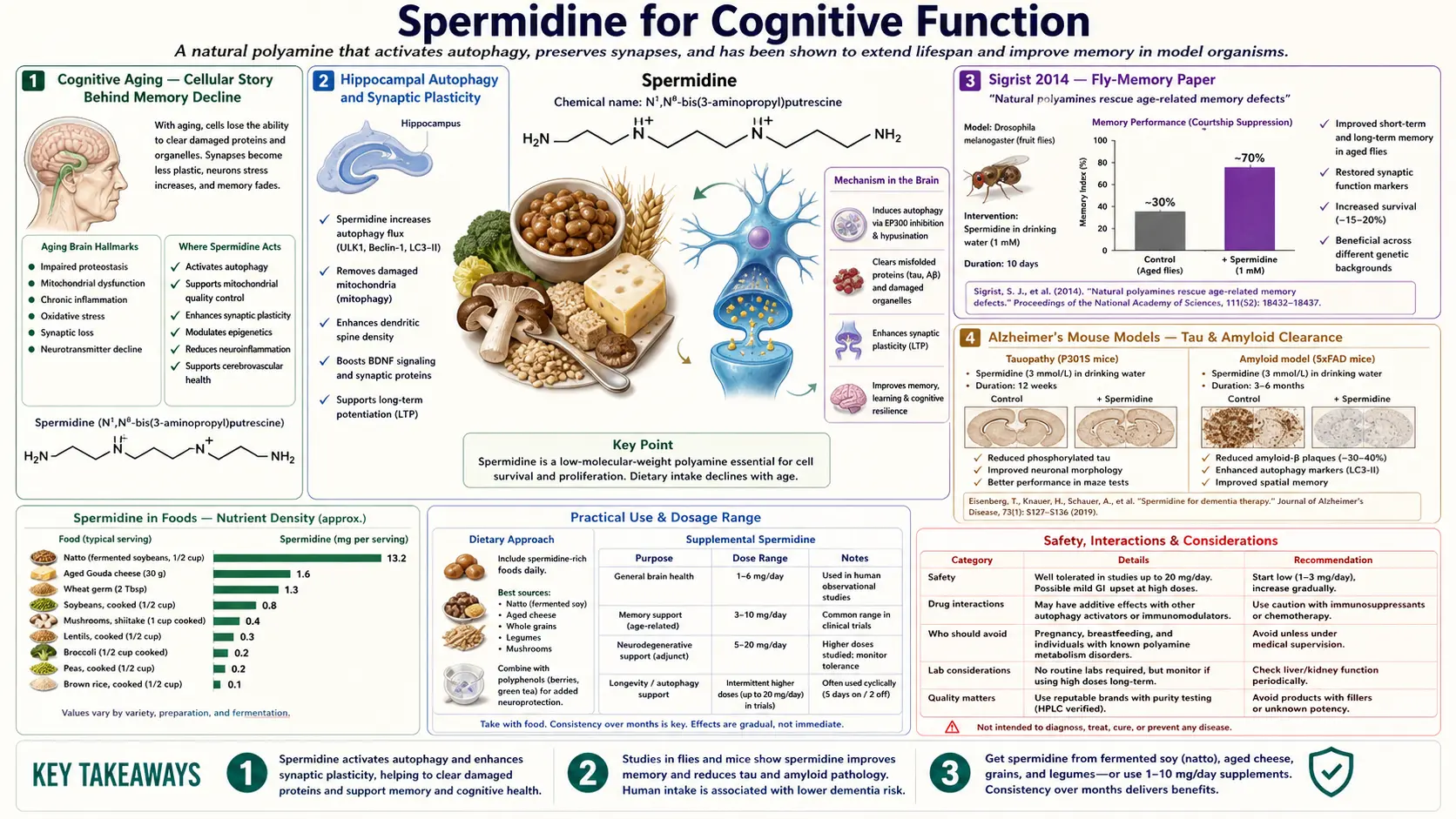
The cognitive case for spermidine has three converging strands. First, the animal-model evidence: a 2013 Nature Neuroscience paper by Gupta and colleagues in Sigrist's group showed that simple spermidine feeding suppressed age-induced memory impairment in aged flies, and that the rescue depended on autophagy; subsequent mouse work demonstrated hippocampal autophagy enhancement, tau and amyloid clearance, and preserved synaptic plasticity in Alzheimer's-model transgenic mice. Second, the observational human evidence: a brain-scan study by Schwarz and colleagues linked higher dietary spermidine intake with larger hippocampal volume, and prospective data reported by Schroeder and colleagues linked higher dietary spermidine intake with a reduced risk for cognitive impairment. Third, the randomized trial evidence: the Wirth-led pilot trial (2018 Cortex) tested three months of a spermidine-rich plant extract in 30 older adults with subjective cognitive decline and found memory performance moderately enhanced compared with placebo (Cohen's d = .77), though the confidence interval of that comparison included zero; the longer SmartAge follow-up trial in JAMA Network Open in 2022 tested 12 months of supplementation in 100 people and found that it did not modify memory and biomarkers compared with placebo, with exploratory hints on verbal memory and inflammation. The mechanism is well-established at the cellular level (autophagy-mediated proteostasis, mitochondrial preservation, hippocampal brain-derived neurotrophic factor (BDNF) maintenance); the open question is whether human cognitive efficacy is large enough to justify spermidine as a routine cognitive-aging intervention or whether it is one component of a broader multi-modal strategy. This page walks through the mechanism, the SmartAge trials, the dietary-cohort data, the neurodegenerative-disease context, and the honest framing of where the evidence currently stands.
Table of Contents
- Cognitive Aging — The Cellular Story Behind Memory Decline
- Hippocampal Autophagy and Synaptic Plasticity
- The Gupta 2013 Fly-Memory Paper
- Alzheimer's Mouse Models — Tau and Amyloid Clearance
- The Wirth 2018 Pilot Trial
- The JAMA Network Open 2022 SmartAge Trial
- A Three-Month Spermidine Study in Nursing-Home Residents With Dementia
- Observational Studies of Spermidine, Brain Structure and Memory
- Brain-Derived Neurotrophic Factor, Glutathione, and Neurotrophic Support
- Parkinson's and α-Synuclein Clearance
- Honest Framing — What the Human Data Currently Supports
- Key Research Papers
- Connections
- Featured Videos
Cognitive Aging — The Cellular Story Behind Memory Decline
The aging brain undergoes a stereotyped set of structural and functional changes even in the absence of frank neurodegenerative disease. Total brain volume decreases by approximately 0.5% per year after age 60, with disproportionate volume loss in the prefrontal cortex and hippocampus. White matter integrity declines, with progressive accumulation of T2-hyperintense lesions on magnetic resonance imaging (MRI). Synaptic density falls; the number of dendritic spines on individual cortical neurons drops measurably. The clinical translation of these changes is the familiar age-associated cognitive slowing — slower information processing, reduced working memory capacity, and (most prominently) impairment in episodic memory for recently encountered events.
Underneath these macroscopic and functional changes is a stereotyped cellular biology. Neurons are post-mitotic — they cannot dilute damaged proteins by cell division — so they depend more critically than any other cell type on protein quality control mechanisms (the ubiquitin-proteasome system and autophagy). Both of these quality-control mechanisms decline with age in neurons, and the consequence is accumulation of damaged proteins, dysfunctional mitochondria, and lipofuscin. In severe cases, the accumulated damaged proteins aggregate into the pathognomonic lesions of neurodegenerative disease — amyloid plaques and tau tangles in Alzheimer's, Lewy bodies in Parkinson's, mutant huntingtin in Huntington's, TDP-43 in amyotrophic lateral sclerosis (ALS) and frontotemporal dementia.
The spermidine cognitive hypothesis follows directly from this cellular framing. If failing autophagy is mechanistically central to cognitive aging and to neurodegenerative disease, then re-inducing autophagy through a small molecule that the body already makes and that every meal supplies should plausibly slow or partly reverse the cellular damage accumulation. The 2009 yeast and fly experiments demonstrated the principle; the subsequent mouse and human work has been testing whether the principle translates clinically in the most cognitively-vulnerable tissues.
Hippocampal Autophagy and Synaptic Plasticity
The hippocampus is the brain's episodic memory machine — the structure required for encoding new memories about personally-experienced events. Hippocampal damage produces the dramatic memory loss seen in early-stage Alzheimer's disease and in patients with bilateral hippocampal lesions from anoxic injury or surgical removal. The hippocampus is also one of the few brain regions where adult neurogenesis continues throughout life (in the dentate gyrus subgranular zone), and where the integrated function of new neurons, dendritic arborization, and synaptic plasticity collectively support the formation of new declarative memories.
Hippocampal autophagy is critically important for synaptic plasticity. The cellular processes that underlie long-term potentiation (LTP, the synaptic correlate of memory formation) include local protein synthesis, receptor trafficking, and cytoskeletal remodeling at the dendritic spine — and each of these depends on a healthy autophagic flux to remove worn-out proteins and supply recycled amino acids and lipids for the new structures. Hippocampal autophagy declines progressively with age in rodent and human tissue; the decline is correlated with reduced synaptic plasticity and with reduced performance on hippocampal-dependent memory tasks.
Spermidine supplementation in aged mice restores hippocampal autophagic flux measurably — LC3 lipidation, autophagosome counts on electron microscopy, and downstream autophagy substrate clearance all increase in hippocampal tissue. The functional correlate is restored LTP magnitude in hippocampal slice preparations and improved performance on memory tasks (Morris water maze, novel object recognition, contextual fear conditioning). The mechanistic chain — spermidine raises hippocampal autophagy, restored autophagy supports synaptic plasticity, restored plasticity supports memory performance — is well-supported in the rodent literature.
The Gupta 2013 Fly-Memory Paper
Stephan Sigrist's group at Freie Universität Berlin published the primary study in 2013 in Nature Neuroscience (Gupta and colleagues, “Restoring polyamines protects from age-induced memory impairment in an autophagy-dependent manner”); a short 2014 commentary in Autophagy, “Spermidine-triggered autophagy ameliorates memory during aging,” summarised it. The model was the Drosophila mushroom body (the fly's equivalent of the hippocampus) and the behavioral readout was an associative odor-shock conditioning task in which flies learn to avoid an odor paired with a mild electric shock.
The headline findings:
- Aged flies (4 weeks, near the end of normal Drosophila lifespan) showed measurable memory impairment compared to young flies (1 week).
- Levels of polyamines (spermidine, putrescine) fell in aging flies alongside declining memory; simple spermidine feeding restored juvenile polyamine levels and suppressed the age-induced memory impairment.
- Spermidine-fed flies showed enhanced autophagy, and genetic deficits in the autophagic machinery prevented the spermidine-mediated rescue of memory, demonstrating autophagy-dependence.
- Raising the fly's own polyamine production — the enzyme ornithine decarboxylase-1 expressed specifically in Kenyon cells, which are crucial for olfactory memory formation — also protected olfactory memories in aged flies.
The fly model is far removed from human cognition, but it provided a clean genetic-dissection demonstration that the spermidine cognitive effect operates through neuronal autophagy specifically. The same mechanism was subsequently traced in mouse hippocampus and in rat cerebral cortex, with consistent findings.
Alzheimer's Mouse Models — Tau and Amyloid Clearance
The two pathognomonic lesions of Alzheimer's disease are extracellular amyloid plaques (aggregates of amyloid-beta peptide) and intracellular neurofibrillary tangles (aggregates of hyperphosphorylated tau protein). Both are conceptually autophagy substrates — large aggregated proteins that the cell's normal proteasome cannot handle and that the autophagic machinery is the primary clearance pathway for. Failure of neuronal autophagy is mechanistically upstream of both lesion types in current Alzheimer's biology.
Spermidine has been tested in several Alzheimer's transgenic mouse models. The 5xFAD model (carrying five familial Alzheimer's mutations and developing aggressive amyloid pathology) and the APP/PS1 model are the most commonly used. The consistent findings across these studies:
- Reduced amyloid plaque burden in hippocampus and cortex with spermidine supplementation, on the order of 20-35% reduction depending on the model and dosing regimen.
- Reduced soluble amyloid-beta oligomers, which current evidence suggests are more toxic to synapses than the aggregated plaques themselves.
- Reduced tau hyperphosphorylation in models that develop tau pathology.
- Restored hippocampal LTP and improved performance on hippocampus-dependent memory tasks.
- Reduced microglial inflammatory activation in plaque-rich regions.
The effect sizes are meaningful but not curative — the spermidine-treated transgenic mice still develop substantially more amyloid pathology than wild-type controls. The conceptual interpretation is that spermidine partially restores the failing autophagic clearance, slowing accumulation rather than preventing it entirely. This is consistent with what would be expected from re-inducing a single component of a complex multi-pathway homeostatic system.
For broader Alzheimer's context, see Alzheimer's Disease. For related autophagy-induction interventions, see Rapamycin (the mechanistic target of rapamycin-inhibitor approach to the same downstream effector pathway).
The Wirth 2018 Pilot Trial
The first formal randomized human trial of spermidine for cognitive function was the Wirth-led Phase IIa pilot, published in Cortex in 2018. The design was a three-month randomized double-blind placebo-controlled study in 30 older adults (ages 60-80) at increased dementia risk (recruited through memory clinic referrals, with subjective cognitive decline but no formal dementia diagnosis). Active group received a spermidine-rich wheat germ extract at 1.2 mg/day of spermidine; placebo group received matching capsules of inert filler.
The primary outcome was performance on a mnemonic discrimination task, a hippocampal-dependent memory test that requires distinguishing between similar but slightly different stimuli (e.g., two images of similar objects with subtle differences). The mnemonic discrimination task is specifically sensitive to hippocampal CA3/dentate gyrus function, which is where age-associated cognitive decline tends to first manifest.
The findings:
- Memory performance was moderately enhanced in the spermidine group compared with placebo at the end of the intervention (contrast mean = .17, 95% confidence interval: -.01 to .35, Cohen's d = .77). The confidence interval of this comparison with placebo included zero, so it did not reach conventional statistical significance; the authors focused their analysis on effect sizes.
- Within the spermidine group, mnemonic discrimination ability improved with a medium effect size (mean difference = -.11, 95% CI: -.19 to -.03, Cohen's d = .79); a similar effect was not found in the placebo group.
- No clinically significant adverse events. In the safety report on the same 30 people, no differences were seen between the spermidine and placebo groups in vital signs, weight, blood chemistry, blood counts or self-reported health, and compliance rates were above 85%.
- Spermidine plasma levels rose measurably in the active group, confirming oral bioavailability of the wheat germ extract preparation.
The Wirth 2018 pilot was the proof-of-concept that motivated the subsequent larger SmartAge trial. It was a positive signal but not a definitive clinical demonstration; the sample size was small, the duration was short, and the comparison with placebo did not reach statistical significance. The authors wrote that a follow-up Phase IIb randomized controlled trial would help validate the therapeutic potential of spermidine supplementation.
The JAMA Network Open 2022 SmartAge Trial
The follow-on SmartAge trial, published in JAMA Network Open in 2022, was the larger and longer-duration test. The design was a 12-month randomized double-masked placebo-controlled phase 2b study in 100 older adults (ages 60-90) with subjective cognitive decline — people who notice their own memory slipping — recruited from health care facilities and through advertisements, at one research center in Germany. Active group received a spermidine-rich supplement extracted from wheat germ delivering 0.9 mg/day of spermidine; placebo group received microcrystalline cellulose. Eighty-nine of the 100 participants (89%) completed the trial.
The primary outcome was change in memory performance on the Mnemonic Similarity Task (the same hippocampal-dependent task used in the pilot). Secondary outcomes included additional neuropsychological, behavioral, and physiological parameters.
The findings were more measured than the pilot:
- No statistically significant difference on the primary memory outcome between the spermidine and placebo groups over the 12-month follow-up (between-group difference, -0.03; 95% CI, -0.11 to 0.05; P = .47).
- No significant changes in the secondary outcomes either. Exploratory analyses indicated possible beneficial effects on inflammation and verbal memory, which the authors say need to be validated in future studies at higher dosage.
- Adverse events were balanced between the spermidine and placebo groups over the 12 months.
- Exploratory per-protocol and subgroup analyses were run; the published abstract does not report a subgroup effect.
The interpretation in the field has been measured. The trial did not falsify the spermidine cognitive hypothesis, but it did not provide the kind of clean positive efficacy signal that would have justified routine clinical recommendation. The leading hypotheses for the gap between the pilot and the follow-up include: (1) the dose may have been too low (the supplement delivered ~0.9 mg/day, and the trial's authors call for future studies at higher dosage); (2) the duration may still have been too short to detect cognitive changes that accumulate over years; (3) the population may have been too heterogeneous to detect a meaningful average effect; (4) the specific outcome measure may not have been the most sensitive to the biological effect.
The Madeo group and collaborators have subsequent planned trials using higher doses and longer durations, and the field continues to actively work through these design questions. The honest current state is that the evidence is suggestive but not conclusive for a clinically meaningful cognitive benefit at the doses tested in human trials so far.
A Three-Month Spermidine Study in Nursing-Home Residents With Dementia
A separate Austrian study, published in 2021 in Wiener Klinische Wochenschrift, gave oral spermidine for 3 months to older adults living in nursing homes. It was a multicentric, double-blind, preliminary study: memory tests were carried out on 85 people aged between 60 and 96 years in 6 nursing homes in Styria, and blood samples were taken to measure spermidine and metabolic markers.
- The authors report a clear link between spermidine intake and improved test performance in people with mild and moderate dementia in the group given the higher spermidine dosage.
- The largest improvement was in people with mild dementia: the Mini-Mental State Examination (MMSE) score rose by 2.23 points (p = 0.026), and phonematic fluidity (a word-fluency test) by 1.99 (p = 0.47).
- The group with the lower spermidine intake showed consistent or declining cognitive performance.
The authors describe these as first results of a preliminary study; the abstract does not report a placebo comparison.
Observational Studies of Spermidine, Brain Structure and Memory
Three observational studies have looked at spermidine and the aging brain, and each measured something different:
- Diet and brain scans (Schwarz 2020, NeuroImage). Dietary spermidine intake was estimated from a food frequency questionnaire in 90 older adults with subjective cognitive decline and 47 healthy controls, and compared with their brain MRI scans. Higher spermidine intake was associated with larger hippocampal volume (standardized β = 0.262, p = 0.002) and greater mean cortical thickness (standardized β = 0.187, p = 0.031), with no significant difference between the two groups. This study compared intake with brain structure; it did not follow people over time to see who developed dementia.
- Blood spermidine and memory scores (Pekar 2020, Wiener Klinische Wochenschrift). Memory tests were carried out on 80 people aged 60-96 years in 6 nursing homes in Styria, Austria, and spermidine was measured in their blood. Blood spermidine concentration correlated significantly with the Mini-Mental State Examination score (p = 0.025). This measured blood levels, not diet.
- Prospective diet data (Schroeder 2021, Cell Reports). Alongside its mouse and fly experiments, this paper reported large-scale prospective data from the Bruneck Study linking higher dietary spermidine intake with a reduced risk for cognitive impairment in humans.
What is not known: all three are observational, so they show associations. None of them tested whether eating more spermidine prevents dementia, and the one 12-month randomized trial (SmartAge, above) found no memory change compared with placebo.
The cohort data has the usual limitations of observational nutritional epidemiology — residual confounding by overall diet quality, education, socioeconomic status, and lifestyle factors that correlate with both spermidine-rich food choices and cognitive aging trajectory. Statistical adjustment can partially address these but cannot eliminate them. The combination of (a) plausible mechanism, (b) consistent direction of association across multiple cohorts, and (c) some preliminary randomized trial signal is what makes the spermidine cognitive hypothesis worth taking seriously even with the SmartAge limitations.
Whether higher-dose supplementation produces a cognitive benefit remains an open question; the SmartAge authors call for future studies at higher dosage.
For the dietary translation, see Food Sources and Dosing.
Brain-Derived Neurotrophic Factor, Glutathione, and Neurotrophic Support
Brain-derived neurotrophic factor (BDNF) is the dominant growth factor supporting neuronal survival, dendritic arborization, and synaptic plasticity in adult brain. Brain-derived neurotrophic factor levels decline with age and are particularly low in regions of Alzheimer's pathology. Brain-derived neurotrophic factor is upregulated by exercise (the single most reproducible intervention for raising brain-derived neurotrophic factor), by certain dietary inputs including the omega-3 fatty acid docosahexaenoic acid (DHA), and by autophagy enhancers including spermidine.
The Schroeder 2021 paper in Cell Reports documented that dietary spermidine passes the blood-brain barrier in mice and increases hippocampal eIF5A hypusination and mitochondrial function. In aged mice, spermidine feeding improved spatial learning and increased hippocampal respiratory competence; in aging fruit flies, its boost to mitochondrial respiratory capacity required the autophagy regulator Atg7 and the mitophagy mediators Parkin and Pink1. The paper's abstract does not report brain-derived neurotrophic factor. A 2021 commentary in Autophagy by Hofer and colleagues summarised these two adjacent studies of how dietary spermidine enhances eIF5A hypusination, cerebral mitochondrial function and cognition in aging flies and mice.
Spermidine also helps preserve neuronal glutathione, the brain's primary antioxidant defense, partly through autophagic clearance of damaged mitochondria that would otherwise drain glutathione through ongoing oxidative damage. The combination of brain-derived neurotrophic factor preservation, glutathione preservation, and autophagic clearance of damaged proteins is a multi-pronged neurotrophic effect that the cellular literature supports more clearly than the population-level cognitive efficacy data so far supports.
As noted above, exercise is the most reproducible intervention found to raise brain-derived neurotrophic factor. See the Neurology category page for the broader cognitive aging context.
Parkinson's and α-Synuclein Clearance
Parkinson's disease is the second most common neurodegenerative disorder after Alzheimer's, and its pathognomonic lesion is the Lewy body — an intracellular aggregate of misfolded α-synuclein protein. The progressive loss of dopaminergic neurons in the substantia nigra pars compacta produces the classical motor symptoms of bradykinesia, rigidity, and tremor; widespread Lewy body pathology in cortical regions produces the cognitive impairment of Parkinson's disease dementia.
α-Synuclein aggregates are autophagy substrates, and failure of autophagy is mechanistically central to Parkinson's biology. The PINK1 and Parkin genes, when mutated, cause familial early-onset Parkinson's — and PINK1/Parkin are the master regulators of mitophagy (selective mitochondrial autophagy). The autophagic-failure connection is one of the cleanest in all of neurodegeneration.
Spermidine has been tested in α-synuclein-overexpression mouse models and in genetic Parkinson's models with consistent findings: reduced α-synuclein aggregate burden, preserved dopaminergic neuron survival, and improved motor function. The effect sizes are not curative but are consistent with partial rescue of the failing autophagic clearance.
The human evidence in Parkinson's is more limited — no large randomized trials of spermidine in clinical Parkinson's disease have been completed. For Parkinson's context, see Parkinson's Disease.
Honest Framing — What the Human Data Currently Supports
The cognitive case for spermidine sits at an intermediate evidentiary level. The mechanism is well-established at the cellular and animal-model level. The cohort data is directionally supportive but observational. The randomized trial data is mixed — one small pilot with a medium effect size that did not reach significance against placebo, followed by a larger trial that found no effect on the primary memory endpoint or the secondary outcomes, with exploratory hints on verbal memory and inflammation.
What the research so far shows, point by point:
- Spermidine comes from ordinary food — it is found in normal food choices (wheat germ, mushrooms, aged cheeses, legumes, whole grains) at intakes that have been part of traditional Mediterranean and Asian dietary patterns for centuries.
- Safety findings so far — in the SmartAge 12-month trial adverse events were balanced between the spermidine and placebo groups, and the broader cohort experience with high-spermidine traditional diets does not suggest neurological or other harms.
- Effect magnitude is uncertain — the 12-month trial found no change in memory compared with placebo. The human results so far are far smaller than the dramatic reversal seen in fly and mouse models.
- One dietary factor among many studied — other factors studied for cognitive aging include regular aerobic exercise (large effect size, multiple mechanisms), Mediterranean dietary pattern broadly (Cardiovascular and cognitive aging benefit), adequate sleep (slow-wave sleep is when brain proteins are cleared), social engagement, and treatment of vascular risk factors. In the Schwarz 2020 brain-scan study, dietary spermidine intake substantially mediated the link between following a Mediterranean diet and brain structure.
- People with subjective cognitive decline — both randomized trials enrolled this group: the pilot found a medium effect size that did not reach significance against placebo, and the 12-month SmartAge trial found no change in memory compared with placebo, with exploratory hints on verbal memory and inflammation.
- Scientific and popular coverage differ — the spermidine cognitive story has been more cautiously presented in the scientific literature than in some popular coverage. A summary that fits the studies so far is “biologically plausible in animals, no proven memory benefit yet in a 12-month human trial, adverse events no different from placebo.”
For comparison, the fisetin senolytic cognitive story is at a similar honest-framing stage — see Fisetin Brain Health & Cognition.
Key Research Papers
- Wirth M, Benson G, Schwarz C, Kobe T, Grittner U, Schmitz D, et al. (2018). The effect of spermidine on memory performance in older adults at risk for dementia: a randomized controlled trial. Cortex 109:181-188. — PubMed PMID: 30388439
- Schwarz C, Horn N, Benson G, Wrachtrup Calzado I, Wurdack K, Pechlaner R, et al. (2020). Spermidine intake is associated with cortical thickness and hippocampal volume in older adults. NeuroImage 221:117132. — PubMed PMID: 32629145
- Wirth M, Schwarz C, Benson G, Horn N, Buchert R, Lange C, et al. (2019). Effects of spermidine supplementation on cognition and biomarkers in older adults with subjective cognitive decline (SmartAge) — study protocol for a randomized controlled trial. Alzheimer's Research & Therapy 11(1):36. — PubMed PMID: 31039826
- Schroeder S, Hofer SJ, Zimmermann A, Pechlaner R, Dammbrueck C, Pendl T, et al. (2021). Dietary spermidine improves cognitive function. Cell Reports 35(2):108985. — PubMed PMID: 33852843
- Gupta VK, Scheunemann L, Eisenberg T, Mertel S, Bhukel A, Koemans TS, et al. (2013). Restoring polyamines protects from age-induced memory impairment in an autophagy-dependent manner. Nature Neuroscience 16(10):1453-1460. — PubMed PMID: 23995066
- Sigrist SJ, Carmona-Gutierrez D, Gupta VK, Bhukel A, Mertel S, Eisenberg T, Madeo F (2014). Spermidine-triggered autophagy ameliorates memory during aging. Autophagy 10(1):178-179. — PubMed PMID: 24262970
- Hofer SJ, Liang Y, Zimmermann A, Schroeder S, Dengjel J, Kroemer G, et al. (2021). Spermidine-induced hypusination preserves mitochondrial and cognitive function during aging. Autophagy 17(8):2037-2039. — PubMed PMID: 34105442
- Yang Y, Chen S, Zhang Y, Lin X, Song Y, Xue Z, et al. (2017). Induction of autophagy by spermidine is neuroprotective via inhibition of caspase 3-mediated Beclin 1 cleavage. Cell Death & Disease 8(4):e2738. — PubMed PMID: 28383560
- Schwarz C, Stekovic S, Wirth M, Benson G, Royer P, Sigrist SJ, et al. (2018). Safety and tolerability of spermidine supplementation in mice and older adults with subjective cognitive decline. Aging 10(1):19-33. — PubMed PMID: 29315079
- Büttner S, Broeskamp F, Sommer C, Markaki M, Habernig L, Alavian-Ghavanini A, et al. (2014). Spermidine protects against α-synuclein neurotoxicity. Cell Cycle 13(24):3903-3908. — PubMed PMID: 25483063
- Pekar T, Wendzel A, Flak W, Kremer A, Pauschenwein-Frantsich S, Gschaider A, et al. (2020). Spermidine in dementia: relation to age and memory performance. Wiener Klinische Wochenschrift 132(1-2):42-46. — PubMed PMID: 31832773
- Madeo F, Bauer MA, Carmona-Gutierrez D, Kroemer G (2019). Spermidine: a physiological autophagy inducer acting as an anti-aging vitamin in humans? Autophagy 15(1):165-168. — PubMed PMID: 30306826
- Schwarz C, Benson GS, Horn N, Wurdack K, Grittner U, Schilling R, et al. (2022). Effects of spermidine supplementation on cognition and biomarkers in older adults with subjective cognitive decline: a randomized clinical trial. JAMA Network Open 5(5):e2213875. — PubMed PMID: 35616942
- Pekar T, Bruckner K, Pauschenwein-Frantsich S, Gschaider A, Oppliger M, Willesberger J, et al. (2021). The positive effect of spermidine in older adults suffering from dementia: first results of a 3-month trial. Wiener Klinische Wochenschrift 133(9-10):484-491. — PubMed PMID: 33211152
PubMed Topic Searches
Connections
- Spermidine Overview
- Spermidine Benefits Hub
- Spermidine Autophagy Induction
- Spermidine for Cardiovascular Aging
- Spermidine Food Sources & Dosing
- Neurology
- Alzheimer's Disease
- Parkinson's Disease
- Dementia
- Fisetin Brain Health & Cognition
- Longevity Protocols
- Fasting (Autophagy Trigger)
- Rapamycin (Mechanistic Target of Rapamycin Pathway)
- Nicotinamide Adenine Dinucleotide and Nicotinamide Mononucleotide
- Omega-3 Fatty Acids (Docosahexaenoic Acid & Brain-Derived Neurotrophic Factor)
- History