Spermidine Food Sources and Dosing
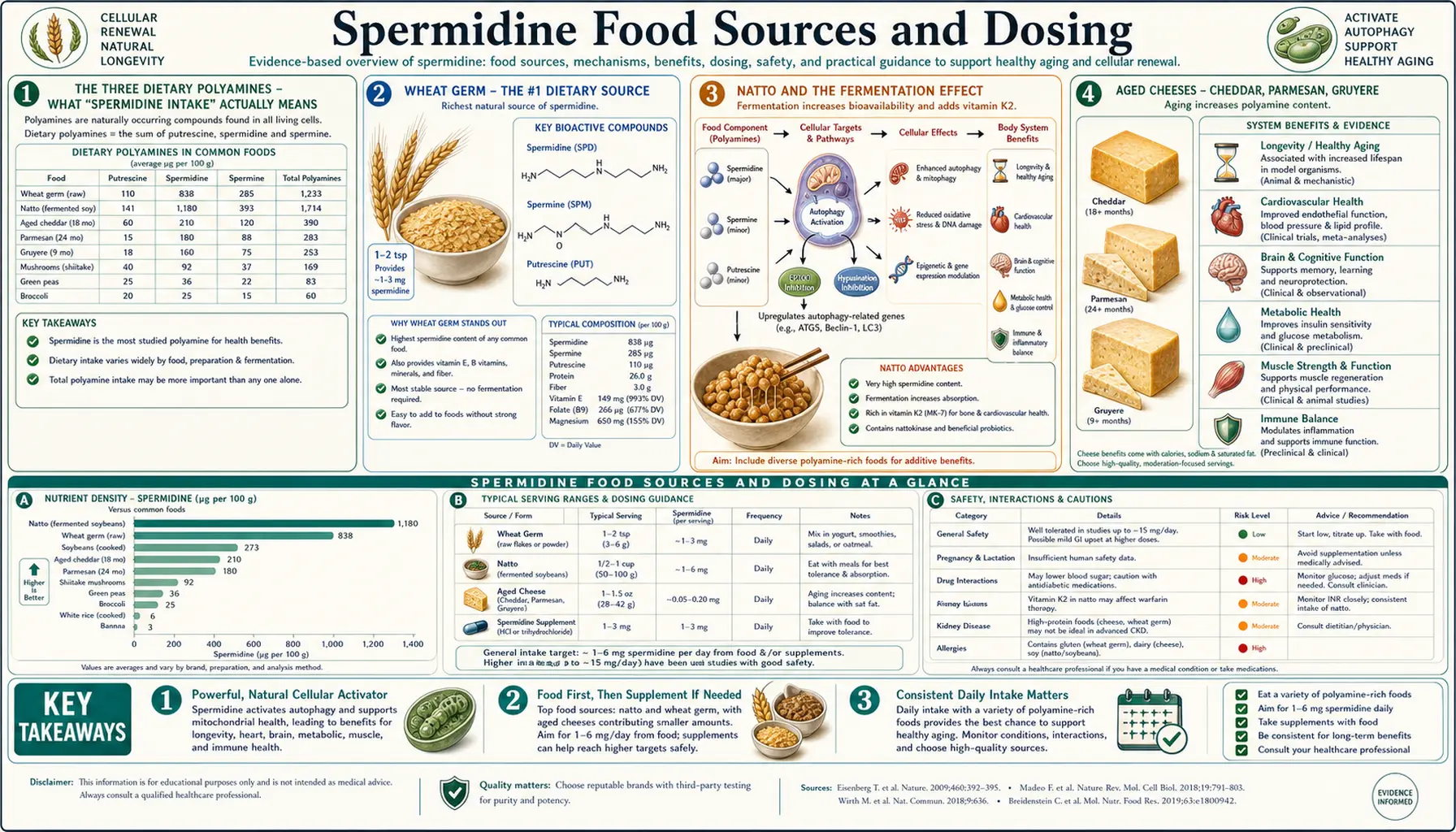
The typical Western diet supplies somewhere between 7 and 15 mg of total polyamines per day — a mixture of putrescine, spermidine, and spermine — with spermidine itself usually contributing 1 to 3 mg in adults who eat little fermented or germinated food. The Bruneck cohort that produced the landmark 2018 American Journal of Clinical Nutrition mortality paper showed that participants in the highest tertile of dietary spermidine intake averaged closer to 12 mg/day, achieved primarily through a Mediterranean-leaning food pattern with substantial whole-grain, legume, fermented dairy, and mushroom content. The single richest practical food source is wheat germ, at roughly 24 mg of spermidine per 100 g, often stirred into yogurt or oatmeal. Natto (fermented soybean) is reported at approximately 250 mg/kg, courtesy of Bacillus subtilis polyamine biosynthesis during fermentation. Aged cheeses — well-aged cheddar, parmigiano-reggiano, gruyère — concentrate spermidine through the polyamine output of the ripening bacterial cultures over months of aging. Mushrooms, particularly shiitake and oyster, contribute meaningfully on a serving basis. Legumes (peas, lentils, soybeans) and sprouted seeds round out the dietary picture. This deep-dive page walks through the food-source data quantitatively, traces the gut-microbiome contribution (gut bacteria are a further source of polyamines, though how much they add in people is not yet known), explains why aged and fermented foods are so much richer than their fresh counterparts, summarizes the human supplementation trials and the doses they used, and lists the spermidine content of everyday foods as the published food tables give it.
Table of Contents
- The Three Dietary Polyamines — What "Spermidine Intake" Actually Means
- Wheat Germ — The #1 Dietary Source
- Natto and the Fermentation Effect
- Aged Cheeses — Cheddar, Parmesan, Gruyère
- Mushrooms, Legumes, and Sprouted Seeds
- The Mediterranean Diet and the Bruneck Cohort
- The Gut Microbiome — A Further Source of Polyamines
- Age-Related Decline in Endogenous Polyamine Synthesis
- Cooking, Storage, and Bioavailability
- Wheat-Germ Extract, Synthetic, and Aged-Cheese Delivery Compared
- Doses Used in Human Supplementation Trials
- Spermidine in Everyday Foods
- Key Research Papers
- Connections
- Featured Videos
The Three Dietary Polyamines — What "Spermidine Intake" Actually Means
Before discussing food sources, it is worth pinning down what gets measured. The dietary polyamines are three small aliphatic molecules: putrescine (a diamine, 4 carbons, 2 amine groups), spermidine (a triamine, 7 carbons, 3 amine groups), and spermine (a tetraamine, 10 carbons, 4 amine groups). The three are biosynthetically linked — putrescine is converted to spermidine by spermidine synthase, and spermidine is converted to spermine by spermine synthase, with decarboxylated S-adenosylmethionine donating the aminopropyl group at each step. The three interconvert biologically through a complementary recycling pathway as well, so a given cell or food sample contains all three in varying proportions.
Most food-composition studies measure all three and report them separately. When the literature refers to "spermidine intake," it almost always means spermidine specifically rather than total polyamines, but the broader concept of "polyamine intake" matters because the body can interconvert them to some extent. Foods that are rich in spermidine tend also to be rich in spermine and putrescine, and the Bruneck mortality paper used a polyamine composite as well as a spermidine-specific analysis, with similar results on both measures.
The food-composition database that underpins most modern work is the Atiya Ali / Strömberg et al. compilation from the early 2010s, supplemented by Munoz-Esparza et al. (2019). Concentrations are usually reported in milligrams per kilogram (mg/kg) of food as eaten, which converts cleanly to milligrams per 100 g by dividing by 10. A daily figure often cited in the spermidine-longevity literature is somewhere between 6 and 12 mg/day of spermidine from food. It is not an official target: the Munoz-Esparza review states that “there are no official recommendations for the daily intake of polyamines.” The lower end of that range moves a typical Western diet up by 4-6 mg through deliberate food choices, and the upper end approximates the highest Bruneck tertile and the wheat-germ-extract supplementation arms of the clinical trials.
Wheat Germ — The #1 Dietary Source
Wheat germ — the small, lipid-rich, vitamin-rich embryo of the wheat kernel that is removed during the production of white flour — is by a substantial margin the most concentrated routine food source of spermidine in the human diet. Reported concentrations cluster around 24 mg per 100 g, with some samples ranging from 18 to 30 mg/100 g depending on wheat cultivar, harvest conditions, and storage. A heaping tablespoon (about 7 g) of wheat germ thus contains roughly 1.7 mg of spermidine. A quarter cup (about 28 g) delivers approximately 6.7 mg.
The germ is the metabolically active embryonic tissue of the seed, and like other germinating or germinable plant tissues it has high polyamine concentrations because polyamines are essential for the rapid cell division that follows germination. Sprouted whole-grain breads, sprouted wheat berries, and sprouted-grain cereals retain meaningful spermidine content, though usually less per gram than isolated wheat germ. Wheat bran (the outer fibrous layer) has much less spermidine than the germ. White flour, with both bran and germ removed, has almost none — one of the many reasons that the shift from whole-grain to refined-flour diets in the twentieth century reduced background polyamine intake substantially.
Practically, wheat germ is sold in two forms: raw (refrigerated for stability because the lipid content oxidizes quickly at room temperature) and toasted (more shelf-stable but with slight loss of vitamin E and possibly some polyamine content during the toasting step, though the spermidine itself is heat-stable enough that the loss is modest). Either form works for dietary purposes. The lipid content makes wheat germ go rancid quickly once opened, which is why it is commonly kept in the refrigerator or freezer in a tightly sealed container and used within 2-3 months. The taste is mild and slightly nutty; it works well stirred into yogurt, oatmeal, smoothies, batters, and salads. By the figures above, a tablespoon a day supplies roughly 1.7 mg of spermidine from food alone.
Caveat for gluten-sensitive patients: wheat germ contains gluten and is not suitable for people with celiac disease or non-celiac gluten sensitivity. The polyamine concentration of other germinated cereal embryos (rye germ, barley germ) is similar in magnitude but they share the gluten problem. For gluten-free dietary spermidine, the main contributors become mushrooms, legumes, aged cheeses (some are essentially gluten-free), natto, and sprouted gluten-free grains and seeds.
Natto and the Fermentation Effect
Natto is a traditional Japanese fermented soybean preparation in which whole cooked soybeans are inoculated with Bacillus subtilis var. natto and fermented for roughly 18-24 hours, producing the characteristic stringy, glutinous, pungent finished product. Published spermidine values for natto cluster around 250 mg/kg, or 25 mg per 100 g, which is roughly comparable to wheat germ on a per-weight basis. A standard 40-50 g serving of natto thus delivers approximately 10-12 mg of spermidine in a single meal.
The crucial observation is that the spermidine concentration in finished natto is roughly an order of magnitude higher than in the cooked soybeans used as the starting material. The polyamine content is built during fermentation by Bacillus subtilis itself, which has a robust polyamine biosynthesis pathway and produces both putrescine and spermidine as part of its normal metabolism. The fermentation effect is the most striking practical example of how microbial activity dominates dietary polyamine availability — a fermented version of almost any food has substantially more spermidine than its unfermented precursor.
Other fermented foods show the same effect to varying degrees. Tempeh (fermented soybean cake produced with Rhizopus molds) has elevated polyamines compared to plain soybeans, though less than natto. Miso (long-fermented soybean and grain paste) has meaningful concentrations and contributes broadly to Japanese-pattern dietary polyamine intake. Kimchi and sauerkraut (lactic-acid-fermented vegetables) contribute modest but non-trivial spermidine. Aged cheeses (discussed separately below) are the European equivalent of the fermentation amplification effect.
Natto remains an acquired taste for non-Japanese palates — the sulfurous aroma, the slimy mucilaginous texture, and the strong ammoniacal note from continued polyamine production during refrigerated storage are all challenging on first introduction. For dietary spermidine purposes the practical question is whether the patient can tolerate it as a regular item; many people find that natto stirred into rice with soy sauce, chopped green onion, and a raw egg yolk (the traditional preparation) is acceptable. Frozen natto stored well and thawed on the morning of consumption maintains its polyamine content. For people who cannot tolerate the taste or texture, the other foods and supplements on this page remain the sources of polyamines.
Aged Cheeses — Cheddar, Parmesan, Gruyère
Aged hard cheeses are the European counterpart to natto in the dietary polyamine economy. Fresh cheeses (mozzarella, ricotta, cottage cheese) have low polyamine concentrations because the bacterial cultures have not had time to produce them. Soft-ripened cheeses (brie, camembert) have moderate concentrations. Aged hard cheeses — varieties like cheddar, parmigiano-reggiano, grana padano, gruyère, manchego, aged gouda — have substantially higher concentrations because their bacterial and mold cultures continue to produce polyamines through months and years of ripening.
Reported concentrations vary widely by variety, age, and producer:
- Aged cheddar (12+ months): approximately 50-100 mg/kg spermidine plus comparable spermine; a one-ounce (28 g) serving delivers roughly 1.5-3 mg spermidine.
- Parmigiano-reggiano (24+ months): approximately 30-80 mg/kg; the grated tablespoon (about 5 g) delivers 0.2-0.4 mg; a quarter-cup chunk eaten as a snack delivers around 1-2 mg.
- Gruyère (12+ months cave-aged): similar range to aged cheddar, with substantial putrescine and spermine alongside the spermidine.
- Aged gouda (12+ months): comparable, sometimes higher in the very long-aged 24-36 month products.
- Manchego (curado, 6-12 months; viejo, 12+ months): moderate to high; the older the cheese the higher the polyamine load.
Measured values show how widely cheese varies. In the food database compiled by Atiya Ali and colleagues (2011), a UK cheddar matured for 1 year held a mean of 199.5 mg/kg spermidine, while the matured cheese they analysed among Swedish dairy products held 1.2 mg/kg.
The polyamines in aged cheese are produced by the secondary microbial flora — Lactobacillus, Lactococcus, Enterococcus, Brevibacterium, and others depending on the variety — that continue metabolic activity during the ripening period. Polyamine production scales roughly with aging time and with the diversity of the microbial community, which is why the most polyamine-rich cheeses tend to be the most pungently flavored ones — the same bacterial activity that produces the flavor compounds produces the polyamines.
A practical implication is that the spermidine content of cheese is not predictable from the label — it depends on age and bacterial community details that the producer may not disclose precisely. As a rough rule, the older and stinkier and more crystalline (those crunchy white crystals in aged parmesan are tyrosine, an aging marker), the more polyamines. In a polyamine-rich diet, well-aged hard cheese is one of the more flavorful contributors. The biogenic amine load of aged cheese is also a relevant consideration for people taking monoamine oxidase inhibitors (MAOIs) (a classic interaction with aged cheese is the tyramine reaction; spermidine and spermine themselves are not implicated in the MAOI reaction, but the aged-cheese category as a whole is restricted in that population).
The connection to dietary polyamines is one of several reasons that the traditional Mediterranean diet pattern, which routinely includes 1-2 oz of aged cheese daily, appears to confer some of its longevity benefit through the polyamine route.
Mushrooms, Legumes, and Sprouted Seeds
Mushrooms are a substantial and often-underappreciated source of dietary polyamines. Fungi as a kingdom have particularly active polyamine metabolism, and several common culinary mushrooms have spermidine concentrations in the 50-90 mg/kg range:
- Shiitake (Lentinula edodes) — commonly cited around 80-90 mg/kg fresh weight, with the highest concentrations in dried shiitake (since the polyamines concentrate as water is removed); a 100 g serving of fresh shiitake or 10 g of dried delivers roughly 8 mg spermidine.
- Oyster mushrooms (Pleurotus ostreatus) — comparable to shiitake, around 70-80 mg/kg.
- Maitake, enoki, and king trumpet mushrooms — moderate to high concentrations in the same general range.
- White button and cremini mushrooms — lower than shiitake or oyster but still meaningful at roughly 20-40 mg/kg, and they are eaten in larger portions in Western cuisine.
- Porcini (dried, as commonly used in cooking) — concentrated like dried shiitake.
For a measured comparison, the food database compiled by Atiya Ali and colleagues (2011) lists mushrooms analysed in Japan at a mean of 88.6 mg/kg spermidine (range 62.4-139.3 mg/kg), and gives 4.4 mg of spermidine for a 50 g portion of mushrooms.
Legumes contribute meaningfully on a per-serving basis because they are eaten in larger portions than mushrooms:
- Soybeans (fresh edamame or dry mature) — approximately 50-70 mg/kg; a 100 g serving of edamame delivers 5-7 mg spermidine.
- Green peas — approximately 40-60 mg/kg; a 1-cup (160 g) serving delivers 6-10 mg.
- Lentils (cooked) — approximately 30-50 mg/kg; a 1-cup (200 g) serving of cooked lentils delivers 6-10 mg.
- Chickpeas (cooked) — approximately 25-40 mg/kg; a 1-cup (170 g) serving delivers 4-7 mg.
- Sprouted lentils and sprouted chickpeas — concentrations are higher than the unsprouted counterparts because germination activates polyamine biosynthesis to support rapid cell division.
The same database lists frozen green peas (analysed in the Czech Republic) at a mean of 46.6 mg/kg spermidine and chickpeas (analysed in France) at 28.8 mg/kg. The Munoz-Esparza review singles out wheat germ and soybeans as the stand-out foods, “with respective values of 2,437 and 1,425 nmol/g for spermidine.”
Sprouted seeds in general are polyamine-rich, for the same germination biology reason that wheat germ is. Broccoli sprouts, alfalfa sprouts, sprouted sunflower seeds, sprouted pumpkin seeds, and sprouted radish seeds all contribute. Concentrations are not as systematically catalogued as for the major cereal germs, but the directional pattern is consistent — any rapidly germinating plant tissue has elevated polyamines as a matter of plant biology.
For more on the mushroom category, see Mushrooms and the related deep-dive on Medicinal Mushrooms. The legume category sits at Lentils and the broader Food hub.
The Mediterranean Diet and the Bruneck Cohort
The Bruneck study is the single most influential observational cohort for the spermidine-mortality hypothesis. The analysis included 829 participants aged 45-84 living in the South Tyrolean alpine town of Bruneck, Italy, part of a cohort recruited in 1990 and followed prospectively for cardiovascular outcomes, cancer incidence, and all-cause mortality. Diet was assessed by repeated dietitian-administered food-frequency questionnaires (2,540 assessments in 1995, 2000, 2005, and 2010), translated into estimated polyamine intake through polyamine food-composition tables. Between 1995 and 2015, 341 participants died.
Kiechl, Pechlaner, Madeo, and colleagues published the polyamine-mortality analysis in the American Journal of Clinical Nutrition in 2018. The key findings:
- Participants in the highest tertile of estimated dietary spermidine intake averaged approximately 12 mg/day, achieved through a Mediterranean-leaning pattern with whole-grain bread, mushrooms, aged cheese, legumes, fresh and cooked vegetables, and salad greens at most meals.
- Participants in the lowest tertile averaged approximately 6 mg/day — closer to the modern Western average and characterized by more refined-grain bread, fewer legumes, less aged cheese, and fewer vegetable-forward meals.
- All-cause deaths fell across thirds of increasing spermidine intake, from 40.5 to 23.7 to 15.1 deaths per 1,000 person-years. Adjusted for age, sex, and calorie intake, the 20-year cumulative death rates were 0.48, 0.41, and 0.38 in the three thirds.
- After further adjustment for lifestyle factors, established predictors of death, and other features of the diet, each one-standard-deviation step up in spermidine intake went with a hazard ratio for death of 0.76 (95% CI 0.67-0.86; a hazard ratio below 1 means a lower death rate). The difference in risk between the top and bottom thirds of intake was similar to that of being 5.7 years younger.
- The authors report that the association was consistent in subgroups and was repeated in a second Austrian cohort, the Salzburg Atherosclerosis Prevention Program in Subjects at High Individual Risk (SAPHIR) study (hazard ratio 0.71 per one-standard-deviation step).
- The mortality gradient was monotonic across tertiles — the middle tertile had intermediate mortality between the two extremes, consistent with a dose-response relationship rather than a threshold effect.
- The association was driven by both cardiovascular and non-cardiovascular mortality, not concentrated in any single disease category.
The honest interpretation of the Bruneck data is that observational cohort evidence cannot establish causation — the highest-spermidine tertile differs from the lowest in many ways beyond polyamine intake, and even rigorous statistical adjustment leaves residual confounding. The plausibility of the spermidine-specific mechanism is supported by the mechanistic work in autophagy and hypusinated eIF5A, by the parallel animal-model lifespan data, and by emerging short-term human trials of wheat-germ-extract supplementation, but a definitive randomized hard-outcome trial in humans has not yet been completed.
The practical lesson from Bruneck is twofold: first, that the magnitude of difference between the lowest and highest tertiles (6 vs 12 mg/day) is achievable through routine food choices without supplementation; and second, that the food pattern that produced the high-intake tertile is not an obscure prescriptive diet but a recognizable Mediterranean-leaning whole-food pattern that is independently associated with longevity benefit in dozens of cohorts. The polyamine angle is one of several plausible mechanisms by which the Mediterranean pattern delivers its benefit.
For more on the Mediterranean dietary pattern in general, see Mediterranean Diet. The cardiovascular-specific aspects of the Bruneck data are detailed in Cardiovascular Aging.
The Gut Microbiome — A Further Source of Polyamines
Besides food and the body's own synthesis, gut bacteria are a further source of polyamines, mainly in the large intestine. How much they contribute in people is not yet known: the Munoz-Esparza review notes that “more information is still needed on the capability to form polyamines of the gut microbiota.” In mice, Matsumoto and colleagues (2012) compared germ-free animals with animals colonised by gut bacteria and found that the bacteria strongly shaped the small molecules present in the colon. The microbial producers are Bacteroides species, Fusobacterium, Clostridium, Escherichia coli, and various lactic-acid bacteria — all common commensals in the healthy adult colon.
The implication is that the relevant variable for systemic polyamine availability is not just dietary intake but also the composition and activity of the colonic microbiome. A patient with a robust, diverse, polyamine-producing microbiome may reach adequate systemic polyamine levels even on a relatively low dietary intake. Conversely, a patient with antibiotic-disrupted microbiome, inflammatory bowel disease, or other dysbiosis may have substantially reduced microbial polyamine production despite adequate dietary intake.
The microbiome-polyamine link is bidirectional. Polyamine intake (both dietary and microbial) shapes the microbiome itself — polyamines are growth substrates for some bacterial species and selectively favor certain community structures. Fermentable fibers (the prebiotics) feed the bacteria that produce polyamines, so a fiber-rich diet supports both microbial polyamine production directly (more bacterial biomass) and indirectly (community composition favoring producer species). Resistant starch, beta-glucans (from oats and mushrooms), pectins (from fruit), and inulin-type fructans (from onions, garlic, leeks, jerusalem artichokes) all support the colonic environment that produces polyamines.
The clinical implication is that any intervention that disrupts the microbiome — especially broad-spectrum antibiotic courses — can be expected to transiently reduce systemic polyamine availability for weeks to months until the microbiome recovers. On the same reasoning, a spermidine-rich diet or supplement begun during an antibiotic course would meet a reduced microbial contribution; prebiotic fiber and multi-strain probiotics are the measures usually discussed for supporting the microbiome's recovery.
For more on the microbiome side of this picture, see Gut Microbiome and the related Prebiotics and Probiotics pages.
Age-Related Decline in Endogenous Polyamine Synthesis
The cellular machinery for endogenous polyamine biosynthesis declines progressively with chronological age. The rate-limiting enzyme, ornithine decarboxylase (ODC1), has lower steady-state activity in tissues from older animals and older humans. Spermidine synthase and S-adenosylmethionine decarboxylase (which produces the aminopropyl donor for the synthase step) similarly decline. The net result is that an older adult, given the same dietary polyamine input as a younger adult, ends up with lower tissue polyamine concentrations.
Hofer and colleagues (2021) summarise that spermidine pools decline during aging in various tissues of model organisms, including mice, and that spermidine supplied in drinking water or food refills them. In people, Pucciarelli and colleagues (2012, University of Camerino) measured polyamines in the whole blood of 78 adults: the 60-80-year group had the lowest spermidine and spermine, while people aged 90-106 were, in the words of the paper's title, “enriched” in both. In older people's immune B cells, an Oxford group (Zhang and colleagues, 2019) found that spermidine is depleted, which lowers eIF5A hypusination, the autophagy switch TFEB, and autophagy itself; adding spermidine to old human B cells in the laboratory restored this pathway and improved their responses. The decline appears to be roughly 30-50% between young adulthood and the eighth decade of life, with substantial inter-individual variation.
This age-related decline is part of the rationale for why dietary or supplemental spermidine repletion might be particularly relevant in older adults, even those whose dietary intake appears adequate on paper. The aging body simply does not retain or produce polyamines as efficiently as the younger body, and an intake that was sufficient at age 30 may be borderline at age 70. In the Bruneck cohort, the authors report that the link between higher spermidine intake and lower mortality was consistent across subgroups.
The same age-related decline pattern is documented for other endogenously synthesized molecules central to the longevity story — nicotinamide adenine dinucleotide (NAD+), glutathione, coenzyme Q10, and others. Spermidine fits comfortably in that category of "endogenous molecule whose levels fall with age and whose replacement may have anti-aging value." The parallels to nicotinamide adenine dinucleotide and nicotinamide mononucleotide (NMN), Glutathione, and Coenzyme Q10 repletion strategies are deliberate and conceptually unified.
Cooking, Storage, and Bioavailability
Spermidine itself is a small, chemically stable molecule. It survives ordinary cooking temperatures essentially intact — boiling, baking, sauteing, grilling, and pressure cooking do not significantly degrade it. The cooked weight of a portion is therefore a reasonable basis for estimating polyamine intake, and standard food-composition databases generally report values for foods as eaten rather than as raw weight.
That said, there are some practical considerations:
- Water-soluble loss — polyamines are water-soluble. Boiling vegetables and discarding the cooking water (the classical preparation of green peas, beans, or lentils with the broth poured off) loses some polyamine content to the discarded liquid. Cooking methods that retain the cooking water (soups, stews, risottos, pressure cooking, steaming) preserve more of the polyamine content. Sauteing with minimal liquid loss similarly preserves the polyamines.
- Fermentation amplification — as noted above, fermentation processes typically increase the polyamine content of a food substantially through bacterial biosynthesis during the fermentation. This is true for natto, miso, tempeh, aged cheeses, sauerkraut, kimchi, and yogurt to varying degrees.
- Germination amplification — sprouting a seed (rather than eating it ungerminated) similarly increases polyamine content. Sprouted whole-grain bread, sprouted legumes, and seed sprouts all have higher polyamines than their unsprouted parent material.
- Storage decay — wheat germ's polyamine content is reasonably stable in refrigerated or frozen storage. Aged cheeses continue producing polyamines slowly throughout their storage life. Fresh produce gradually loses polyamines over weeks of refrigeration as cellular metabolism continues.
- Bioavailability — dietary polyamines are absorbed in the duodenum and the first part of the jejunum (the upper small intestine), according to the Munoz-Esparza review. Absorbed spermidine enters the portal circulation and is partially extracted by the liver on first pass. The first human pharmacokinetic study (Senekowitsch and colleagues, 2023) gave 12 healthy volunteers 15 mg of spermidine a day for 5 days in a placebo-controlled crossover trial: blood spermidine did not rise, but blood spermine did, which the authors read as swallowed spermidine being converted into spermine before it reaches the circulation. They judged it “rather unlikely that spermidine supplements with doses <15 mg/d exert any short-term effects.” There is no clear advantage to fasting administration vs with-food administration; the wheat-germ-extract human trials used both protocols with similar outcomes.
The practical bottom line is that almost any way of cooking polyamine-rich foods preserves most of the polyamine content. The only meaningful loss is from discarding boiling liquid in the classical drain-the-water vegetable preparations. The fermentation and germination amplifications are large — the fermented or sprouted version of a food generally carries far more polyamines than the plain version.
Wheat-Germ Extract, Synthetic, and Aged-Cheese Delivery Compared
Three different supplemental and dietary delivery formats for spermidine are used in the modern marketplace and the academic literature:
- Wheat-germ-extract supplements — concentrated polyamine-rich extracts of wheat germ, typically standardized to deliver a specified dose of spermidine (commonly 1-3 mg per capsule, with 1.2 mg being the most common standardized dose). These were the formulation used in the Schwarz and Wirth human trials, including the SmartAge cognitive trial. The advantages: well-characterized clinical safety record, food-matrix delivery with the co-present nutrients (vitamin E, B vitamins, healthy fats) intact, mechanism of action confirmed in the same product format used in trials. The disadvantages: standardized dose is still relatively low compared to the high-intake Bruneck tertile, gluten content (relevant for celiac and non-celiac gluten-sensitive patients), product-to-product variation in standardization rigor across brands.
- Synthetic spermidine — chemically synthesized spermidine trihydrochloride or spermidine free base, sold as powder or in capsules. The advantages: precise dose control, no gluten, can deliver higher doses per capsule, generally lower cost per milligram of spermidine. The disadvantages: no food matrix, less mature human clinical safety record than wheat-germ extract (though no specific safety signal has emerged), regulatory ambiguity in some jurisdictions, sometimes a slightly metallic or bitter taste in powder form.
- Aged-cheese delivery — getting the polyamine dose through routine consumption of aged cheese as part of meals. The advantages: pleasant to consume, integrates seamlessly with Mediterranean-pattern eating, provides additional nutrients (calcium, vitamin K2, protein, beneficial fatty acids), no separate supplement-taking ritual. The disadvantages: variable polyamine content by variety and age, calorically dense (high saturated fat and sodium content), tyramine and other biogenic amines may matter for monoamine oxidase inhibitor patients and migraine-sensitive individuals, lactose-intolerant patients may need to focus on aged hard cheeses (which are essentially lactose-free) rather than fresh varieties.
Food and supplements are not exclusive: wheat germ, mushrooms, legumes, and aged cheese supply a dietary baseline, and commercial wheat-germ-extract supplements, standardized to a stated spermidine content per serving and made from the same kind of extract as the trial product, add to it.
Doses Used in Human Supplementation Trials
The doses studied in formal human trials have been small: 1.2 mg of spermidine a day in the 3-month pilot trials and 0.9 mg a day in the 12-month SmartAge trial, both from wheat-germ extract, with 15 mg a day used only in a 5-day pharmacokinetic study. The major human trials and their dosing:
- Schwarz et al. 2018 (Aging) — 1.2 mg/day of wheat-germ-extract-derived spermidine in 30 older adults (60-80 years) with subjective cognitive decline for 3 months. The primary endpoint was safety; no differences were observed between the spermidine and placebo groups in vital signs, weight, blood chemistry, blood counts, or self-reported health. Compliance above 85% indicated good tolerability.
- Wirth et al. 2018 (Cortex) — a 3-month pilot trial of a spermidine-rich plant extract in 30 older adults (60-80 years) with subjective cognitive decline reported that memory performance was moderately enhanced in the spermidine group compared with placebo.
- SmartAge trial (Schwarz et al. 2022, JAMA Network Open) — 100 adults aged 60-90 with subjective cognitive decline were randomized to 0.9 mg/day of spermidine from wheat-germ extract or placebo for 12 months (2017-2020); 89 completed the trial. No significant change was seen in the main memory test (mnemonic discrimination; between-group difference -0.03, P = .47) or in the secondary outcomes, and the authors concluded that spermidine “did not modify memory and biomarkers compared with placebo.” Adverse events were balanced between groups. Exploratory analyses hinted at possible benefits on inflammation and verbal memory, which the authors say need testing at higher doses.
- Schroeder et al. 2021 (Cell Reports) — animal and population data rather than a supplementation trial: in mice, dietary spermidine crossed the blood-brain barrier and increased hippocampal eIF5A hypusination and mitochondrial function; in fruit flies its boost to mitochondrial respiration required the autophagy and mitophagy genes Atg7, Parkin, and Pink1; and the paper reported large-scale prospective human data linking higher dietary spermidine intake with a lower risk of cognitive impairment.
- Senekowitsch et al. 2023 (Nutrients) — 15 mg/day for 5 days in 12 healthy volunteers, a pharmacokinetic study (see Cooking, Storage, and Bioavailability above): blood spermine rose, blood spermidine did not.
- Smaller pilot trials — have used 3-5 mg/day for shorter durations, mostly with safety as primary endpoint. No safety signals at these doses.
The upper end of safe supplemental intake in humans is not formally established because the trials have not pushed the dose higher than necessary. Animal studies have used very high doses (10-50 mg/kg, which would scale to hundreds of mg/day human-equivalent) without obvious acute toxicity. The published trial safety data cover 1.2 mg/day for 3 months and 0.9 mg/day for 12 months; intakes in the 5-15 mg/day range (achievable through diet and supplements combined) have observational data from the Bruneck cohort and similar populations who naturally consume those amounts, and substantially higher pharmacologic doses are not established for general use.
The supplement doses with direct human trial evidence are 1.2 mg/day (3 months) and 0.9 mg/day (12 months); the 12-month trial found no effect on its main memory test. Commercial wheat-germ-extract supplements commonly supply 1-3 mg per serving (see above).
The cancer caveat noted in the Autophagy Induction page applies to dosing decisions as well — polyamines including spermidine are required for cell proliferation, and isolated polyamine biology in oncology has been studied as a potential growth-promotion concern. The clinical evidence on dietary spermidine and cancer outcomes is mixed but not pointing in a strongly worrying direction; the Bruneck cohort showed no excess cancer mortality in the highest-intake tertile. For people with active cancer or a recent cancer history, the relevant facts are that polyamines are required for cell proliferation, that high polyamine levels have been studied as a possible tumor-growth concern, and that the human supplementation trials described on this page did not enroll people with cancer.
Spermidine in Everyday Foods
The foods below appear again and again in high-spermidine eating patterns such as the Bruneck high-intake third. The figures are spermidine contents as the published food tables give them; actual content varies with variety, ripening, and storage, and no table gives a daily total for a combination of these foods.
- Wheat germ — stirred into whole-milk yogurt or oatmeal; the Munoz-Esparza review gives 2,437 nmol/g of spermidine, one of the two stand-out values among foods.
- Green peas — 9.1 mg of spermidine in a 140 g portion in the Swedish food-database table of Atiya Ali and colleagues (2011); frozen green peas 46.6 mg/kg.
- Lentil soup — 5.5 mg in a 250 g portion (same table).
- Mushrooms — 4.4 mg in a 50 g portion (same table); mushrooms analysed in Japan averaged 88.6 mg/kg.
- Red beans — 3.7 mg in a 190 g portion (same table).
- Broccoli — 3.6 mg in a 100 g portion (same table).
- Cheese — 2.0 mg in a 20 g portion (same table), with very wide variation by type and age: a UK cheddar matured for 1 year held 199.5 mg/kg, a Swedish matured cheese 1.2 mg/kg.
- Chickpeas (as in hummus) — 28.8 mg/kg.
- Natto over brown rice — for people who eat natto; published natto values cluster around 250 mg/kg (see the natto section above).
For people who do not eat one of the major categories (no wheat in celiac disease, no cheese in a vegan diet, no soy with a soy allergy), the remaining categories still supply spermidine. In gluten-free eating the main sources are mushrooms, legumes, aged cheese, and sprouted gluten-free seeds; in vegan eating, natto and tempeh, wheat germ, mushrooms, sprouted legumes, and sprouted seeds; in cheese-free eating, wheat germ, natto, mushrooms, and legumes. The spread of polyamines across so many food groups means almost any whole-food pattern contains several of them.
Wheat-germ-extract supplements supply spermidine in the form tested in the human trials (1.2 mg/day and 0.9 mg/day); they do not supply the rest of a whole-food diet.
For the broader rationale behind dietary intervention for cognitive and cardiovascular aging, see Cognitive Function and Cardiovascular Aging. For the autophagy mechanism that underlies most of the benefit, see Autophagy Induction.
Key Research Papers
- Kiechl S, Pechlaner R, Willeit P, Notdurfter M, Paulweber B, Willeit K, et al. (2018). Higher spermidine intake is linked to lower mortality: a prospective population-based study. American Journal of Clinical Nutrition 108(2):371-380. — PubMed PMID: 29955838
- Madeo F, Eisenberg T, Pietrocola F, Kroemer G (2018). Spermidine in health and disease. Science 359(6374):eaan2788. — PubMed PMID: 29371440
- Schwarz C, Stekovic S, Wirth M, Benson G, Royer P, Sigrist SJ, et al. (2018). Safety and tolerability of spermidine supplementation in mice and older adults with subjective cognitive decline. Aging 10(1):19-33. — PubMed PMID: 29315079
- Wirth M, Benson G, Schwarz C, Kobe T, Grittner U, Schmitz D, et al. (2018). The effect of spermidine on memory performance in older adults at risk for dementia: a randomized controlled trial. Cortex 109:181-188. — PubMed PMID: 30388439
- Schroeder S, Hofer SJ, Zimmermann A, Pechlaner R, Dammbrueck C, Pendl T, et al. (2021). Dietary spermidine improves cognitive function. Cell Reports 35(2):108985. — PubMed PMID: 33852843
- Atiya Ali M, Poortvliet E, Strömberg R, Yngve A (2011). Polyamines in foods: development of a food database. Food & Nutrition Research 55. — PubMed PMID: 21249159
- Munoz-Esparza NC, Latorre-Moratalla ML, Comas-Baste O, Toro-Funes N, Veciana-Nogues MT, Vidal-Carou MC (2019). Polyamines in food. Frontiers in Nutrition 6:108. — PubMed PMID: 31355206
- Pucciarelli S, Moreschini B, Micozzi D, De Fronzo GS, Carpi FM, Polzonetti V, et al. (2012). Spermidine and spermine are enriched in whole blood of nona/centenarians. Rejuvenation Research 15(6):590-595. — PubMed PMID: 22950434
- Soda K, Kano Y, Sakuragi M, Takao K, Lefor A, Konishi F (2009). Long-term oral polyamine intake increases blood polyamine concentrations. Journal of Nutritional Science and Vitaminology 55(4):361-366. — PubMed PMID: 19763038
- Eisenberg T, Abdellatif M, Schroeder S, Primessnig U, Stekovic S, Pendl T, et al. (2016). Cardioprotection and lifespan extension by the natural polyamine spermidine. Nature Medicine 22(12):1428-1438. — PubMed PMID: 27841876
- Matsumoto M, Kibe R, Ooga T, Aiba Y, Kurihara S, Sawaki E, et al. (2012). Impact of intestinal microbiota on intestinal luminal metabolome. Scientific Reports 2:233. — PubMed PMID: 22724057
- Hofer SJ, Liang Y, Zimmermann A, Schroeder S, Dengjel J, Kroemer G, et al. (2021). Spermidine-induced hypusination preserves mitochondrial and cognitive function during aging. Autophagy 17(8):2037-2039. — PubMed PMID: 34105442
- Schwarz C, Benson GS, Horn N, Wurdack K, Grittner U, Schilling R, et al. (2022). Effects of spermidine supplementation on cognition and biomarkers in older adults with subjective cognitive decline: a randomized clinical trial. JAMA Network Open 5(5):e2213875. — PubMed PMID: 35616942
- Senekowitsch S, Wietkamp E, Grimm M, Schmelter F, Schick P, Kordowski A, et al. (2023). High-dose spermidine supplementation does not increase spermidine levels in blood plasma and saliva of healthy adults: a randomized placebo-controlled pharmacokinetic and metabolomic study. Nutrients 15(8):1852. — PubMed PMID: 37111071
- Zhang H, Alsaleh G, Feltham J, Sun Y, Napolitano G, Riffelmacher T, et al. (2019). Polyamines control eIF5A hypusination, TFEB translation, and autophagy to reverse B cell senescence. Molecular Cell 76(1):110-125.e9. — PubMed PMID: 31474573
PubMed Topic Searches
Connections
- Spermidine Overview
- Spermidine Benefits Hub
- Spermidine for Autophagy Induction
- Spermidine for Cardiovascular Aging
- Spermidine for Cognitive Function
- Mediterranean Diet
- Gut Microbiome
- Prebiotics
- Probiotics
- Fasting (Autophagy Trigger)
- Longevity Protocols
- Mushrooms (Shiitake, Oyster)
- Medicinal Mushrooms
- Lentils (Legume Polyamine)
- Cheese (Aged Polyamine Source)
- Nicotinamide Adenine Dinucleotide and Nicotinamide Mononucleotide
- Glutathione
- Coenzyme Q10
- Fisetin (Senolytic Parallel)
- History