PQQ for NGF Synthesis & Neuroprotection
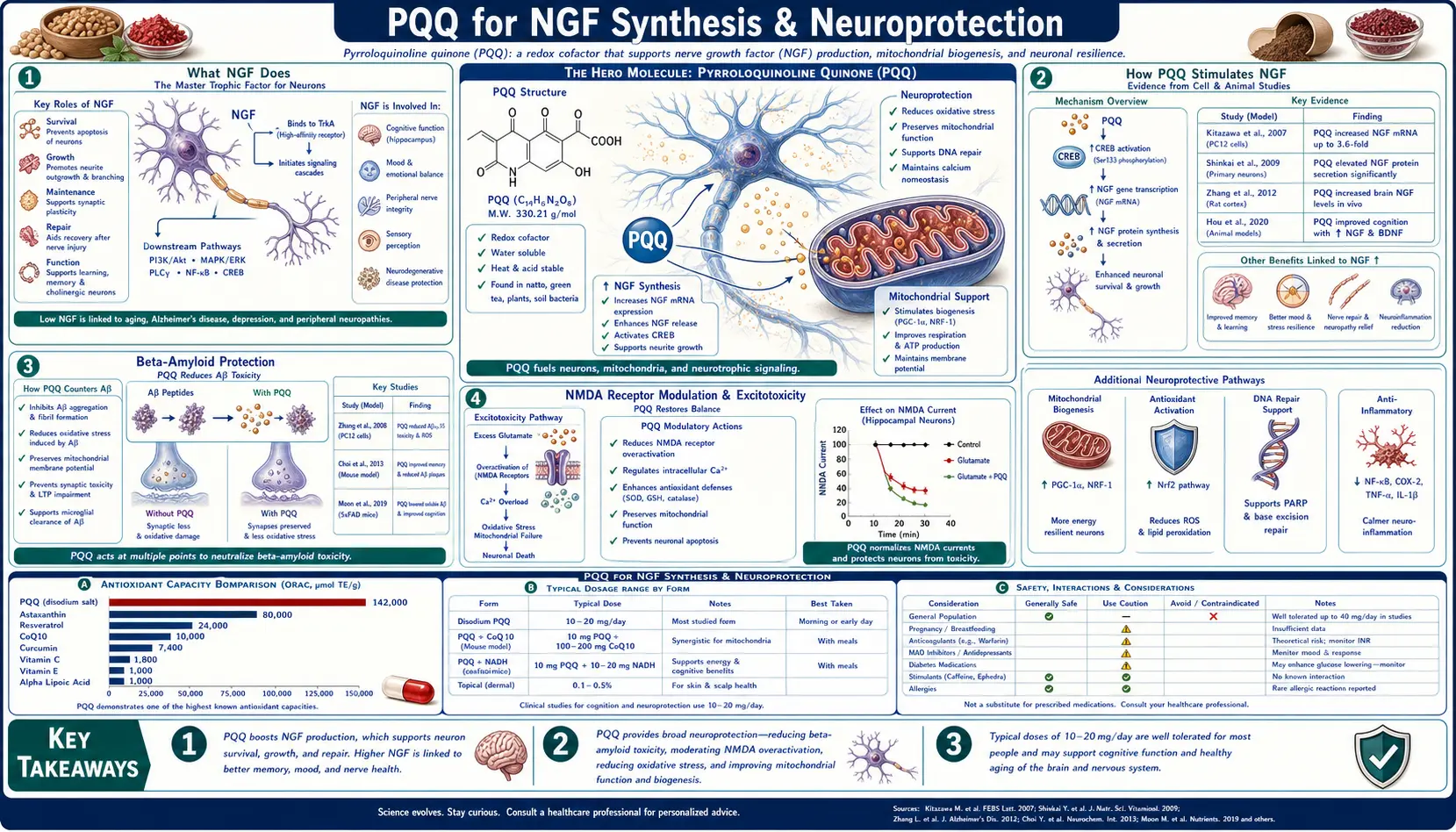
In cultured mouse astroglial cells, PQQ stimulated the synthesis of nerve growth factor (NGF), the strongest effect among the coenzymes tested in those cells (Murase et al. 1993). Other laboratory work found that PQQ reduces amyloid fibril formation in the test tube, acts at the NMDA receptor's redox modulatory site in cultured neurons, and reduced brain damage in rat models of stroke. None of these effects has been tested in people with a neurological disease: the human trials of PQQ were in healthy adults and measured cognitive test scores, not NGF, amyloid or NMDA activity. This deep-dive sets out what each line of laboratory and animal evidence found.
Table of Contents
- What NGF Does
- PQQ and NGF: The Cell-Culture Finding
- Amyloid Fibrils: Test-Tube Findings
- NMDA Receptor Redox Site & Excitotoxicity
- Animal Models of Alzheimer's Disease
- Animal Models of Stroke
- Proposed Mechanisms Side by Side
- PQQ and Lion's Mane: Separate Lines of Research
- Human Evidence and Doses Studied
- Safety Findings and Limits of the Evidence
- Key Research Papers
- Connections
- Featured Videos
What NGF Does
Nerve growth factor (NGF) is a small secreted protein in the neurotrophin family, discovered by Rita Levi-Montalcini and Stanley Cohen, who shared the 1986 Nobel Prize in Physiology or Medicine for the discovery of growth factors. It is the prototype of a family of trophic factors (NGF, BDNF, NT-3, NT-4) that support neuronal survival, axonal growth and synaptic plasticity.
NGF's main roles in the adult nervous system:
- Cholinergic neurons — the basal forebrain cholinergic neurons that project to the cortex and hippocampus depend on NGF signalling. These neurons are among those lost early in Alzheimer's disease.
- Synaptic plasticity — NGF supports structural changes at synapses involved in learning and memory
- Nerve repair — after nerve injury, NGF promotes axonal sprouting
- Sensory neurons — small-fibre sensory and pain-sensing neurons depend on NGF
NGF itself was tried as a treatment for Alzheimer's disease in the 1990s by infusing it into the brain's fluid spaces; side effects including pain and weight loss made the approach impractical. Research since has looked for small molecules that make cells produce more of their own NGF. PQQ and compounds from lion's mane mushroom (Hericium erinaceus) are among the natural substances studied for this in cell culture.
PQQ and NGF: The Cell-Culture Finding
The NGF finding comes from Murase K, Hattori A, Kohno M and Hayashi K (1993) at Gifu Pharmaceutical University, published in Biochemistry and Molecular Biology International:
- The group tested several coenzymes — PQQ, TOPA and lipoic acid — on NGF synthesis in mouse astroglial cells and two other cell lines in culture
- All three stimulated NGF synthesis without causing cytotoxicity
- PQQ had the strongest effect in astroglial cells; lipoic acid had the strongest effect in one of the other cell lines
- The authors suggested the activity depended on the compounds' oxidative or reductive properties rather than a particular ring structure
The paper did not identify the signalling pathway involved and did not test PQQ in animals or people. No study cited here has measured NGF in the brain or cerebrospinal fluid of animals or people given oral PQQ, and the human cognition trials (Itoh, Nakano, Shiojima, Tamakoshi) did not measure NGF.
Amyloid Fibrils: Test-Tube Findings
Amyloid-beta (Aβ) peptides build up into plaques in Alzheimer's disease, and alpha-synuclein forms aggregates in Parkinson's disease. In laboratory experiments:
- Kim et al. 2010 (Prion) — PQQ reduced fibril formation by amyloid beta (1-42) and mouse prion protein in the test tube
- Kobayashi et al. 2006 — PQQ prevented fibril formation of alpha-synuclein in the test tube
- Tsukakoshi et al. 2018 — the same research group described PQQ's blood-brain-barrier permeability as insufficient in an in-vitro model, and made an ester derivative (PQQ-trimethylester) with about twice the permeability and stronger anti-fibril activity
Whether oral PQQ reaches the brain in amounts that affect amyloid in people is unknown. No human study has measured amyloid or tau after PQQ.
NMDA Receptor Redox Site & Excitotoxicity
The NMDA (N-methyl-D-aspartate) receptor is a glutamate-gated ion channel involved in learning and memory. When glutamate builds up abnormally — after a stroke or brain injury, for example — excessive NMDA receptor activity lets in calcium that can kill neurons (excitotoxicity).
The PQQ finding comes from Aizenman et al. 1992 (Journal of Neuroscience), in rat cortical neurons in culture:
- At 50 µM, PQQ acted at the NMDA receptor's redox modulatory site — not the glutamate-binding site — and depressed NMDA-induced currents
- At 50-200 µM, PQQ protected the cultures against NMDA-mediated toxicity
These are concentrations applied directly to cells; how they compare with levels reached in the brain after oral PQQ is not known. No study cited here has compared PQQ with any Alzheimer's medicine, and no human study has measured NMDA receptor activity after PQQ.
Animal Models of Alzheimer's Disease
Transgenic mice such as the APP/PS1 strain develop amyloid deposits and memory problems with age and are used to test possible treatments. Other models inject amyloid-beta into the brain.
- Zhao et al. 2014 (Neurobiology of Aging) — in APP/PS1 mice, a synthetic tri-lithium salt of PQQ reduced amyloid deposition and improved learning and memory. The compound combines lithium with PQQ, so the result is not a test of PQQ alone.
- Li et al. 2024 (Advanced Science) — a computational screen predicted notable blood-brain-barrier permeability for PQQ, and in mice given amyloid-beta (1-42) to induce an Alzheimer-like condition, PQQ reduced cognitive deficits; the authors reported effects on genes linked to synapses, on reactive oxygen species and on SIRT1 and CREB pathways.
Mouse models reproduce parts of Alzheimer's pathology but not the full human disease, and many treatments that worked in mice have failed in human trials. No trial of PQQ in people with Alzheimer's disease or mild cognitive impairment was found for this page.
Animal Models of Stroke
In ischemic stroke, a core of dead tissue is surrounded by partly damaged tissue that may recover if blood flow returns and further damage is limited. PQQ has been tested in two rat models:
- Jensen et al. 1994 (Neuroscience) — in a rat pup model of cerebral hypoxia/ischemia, PQQ reduced infarct size when given before the injury and also when given after it; body and brain temperature did not differ between groups
- Zhang et al. 2006 (Brain Research) — in adult rats with 2-hour reversible middle cerebral artery occlusion, a single intravenous dose of 10 mg/kg PQQ at the start of occlusion or 3 hours after it reduced infarct volume at 72 hours; 3 mg/kg given at 3 hours also reduced infarct volume, but 1 mg/kg did not. Neurobehavioural scores were better at 10 and 3 mg/kg
In rat heart-attack models, PQQ given by injection also reduced infarct size (Zhu et al. 2004). These studies used injected doses. Many compounds that protected the brain in animal stroke models have not worked in human trials, and PQQ has not been tested in people with stroke, either in the acute phase or during recovery.
Proposed Mechanisms Side by Side
The neuroprotective claims made for PQQ rest on several separate laboratory findings:
| Mechanism | What Was Found | Where |
|---|---|---|
| Mitochondrial biogenesis | CREB → PGC-1α signalling and more mitochondrial markers (Chowanadisai 2010) | Mouse liver-derived cells in culture |
| NGF synthesis | More NGF made by astroglial cells (Murase 1993) | Mouse cells in culture |
| NMDA receptor redox site | Depressed NMDA currents; protection against NMDA toxicity (Aizenman 1992) | Rat neurons in culture |
| Amyloid fibrils | Less fibril formation by Aβ, prion protein and alpha-synuclein (Kim 2010; Kobayashi 2006) | Test tube |
| Redox activity | Antioxidant and, under some conditions, pro-oxidant activity (He 2003); about 20,000 catalytic cycles in a chemical redox assay, tabulated in a 2009 review with an author from a PQQ manufacturer (Rucker 2009) | Test tube |
The 20,000-cycle figure is a test-tube measure of chemical stability; it does not show how long PQQ acts in the body. Whether these mechanisms add up to any protective effect in people has not been tested.
PQQ and Lion's Mane: Separate Lines of Research
PQQ is often sold or discussed together with lion's mane mushroom (Hericium erinaceus), because both have been reported to stimulate NGF synthesis in cell studies.
Lion's mane research
- Compounds — hericenones (from the fruiting body) and erinacines (from the mycelium) have been studied for NGF-stimulating activity in cell and animal experiments
- Mori et al. 2009 (Phytotherapy Research) — a double-blind, placebo-controlled trial in 30 Japanese adults aged 50-80 with mild cognitive impairment; the lion's mane group took four 250 mg tablets of 96% dried mushroom powder three times a day for 16 weeks. Cognitive scale scores were significantly higher than placebo at weeks 8, 12 and 16, and fell significantly 4 weeks after intake stopped. Laboratory tests showed no adverse effects. The first author was from a mushroom company's laboratory.
The combination
No trial has tested PQQ and lion's mane together, so whether the combination has any added effect on NGF or cognition is unknown. The two compounds' reported NGF effects come from different cell experiments and have not been compared directly.
Human Evidence and Doses Studied
No human trial of PQQ in a neurodegenerative disease, stroke or mild cognitive impairment is cited here. The human trials of PQQ were in healthy adults and measured cognitive test scores (see the Cognition deep-dive):
- Itoh 2016: 41 healthy older adults, 20 mg/day PQQ disodium salt for 12 weeks
- Nakano 2016: 20 healthy adults aged 50-70, 20 mg/day for 12 weeks (prefrontal blood-flow measures)
- Shiojima 2022: 64 healthy adults aged 40 to under 80 who felt more forgetful, 21.5 mg/day for 12 weeks
- Tamakoshi 2023: adults aged 20-65, 20 mg/day for 12 weeks
Most of these trials were run or funded by companies that make or sell PQQ disodium salt. The animal studies above used injected doses (Jensen 1994; Zhang 2006) or a lithium-PQQ compound (Zhao 2014), which do not correspond to oral supplement doses. The European Food Safety Authority's 2017 safety assessment covered up to 20 mg/day in food supplements for healthy adults, excluding pregnant and breastfeeding women.
New or worsening memory problems can have treatable causes, such as vitamin B12 deficiency, thyroid disease, depression, sleep apnoea or medicine side effects.
Safety Findings and Limits of the Evidence
- No disease trials — PQQ has not been tested as a treatment for Alzheimer's disease, Parkinson's disease or stroke, alone or alongside prescribed treatment. The neuroprotection evidence comes from cell, test-tube and animal studies.
- Short-term safety — the 12-week trials in healthy adults reported no adverse events (Shiojima 2022) or no abnormal blood, urine or examination findings (Itoh 2016). These trials were small and short.
- Medicines — the trials did not study interactions with medicines, including anticoagulants and antiplatelet drugs; no interaction data were found for this page.
- Lion's mane — its safety and evidence are covered on the lion's mane page; no study has tested it with PQQ.
- Pregnancy and breastfeeding — supplemental PQQ has not been studied; EFSA's assessment excluded pregnant and breastfeeding women.
- Size of the effects — the cognitive changes in healthy adults were modest and inconsistent across tests.
Decisions about supplements belong with a clinician.
Key Research Papers
- Aizenman E, Hartnett KA, Zhong C, Gallop PM, Rosenberg PA (1992). Interaction of the putative essential nutrient pyrroloquinoline quinone with the N-methyl-D-aspartate receptor redox modulatory site. Journal of Neuroscience 12:2362-9 — PubMed PMID: 1318959
- Murase K, Hattori A, Kohno M, Hayashi K (1993). Stimulation of nerve growth factor synthesis/secretion in mouse astroglial cells by coenzymes. Biochemistry and Molecular Biology International 30:615-21 — PubMed PMID: 8401318
- Jensen FE, Gardner GJ, Williams AP, Gallop PM, Aizenman E, Rosenberg PA (1994). The putative essential nutrient pyrroloquinoline quinone is neuroprotective in a rodent model of hypoxic/ischemic brain injury. Neuroscience 62:399-406 — PubMed PMID: 7830887
- He K, Nukada H, Urakami T, Murphy MP (2003). Antioxidant and pro-oxidant properties of pyrroloquinoline quinone (PQQ): implications for its function in biological systems. Biochemical Pharmacology 65:67-74 — PubMed PMID: 12473380
- Zhu BQ, Zhou HZ, Teerlink JR, Karliner JS (2004). Pyrroloquinoline quinone (PQQ) decreases myocardial infarct size and improves cardiac function in rat models of ischemia and ischemia/reperfusion. Cardiovascular Drugs and Therapy 18:421-31 — PubMed PMID: 15770429
- Kobayashi M, Kim J, Kobayashi N, et al. (2006). Pyrroloquinoline quinone (PQQ) prevents fibril formation of alpha-synuclein. Biochemical and Biophysical Research Communications 349:1139-44 — PubMed PMID: 16962995
- Zhang Y, Feustel PJ, Kimelberg HK (2006). Neuroprotection by pyrroloquinoline quinone (PQQ) in reversible middle cerebral artery occlusion in the adult rat. Brain Research 1094:200-6 — PubMed PMID: 16709402
- Mori K, Inatomi S, Ouchi K, Azumi Y, Tuchida T (2009). Improving effects of the mushroom Yamabushitake (Hericium erinaceus) on mild cognitive impairment: a double-blind placebo-controlled clinical trial. Phytotherapy Research 23:367-72 — PubMed PMID: 18844328
- Rucker R, Chowanadisai W, Nakano M (2009). Potential physiological importance of pyrroloquinoline quinone. Alternative Medicine Review 14:268-77 — PubMed PMID: 19803551
- Chowanadisai W, Bauerly KA, Tchaparian E, Wong A, Cortopassi GA, Rucker RB (2010). Pyrroloquinoline quinone stimulates mitochondrial biogenesis through cAMP response element-binding protein phosphorylation and increased PGC-1α expression. Journal of Biological Chemistry 285:142-52 — PubMed PMID: 19861415
- Kim J, Kobayashi M, Fukuda M, et al. (2010). Pyrroloquinoline quinone inhibits the fibrillation of amyloid proteins. Prion 4:26-31 — PubMed PMID: 20083898
- Zhao L, Gong N, Liu M, et al. (2014). Beneficial synergistic effects of microdose lithium with pyrroloquinoline quinone in an Alzheimer's disease mouse model. Neurobiology of Aging 35:2736-45 — PubMed PMID: 25018109
- Itoh Y, Hine K, Miura H, Uetake T, Nakano M, Takemura N, Sakatani K (2016). Effect of the antioxidant supplement pyrroloquinoline quinone disodium salt (BioPQQ™) on cognitive functions. Advances in Experimental Medicine and Biology 876:319-25 — PubMed PMID: 26782228
- EFSA Panel on Dietetic Products, Nutrition and Allergies (NDA); Turck D, Bresson JL, Burlingame B, et al. (2017). Safety of pyrroloquinoline quinone disodium salt as a novel food pursuant to Regulation (EC) No 258/97. EFSA Journal 15:e05058 — PubMed PMID: 32625350
- Tsukakoshi K, Yoshida W, Kobayashi M, et al. (2018). Esterification of PQQ enhances blood-brain barrier permeability and inhibitory activity against amyloidogenic protein fibril formation. ACS Chemical Neuroscience 9:2898-903 — PubMed PMID: 30074759
- Shiojima Y, Takahashi M, Takahashi R, Moriyama H, Bagchi D, Bagchi M, Akanuma M (2022). Effect of dietary pyrroloquinoline quinone disodium salt on cognitive function in healthy volunteers: a randomized, double-blind, placebo-controlled, parallel-group study. Journal of the American Nutrition Association 41:796-809 (erratum: 41:855) — PubMed PMID: 34415830
- Li X, Sun Y, Zhou Z, et al. (2024). Deep learning-driven exploration of pyrroloquinoline quinone neuroprotective activity in Alzheimer's disease. Advanced Science 11:e2308970 — PubMed PMID: 38454653
PubMed Topic Searches
- PubMed: PQQ neuroprotection
- PubMed: PQQ NGF
- PubMed: PQQ + lion's mane
- PubMed: lion's mane cognitive clinical trials
- PubMed: NGF inducers / small molecules
- PubMed: PQQ NGF astrocytes
- PubMed: PQQ Aβ aggregation
- PubMed: PQQ NMDA excitotoxicity
- PubMed: PQQ in AD mouse models
- PubMed: PQQ cerebral ischemia / stroke
- PubMed: lion's mane hericenones / NGF
- PubMed: erinacines / mycelium / neuroprotection
- PubMed: memantine NMDA mechanism
- PubMed: cholinergic system + NGF
- PubMed: citicoline post-stroke
- PubMed: NGF intracerebroventricular AD trials
Connections
- PQQ Overview
- PQQ Benefits Hub
- PQQ for Mitochondrial Biogenesis
- PQQ for Cognition
- PQQ for Sleep & Mood
- Lion's Mane Mushroom
- CoQ10
- ALA for Neuroprotection
- Methylene Blue
- NAD+ & NMN
- All Antioxidants
- Alzheimer's Disease
- Parkinson's Disease
- Brain Fog
- Fatigue
- Chronic Fatigue Syndrome
- Oxidative Stress
- Longevity Protocols
- Vitamin B12
- Magnesium
- History