PQQ for Sleep, Mood & Mental Fatigue
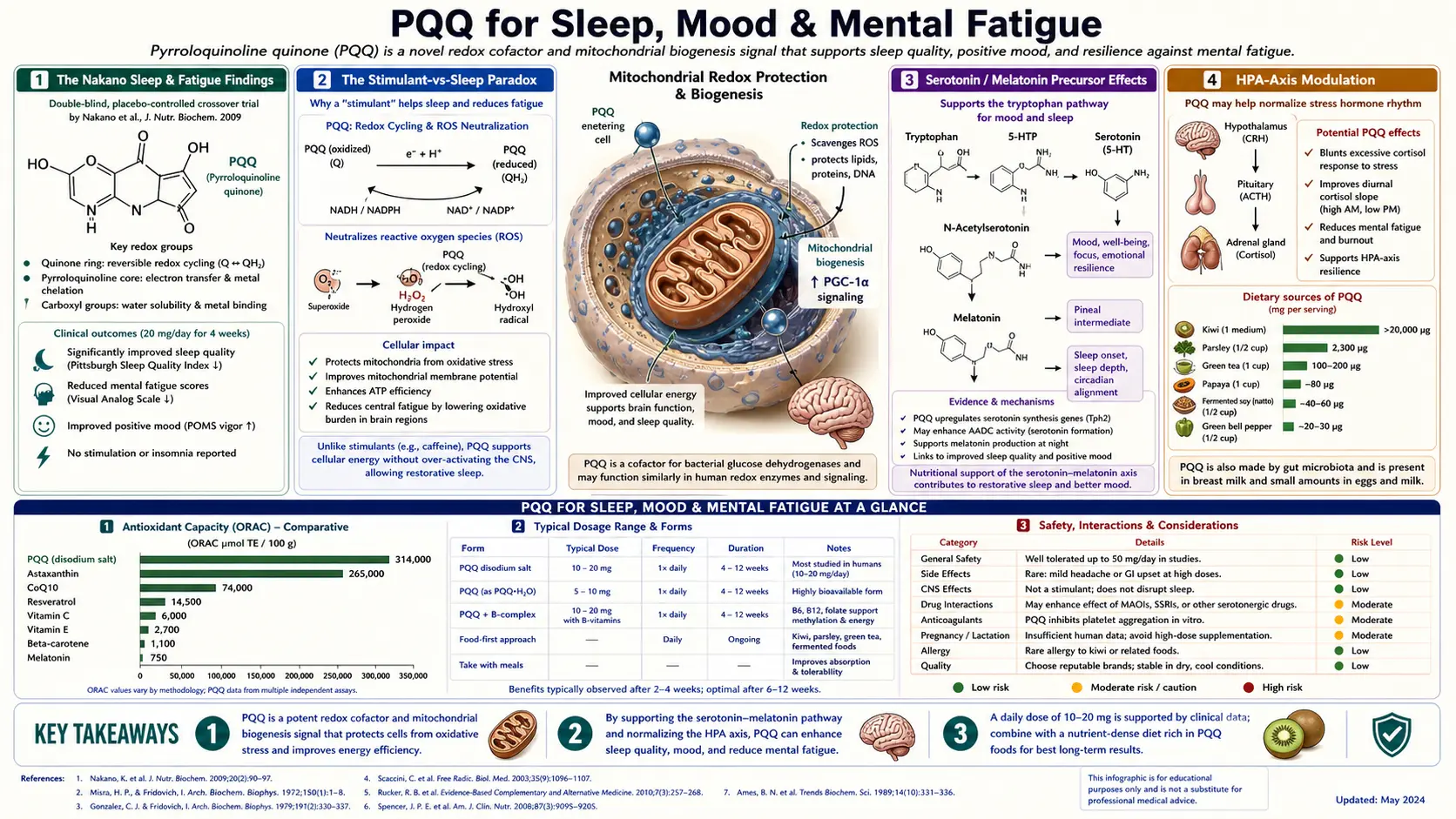
The sleep, mood and fatigue data on PQQ come mainly from one small study without a placebo group: in Nakano et al. 2012, 17 adults took 20 mg/day for 8 weeks and reported better mood, sleep and fatigue scores afterwards. Without a placebo group, those changes cannot be separated from expectation effects. Proposed explanations — mitochondrial support in sleep-regulating brain areas, effects on serotonin and melatonin, or on the stress-hormone axis — have not been tested in people, and no randomized trial of PQQ has been done in chronic fatigue syndrome, fibromyalgia or long COVID.
Table of Contents
- The Nakano 2012 Sleep & Fatigue Study
- Is PQQ a Stimulant?
- Serotonin / Melatonin: A Hypothesis
- Cortisol and the HPA Axis
- What Is Known About Dose Timing
- Magnesium and Sleep: A Separate Literature
- Chronic Fatigue & Brain Fog: What Has Been Studied
- Post-Viral Fatigue Syndromes
- Mental Fatigue
- Doses Used in Studies
- Safety Findings and Limits of the Evidence
- Key Research Papers
- Connections
- Featured Videos
The Nakano 2012 Sleep & Fatigue Study
The most direct sleep and fatigue data on PQQ come from Nakano M, Yamamoto T, Okamura H, Tsuda A and Kowatari Y, "Effects of oral supplementation with pyrroloquinoline quinone on stress, fatigue, and sleep," published in 2012 in Functional Foods in Health and Disease, a journal not indexed in PubMed. The abstract does not state the funding; the first author, Masahiko Nakano, is listed on other PQQ papers as working in a PQQ manufacturer's research laboratory.
Design
- Population: 17 adults
- Intervention: 20 mg/day PQQ
- Duration: 8 weeks
- Design: open-label — everyone took PQQ and knew it; there was no placebo group
Reported results
- All six measures on a mood questionnaire — vigor, fatigue, tension-anxiety, depression, anger-hostility and confusion — were significantly improved after 8 weeks
- Quality-of-life, appetite, sleep and pain scores also improved
- Sleep questionnaires showed improvements in sleepiness on waking, sleep onset and maintenance, and sleep duration
- The sleep changes correlated with the cortisol awakening response (the rise in cortisol after waking)
Without a placebo group, improvements of this kind cannot be separated from expectation effects, regression to the mean or seasonal change. The cognition trials described in the Cognition deep-dive did not report sleep outcomes, so this finding has not been tested in a placebo-controlled trial.
Is PQQ a Stimulant?
PQQ is often described in marketing and online writing as having a mild stimulant or alertness effect. No study cited on this page measured alertness after a dose, and the published trials did not report stimulant-like side effects. The open-label Nakano 2012 study reported better sleep, not worse, over 8 weeks.
The CREB → PGC-1α signalling that PQQ triggers in cultured cells (Chowanadisai et al. 2010) is a gene-expression response, not a stimulant mechanism like caffeine's blocking of adenosine receptors. Whether PQQ has any acute effect on alertness in people is unknown.
Serotonin / Melatonin: A Hypothesis
One proposed explanation for the sleep findings involves the pathway that turns dietary tryptophan into serotonin and then melatonin:
Dietary tryptophan → 5-hydroxytryptophan (5-HTP) → serotonin (5-HT) → N-acetylserotonin → melatonin.
The conversion of tryptophan to 5-HTP uses tryptophan hydroxylase, an enzyme that needs tetrahydrobiopterin; the conversion of serotonin to N-acetylserotonin uses acetyl-CoA; and melatonin synthesis in the pineal gland is most active in darkness. The suggestion is that better cellular energy supply or lower oxidative stress might support these steps.
No study has measured serotonin, melatonin or tetrahydrobiopterin in people taking PQQ. This is a plausibility argument from general biology, not a finding.
Cortisol and the HPA Axis
The hypothalamic-pituitary-adrenal (HPA) axis controls cortisol, which normally peaks soon after waking and falls through the day. Altered daily cortisol patterns have been reported in research on chronic fatigue, depression and other conditions.
The only cortisol measurement in the PQQ research cited here is from the open-label Nakano 2012 study, which reported that the sleep changes correlated with the cortisol awakening response. No placebo-controlled trial has measured cortisol curves with PQQ. Ideas that PQQ supports mitochondria in hypothalamic, pituitary or adrenal cells are hypotheses that have not been tested.
See Adrenal Fatigue for the broader topic.
What Is Known About Dose Timing
Supplement guides often describe taking PQQ in the morning. No trial cited on this page compared morning with evening doses, and the trial abstracts do not state a time of day.
No human half-life for PQQ is cited here. The best-known absorption data come from mice: in Smidt et al. 1991, about 62% (range 19-89%) of an oral dose of radiolabelled PQQ was absorbed, about 81% of the absorbed dose was excreted by the kidneys within 24 hours, and skin and kidney were the only tissues retaining significant amounts at 24 hours. The European Food Safety Authority noted in 2017 that information on the absorption, distribution, metabolism and excretion of PQQ in animals and humans is limited.
Magnesium and Sleep: A Separate Literature
PQQ is sometimes discussed alongside magnesium in writing on sleep. Magnesium has its own research on sleep, covered on the magnesium and sleep page. Magnesium is also bound to ATP inside cells. No trial has tested PQQ and magnesium together, so any combined effect on sleep is unknown.
Chronic Fatigue & Brain Fog: What Has Been Studied
Chronic fatigue and brain fog have many possible causes, including thyroid disease, anaemia, sleep apnoea, depression, infections and autoimmune disease. Mitochondrial abnormalities have been reported in research on chronic fatigue syndrome and fibromyalgia, and PQQ appears in narrative reviews of mitochondrial nutrients for these conditions.
No randomized trial of PQQ alone in chronic fatigue syndrome, fibromyalgia, long COVID or post-viral syndromes was found in PubMed for this page, and no trial has tested PQQ in multi-nutrient combinations for these conditions. In ME/CFS, research describes post-exertional malaise — a worsening of symptoms after exertion — as a defining feature.
For brain fog, the PQQ trials in healthy adults measured cognitive test scores (see the Cognition deep-dive), not brain fog as a symptom.
Post-Viral Fatigue Syndromes
Long COVID, fatigue after Epstein-Barr virus infection and other post-infectious fatigue states share features with ME/CFS, and research groups have reported mitochondrial and oxidative-stress abnormalities in some of these populations.
Because PQQ raised PGC-1α in cell studies and in one small exercise trial in healthy men (Hwang et al. 2020), it has been proposed for post-viral fatigue. Whether PQQ changes any outcome in post-viral fatigue has not been tested in a randomized trial.
For long COVID, the Methylene Blue and Long-COVID article covers a different mitochondrial compound.
Mental Fatigue
Mental fatigue — cognitive effort feeling progressively harder during sustained work — is studied separately from sleepiness. The proposed link to PQQ is energy supply at synapses, which has not been measured in people taking PQQ.
The open-label Nakano 2012 study reported lower fatigue scores on a mood questionnaire after 8 weeks. No placebo-controlled trial of PQQ has used mental fatigue as an outcome. Creatine has its own separate research on cognitive performance under sustained effort and sleep deprivation; no trial has tested it with PQQ.
Doses Used in Studies
- Sleep, mood and fatigue (open-label): 20 mg/day for 8 weeks (Nakano 2012)
- Cognition trials: 20 mg/day for 12 weeks (Itoh 2016, Nakano 2016, Tamakoshi 2023); 21.5 mg/day for 12 weeks (Shiojima 2022)
- Exercise and PGC-1α: 20 mg/day for 6 weeks (Hwang 2020)
No trial compared doses or times of day, and none followed people beyond 12 weeks. The European Food Safety Authority's 2017 safety assessment covered up to 20 mg/day in food supplements for healthy adults, excluding pregnant and breastfeeding women.
Safety Findings and Limits of the Evidence
- Weak sleep evidence — the sleep findings come from one 17-person open-label study; no placebo-controlled sleep trial has been published.
- Other causes of poor sleep and fatigue — sleep apnoea, restless legs, insomnia, depression, iron deficiency, vitamin B12 or folate deficiency and thyroid disease are common causes that the PQQ studies did not address.
- Depression — PQQ has not been tested as a treatment for depression or alongside antidepressants.
- Short-term safety — the 12-week cognition trials reported no adverse events (Shiojima 2022) or no abnormal blood, urine or examination findings (Itoh 2016). These trials were small and short.
- Pregnancy and breastfeeding — supplemental PQQ has not been studied; EFSA's assessment excluded pregnant and breastfeeding women.
- Medicines and stimulants — the trials did not study interactions with medicines or with caffeine; no interaction data were found for this page.
Decisions about supplements belong with a clinician.
Key Research Papers
- Smidt CR, Unkefer CJ, Houck DR, Rucker RB (1991). Intestinal absorption and tissue distribution of [14C]pyrroloquinoline quinone in mice. Proceedings of the Society for Experimental Biology and Medicine 197:27-31 — PubMed PMID: 1850522
- Chowanadisai W, Bauerly KA, Tchaparian E, Wong A, Cortopassi GA, Rucker RB (2010). Pyrroloquinoline quinone stimulates mitochondrial biogenesis through cAMP response element-binding protein phosphorylation and increased PGC-1α expression. Journal of Biological Chemistry 285:142-52 — PubMed PMID: 19861415
- Nakano M, Yamamoto T, Okamura H, Tsuda A, Kowatari Y (2012). Effects of oral supplementation with pyrroloquinoline quinone on stress, fatigue, and sleep. Functional Foods in Health and Disease 2:307 (not indexed in PubMed) — doi:10.31989/ffhd.v2i8.81
- Harris CB, Chowanadisai W, Mishchuk DO, Satre MA, Slupsky CM, Rucker RB (2013). Dietary pyrroloquinoline quinone (PQQ) alters indicators of inflammation and mitochondrial-related metabolism in human subjects. Journal of Nutritional Biochemistry 24:2076-84 — PubMed PMID: 24231099
- Itoh Y, Hine K, Miura H, Uetake T, Nakano M, Takemura N, Sakatani K (2016). Effect of the antioxidant supplement pyrroloquinoline quinone disodium salt (BioPQQ™) on cognitive functions. Advances in Experimental Medicine and Biology 876:319-25 — PubMed PMID: 26782228
- EFSA Panel on Dietetic Products, Nutrition and Allergies (NDA); Turck D, Bresson JL, Burlingame B, et al. (2017). Safety of pyrroloquinoline quinone disodium salt as a novel food pursuant to Regulation (EC) No 258/97. EFSA Journal 15:e05058 — PubMed PMID: 32625350
- Hwang PS, Machek SB, Cardaci TD, Wilburn DT, Kim CS, Suezaki ES, Willoughby DS (2020). Effects of pyrroloquinoline quinone (PQQ) supplementation on aerobic exercise performance and indices of mitochondrial biogenesis in untrained men. Journal of the American College of Nutrition 39:547-56 — PubMed PMID: 31860387
- Shiojima Y, Takahashi M, Takahashi R, Moriyama H, Bagchi D, Bagchi M, Akanuma M (2022). Effect of dietary pyrroloquinoline quinone disodium salt on cognitive function in healthy volunteers: a randomized, double-blind, placebo-controlled, parallel-group study. Journal of the American Nutrition Association 41:796-809 (erratum: 41:855) — PubMed PMID: 34415830
PubMed Topic Searches
- PubMed: PQQ sleep / fatigue
- PubMed: PQQ mental fatigue / stress
- PubMed: mitochondrial dysfunction + brain fog
- PubMed: PQQ + post-viral fatigue
- PubMed: pineal mitochondria + melatonin
- PubMed: ME/CFS + mitochondrial dysfunction
- PubMed: long-COVID + mitochondrial dysfunction
- PubMed: fibromyalgia + mitochondrial dysfunction
- PubMed: magnesium + sleep
- PubMed: tryptophan / serotonin / melatonin / sleep
- PubMed: HPA dysregulation
- PubMed: creatine + cognitive performance
- PubMed: SCN + mitochondria + circadian
Connections
- PQQ Overview
- PQQ Benefits Hub
- PQQ for Mitochondrial Biogenesis
- PQQ for Cognition
- PQQ for NGF Synthesis
- CoQ10 (pairing)
- ALA for Mitochondria
- Methylene Blue & Long-COVID
- All Antioxidants
- Magnesium & Sleep
- Magnesium
- Creatine
- Vitamin B12
- Fatigue
- Brain Fog
- Chronic Fatigue Syndrome
- Fibromyalgia
- Adrenal Fatigue
- Post-Viral Triggers (EBV)
- Sleep Hygiene
- Longevity Protocols
- History