PQQ for Cognition, Memory & Attention
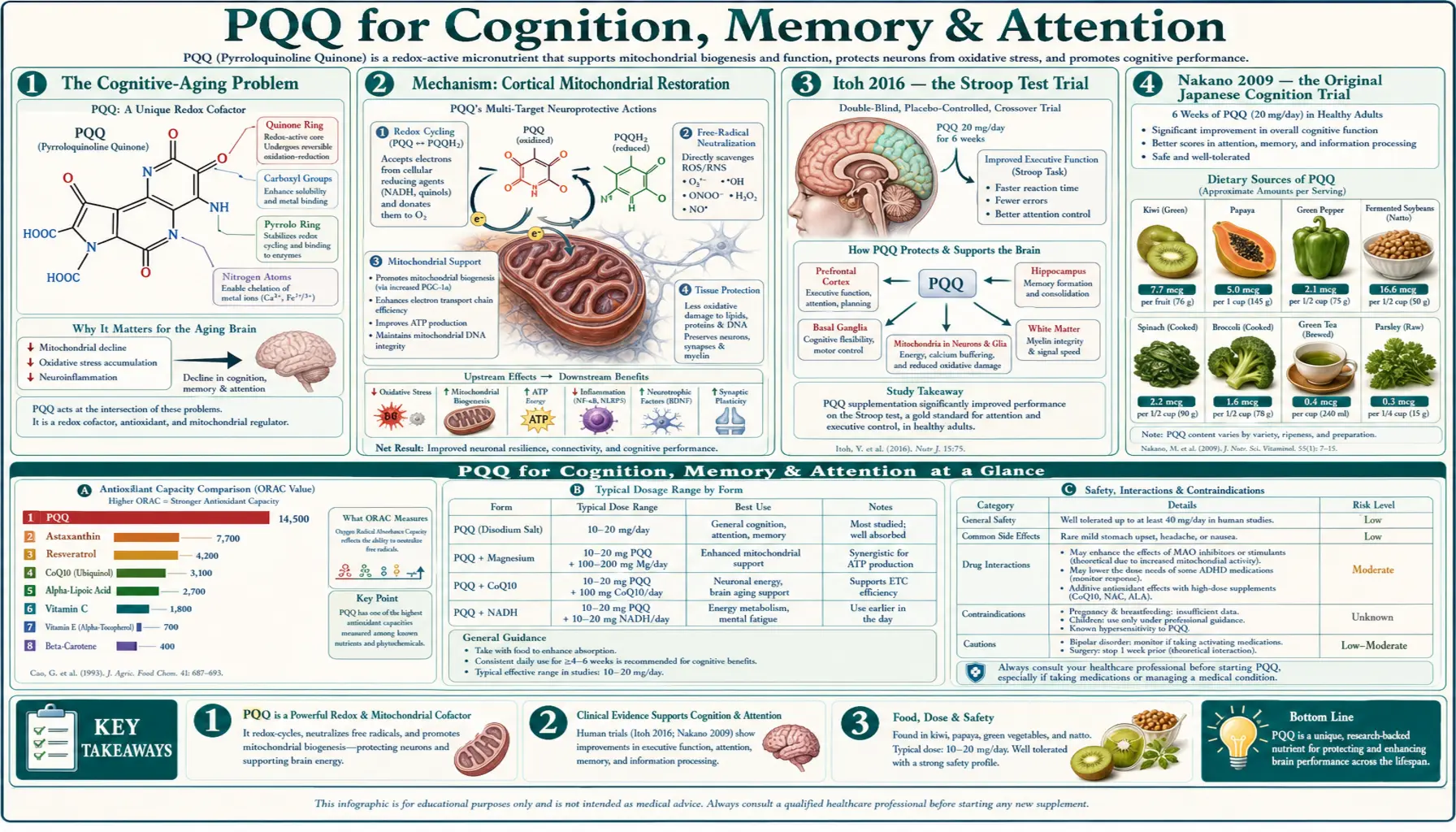
Four small placebo-controlled trials in healthy Japanese adults — Itoh 2016, Nakano 2016, Shiojima 2022 and Tamakoshi 2023 — gave about 20 mg/day of PQQ disodium salt for 12 weeks. Some cognitive test scores changed more with PQQ than with placebo, often only in subgroups, and most of the trials were run or funded by companies that make or sell the PQQ salt tested. No trial has been done in people diagnosed with mild cognitive impairment or dementia. This deep-dive walks through each trial, the proposed mitochondrial mechanism, and what the evidence does not show.
Table of Contents
- The Cognitive-Aging Problem
- Proposed Mechanism: Mitochondria in the Brain
- Itoh 2016 — the Stroop Test Trial
- Nakano 2016 — the Prefrontal Blood-Flow Trial
- Shiojima 2022 and Tamakoshi 2023
- Trials That Could Not Be Traced
- PQQ With CoQ10: What Has Been Tested
- How Large Were the Effects?
- Who Was Studied
- Doses and Durations Used in the Trials
- Safety Findings and Limits of the Evidence
- Key Research Papers
- Connections
- Featured Videos
The Cognitive-Aging Problem
Performance on timed cognitive tests — processing speed, working memory, attention — tends to fall with age, even in people with no neurological disease. Many middle-aged and older adults also report subjective forgetfulness: forgetting names, losing track of conversations, walking into a room and forgetting why. Two of the PQQ trials below recruited people of this kind, and the others recruited healthy adults without any cognitive diagnosis.
Mitochondrial changes in ageing brain cells are one of several proposed contributors to this decline, and that is the reason mitochondrial compounds such as PQQ have been tested. The link from PQQ to brain mitochondria in people has not been measured directly; it rests on cell and animal studies.
Proposed Mechanism: Mitochondria in the Brain
The hypothesis put forward for PQQ's cognitive effects has three steps, and each has gaps:
- PQQ would need to reach the brain. Whether it crosses the blood-brain barrier well is unsettled. One group described PQQ's blood-brain-barrier permeability as insufficient in an in-vitro model and made an ester derivative to improve it (Tsukakoshi et al. 2018), while a 2024 computational and mouse study predicted notable permeability (Li et al. 2024).
- PQQ would need to switch on mitochondrial biogenesis there. The CREB → PGC-1α pathway was shown in mouse liver-derived cells in culture (Chowanadisai et al. 2010), described in the Mitochondrial Biogenesis deep-dive. It has not been measured in human brain tissue.
- More mitochondrial capacity would need to improve brain function. Synapses use a large share of the brain's energy, so better energy supply is a plausible route to better test performance, but no PQQ trial has measured it.
The trials measured outcomes at 12 weeks (and in one, also at 8 weeks), so they say nothing about how quickly any effect appears or whether it lasts after people stop.
Other proposed contributors come from laboratory work:
- Antioxidant activity in test-tube systems, where PQQ can also act as a pro-oxidant under some conditions (He et al. 2003)
- Nerve growth factor synthesis in cultured mouse astroglial cells (Murase et al. 1993; see the NGF Synthesis deep-dive)
- Reduced amyloid-beta fibril formation in test-tube experiments (Kim et al. 2010)
- Action at the NMDA receptor's redox modulatory site in cultured rat neurons (Aizenman et al. 1992)
None of these mechanisms has been shown to operate in the people who took part in the trials.
Itoh 2016 — the Stroop Test Trial
Itoh Y, Hine K, Miura H, Uetake T, Nakano M, Takemura N, Sakatani K (2016). Published in Advances in Experimental Medicine and Biology. One author was from the research laboratory of the manufacturer of the PQQ salt tested.
Design
- Population: 41 healthy older adults
- Intervention: PQQ disodium salt 20 mg/day or placebo, randomized and double-blind
- Duration: 12 weeks
- Outcomes: selective attention on the Stroop and reverse Stroop tests; visual-spatial function on a tablet test (Touch M)
Results
- On the Stroop test, the change in the interference ratio was significantly smaller in the PQQ group than in the placebo group
- On the tablet visual-spatial test, scores rose significantly only in PQQ participants with lower starting scores (initial score below 70), in a stratified analysis
- No abnormal blood or urine findings and no adverse findings on examination were reported
- A preliminary near-infrared spectroscopy measurement suggested higher prefrontal blood flow after PQQ
Interpretation
The Stroop test measures the ability to suppress an automatic response (reading a colour word) in favour of a controlled one (naming the ink colour), a function that tends to decline with age. The trial was small, the visual-spatial result came from a subgroup analysis, and the abstract does not report effect sizes. The authors concluded that PQQ may help prevent a decline in brain function in older people; an independent replication has not been published.
Nakano 2016 — the Prefrontal Blood-Flow Trial
Nakano M, Murayama Y, Hu L, Ikemoto K, Uetake T, Sakatani K (2016), also in Advances in Experimental Medicine and Biology. Authors included researchers from the manufacturer.
Design
- Population: 20 healthy adults aged 50-70
- Intervention: PQQ disodium salt 20 mg/day or placebo
- Duration: 12 weeks
- Outcomes: haemoglobin concentration and tissue oxygen saturation in the prefrontal cortex at rest, measured by time-resolved near-infrared spectroscopy
Results
- Baseline haemoglobin and total haemoglobin in the right prefrontal cortex rose significantly after PQQ, which the authors read as increased blood flow
- Falls in tissue oxygen saturation were larger in the PQQ group than in the placebo group, which the authors read as increased oxygen use
This trial measured blood flow and oxygen markers, not cognitive scores. Separately, a 2012 open-label study by Nakano and colleagues on stress, fatigue and sleep (17 people, no placebo group) is covered in the Sleep & Mood deep-dive.
Shiojima 2022 and Tamakoshi 2023
Shiojima et al. 2022 (Journal of the American Nutrition Association)
- Design: randomized, double-blind, placebo-controlled; 64 healthy adults aged 40 to under 80 who felt they had become more forgetful; 21.5 mg/day PQQ disodium salt or placebo for 12 weeks; 58 completed
- Results: the PQQ group improved more than placebo on several domains of a computerized test battery (including composite memory, verbal memory and reaction time), on a forgetfulness questionnaire and on the Japanese MMSE; no adverse events were observed
- Funding and authors: several authors were from a supplement company, and the salt tested was that company's own product
Tamakoshi et al. 2023 (Food & Function)
- Design: double-blind, placebo-controlled; adults aged 20-65; 20 mg/day for 12 weeks. The abstract does not give the number of participants
- Results: composite and verbal memory improved at 12 weeks; in an age-stratified analysis, younger adults (20-40) improved in cognitive flexibility and processing speed at 8 weeks, and older adults (41-65) in memory at 12 weeks
- Funding and authors: most authors were from the manufacturer
Trials That Could Not Be Traced
Earlier versions of this page described three further trials: a 2009 Japanese report of a 24-week trial in 71 adults, a 2018 "Korean trial" in 67 older adults, and a 2021 PQQ + CoQ10 cognition trial attributed to Kim and colleagues. None of them could be found in PubMed or Crossref, so their figures and the claims built on them have been removed. The sleep and fatigue findings once attributed to the 2009 report come from a separate 2012 open-label study of 17 people, covered in the Sleep & Mood deep-dive.
The real Baylor University trial by Hwang and colleagues (2020) was an exercise study in 23 untrained men, not a cognition trial: PGC-1α protein rose more with PQQ, while aerobic performance and body composition did not differ from placebo. It is described in the Mitochondrial Biogenesis deep-dive.
PQQ With CoQ10: What Has Been Tested
PQQ is often sold together with CoQ10, on the reasoning that PQQ may signal for more mitochondria in cell and rodent studies while CoQ10 carries electrons inside the existing electron transport chain. No trial found for this page has tested whether the combination does more for cognition than either compound alone, and no trial has compared PQQ directly with CoQ10.
How Large Were the Effects?
The trial abstracts report which test scores changed significantly, not standardized effect sizes, and the trials used different test batteries, so their results cannot be pooled into a single number. No trial has compared PQQ with exercise, with CoQ10 or with any prescription medicine. Results were mixed across tests within each trial: some scores improved, several only in subgroups (lower starting scores in Itoh 2016; age bands in Tamakoshi 2023).
The trials were small (20 to 64 people), lasted 12 weeks, and were mostly run or funded by manufacturers. Small industry-run trials with many outcomes are more likely than large independent ones to report positive results that later trials do not reproduce.
Who Was Studied
- Healthy older adults — Itoh 2016 (41 people) and Nakano 2016 (20 people aged 50-70)
- Healthy adults aged 40 to under 80 who felt more forgetful — Shiojima 2022
- Healthy adults aged 20-65 — Tamakoshi 2023
All four trials were in Japan. No trial has tested PQQ in people diagnosed with mild cognitive impairment, Alzheimer's disease or another dementia, in people with post-viral cognitive symptoms, or in people taking Alzheimer's medicines. Forgetfulness can also come from causes such as depression, thyroid disease, vitamin B12 deficiency, sleep problems or medicines, none of which these trials addressed.
Doses and Durations Used in the Trials
- Itoh 2016: 20 mg/day PQQ disodium salt for 12 weeks
- Nakano 2016: 20 mg/day for 12 weeks
- Shiojima 2022: 21.5 mg/day for 12 weeks
- Tamakoshi 2023: 20 mg/day for 12 weeks, with assessments at 8 and 12 weeks
No trial compared different doses or times of day, and none followed people for longer than 12 weeks. Product labels vary in how much PQQ they contain. The European Food Safety Authority's 2017 safety assessment covered up to 20 mg/day in food supplements for healthy adults, excluding pregnant and breastfeeding women.
Safety Findings and Limits of the Evidence
- Short-term safety — the 12-week trials reported no adverse events (Shiojima 2022) or no abnormal blood, urine or examination findings (Itoh 2016). These trials were small and short.
- Size of the effects — the reported changes were modest and inconsistent across tests; the trials do not show drug-like cognitive enhancement.
- Who funded the research — most trials were run or funded by companies that make or sell PQQ disodium salt, and independent replication is lacking.
- Dementia — PQQ has not been studied in people with Alzheimer's disease or other dementias, alone or alongside prescribed treatment.
- Medicines — the trials did not study interactions with medicines; no interaction data were found for this page.
- Pregnancy and breastfeeding — supplemental doses have not been studied; EFSA's assessment excluded pregnant and breastfeeding women.
Decisions about supplements belong with a clinician.
Key Research Papers
- Aizenman E, Hartnett KA, Zhong C, Gallop PM, Rosenberg PA (1992). Interaction of the putative essential nutrient pyrroloquinoline quinone with the N-methyl-D-aspartate receptor redox modulatory site. Journal of Neuroscience 12:2362-9 — PubMed PMID: 1318959
- Murase K, Hattori A, Kohno M, Hayashi K (1993). Stimulation of nerve growth factor synthesis/secretion in mouse astroglial cells by coenzymes. Biochemistry and Molecular Biology International 30:615-21 — PubMed PMID: 8401318
- He K, Nukada H, Urakami T, Murphy MP (2003). Antioxidant and pro-oxidant properties of pyrroloquinoline quinone (PQQ): implications for its function in biological systems. Biochemical Pharmacology 65:67-74 — PubMed PMID: 12473380
- Chowanadisai W, Bauerly KA, Tchaparian E, Wong A, Cortopassi GA, Rucker RB (2010). Pyrroloquinoline quinone stimulates mitochondrial biogenesis through cAMP response element-binding protein phosphorylation and increased PGC-1α expression. Journal of Biological Chemistry 285:142-52 — PubMed PMID: 19861415
- Kim J, Kobayashi M, Fukuda M, et al. (2010). Pyrroloquinoline quinone inhibits the fibrillation of amyloid proteins. Prion 4:26-31 — PubMed PMID: 20083898
- Nakano M, Yamamoto T, Okamura H, Tsuda A, Kowatari Y (2012). Effects of oral supplementation with pyrroloquinoline quinone on stress, fatigue, and sleep. Functional Foods in Health and Disease 2:307 (not indexed in PubMed) — doi:10.31989/ffhd.v2i8.81
- Harris CB, Chowanadisai W, Mishchuk DO, Satre MA, Slupsky CM, Rucker RB (2013). Dietary pyrroloquinoline quinone (PQQ) alters indicators of inflammation and mitochondrial-related metabolism in human subjects. Journal of Nutritional Biochemistry 24:2076-84 — PubMed PMID: 24231099
- Itoh Y, Hine K, Miura H, Uetake T, Nakano M, Takemura N, Sakatani K (2016). Effect of the antioxidant supplement pyrroloquinoline quinone disodium salt (BioPQQ™) on cognitive functions. Advances in Experimental Medicine and Biology 876:319-25 — PubMed PMID: 26782228
- Nakano M, Murayama Y, Hu L, Ikemoto K, Uetake T, Sakatani K (2016). Effects of antioxidant supplements (BioPQQ™) on cerebral blood flow and oxygen metabolism in the prefrontal cortex. Advances in Experimental Medicine and Biology 923:215-22 — PubMed PMID: 27526146
- EFSA Panel on Dietetic Products, Nutrition and Allergies (NDA); Turck D, Bresson JL, Burlingame B, et al. (2017). Safety of pyrroloquinoline quinone disodium salt as a novel food pursuant to Regulation (EC) No 258/97. EFSA Journal 15:e05058 — PubMed PMID: 32625350
- Tsukakoshi K, Yoshida W, Kobayashi M, et al. (2018). Esterification of PQQ enhances blood-brain barrier permeability and inhibitory activity against amyloidogenic protein fibril formation. ACS Chemical Neuroscience 9:2898-903 — PubMed PMID: 30074759
- Hwang PS, Machek SB, Cardaci TD, Wilburn DT, Kim CS, Suezaki ES, Willoughby DS (2020). Effects of pyrroloquinoline quinone (PQQ) supplementation on aerobic exercise performance and indices of mitochondrial biogenesis in untrained men. Journal of the American College of Nutrition 39:547-56 — PubMed PMID: 31860387
- Shiojima Y, Takahashi M, Takahashi R, Moriyama H, Bagchi D, Bagchi M, Akanuma M (2022). Effect of dietary pyrroloquinoline quinone disodium salt on cognitive function in healthy volunteers: a randomized, double-blind, placebo-controlled, parallel-group study. Journal of the American Nutrition Association 41:796-809 (erratum: 41:855) — PubMed PMID: 34415830
- Tamakoshi M, Suzuki T, Nishihara E, Nakamura S, Ikemoto K (2023). Pyrroloquinoline quinone disodium salt improves brain function in both younger and older adults. Food & Function 14:2496-501 — PubMed PMID: 36807425
- Li X, Sun Y, Zhou Z, et al. (2024). Deep learning-driven exploration of pyrroloquinoline quinone neuroprotective activity in Alzheimer's disease. Advanced Science 11:e2308970 — PubMed PMID: 38454653
PubMed Topic Searches
- PubMed: PQQ cognition / memory
- PubMed: PQQ attention / working memory
- PubMed: PQQ + CoQ10 combination cognitive
- PubMed: mitochondrial biogenesis + cognitive aging
- PubMed: PQQ disodium salt clinical trials
- PubMed: cortical mitochondria + cognitive aging
- PubMed: CoQ10 cognition meta-analyses
- PubMed: aerobic exercise cognition meta-analyses
- PubMed: Stroop test, prefrontal cortex and aging
- PubMed: d-ROMs oxidative-stress biomarker
- PubMed: donepezil / memantine meta-analyses
Connections
- PQQ Overview
- PQQ Benefits Hub
- PQQ for Mitochondrial Biogenesis
- PQQ for Sleep & Mood
- PQQ for NGF Synthesis
- CoQ10 (cognitive pairing)
- ALA for Neuroprotection
- NAD+ & NMN
- Methylene Blue
- All Antioxidants
- Lion's Mane Mushroom
- Creatine
- Vitamin B12
- Methionine
- Brain Fog
- Fatigue
- Alzheimer's Disease
- Chronic Fatigue Syndrome
- Longevity Protocols
- Natto (Food Source)
- History