Methylene Blue for Cognitive Enhancement and ADHD: Evidence and Off-Label Use
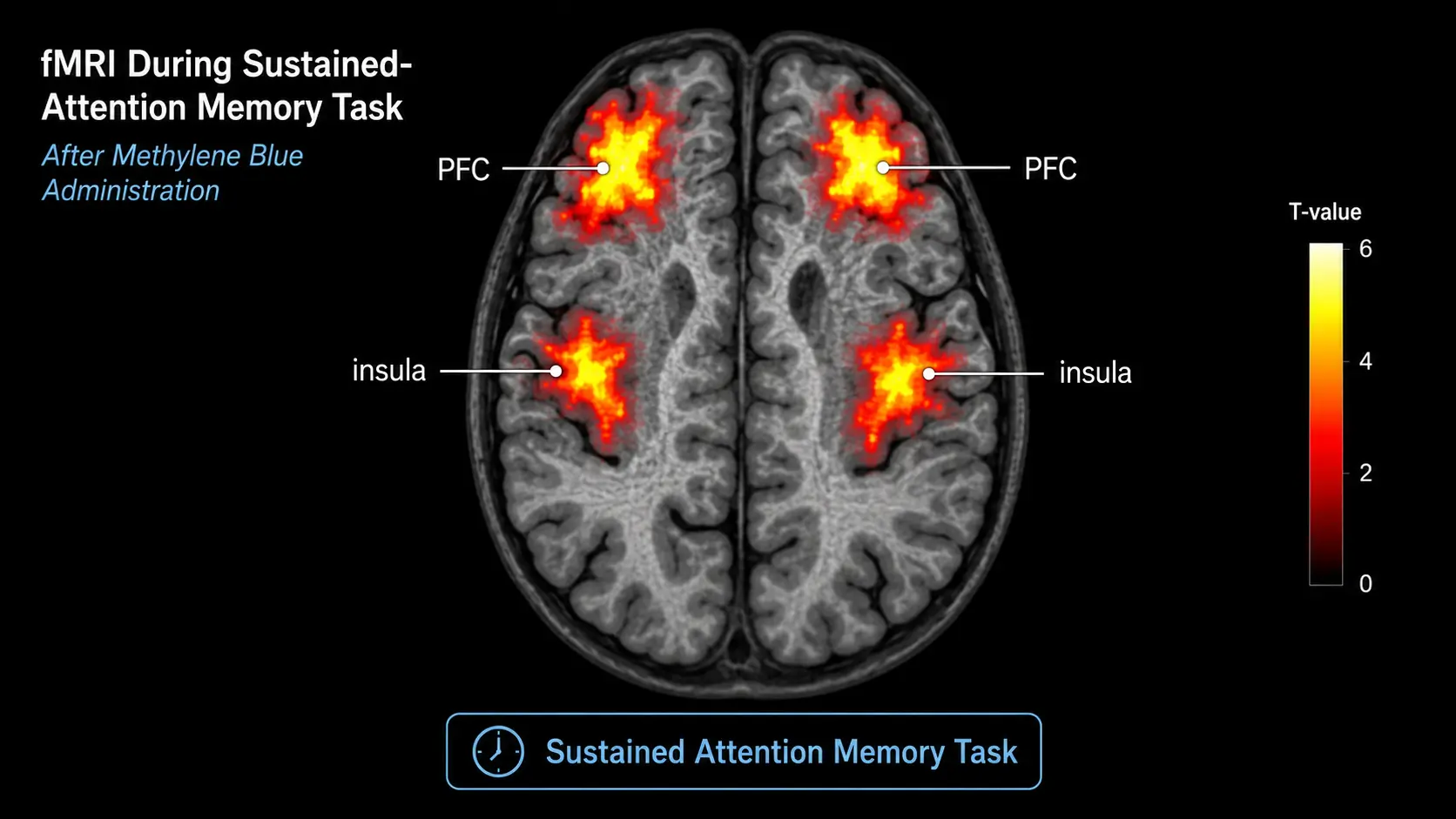
Cognitive enhancement is the off-label use behind much of the recent interest in methylene blue. The premise is that a molecule that, in laboratory studies, can carry electrons in the mitochondrial respiratory chain might also affect attention and memory. The evidence is uneven: the mechanism comes mostly from cell and animal studies, the human evidence in healthy adults comes from small single-dose imaging studies, and no trial has tested methylene blue for ADHD. Its only use approved by the US Food and Drug Administration is the treatment of acquired methemoglobinemia with methylene blue injection.
Table of Contents
The Rodriguez 2016 fMRI Trial
The most-cited human cognitive study is Rodriguez et al. 2016, published in Radiology. In this randomized, double-blind, placebo-controlled trial, 26 healthy adults aged 22 to 62 had functional MRI during a sustained-attention task (a psychomotor vigilance task) and a short-term memory task, before and one hour after a single low oral dose of methylene blue or placebo. Methylene blue increased the MRI response in the bilateral insular cortex during the sustained-attention task and in prefrontal, parietal and occipital cortex during the memory task, and was associated with a 7% increase in correct responses during memory retrieval (Rodriguez 2016). A related study by the same group reported reduced blood flow in a task-related network and stronger resting-state connectivity after a single low dose (Rodriguez 2017).
The limits follow from the design: a small sample, one dose, healthy volunteers, and outcomes measured one hour after dosing. The study shows a short-term change in brain activity and in one memory measure; it does not show a lasting benefit or a benefit in any disease.
Animal Memory Evidence
Most of the memory evidence comes from rats. Findings from the studies cited on this page:
- In normal rats, a low dose (1 mg/kg) increased brain cytochrome c oxidation 24 hours after injection, and daily post-training injections improved spatial memory retention in a baited holeboard maze (Callaway 2004).
- In rats, 4 mg/kg improved behavioural habituation and object-recognition memory; doses of 1–10 mg/kg did not change locomotion or feeding, while 50–100 mg/kg reduced wheel running; low concentrations increased brain oxygen consumption (Riha 2005).
- The same authors summarize earlier work in which methylene blue given after training improved memory retention in avoidance and appetitive tasks and restored spatial memory impaired by an inhibitor of cytochrome oxidase (Riha 2005).
- In rats with permanently reduced blood flow to the brain (bilateral carotid occlusion), daily methylene blue (4 mg/kg) for one month lessened learning and memory deficits in a visual water task (Auchter 2014).
The authors link these memory effects to increased brain oxygen consumption and cytochrome oxidase activity (Callaway 2004; Riha 2005). They are animal findings; how far they carry over to people has not been established. The proposed mechanism is described on the Mitochondrial Mechanism page.
Dose-Response for Cognition
Reviews by Gonzalez-Lima’s group describe methylene blue as showing a hormetic dose-response — “opposite effects at low and high doses” — in the mostly animal and cell studies they reviewed (Rojas 2012; Bruchey and Gonzalez-Lima 2008). In the rat studies above, memory effects were reported at low doses, and the highest doses tested reduced activity (Callaway 2004; Riha 2005).
No human study has mapped a dose-response for cognition: the Rodriguez trial tested one low dose. The US label for methylene blue injection records the harms of large intravenous doses; label and trial doses are compared on the Dosing Guide page.
Brain Fog: What Has Been Studied
“Brain fog” is a lay term for impaired focus, slow recall and reduced mental clarity reported with many conditions, including post-viral illness, sleep loss, thyroid disease and depression. There is no biomarker for it. None of the trials cited on this page tested methylene blue for brain fog; the interest rests on the mitochondrial mechanism described in laboratory studies.
For details on brain fog as a clinical syndrome, see the Brain Fog page.
ADHD and Methylene Blue
Mitochondrial dysfunction has been proposed as a possible contributor to ADHD. A systematic review of mitochondrial genetics found 10 studies reporting mitochondrial genetic variation in ADHD — increased mitochondrial DNA copy number, single-nucleotide polymorphisms and haplogroup associations — and noted that the literature on the hypothesis is limited (Giannoulis 2024). An early PET study found 8.1% lower global brain glucose metabolism in 25 adults with childhood-onset hyperactivity than in 50 controls (Zametkin 1990). These findings are the background to informal interest in methylene blue for ADHD. What the record shows:
- No published trial — as of October 2026, a PubMed search finds no clinical trial of methylene blue in ADHD.
- Stimulant interactions — the prescribing information for lisdexamfetamine contraindicates it in people taking a monoamine oxidase inhibitor (MAOI) or within 14 days of stopping one, naming intravenous methylene blue, because of an increased risk of hypertensive crisis. The prescribing information for methylphenidate contraindicates use with an MAOI or within 14 days of one, without naming methylene blue.
- Antidepressants — the methylene blue injection label carries a boxed warning that it may cause serious or fatal serotonin syndrome with SSRIs, SNRIs, MAOIs and opioids.
The case for methylene blue in ADHD is therefore mechanistic only: there are no human trial results to report.
Post-Viral Cognitive Symptoms
Post-viral cognitive symptoms, including those after COVID-19, have been proposed to involve mitochondrial dysfunction, which is the reasoning behind interest in methylene blue. None of the trials cited on this page tested methylene blue for post-COVID cognitive symptoms. See the Long COVID page for the studies that exist.
Aging and Mild Cognitive Impairment
The research relevant to ageing and mild cognitive impairment:
- In rats with chronically reduced blood flow to the brain, methylene blue lessened learning and memory deficits; the authors suggest it may be beneficial for conditions involving reduced brain blood flow, such as mild cognitive impairment, vascular dementia and Alzheimer’s disease (Auchter 2014).
- An exploratory phase 2 trial of methylthioninium chloride (methylene blue itself) in 321 people with mild or moderate Alzheimer’s disease reported benefits at the 138 mg/day dose — on the ADAS-cog scale in moderate disease at 24 weeks, and on a regional cerebral blood flow measure in mild disease; delivery of the highest dose was impaired by absorption limits (Wischik 2015).
- The phase 3 programme then used LMTM (leuco-methylthioninium, also called hydromethylthionine), a stabilized reduced form of the same molecule. TRx-237-015 (891 people) showed no benefit on its co-primary outcomes at either higher dose (Gauthier 2016). TRx-237-005 (800 people) revised its analysis plan before unblinding to compare non-randomized subgroups taking LMTM as their only Alzheimer’s medicine; those revised analyses were significant, and the authors stated that a further suitably randomized trial is required (Wilcock 2018). LUCIDITY (598 people with mild cognitive impairment or mild to moderate Alzheimer’s disease) could not show differences on its co-primary endpoints at 52 weeks; the authors report differences in the mild cognitive impairment group between early- and delayed-start treatment at 78 and 104 weeks (Wischik 2026).
In none of the three phase 3 trials did a randomized comparison on the co-primary clinical outcomes show a benefit. The label’s boxed warning covers SSRIs, SNRIs, MAOIs and opioids, and the label contraindicates methylene blue in G6PD deficiency because of the risk of hemolytic anemia.
What the Evidence Does and Does Not Show
What the studies cited on this page report:
- In 26 healthy adults, a single low oral dose increased MRI activity during attention and memory tasks and was associated with a 7% increase in correct memory-retrieval responses one hour later (Rodriguez 2016).
- In rats, low doses improved memory retention (Callaway 2004; Riha 2005; Auchter 2014).
- In 37 people with bipolar disorder taking lamotrigine, a 195 mg dose improved residual depression and anxiety compared with a 15 mg dose, with no significant effect on cognitive symptoms (Alda 2017).
- On the label, discolored urine was reported in 74% and skin discoloration in 13% of 82 healthy adults given 2 mg/kg intravenously.
What has not been shown:
- An effect of repeated dosing on cognition in healthy adults — none of the trials cited here tested it.
- Any result in ADHD — no trial has been published.
- A benefit in Alzheimer’s disease in a randomized comparison on the co-primary outcomes of a phase 3 trial (Gauthier 2016; Wilcock 2018; Wischik 2026).
The label’s warnings — serotonin syndrome with serotonergic drugs and opioids, and hemolysis in G6PD deficiency — are covered on the Drug Interactions and Methemoglobinemia and G6PD Deficiency pages; pharmaceutical and industrial grades are compared on the Pharmaceutical Grade page.
Key Research Papers
- Rodriguez P, Zhou W, Barrett DW, et al. (2016). Multimodal randomized functional MR imaging of the effects of methylene blue in the human brain. Radiology 281(2):516–526 — PubMed PMID: 27351678
- Rodriguez P, Singh AP, Malloy KE, et al. (2017). Methylene blue modulates functional connectivity in the human brain. Brain Imaging and Behavior 11(3):640–648 — PubMed PMID: 26961091
- Callaway NL, Riha PD, Bruchey AK, Munshi Z, Gonzalez-Lima F (2004). Methylene blue improves brain oxidative metabolism and memory retention in rats. Pharmacology Biochemistry and Behavior 77(1):175–81 (rat study) — PubMed PMID: 14724055
- Riha PD, Bruchey AK, Echevarria DJ, Gonzalez-Lima F (2005). Memory facilitation by methylene blue: dose-dependent effect on behavior and brain oxygen consumption. European Journal of Pharmacology 511(2–3):151–8 (rat study) — PubMed PMID: 15792783
- Auchter A, Williams J, Barksdale B, Monfils MH, Gonzalez-Lima F (2014). Therapeutic benefits of methylene blue on cognitive impairment during chronic cerebral hypoperfusion. Journal of Alzheimer’s Disease 42 Suppl 4:S525–35 (rat study) — PubMed PMID: 25079810
- Rojas JC, Bruchey AK, Gonzalez-Lima F (2012). Neurometabolic mechanisms for memory enhancement and neuroprotection of methylene blue. Progress in Neurobiology 96(1):32–45 (review) — PubMed PMID: 22067440
- Bruchey AK, Gonzalez-Lima F (2008). Behavioral, physiological and biochemical hormetic responses to the autoxidizable dye methylene blue. American Journal of Pharmacology and Toxicology 3(1):72–79 (review) — PubMed PMID: 20463863
- Wischik CM, Staff RT, Wischik DJ, et al. (2015). Tau aggregation inhibitor therapy: an exploratory phase 2 study in mild or moderate Alzheimer’s disease. Journal of Alzheimer’s Disease 44(2):705–20 — PubMed PMID: 25550228
- Gauthier S, Feldman HH, Schneider LS, et al. (2016). Efficacy and safety of tau-aggregation inhibitor therapy in patients with mild or moderate Alzheimer’s disease: a randomised, controlled, double-blind, parallel-arm, phase 3 trial. Lancet 388(10062):2873–2884 (TRx-237-015) — PubMed PMID: 27863809
- Wilcock GK, Gauthier S, Frisoni GB, et al. (2018). Potential of low dose leuco-methylthioninium bis(hydromethanesulphonate) (LMTM) monotherapy for treatment of mild Alzheimer’s disease: cohort analysis as modified primary outcome in a phase III clinical trial. Journal of Alzheimer’s Disease 61(1):435–457 (TRx-237-005) — PubMed PMID: 29154277
- Wischik CM, Stefanacci R, Bentham P, et al. (2026). Clinical, imaging and blood biomarker outcomes in a phase 3 clinical trial of tau aggregation inhibitor hydromethylthionine mesylate in mild cognitive impairment and mild to moderate dementia due to Alzheimer’s disease. Journal of Prevention of Alzheimer’s Disease 13(3):100480 (LUCIDITY, TRx-237-039) — PubMed PMID: 41570392
- Alda M, McKinnon M, Blagdon R, et al. (2017). Methylene blue treatment for residual symptoms of bipolar disorder: randomised crossover study. British Journal of Psychiatry 210(1):54–60 — PubMed PMID: 27284082
- Giannoulis SV, Müller D, Kennedy JL, Gonçalves V (2024). Systematic review of mitochondrial genetic variation in attention-deficit/hyperactivity disorder. European Child & Adolescent Psychiatry 33(6):1675–1685 (systematic review) — PubMed PMID: 35796884
- Zametkin AJ, Nordahl TE, Gross M, et al. (1990). Cerebral glucose metabolism in adults with hyperactivity of childhood onset. New England Journal of Medicine 323(20):1361–6 — PubMed PMID: 2233902
- U.S. Food and Drug Administration, Drugs@FDA. Methylene blue injection, 5 mg/mL, for intravenous use: prescribing information (NDA 204630), revised November 2023 — accessdata.fda.gov
- Lisdexamfetamine dimesylate capsules: prescribing information, Contraindications (DailyMed, U.S. National Library of Medicine) — dailymed.nlm.nih.gov
- Methylphenidate hydrochloride extended-release capsules: prescribing information, Contraindications (DailyMed, U.S. National Library of Medicine) — dailymed.nlm.nih.gov
PubMed Topic Searches
Connections
- Methylene Blue
- Brain Fog
- Mitochondrial Mechanism and Bioenergetics
- Methylene Blue and Long COVID
- Drug Interactions and Serotonin Syndrome
- Dosing Guide
- Depression
- ADHD
- Dementia
- NAD and NMN
- Oxidative Stress
- Creatine
- Ginkgo Biloba
- Bacopa Monnieri
- Pharmaceutical Grade vs Industrial Dye
- Longevity Protocols
- Methemoglobinemia and G6PD Deficiency
- History Ehrlich Phenothiazines
- Psychiatry