Dementia
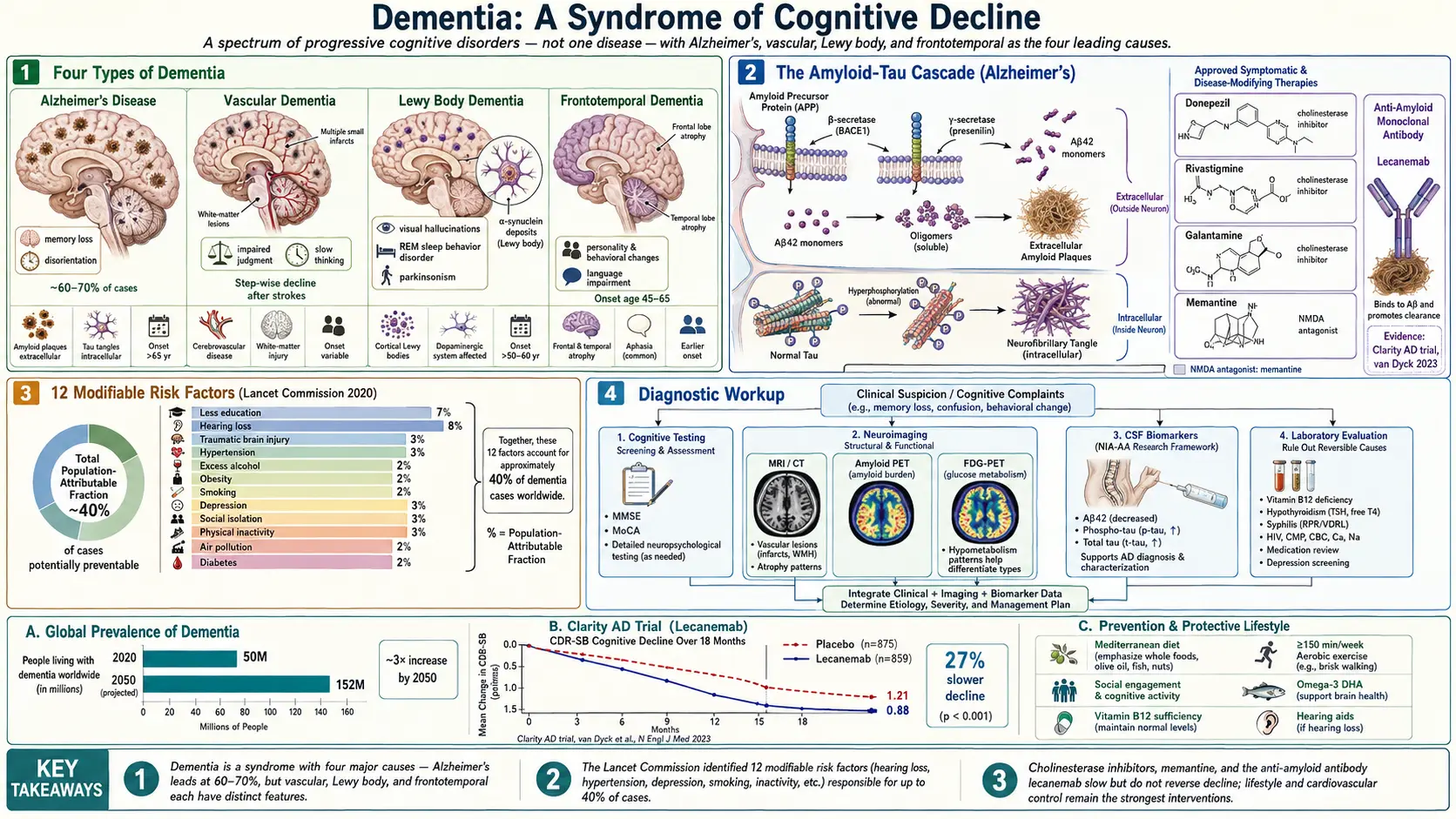
Table of Contents
- What is Dementia?
- Dementia, Normal Ageing and Mild Cognitive Impairment
- Types of Dementia
- Common Symptoms of Dementia
- Causes and Risk Factors
- Diagnosis
- Reversible Causes: Always Rule These Out First
- Treatment Options
- Supplements and Diet: Honest Evidence Tiers
- Prevention Strategies
- Living With It: Practical Help for Families
- Complications of Dementia
- Key Research Papers
- Connections
- Featured Videos
What is Dementia?
Dementia is a general term for a decline in cognitive function severe enough to interfere with daily life. It affects memory, thinking, communication, and the ability to perform everyday activities. Dementia is not a single disease but a syndrome with various underlying causes.
A syndrome, not a diagnosis
The word works like "fever" — it describes a state, not a cause. Two things must be true for it to apply: cognition has declined from that person's own previous level in more than one domain, and the decline is now interfering with everyday independence. The second half is what separates dementia from worrying about your keys.
An analogy that families find useful: think of the brain as a large organisation. Memory is the filing system, language is the communications department, executive function is the manager who plans and prioritises, and visuospatial processing is the department that reads maps. Different diseases attack different departments first. Alzheimer's typically takes out the filing system before anything else. Frontotemporal dementia removes the manager while the files stay intact. Lewy body disease disrupts the department that interprets what the eyes are seeing. Knowing which department is failing tells you the likely diagnosis, and more importantly tells the family what help is actually needed.
Because the underlying diseases differ, so do their treatments, their trajectories, and their dangers. Getting the type right is not academic — giving the wrong drug in Lewy body dementia, for instance, can cause severe harm.
Dementia, Normal Ageing and Mild Cognitive Impairment
This is the question most people arrive with, so here is the practical distinction.
Normal ageing slows retrieval. You forget a name and it surfaces twenty minutes later. You misplace your glasses and then retrace your steps and find them. You forget why you walked into a room, then remember. Crucially, you are aware of the lapses, they annoy you, and nothing in your daily life has changed.
Dementia loses the information rather than delaying it. The conversation from yesterday is not retrieved late — it never registers as having happened. Repeated questions within a single conversation, difficulty following a familiar recipe, getting lost on a route driven for years, trouble managing money that used to be easy, and, tellingly, reduced awareness of the problem itself are the changes that matter. Families usually notice before the person does, and often notice function rather than memory: bills going unpaid, a normally sociable person withdrawing, driving becoming alarming.
Mild cognitive impairment (MCI) sits in between: measurable decline on testing, but everyday independence preserved. It is worth naming because the outlook is genuinely uncertain and is often over-stated in both directions. A proportion of people with MCI progress to dementia, a proportion stay stable, and a proportion return to normal — often because a treatable contributor such as depression, sleep apnea, thyroid disease, B12 deficiency or a medication was found and fixed. MCI is therefore the point at which chasing reversible causes has the highest return.
A simple rule for when to seek assessment: when the change is affecting function, or when the people around you have noticed. Not when you forget a name.
Types of Dementia
1. Alzheimer's Disease
- Most common type of dementia.
- Symptoms: Memory loss, confusion, difficulty with language, and disorientation.
- Cause: Abnormal buildup of proteins (amyloid plaques and tau tangles) in the brain.
- The pattern: recent memory goes first while long-past memories stay vivid — which is why someone can describe their wedding day in detail but not this morning's breakfast. Disorientation for time comes early, then for place. Word-finding trouble follows. Progression is gradual over years.
- The changes in the brain begin roughly 15 to 20 years before symptoms. That long silent phase is why prevention efforts have to start in midlife, and why treatments aimed at amyloid are tested in the earliest stages. See Alzheimer's Disease.
2. Vascular Dementia
- Second most common type, caused by reduced blood flow to the brain.
- Common after a stroke or series of mini-strokes.
- Symptoms: Impaired judgment, difficulty planning, and slower thinking.
- The pattern: slowed processing and difficulty planning tend to precede frank memory loss, and decline can be stepwise — stable for months, then a sudden drop, then stable again — rather than smoothly progressive. Walking often becomes slow and unsteady early.
- This is the type whose risk factors are most clearly modifiable: blood pressure, cholesterol, diabetes, smoking, atrial fibrillation. See Vascular Dementia, Hypertension and Stroke.
- Mixed dementia is probably the commonest reality in people over 80 — Alzheimer's changes and vascular damage together. That matters because it means cardiovascular treatment is worth doing even when the diagnosis on the letter says Alzheimer's.
3. Lewy Body Dementia
- Associated with abnormal protein deposits called Lewy bodies in the brain.
- Symptoms: Visual hallucinations, sleep disturbances, and movement problems.
- Overlaps with Parkinson’s disease.
- The four features that identify it are set out in the consortium's consensus criteria: fluctuating attention and alertness (good hours and bad hours within the same day), recurrent well-formed visual hallucinations — typically people or animals, and often not frightening — parkinsonian movement changes, and REM sleep behaviour disorder, in which people physically act out dreams, sometimes for years or decades beforehand [3].
- Critical safety point: people with Lewy body dementia can react severely to antipsychotic drugs, with marked worsening of rigidity and confusion. Haloperidol in particular is avoided. If a relative has visual hallucinations and acts out dreams, say so before any sedating drug is given — in an emergency department, at a care home, before surgery.
4. Frontotemporal Dementia (FTD)
- Affects the frontal and temporal lobes of the brain.
- Symptoms: Changes in personality, behavior, and language difficulties.
- Occurs at a younger age than other types of dementia, often between 45 and 65 years old.
- Memory can be strikingly normal early on, which is why it is so often mistaken for depression, a midlife crisis, or a marital problem for years before diagnosis. What changes instead is behaviour: loss of empathy and social judgement, disinhibition, apathy mistaken for laziness, rigid new routines, and a marked new sweet tooth or overeating.
- The language form (primary progressive aphasia) presents as gradual loss of words or of the ability to construct sentences, with intact memory.
- It carries a stronger genetic component than the other types, and genetic counselling is often appropriate.
Common Symptoms of Dementia
Symptoms vary depending on the type of dementia but often include:
- Memory loss that disrupts daily life.
- Difficulty communicating or finding words.
- Impaired reasoning and judgment.
- Confusion and disorientation.
- Changes in mood and behavior, including depression and anxiety.
- Difficulty with visual and spatial abilities, such as getting lost.
- Inability to perform familiar tasks or handle complex tasks.
The early signs that are not about memory
Because "dementia" is filed under memory in most people's minds, the earliest signs are frequently missed. Watch for:
- Withdrawal from things that used to be easy — leaving a club, avoiding conversations in groups, giving up a hobby. This is often the person quietly managing around a deficit they have noticed.
- Loss of initiative (apathy) — sitting for hours, not starting anything. This is a brain symptom, not depression or laziness, and it is one of the most common and most misread changes.
- Financial slips — unopened bills, repeated payments, unusual susceptibility to scam calls. Financial vulnerability often appears before any diagnosis and does real damage.
- Repeating questions within one conversation — more revealing than forgetting a single fact.
- Personality change — new suspiciousness, uncharacteristic bluntness, loss of tact.
- Losing the thread of a story or a film, or difficulty following a multi-step recipe.
A note on why symptoms swing. Almost everyone with dementia is worse in the late afternoon and evening (often called sundowning), worse when tired, worse in unfamiliar surroundings, and dramatically worse during any physical illness. A sudden change over hours or a day or two is not the dementia progressing — it is delirium, usually from infection, dehydration, constipation, pain or a new medication, and it needs medical attention. Treating the cause usually restores the previous level.
Causes and Risk Factors
- Age: The risk increases significantly after 65 years old.
- Family history: Genetics can play a role, especially in early-onset dementia.
- Health conditions: Such as high blood pressure, diabetes, and high cholesterol.
- Lifestyle factors: Smoking, poor diet, and lack of exercise can increase risk.
- Brain injury: Traumatic brain injuries can elevate the risk of developing dementia.
- Hearing loss: One of the more consistently identified midlife risk factors — see the prevention section, where the trial evidence turns out to be more nuanced than the headlines. See Hearing Loss.
- Depression, social isolation and physical inactivity: All associated with higher risk, and all modifiable.
- Excess alcohol: Heavy long-term drinking damages the brain directly and also causes thiamine deficiency.
- Air pollution: An increasingly recognised environmental contributor.
- Atrial fibrillation: Through both overt strokes and silent ones. See Atrial Fibrillation.
The Lancet standing Commission's 2024 report gathers these into a life-course framework, grouping modifiable risk factors by the stage of life at which they matter most — education in early life; hearing, head injury, blood pressure, alcohol, obesity, smoking, depression, physical inactivity, diabetes and cholesterol in midlife; social isolation, air pollution and vision loss in later life [1]. The practical message is that the highest-leverage window is midlife, decades before any symptom appears.
On genetics. Most dementia is not directly inherited. The APOE4 variant raises risk but is neither necessary nor sufficient — plenty of people carrying it never develop dementia, and most people with Alzheimer's do not carry two copies. Truly inherited, single-gene forms are rare and usually cause disease before 65, often with several affected relatives at similar young ages. Direct-to-consumer APOE testing frequently causes distress out of proportion to what the result can tell an individual.
Diagnosis
- Medical history and physical examination: To assess symptoms and medical background.
- Cognitive and neuropsychological tests: To evaluate memory, reasoning, and problem-solving skills.
- Imaging tests: MRI or CT scans to detect brain abnormalities or damage.
- Lab tests: To rule out other conditions such as vitamin deficiencies or thyroid problems.
- Neurological examination: To evaluate brain and nervous system function.
The most valuable part of the assessment is the informant history
Someone who knows the person well should attend and should be able to speak to the clinician, ideally including some time separately. Insight is often impaired, so the account given by the person alone can be reassuring and wrong. Before the appointment, write down: when the first change was noticed and what it was; whether the decline has been gradual or stepwise; specific examples rather than adjectives ("stopped being able to use the washing machine in March", not "confused"); a full medication list including over-the-counter drugs and supplements; alcohol intake; and any family history.
What the cognitive tests do and do not tell you
Brief screening instruments — MMSE, MoCA, Mini-Cog — are useful for tracking change over time and for flagging a problem. They are not diagnostic on their own. A highly educated person can score well while having declined substantially from their own baseline, and someone with limited education, poor English, hearing loss or depression can score badly with no dementia at all. A formal neuropsychological assessment is far more informative when the picture is unclear or the person is young.
Imaging and newer tests
A structural scan (CT or preferably MRI) looks for stroke damage, tumours, bleeding and hydrocephalus, and shows the pattern of shrinkage. FDG-PET can distinguish types by the pattern of reduced brain metabolism. Amyloid PET and cerebrospinal fluid amyloid and tau measurements can confirm Alzheimer's biology, and blood-based biomarkers (notably phosphorylated tau) are moving rapidly into use. Two cautions: these tests confirm the biology, not the syndrome — a positive amyloid result in someone with normal cognition is not a diagnosis of dementia; and access, cost and interpretation vary widely.
Reversible Causes: Always Rule These Out First
A minority of people presenting with cognitive decline have something treatable. Missing it is one of the more consequential errors in this area, and the tests are cheap. Every workup should cover:
- Vitamin B12 and folate deficiency — can cause confusion, memory loss and neuropathy. Risk is raised by long-term metformin, proton-pump inhibitors, and a diet without animal foods. See Vitamin B12 and Vitamin B9 (Folate).
- Thyroid disease — an underactive thyroid classically produces slowed thinking mistaken for dementia.
- Depression — can impair concentration and memory severely enough to mimic dementia. Unlike dementia, the person typically complains loudly about their memory rather than minimising it. See Depression.
- Medications — the single biggest reversible contributor. Drugs with anticholinergic effects (older antihistamines, oxybutynin for bladder, some antidepressants, some anti-nausea drugs) impair cognition measurably, as do benzodiazepines and "Z-drug" sleeping tablets, opioids, and some anti-epileptics. A structured medication review is one of the highest-yield interventions available.
- Alcohol — both direct toxicity and thiamine deficiency.
- Obstructive sleep apnea — chronic overnight oxygen dips impair cognition, and it is treatable. See Obstructive Sleep Apnea.
- Normal pressure hydrocephalus — the classic triad of a slow, magnetic, shuffling gait, urinary incontinence and cognitive slowing. Sometimes improved by shunting, so it is worth identifying.
- Subdural haematoma — a slow bleed after a head injury that may have seemed trivial, and easy to miss without a scan.
- Uncorrected hearing and vision loss — someone who cannot hear the question often appears confused. Check the hearing aid has working batteries before concluding anything.
Treatment Options
- Medications:
- Cholinesterase inhibitors: Such as donepezil, rivastigmine, and galantamine for Alzheimer's and other dementias.
- Memantine: Helps manage moderate to severe dementia symptoms by regulating glutamate activity.
- Therapies:
- Cognitive stimulation therapy: Engages memory and thinking skills.
- Occupational therapy: Helps individuals maintain independence in daily tasks.
- Lifestyle changes:
- Regular physical activity: Supports overall brain health.
- Social engagement: Helps improve mood and cognitive function.
- Healthy diet: Emphasizing vegetables, fruit, oily fish and other whole foods.
How much do the cholinesterase inhibitors actually do?
A Cochrane review of 30 studies in 8,257 participants found donepezil produces small but consistent benefits in cognition, daily function and clinician-rated global state compared with placebo, on moderate-quality evidence [4]. "Small but real" is the honest description. It does not stop the disease, and gains are measured in months of function rather than years.
Practical points: nausea, diarrhoea, vivid dreams and a slow pulse are the common side effects, and taking the tablet in the morning rather than at bedtime often fixes the dreams. Rivastigmine comes as a skin patch, which suits people who cannot swallow tablets. Cholinesterase inhibitors are particularly useful in Lewy body dementia, where they often help the hallucinations and fluctuating attention noticeably more than they help in Alzheimer's. They have no established role in frontotemporal dementia and may worsen behaviour there.
The anti-amyloid antibodies: what the numbers mean
Lecanemab is the first treatment shown to slow decline rather than only mask symptoms, and its results deserve to be reported precisely. In the Clarity AD trial, 1,795 people with early Alzheimer's were randomized to lecanemab or placebo. At 18 months, the change on the CDR-SB scale was 1.21 with lecanemab versus 1.66 with placebo — a difference of 0.45 points on an 18-point scale. Brain amyloid fell substantially. Infusion reactions occurred in 26.4%, and amyloid-related imaging abnormalities with brain swelling or effusions in 12.6% [2].
Read plainly: this is a real, statistically robust slowing of decline, and it is modest — experts genuinely disagree about whether a 0.45-point difference is noticeable to a family. It requires fortnightly infusions, repeated MRI monitoring, applies only to early disease with confirmed amyloid, and carries a meaningful risk of brain swelling or small bleeds. It is not a cure and it does not reverse anything. Anyone considering it deserves those numbers rather than the headline.
Treating behaviour without reaching for a sedative
Agitation, aggression and distress are usually communication. The first question is always what the behaviour is for: pain that cannot be described, constipation, a full bladder, an infection, too much noise, being cold, boredom, or fear of an unfamiliar person. Solving that resolves most episodes.
Antipsychotic drugs carry a documented increase in stroke and death in people with dementia, which is why they carry regulatory warnings and are reserved for severe distress or risk of harm, at the lowest dose, for the shortest time, with a planned review date. If a relative is started on one, ask when it will be stopped — the commonest failure is that nobody ever revisits it. And remember the Lewy body caution above.
Supplements and Diet: Honest Evidence Tiers
This is a market that preys on fear, so each item is labelled with what the trials actually found.
Ginkgo biloba — tested properly, and it does not work
The GEM study followed 3,069 older adults for a median of about six years on ginkgo 120 mg twice daily or placebo. Dementia developed in 277 on ginkgo and 246 on placebo — a hazard ratio of 1.12 (95% CI 0.94–1.33), that is, no benefit and if anything a numerically higher rate. It also failed to slow progression in those who already had mild cognitive impairment [5]. This is a well-conducted, adequately sized, long trial with a clear negative answer.
B vitamins and homocysteine — promising in a specific subgroup, not established
The VITACOG trial gave B vitamins (folic acid, B6, B12) or placebo to people with mild cognitive impairment. The rate of brain shrinkage over two years was 0.76% per year on treatment versus 1.08% on placebo, and the effect was concentrated in those with raised homocysteine at baseline — where atrophy was 53% lower on treatment [6]. That is a striking result on a brain-imaging outcome in a small trial, and it has not translated into demonstrated prevention of dementia. The reasonable reading: if you have mild cognitive impairment, it is worth having B12, folate and homocysteine measured and any deficiency corrected. That is different from everyone taking B vitamins as insurance.
Vitamin E, omega-3 and the rest
Vitamin E has not prevented dementia in prevention trials, and high doses carry their own risks. Omega-3 supplements have not prevented cognitive decline in the large prevention trials, though eating oily fish is associated with lower risk in observational studies — a distinction worth holding on to. Coconut oil, "brain-boosting" nootropic blends and most branded memory supplements have no meaningful trial support. Where a genuine deficiency exists, correcting it matters; taking supplements to prevent dementia in a well-nourished person is not supported.
Food, plainly
The best-supported eating patterns here are Mediterranean-style and the closely related MIND pattern, and their evidence is largely observational, with mixed trial results. What both amount to in practice: leafy greens most days; berries; vegetables at most meals; legumes such as lentils and black beans; nuts; oily fish twice a week; extra-virgin olive oil as the main added fat; whole grains rather than refined — oats, barley and brown rice; and much less ultra-processed food, fried food and sugary drink. It is worth doing on cardiovascular grounds alone, which is not a small thing given how much dementia is vascular.
Prevention Strategies
- Maintain cardiovascular health: Managing blood pressure, cholesterol, and diabetes.
- Stay mentally active: Engaging in puzzles, reading, and other brain-stimulating activities.
- Regular physical exercise: Promotes healthy blood flow to the brain.
- Healthy diet: A balanced diet, such as the Mediterranean diet, may help reduce risk.
- Avoid smoking and limit alcohol intake.
What the trials found — including where the headlines overstated it
Blood pressure — the strongest lever, with an honest caveat. SPRINT MIND randomized 9,361 adults with hypertension to a systolic target below 120 or below 140. Probable dementia occurred in 7.2 versus 8.6 cases per 1,000 person-years — a hazard ratio of 0.83 that did not reach statistical significance. But mild cognitive impairment was significantly reduced (HR 0.81), as was the combined outcome of MCI or dementia (HR 0.85). The trial stopped early for cardiovascular benefit and had fewer dementia cases than expected, so it was likely underpowered for dementia specifically [7]. Fair summary: intensive blood-pressure control clearly reduces cognitive impairment and probably reduces dementia. See Hypertension.
Multidomain lifestyle programmes — real but small. The FINGER trial randomized 1,260 at-risk older Finns to a two-year programme of diet, exercise, cognitive training and vascular risk monitoring, or control. The intervention group did better, with a between-group difference in cognitive score change of 0.022 per year — statistically significant, and small [8]. It is genuine evidence that lifestyle change moves cognition, and it is not a dramatic effect.
Hearing aids — where the headline was wrong. The ACHIEVE trial randomized 977 older adults with hearing loss to hearing intervention or health education. Over three years, the primary analysis found no difference in cognitive decline between groups. A prespecified sensitivity analysis did find a difference between the two sub-cohorts: those recruited from an existing study who were older and at higher risk appeared to benefit, while the healthier volunteers did not [9]. So the honest position is that hearing aids may help people at higher risk, and the widely reported "48% reduction" figure came from that subgroup rather than the trial's main result. Treat hearing loss because hearing matters, and because it plausibly helps — not because prevention is proven.
The rest, briefly: regular physical activity has the most consistent observational support of any single behaviour; social engagement and education build what is often called cognitive reserve; commercial "brain training" games reliably improve your score at that game and do not generalise to everyday function; treating depression, correcting hearing and vision, avoiding head injury, and stopping smoking all belong on the list.
Living With It: Practical Help for Families
Most of what determines quality of life in dementia is not prescribed.
- Do the legal and financial work early, while the person can still participate. Power of attorney for both finances and health, a will, and a conversation about what they would want at the end. Doing this after capacity is lost is far harder, slower and more expensive, and removes the person's own voice from decisions about their life.
- Protect the money now. Financial exploitation is common and devastating. Reduce credit limits, add a trusted second signatory, block cold callers, and switch to paperless where a family member can monitor.
- Do not argue with a false belief. Correcting someone who thinks their late spouse is coming home makes them grieve again. Respond to the feeling rather than the fact, and redirect — this is the single most useful communication skill families learn, and it feels dishonest until you see it work.
- Simplify how you speak: one idea per sentence, one question at a time, closed questions rather than open ones, plenty of time to answer. Reduce competing noise — turn the television off before talking.
- Structure and familiarity help enormously. Same routine, same places for things, good lighting to reduce misperception, and a large clear clock showing the day and date.
- Address driving early and honestly. It is one of the hardest conversations and one of the most important, and it is easier while the person can still take part in the decision.
- Get help before you need it. Caregiver burnout is the most common reason for a move into residential care, and it arrives quietly. Respite, day services and carer support groups exist and are consistently under-used. Caregiver depression is common, treatable, and worth naming to your own doctor.
- Plan for hospital. Keep a one-page document listing the diagnosis, current medications, what the person can and cannot do, how they communicate pain, what calms them, and drugs to avoid — particularly the antipsychotic caution in Lewy body dementia. Hand it over on arrival.
Complications of Dementia
- Reduced quality of life: Affects daily functioning and independence.
- Increased risk of injury: Due to impaired judgment and coordination.
- Malnutrition and dehydration: Difficulty eating or forgetting to eat and drink.
- Pneumonia: Swallowing difficulties can lead to aspiration and lung infections.
- Death: Advanced dementia can result in severe health complications that contribute to mortality.
Two practical additions. Delirium — a sudden confusional state on top of the dementia — is extremely common during any illness or hospital admission, is frequently mistaken for sudden deterioration, and is largely reversible when its cause is treated. Suspect it whenever the change happened over hours or days rather than months.
And on eating in advanced dementia: swallowing difficulty is part of the late disease. The evidence does not support feeding tubes improving survival, comfort or pneumonia risk in advanced dementia, and careful hand-feeding of favourite foods, at the person's own pace, is generally the kinder and better-supported approach. That is a conversation worth having before a crisis forces it.
Key Research Papers
Historical Background
Dementia has been recognized since ancient times, but the modern understanding began with Alois Alzheimer, who in 1906 described the first case of the disease that now bears his name after examining the brain of Auguste Deter. The term "dementia" itself derives from the Latin "de" (out of) and "mens" (mind), and was used in medical literature as early as the 18th century by Philippe Pinel.
Key Research Papers
This list was rebuilt in full after an audit found that ten of the twelve DOI links previously shown here resolved to the wrong paper or to nothing at all. Every citation below was verified live against its own PubMed record — authors, journal, year and title all checked against the source.
- Livingston G, Huntley J, Liu KY, et al. Dementia prevention, intervention, and care: 2024 report of the Lancet standing Commission. Lancet. 2024;404(10452):572-628 — PubMed PMID: 39096926 · doi:10.1016/S0140-6736(24)01296-0
- van Dyck CH, Swanson CJ, Aisen P, et al. Lecanemab in Early Alzheimer's Disease. N Engl J Med. 2023;388(1):9-21 — PubMed PMID: 36449413 · doi:10.1056/NEJMoa2212948
- McKeith IG, Boeve BF, Dickson DW, et al. Diagnosis and management of dementia with Lewy bodies: Fourth consensus report of the DLB Consortium. Neurology. 2017;89(1):88-100 — PubMed PMID: 28592453 · doi:10.1212/WNL.0000000000004058
- Birks JS, Harvey RJ. Donepezil for dementia due to Alzheimer's disease. Cochrane Database Syst Rev. 2018;6(6):CD001190 — PubMed PMID: 29923184 · doi:10.1002/14651858.CD001190.pub3
- DeKosky ST, Williamson JD, Fitzpatrick AL, et al. Ginkgo biloba for prevention of dementia: a randomized controlled trial. JAMA. 2008;300(19):2253-62 — PubMed PMID: 19017911 · doi:10.1001/jama.2008.683
- Smith AD, Smith SM, de Jager CA, et al. Homocysteine-lowering by B vitamins slows the rate of accelerated brain atrophy in mild cognitive impairment: a randomized controlled trial. PLoS One. 2010;5(9):e12244 — PubMed PMID: 20838622 · doi:10.1371/journal.pone.0012244
- Williamson JD, Pajewski NM, Auchus AP, et al. Effect of Intensive vs Standard Blood Pressure Control on Probable Dementia: A Randomized Clinical Trial. JAMA. 2019;321(6):553-561 — PubMed PMID: 30688979 · doi:10.1001/jama.2018.21442
- Ngandu T, Lehtisalo J, Solomon A, et al. A 2 year multidomain intervention of diet, exercise, cognitive training, and vascular risk monitoring versus control to prevent cognitive decline in at-risk elderly people (FINGER): a randomised controlled trial. Lancet. 2015;385(9984):2255-63 — PubMed PMID: 25771249 · doi:10.1016/S0140-6736(15)60461-5
- Lin FR, Pike JR, Albert MS, et al. Hearing intervention versus health education control to reduce cognitive decline in older adults with hearing loss in the USA (ACHIEVE): a multicentre, randomised controlled trial. Lancet. 2023;402(10404):786-797 — PubMed PMID: 37478886 · doi:10.1016/S0140-6736(23)01406-X
PubMed Topic Searches
- PubMed: dementia epidemiology global
- PubMed: Alzheimer disease pathology
- PubMed: vascular dementia
- PubMed: Lewy body dementia
- PubMed: dementia prevention lifestyle
- PubMed: dementia exercise
- PubMed: dementia Mediterranean diet
- PubMed: dementia omega-3 DHA
- PubMed: dementia vitamin B12
- PubMed: dementia vitamin D
- PubMed: dementia sleep
- PubMed: dementia hearing loss
Connections
- Psychiatry
- Alzheimer's Disease
- Depression
- Vitamin B12
- Omega-3 Fatty Acids
- Insomnia
- Magnesium
- Vitamin D3
- Vitamin E
- Turmeric
- Sleep Hygiene
- Anxiety
- Stroke
- Diabetes
- Bacopa Monnieri
- Stress Management
- Creatine
- Methylene Blue
- Vitamin B9
- Hearing Loss
- Urinary Incontinence
- Vascular Dementia
- Lewy Body Dementia
- Turmeric for Brain Health and Cognition — curcumin trial evidence on memory, amyloid, and cognitive decline.
- Herbs covered on this site that discuss this condition: Sage (Salvia officinalis) · Black Turmeric (Curcuma caesia) · Ginseng (Panax ginseng) · Lemon Balm (Melissa officinalis)
- Hypertension — the strongest single lever in dementia prevention
- Atrial Fibrillation — overt and silent strokes as a route to cognitive decline
- Obstructive Sleep Apnea — a treatable, commonly missed contributor to cognitive impairment
- Dr. Bryan Ardis: Nicotine and Alzheimer’s Disease
- Parkinson's Disease
- Lion's Mane
- Ginkgo Biloba