Creatine: Energy Buffer for Muscle and Brain
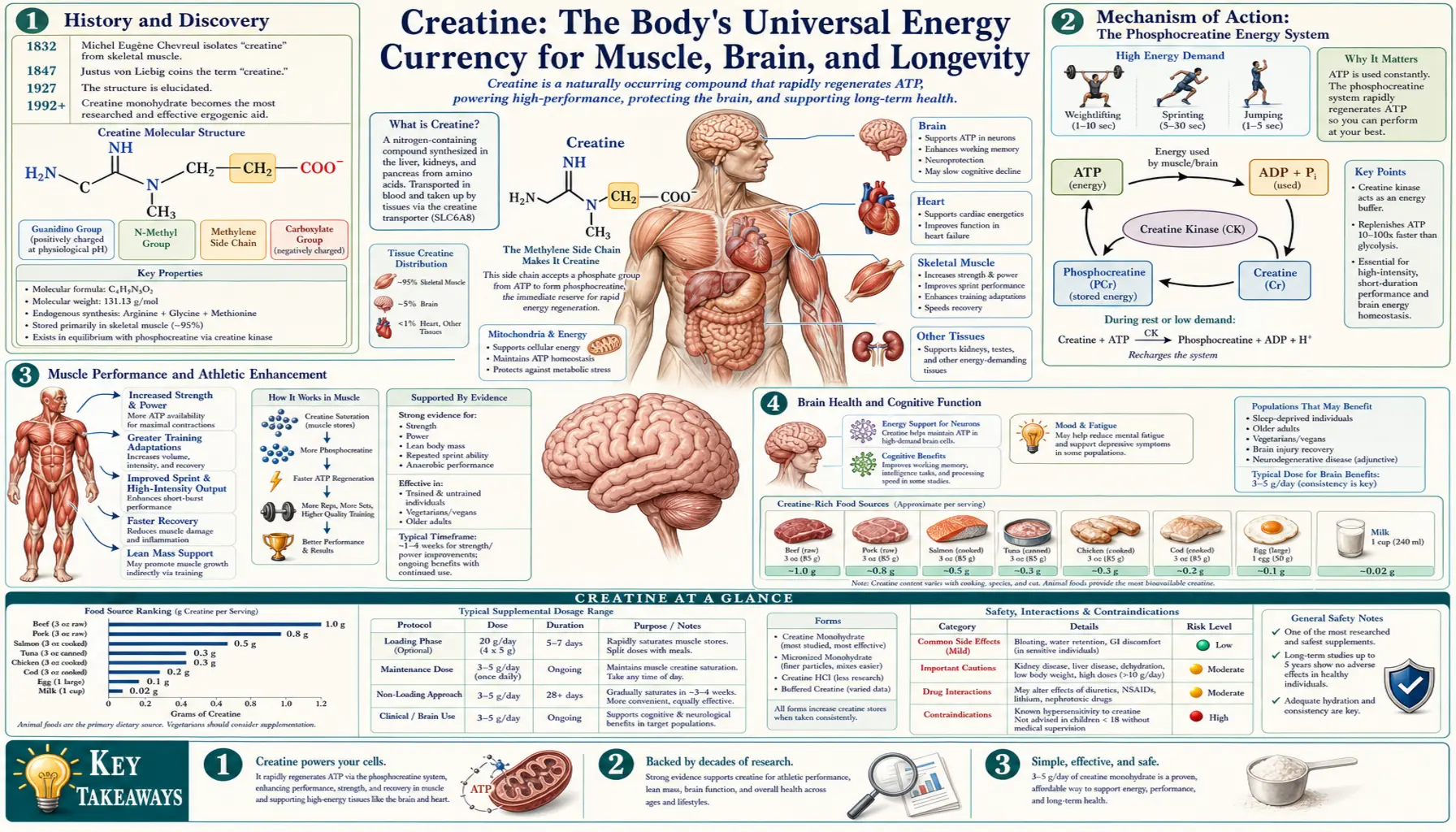
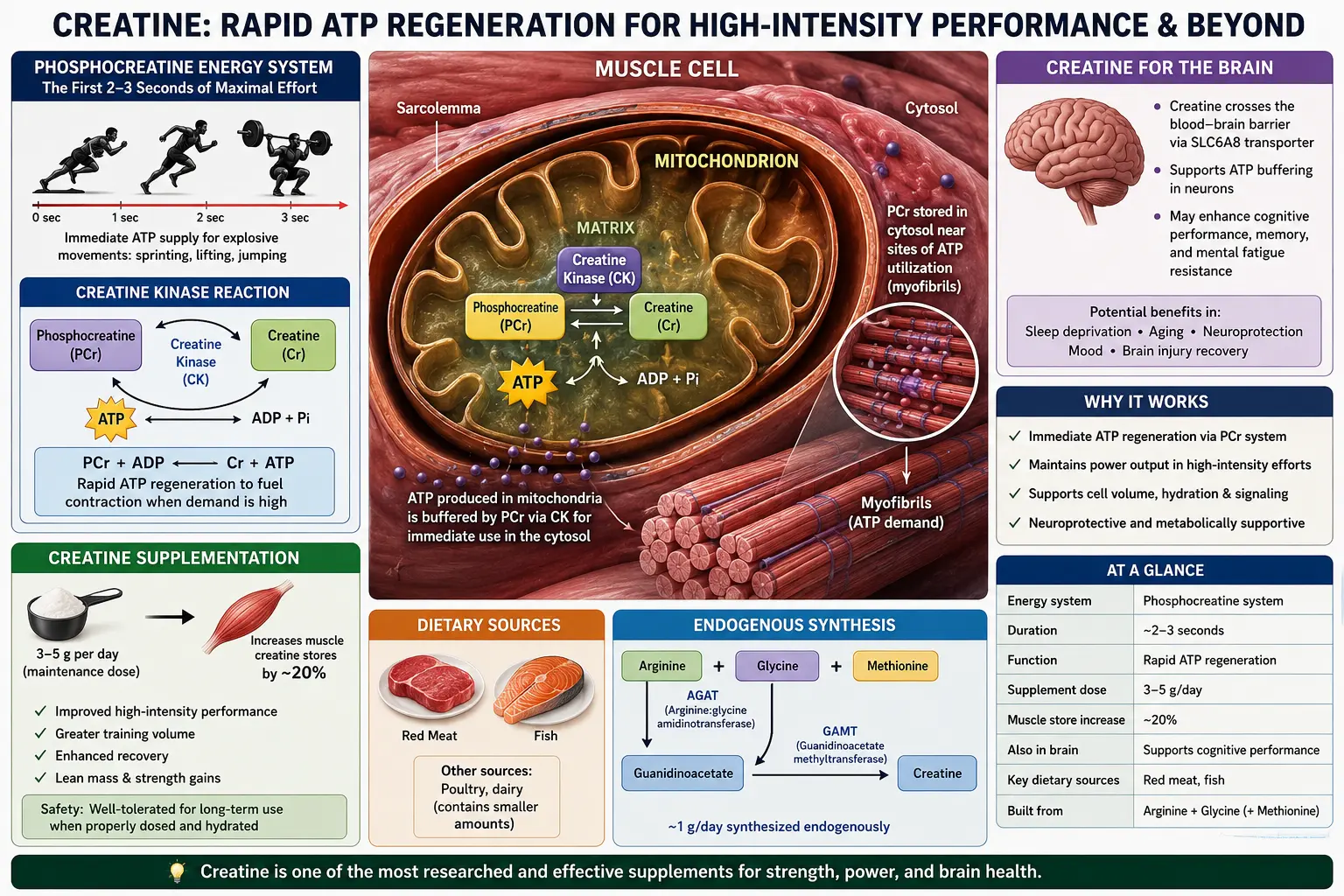
Creatine is a compound the body makes for itself and also obtains from meat and fish. According to the 2017 International Society of Sports Nutrition (ISSN) position stand, it is synthesized primarily in the liver and kidneys from the amino acids arginine and glycine, with a methyl group supplied by S-adenosylmethionine (made from methionine); about 95% of the body's creatine is in skeletal muscle, with small amounts (about 5%) in the brain and testes. Stored as phosphocreatine, it is the fastest route the cell has for regenerating ATP (adenosine triphosphate) during short, all-out efforts. The ISSN calls creatine monohydrate “the most effective ergogenic nutritional supplement currently available to athletes” for increasing high-intensity exercise capacity and lean body mass during training, and meta-analyses report small but consistent gains in strength and lean mass when it is combined with resistance training. Research on the brain, ageing, mood, blood sugar and cancer is earlier-stage: much of it comes from small trials, single-arm pilots, population surveys or animal studies, and the findings are mixed. A 2025 analysis of side effects in 685 clinical trials found no overall difference between creatine and placebo groups.
Interactive Visualization Muscle Contraction — release the calcium Expose the actin binding sites and watch myosin heads ratchet through the cross-bridge cycle to shorten the sarcomere. Launch →Table of Contents
- History and Discovery
- Mechanism of Action: The Phosphocreatine Energy System
- Muscle Strength, Lean Mass and Exercise Performance
- Brain Health and Cognitive Function
- Heart Failure Research
- Aging and Sarcopenia
- Immune Function and Cancer Research
- Blood Sugar and Type 2 Diabetes
- Women's Health
- Bone Health
- Mental Health and Depression
- Creatine Deficiency Syndromes
- Vegetarians and Vegans
- Dietary Sources
- Supplementation: Forms and Doses Used in Research
- Safety and Kidney Function
- Key Research Papers
- Connections
- Featured Videos
1. History and Discovery
Creatine was discovered in 1832 by the French chemist Michel Eugène Chevreul, who isolated it from meat and named it after the Greek word kreas, meaning meat. Its link to muscular energy emerged with the discovery of phosphocreatine in 1927, and the modern supplement era began with the 1992 muscle-loading study by Harris, Söderlund and Hultman in Sweden, which showed that oral creatine raises the creatine content of human muscle. The fuller story is told in the dedicated History article.
2. Mechanism of Action: The Phosphocreatine Energy System
Every cell runs on ATP, and muscle must regenerate ATP from ADP as fast as it is used or contraction stops. Three energy systems do this on different timescales: the phosphocreatine (phosphagen) system, which is the fastest but has a small capacity; anaerobic glycolysis, which is slower; and oxidative phosphorylation in the mitochondria, the slowest but able to run for hours.
The enzyme creatine kinase catalyzes the reversible transfer of a phosphate group from phosphocreatine to ADP, regenerating ATP without needing oxygen:
Phosphocreatine + ADP ↔ Creatine + ATP
In a muscle-biopsy study of ten 6-second maximal cycling sprints (Gaitanos 1993), the energy for the first sprint came in equal parts from phosphocreatine breakdown and anaerobic glycolysis, and phosphocreatine fell by 57% within that first 6 seconds. According to the ISSN position stand, a normal diet containing 1–2 g/day of creatine leaves muscle stores about 60–80% saturated, and supplementation raises muscle creatine and phosphocreatine by 20–40%. The research on creatine therefore concentrates on heavy lifts, sprints and repeated high-intensity efforts.
The ISSN position stand also describes the creatine kinase/phosphocreatine system as an energy shuttle: mitochondrial creatine kinase uses newly made ATP to form phosphocreatine, which diffuses into the cytosol, where cytosolic creatine kinase regenerates ATP at the sites that consume it, connecting sites of ATP production with sites of ATP use.
3. Muscle Strength, Lean Mass and Exercise Performance
A 2003 review by Kreider of about 300 studies reported that about 70% found statistically significant results. A review by Rawson and Volek (2003) in the Journal of Strength and Conditioning Research, covering 22 studies, found that the average increase in muscle strength with creatine plus resistance training was 8% greater than with placebo plus training (20% vs. 12%), and the average increase in weightlifting performance 14% greater (26% vs. 12%), while noting that the response is highly variable.
In a 12-week trial by Volek and colleagues (Medicine & Science in Sports & Exercise, 1999), 19 resistance-trained men followed periodized heavy resistance training with creatine (25 g/day for 1 week, then 5 g/day) or placebo. Bench press rose 24% with creatine vs. 16% with placebo, and squat 32% vs. 24%; fat-free mass rose 6.3% vs. 3.1%, and muscle fibre cross-sectional area increased more with creatine in type I (35% vs. 11%), type IIA (36% vs. 15%) and type IIAB (35% vs. 6%) fibres.
A 2022 meta-analysis by Delpino and colleagues in Nutrition (35 randomized trials, 1,192 participants) found that creatine increased lean body mass by 0.68 kg overall (95% CI 0.26–1.11) and by 1.10 kg (0.56–1.65) when combined with resistance training, regardless of age. Without exercise the difference was 0.03 kg (−0.65 to 0.70), not significant. Men gained 1.46 kg (0.47–2.46); the 0.29 kg gain in women (−0.43 to 1.01) was not significant. The 2021 review by Antonio and colleagues notes that lean-mass gains in short studies of about a week are likely explained by increased body water.
Two meta-analyses show where the effect is weaker. Branch’s 2003 meta-analysis of 100 placebo-controlled studies found the largest effects for repeated laboratory tasks of 30 seconds or less and concluded that creatine “does not appear to be effective in improving running and swimming performance.” A 2023 meta-analysis by Gras and colleagues (19 randomized trials, 424 people) found that VO2max rose in both groups but rose less with creatine than with placebo (effect size −0.32, 95% CI −0.51 to −0.12), and its authors concluded that creatine “has a negative effect on VO2max.” The strength, power and endurance findings are set out in full on the Muscle Strength and Performance page, and creatine taken without a training programme on the Creatine Without Exercise page.
4. Brain Health and Cognitive Function
The brain uses the same creatine kinase/phosphocreatine system as muscle, which is why creatine has been studied for cognition. The trials so far are small, and the effects differ by cognitive task.
In a double-blind, placebo-controlled crossover trial by Rae and colleagues at the University of Sydney (Proceedings of the Royal Society B, 2003), 45 young adult vegetarians took 5 g/day of creatine for six weeks; creatine had a significant positive effect (p < 0.0001) on working memory (backward digit span) and on intelligence (Raven's Advanced Progressive Matrices).
In McMorris and colleagues' 2006 study in Psychopharmacology (19 participants, 5 g four times a day for 7 days), the creatine group showed significantly less change after 24 hours without sleep in random movement generation, choice reaction time, balance and mood state. A follow-up in Physiology & Behavior (2007), with testing up to 36 hours of sleep deprivation, found a creatine advantage only on a complex central executive task at 36 hours, and no differences on the other measures. In a 2024 study in Scientific Reports, a single high dose (0.35 g/kg) taken during about 21 hours of sleep deprivation changed brain high-energy phosphate measures and improved cognitive performance and processing speed (Gordji-Nejad 2024).
A 2018 systematic review of six randomized trials in healthy people (281 participants) concluded that creatine may improve short-term memory and intelligence/reasoning, that its effect on other cognitive domains remains unclear, and that vegetarians responded better than meat-eaters in memory tasks (Avgerinos 2018).
In a 2023 paper in eLife, a Peking University group led by Yi Rao reported that creatine is present in the synaptic vesicles of mouse brain at levels lower than glutamate and GABA but higher than acetylcholine and serotonin, is released in a calcium-dependent way, and inhibits neocortical pyramidal neurons. The authors wrote that their results are consistent with the possibility of creatine as a neurotransmitter, “though not yet reaching the level of proof for the now classic transmitters.”
In a single-arm pilot trial at the University of Kansas Medical Center (the CABA trial, Alzheimer's & Dementia: Translational Research & Clinical Interventions, 2025), 20 patients with Alzheimer's disease took 20 g/day for 8 weeks; 19 reached the compliance target, brain total creatine rose by 11%, and scores improved on global and fluid cognition composites and several individual tests. With no placebo group, the authors describe this as preliminary evidence for future trials. In an open-label randomized pilot study in 39 children and adolescents with traumatic brain injury (Sakellaris 2006), creatine at 0.4 g/kg/day for 6 months was associated with improvements in cognitive, personality/behaviour, self-care and communication measures. The brain research is covered in more depth on the Cognitive Function page.
5. Heart Failure Research
The research on creatine in heart failure has studied skeletal muscle rather than the heart itself. In a double-blind, placebo-controlled trial by Gordon and colleagues (Cardiovascular Research, 1995), 17 patients with chronic heart failure took creatine 20 g/day for 10 days. Ejection fraction did not change. Skeletal muscle total creatine rose by 17% and phosphocreatine by 12%, and one-legged exercise performance improved by 21%, two-legged performance by 10% and peak torque by 5%.
Andrews and colleagues (European Heart Journal, 1998) gave patients with chronic heart failure creatine 20 g/day or placebo for 5 days and concluded that creatine “augments skeletal muscle endurance and attenuates the abnormal skeletal muscle metabolic response to exercise” in a forearm handgrip model. Both trials were short (10 days and 5 days of creatine).
6. Aging and Sarcopenia
Sarcopenia is the age-related loss of muscle mass and function. A meta-analysis by Chilibeck, Kaviani, Candow and Zello (2017) in the Open Access Journal of Sports Medicine pooled 22 randomized trials in 721 older adults (mean ages 57–70 years) doing resistance training 2–3 days a week for 7–52 weeks. Compared with training plus placebo, creatine plus training gave greater gains in lean tissue mass (1.37 kg, 95% CI 0.97–1.76), chest press strength (standardized mean difference 0.35) and leg press strength (0.24).
A 2025 narrative review by Candow and colleagues in the Journal of the International Society of Sports Nutrition reports that creatine monohydrate, primarily when combined with exercise training, has shown beneficial effects in older adults on lean mass, regional muscle size, strength, bone area and thickness, functional ability, glucose kinetics, cognition and memory; several of its authors disclose research funding or advisory roles with creatine manufacturers. A 2025 review in Experimental Gerontology (Ostojic and colleagues) discusses mechanisms through which creatine may influence cellular senescence, such as cellular energy balance and oxidative stress, and highlights gaps in the mechanistic understanding. The Aging and Sarcopenia page covers this research in more detail.
7. Immune Function and Cancer Research
The immune and cancer research on creatine is so far almost entirely in mice. In a 2019 study in the Journal of Experimental Medicine (Di Biase and colleagues, from Lili Yang's laboratory at UCLA), mice lacking the creatine transporter gene (Slc6a8) had severely impaired anti-tumour T cell immunity; creatine supplementation suppressed tumour growth in several mouse tumour models, and combining it with PD-1/PD-L1 blockade showed synergistic tumour suppression. The authors describe creatine as a “molecular battery” that conserves energy to power T cell activity. A 2023 mouse study in Frontiers in Immunology (Peng and Saito) reported that creatine supplementation suppressed melanoma tumour growth and shifted tumour macrophages towards an anti-tumour (M1) state by raising their ATP production.
In humans the evidence so far is observational. A cross-sectional analysis of 25,879 adults in NHANES 2007–2018 (Jiang and colleagues, Frontiers in Nutrition, 2024) found that each standard-deviation increase in dietary creatine intake was associated with 5% lower odds of cancer (adjusted odds ratio 0.95, 95% CI 0.91–0.99); the authors call for prospective studies to clarify the relationship. A trial protocol published in BMC Cancer in 2024 (CREATINE-52) describes a planned 52-week double-blind trial of creatine plus resistance training in 200 men with metastatic prostate cancer receiving androgen deprivation therapy.
8. Blood Sugar and Type 2 Diabetes
In a 12-week randomized, double-blind, placebo-controlled trial by Bruno Gualano and colleagues at the University of São Paulo (Medicine & Science in Sports & Exercise, 2011), 25 people with type 2 diabetes in an exercise programme took creatine (5 g/day) or placebo. HbA1c fell from 7.4% to 6.4% with creatine and went from 7.5% to 7.6% with placebo (p = 0.004). The creatine group also had lower blood glucose at 0, 30 and 60 minutes of a meal tolerance test and increased GLUT-4 translocation, which the authors suggest is the underlying mechanism; insulin, C-peptide and insulin-sensitivity measures did not differ between groups.
A 2022 systematic review and meta-analysis by Delpino and Figueiredo in Clinical Nutrition ESPEN (nine studies) found no significant effect of creatine on fasting blood glucose or insulin resistance in its pooled analysis and concluded there is an insufficient basis to state that creatine positively affects diabetes parameters, calling for further trials in people with diabetes.
9. Women's Health
Most creatine trials have been done in men, and reviews disagree on how women's creatine stores compare. A 2021 review by Smith-Ryan and colleagues in Nutrients states that females have 70–80% lower endogenous creatine stores than males; the 2021 review by Antonio and colleagues notes instead that women may have higher resting muscle creatine concentrations, which it suggests may help explain some research showing a smaller response in women. In the Delpino 2022 meta-analysis described above, the lean-mass gain was significant in men but not in women. Both reviews disclose author ties to companies that make creatine.
An analysis of 4,522 women and girls aged 12 and over in NHANES 2017–2020 (Ostojic and colleagues, 2024, Food Science & Nutrition) found that dietary creatine intake of 13 mg or more per kilogram of body mass per day was associated with lower odds of irregular periods (odds ratio 0.75), while lower intake was associated with higher odds of pelvic infection, hysterectomy and oophorectomy. These are cross-sectional associations, and the authors call for further studies.
The CONCRET-MENOPA trial (Journal of the American Nutrition Association, 2026) randomized 36 perimenopausal and menopausal women to two doses of creatine hydrochloride (750 or 1,500 mg/day), a creatine hydrochloride and creatine ethyl ester combination, or placebo for 8 weeks. The 1,500 mg/day group did better than placebo on reaction time, frontal brain creatine (a 16.4% rise vs. 0.9% with placebo, p < 0.01) and serum lipid profiles, with no severe adverse effects reported.
Pregnancy research is so far in animals. In the spiny mouse, a maternal diet supplemented with creatine from mid-pregnancy almost completely prevented markers of lipid peroxidation and cell death in the newborn brain after birth hypoxia (Ireland, Dickinson and colleagues, Neuroscience, 2011).
10. Bone Health
In a 2-year randomized controlled trial in 237 postmenopausal women (Chilibeck, Candow and colleagues, Medicine & Science in Sports & Exercise, 2023), creatine (0.14 g/kg/day) or placebo was taken during a resistance training and walking programme. Creatine had no effect on bone mineral density at the femoral neck, total hip or lumbar spine, the trial's primary outcome. It did maintain femoral-neck section modulus, a predictor of bone bending strength, and buckling ratio, a predictor of cortical stability under compression, and it shortened 80-metre walking time; it had no effect on bench-press or hack-squat strength. In the subanalysis of participants who completed the trial, creatine increased lean tissue mass compared with placebo.
A 2025 letter in Osteoporosis International argues, as its title puts it, that there is “insufficient evidence to recommend creatine supplementation as a therapeutic option for osteoporosis.”
11. Mental Health and Depression
The best-known trial of creatine in depression was led by In Kyoon Lyoo (American Journal of Psychiatry, 2012). Fifty-two women with major depressive disorder took the SSRI escitalopram plus either creatine (5 g/day, 25 women) or placebo (27 women) for 8 weeks. The creatine group showed significantly greater improvement in Hamilton Depression Rating Scale scores from week 2, maintained at weeks 4 and 8. Discontinuation rates (32.0% vs. 18.5%) and the overall frequency of adverse events did not differ significantly between groups.
A 2025 systematic review and meta-analysis in the British Journal of Nutrition (Eckert and colleagues; 11 trials, 1,093 participants) found a standardized mean difference of −0.34 in depressive symptoms with creatine, equivalent to 2.2 points on the 17-item Hamilton scale, below the minimal important difference of 3.0 points. It rated the certainty of evidence as very low, found substantial heterogeneity and signs of bias favouring creatine, and concluded that creatine may offer a small-to-moderate benefit but that the true effect may be trivial or null.
12. Creatine Deficiency Syndromes
Three rare inherited disorders reduce the body's ability to make creatine or move it into cells. According to the ISSN position stand, people with these syndromes have low creatine and phosphocreatine in muscle and brain, with manifestations that can include myopathy, movement disorders, speech delay, autism, intellectual disability, epilepsy and developmental problems.
- GAMT deficiency (guanidinoacetate methyltransferase): in a 2014 report on 48 patients, 44 had global developmental delay or intellectual disability and 35 had epilepsy. Treatment combined creatine monohydrate with high doses of L-ornithine and/or an arginine-restricted diet and was associated with improvement or stabilization of symptoms in all symptomatic cases; the 4 patients treated before 9 months of age had normal or almost normal development (Stockler-Ipsiroglu 2014).
- AGAT deficiency (L-arginine:glycine amidinotransferase): like GAMT deficiency, a defect in the brain's own creatine synthesis. Because the creatine transporter still works, it can be treated with high-dose oral creatine (Fernandes-Pires 2022).
- Creatine transporter deficiency (SLC6A8, X-linked): the transporter that carries creatine into the brain is defective. A 2022 review reports that current treatment strategies benefit about one-third of patients and that new therapies are being developed (Fernandes-Pires 2022); the ISSN position stand notes less consistent effects of creatine supplementation in this syndrome than in AGAT and GAMT deficiency.
13. Vegetarians and Vegans
Because creatine in the diet comes almost entirely from meat and fish, vegetarians take in very little. The ISSN position stand reports lower intramuscular creatine stores in vegetarians, about 90–110 mmol/kg of dry muscle, against an average of about 120 mmol/kg in a 70 kg person. In a resistance-training trial by Burke and colleagues (2003), vegetarians started with lower muscle total creatine than non-vegetarians (117 vs. 130 mmol/kg) and, on creatine, had greater increases in total creatine, phosphocreatine, lean tissue and total work.
Brain creatine appears to be a different matter. In a cross-sectional magnetic resonance spectroscopy study (Yazigi Solis 2014), vegetarians had much lower dietary creatine intake than omnivores (0.03 vs. 1.34 g/day) but comparable brain creatine content, and the authors concluded that under normal conditions the brain depends on its own creatine synthesis. In a randomized double-blind trial in 128 young women (Benton and Donohoe, 2011, British Journal of Nutrition), 20 g/day of creatine for 5 days improved memory in vegetarians but not in meat-eaters, did not affect verbal fluency or vigilance, and reduced the variability of choice reaction times in both groups.
14. Dietary Sources
According to the ISSN position stand, the body needs to replace about 1–3 g of creatine per day, depending on muscle mass; about half of this comes from the diet and the rest is synthesized in the body. A pound of uncooked beef or salmon provides about 1–2 g. A 1994 review by Balsom and colleagues estimates daily turnover to creatinine at about 2 g for a 70 kg man. Approximate creatine contents of raw foods, as widely reproduced from the table in that review:
- Herring: 6.5–10 g per kg
- Salmon: 4.5 g per kg
- Beef: 4.5 g per kg
- Pork: 5.0 g per kg
- Tuna: 4.0 g per kg
- Cod: 3.0 g per kg
- Milk: 0.1 g per liter
Harris and colleagues (1992) note that a single 5 g supplement dose corresponds to the creatine content of 1.1 kg of fresh, uncooked steak. The values above are for raw foods; the sources cited here do not give a figure for losses during cooking. Food values are covered on the Sources page.
15. Supplementation: Forms and Doses Used in Research
Loading Regimen
The ISSN position stand describes the quickest way to raise muscle creatine as about 0.3 g/kg/day (commonly 5 g four times daily, about 20 g/day) for 5–7 days, followed by 3–5 g/day to maintain the elevated stores. In Hultman and colleagues' 1996 study in 31 men (Journal of Applied Physiology), 20 g/day for 6 days raised muscle total creatine by about 20%, and 2 g/day kept it there for a further 30 days. The 20–40% rise in muscle creatine and phosphocreatine is the ISSN position stand's summary figure across studies.
Daily Dose Without Loading
In the same Hultman study, 3 g/day for 28 days produced a similar, more gradual rise of about 20%. The ISSN states that 3–5 g/day raises muscle creatine over 3–4 weeks, although the early performance effects of this approach are less supported than those of loading. In a 28-day trial in 59 soccer players, diarrhoea was more common with a single 10 g dose than with two 5 g doses (55.6% vs. 28.6%) (Ostojic 2008).
Timing
In a 4-week study of 19 recreational male bodybuilders (Antonio and Ciccone 2013), 5 g taken immediately before or immediately after training produced no statistically significant group differences; using magnitude-based inference, the authors concluded that post-workout intake appeared superior for fat-free mass and bench-press strength.
Forms of Creatine
- Creatine monohydrate: the form used in nearly all efficacy and safety trials. The ISSN position stand calls it “the most extensively studied and clinically effective form of creatine” and states that clinical evidence has not shown creatine citrate, serum, ethyl ester, buffered creatine or nitrate to promote greater creatine retention.
- Micronized creatine monohydrate: the same molecule ground to a finer particle size for easier mixing; the reviews cited here report no trial comparing it with standard monohydrate on muscle creatine or performance.
- Creatine hydrochloride (HCl): more water-soluble than monohydrate in laboratory tests; the 2021 review by Antonio and colleagues found no peer-reviewed paper showing that creatine salts raise muscle creatine more than equal amounts of monohydrate. The CONCRET-MENOPA trial used creatine hydrochloride at 750–1,500 mg/day.
- Buffered creatine: in a 28-day double-blind trial in 36 resistance-trained participants (Jagim 2012), a buffered product did not produce greater changes in muscle creatine, body composition or training adaptations than monohydrate, and did not have fewer side effects.
- Creatine ethyl ester: in a trial in 30 men given about 20 g/day for 5 days and then about 5 g/day for 42 days with resistance training (Spillane 2009), it raised serum creatinine and was not as effective as monohydrate at increasing serum and muscle creatine or improving body composition and strength.
Each form, and the water and body-weight changes seen during loading, is covered on the Forms, Dosing and Safety page.
16. Safety and Kidney Function
Concern about creatine and the kidneys stems partly from creatine's link to creatinine, the standard blood marker used to estimate kidney function. Jacques Poortmans and Marc Francaux at the Free University of Brussels compared creatinine, urea and albumin clearances in athletes who had used creatine for 10 months to 5 years with a control group and found no differences (1999). In a 2005 study, 20 healthy young men took 21 g/day for 14 days; urinary excretion of methylamine and formaldehyde rose, but urinary albumin did not, and the authors concluded there were no detrimental effects on kidney permeability.
Meta-analyses report the same pattern. A 2025 meta-analysis in BMC Nephrology (Naeini and colleagues) found a small, statistically significant rise in serum creatinine with creatine but no significant change in glomerular filtration rate (GFR), and interpreted the creatinine rise as metabolic turnover rather than kidney impairment. Two 2026 meta-analyses found mean serum creatinine rises of 0.13 and 0.14 mg/dL: Tsiaras 2026 found no difference in urea or eGFR, and de Souza Almeida 2026 found creatinine-based GFR lower but no significant change in GFR measured with Cr-EDTA, or in urea, albuminuria or proteinuria. Because eGFR is calculated from serum creatinine, a creatine user's creatinine-based eGFR can read lower without a change in measured kidney filtration. Data in people with pre-existing kidney disease are limited, and the ISSN position stand notes that some have suggested such people consult a physician before supplementing.
A 2025 analysis led by Richard Kreider at Texas A&M University (Journal of the International Society of Sports Nutrition) reviewed side effects reported in 685 clinical trials of creatine, with 12,839 participants taking creatine and 13,452 taking placebo. Side effects were reported in 13.7% of studies in the creatine groups and 13.2% in the placebo groups, with no significant difference; there was a slightly higher percentage of studies reporting gastrointestinal issues and muscle cramping or pain with creatine, but not when the total number of participants was considered. The authors disclose industry-funded creatine research. The ISSN position stand concludes: “There is no compelling scientific evidence that the short- or long-term use of creatine monohydrate (up to 30 g/day for 5 years) has any detrimental effects on otherwise healthy individuals or among clinical populations who may benefit from creatine supplementation.” Decisions about supplements, particularly with kidney disease, belong with a clinician.
Key Research Papers
- Harris RC, Söderlund K, Hultman E. Elevation of creatine in resting and exercised muscle of normal subjects by creatine supplementation. Clinical Science. 1992;83(3):367-374. PubMed PMID: 1327657
- Hultman E, Söderlund K, Timmons JA, Cederblad G, Greenhaff PL. Muscle creatine loading in men. Journal of Applied Physiology. 1996;81(1):232-237. PubMed PMID: 8828669
- Volek JS, Duncan ND, Mazzetti SA, et al. Performance and muscle fiber adaptations to creatine supplementation and heavy resistance training. Medicine & Science in Sports & Exercise. 1999;31(8):1147-1156. PubMed PMID: 10449017
- Rawson ES, Volek JS. Effects of creatine supplementation and resistance training on muscle strength and weightlifting performance. Journal of Strength and Conditioning Research. 2003;17(4):822-831. PubMed PMID: 14636102
- Rae C, Digney AL, McEwan SR, Bates TC. Oral creatine monohydrate supplementation improves brain performance: a double-blind, placebo-controlled, cross-over trial. Proceedings of the Royal Society of London, Series B. 2003;270(1529):2147-2150. Search PubMed
- McMorris T, Harris RC, Swain J, et al. Effect of creatine supplementation and sleep deprivation, with mild exercise, on cognitive and psychomotor performance, mood state, and plasma concentrations of catecholamines and cortisol. Psychopharmacology. 2006;185(1):93-103. PubMed PMID: 16416332
- Sakellaris G, Kotsiou M, Tamiolaki M, et al. Prevention of complications related to traumatic brain injury in children and adolescents with creatine administration: an open label randomized pilot study. Journal of Trauma. 2006;61(2):322-329. PubMed PMID: 16917445
- Lyoo IK, Yoon S, Kim TS, et al. A randomized, double-blind placebo-controlled trial of oral creatine monohydrate augmentation for enhanced response to a selective serotonin reuptake inhibitor in women with major depressive disorder. American Journal of Psychiatry. 2012;169(9):937-945. PubMed PMID: 22864465
- Kreider RB, Kalman DS, Antonio J, et al. International Society of Sports Nutrition position stand: safety and efficacy of creatine supplementation in exercise, sport, and medicine. Journal of the International Society of Sports Nutrition. 2017;14:18. PubMed PMID: 28615996
- Di Biase S, Ma X, Wang X, et al. Creatine uptake regulates CD8 T cell antitumor immunity. Journal of Experimental Medicine. 2019;216(12):2869-2882. PubMed PMID: 31628186
- Gualano B, de Salles Painelli V, Roschel H, et al. Creatine in type 2 diabetes: a randomized, double-blind, placebo-controlled trial. Medicine & Science in Sports & Exercise. 2011;43(5):770-778. PubMed PMID: 20881878
- Delpino FM, Figueiredo LM, Forbes SC, Candow DG, Santos HO. Influence of age, sex, and type of exercise on the efficacy of creatine supplementation on lean body mass: a systematic review and meta-analysis of randomized clinical trials. Nutrition. 2022;103-104:111791. PubMed PMID: 35986981
- Bian X, Zhu J, Jia X, et al. Suggestion of creatine as a new neurotransmitter by approaches ranging from chemical analysis and biochemistry to electrophysiology. eLife. 2023;12:RP89317. PubMed PMID: 38126335
- Chilibeck PD, Candow DG, Gordon JJ, et al. A 2-yr randomized controlled trial on creatine supplementation during exercise for postmenopausal bone health. Medicine & Science in Sports & Exercise. 2023;55(10):1750-1760. PubMed PMID: 37144634
- Gordji-Nejad A, Matusch A, Kleedörfer S, et al. Single dose creatine improves cognitive performance and induces changes in cerebral high energy phosphates during sleep deprivation. Scientific Reports. 2024;14:4937. PubMed PMID: 38418482
- Kreider RB, Gonzalez DE, Hines K, Gil A, Bonilla DA. Safety of creatine supplementation: analysis of the prevalence of reported side effects in clinical trials and adverse event reports. Journal of the International Society of Sports Nutrition. 2025;22(sup1):2488937. PubMed PMID: 40198156
- Smith AN, Choi IY, Lee P, et al. Creatine monohydrate pilot in Alzheimer's: feasibility, brain creatine, and cognition. Alzheimer's & Dementia: Translational Research & Clinical Interventions. 2025;11(2):e70101. PubMed PMID: 40395689
- Gaitanos GC, Williams C, Boobis LH, Brooks S. Human muscle metabolism during intermittent maximal exercise. Journal of Applied Physiology. 1993;75(2):712-719. PubMed PMID: 8226473
- Kreider RB. Effects of creatine supplementation on performance and training adaptations. Molecular and Cellular Biochemistry. 2003;244(1-2):89-94. PubMed PMID: 12701815
- Branch JD. Effect of creatine supplementation on body composition and performance: a meta-analysis. International Journal of Sport Nutrition and Exercise Metabolism. 2003;13(2):198-226. PubMed PMID: 12945830
- Gras D, Lanhers C, Bagheri R, et al. Creatine supplementation and VO2max: a systematic review and meta-analysis. Critical Reviews in Food Science and Nutrition. 2023;63(21):4855-4866. PubMed PMID: 34859731
- McMorris T, Harris RC, Howard AN, et al. Creatine supplementation, sleep deprivation, cortisol, melatonin and behavior. Physiology & Behavior. 2007;90(1):21-28. PubMed PMID: 17046034
- Avgerinos KI, Spyrou N, Bougioukas KI, Kapogiannis D. Effects of creatine supplementation on cognitive function of healthy individuals: a systematic review of randomized controlled trials. Experimental Gerontology. 2018;108:166-173. PubMed PMID: 29704637
- Gordon A, Hultman E, Kaijser L, et al. Creatine supplementation in chronic heart failure increases skeletal muscle creatine phosphate and muscle performance. Cardiovascular Research. 1995;30(3):413-418. PubMed PMID: 7585833
- Andrews R, Greenhaff P, Curtis S, Perry A, Cowley AJ. The effect of dietary creatine supplementation on skeletal muscle metabolism in congestive heart failure. European Heart Journal. 1998;19(4):617-622. PubMed PMID: 9597411
- Chilibeck PD, Kaviani M, Candow DG, Zello GA. Effect of creatine supplementation during resistance training on lean tissue mass and muscular strength in older adults: a meta-analysis. Open Access Journal of Sports Medicine. 2017;8:213-226. PubMed PMID: 29138605
- Candow DG, Ostojic SM, Chilibeck PD, et al. Creatine monohydrate supplementation for older adults and clinical populations. Journal of the International Society of Sports Nutrition. 2025;22(sup1):2534130. PubMed PMID: 40673730
- Ostojic SM, Prémusz V, Ács P. Creatine and cellular senescence: from molecular pathways to populational health. Experimental Gerontology. 2025;207:112798. PubMed PMID: 40456458
- Peng Z, Saito S. Creatine supplementation enhances anti-tumor immunity by promoting adenosine triphosphate production in macrophages. Frontiers in Immunology. 2023;14:1176956. PubMed PMID: 37662917
- Jiang J, Zhao H, Chen J, et al. The association between dietary creatine intake and cancer in U.S. adults: insights from NHANES 2007-2018. Frontiers in Nutrition. 2024;11:1460057. PubMed PMID: 39867555
- Coletta AM, Simon LH, Maslana K, et al. Creatine supplementation and resistance training to preserve muscle mass and attenuate cancer progression (CREATINE-52): a protocol for a double-blind randomized controlled trial. BMC Cancer. 2024;24(1):493. PubMed PMID: 38637770
- Delpino FM, Figueiredo LM. Does creatine supplementation improve glycemic control and insulin resistance in healthy and diabetic patients? A systematic review and meta-analysis. Clinical Nutrition ESPEN. 2022;47:128-134. PubMed PMID: 35063192
- Smith-Ryan AE, Cabre HE, Eckerson JM, Candow DG. Creatine supplementation in women's health: a lifespan perspective. Nutrients. 2021;13(3):877. PubMed PMID: 33800439
- Antonio J, Candow DG, Forbes SC, et al. Common questions and misconceptions about creatine supplementation: what does the scientific evidence really show? Journal of the International Society of Sports Nutrition. 2021;18(1):13. PubMed PMID: 33557850
- Ostojic SM, Stea TH, Ellery SJ, Smith-Ryan AE. Association between dietary intake of creatine and female reproductive health: evidence from NHANES 2017-2020. Food Science & Nutrition. 2024;12(7):4893-4898. PubMed PMID: 39055234
- Korovljev D, Ostojic J, Panic J, et al. The effects of 8-week creatine hydrochloride and creatine ethyl ester supplementation on cognition, clinical outcomes, and brain creatine levels in perimenopausal and menopausal women (CONCRET-MENOPA): a randomized controlled trial. Journal of the American Nutrition Association. 2026;45(3):199-210. PubMed PMID: 40854087
- Ireland Z, Castillo-Melendez M, Dickinson H, Snow R, Walker DW. A maternal diet supplemented with creatine from mid-pregnancy protects the newborn spiny mouse brain from birth hypoxia. Neuroscience. 2011;194:372-379. PubMed PMID: 21640166
- Machado M. Insufficient evidence to recommend creatine supplementation as a therapeutic option for osteoporosis. Osteoporosis International. 2025;36(12):2579-2580. PubMed PMID: 41065817
- Eckert I, Lima J, Dariva AA. Creatine supplementation for treating symptoms of depression: a systematic review and meta-analysis. British Journal of Nutrition. 2025;134(11):947-959. PubMed PMID: 41189312
- Stockler-Ipsiroglu S, van Karnebeek C, Longo N, et al. Guanidinoacetate methyltransferase (GAMT) deficiency: outcomes in 48 individuals and recommendations for diagnosis, treatment and monitoring. Molecular Genetics and Metabolism. 2014;111(1):16-25. PubMed PMID: 24268530
- Fernandes-Pires G, Braissant O. Current and potential new treatment strategies for creatine deficiency syndromes. Molecular Genetics and Metabolism. 2022;135(1):15-26. PubMed PMID: 34972654
- Burke DG, Chilibeck PD, Parise G, et al. Effect of creatine and weight training on muscle creatine and performance in vegetarians. Medicine & Science in Sports & Exercise. 2003;35(11):1946-1955. PubMed PMID: 14600563
- Yazigi Solis M, de Salles Painelli V, Giannini Artioli G, et al. Brain creatine depletion in vegetarians? A cross-sectional 1H-magnetic resonance spectroscopy (1H-MRS) study. British Journal of Nutrition. 2014;111(7):1272-1274. PubMed PMID: 24290771
- Benton D, Donohoe R. The influence of creatine supplementation on the cognitive functioning of vegetarians and omnivores. British Journal of Nutrition. 2011;105(7):1100-1105. PubMed PMID: 21118604
- Balsom PD, Söderlund K, Ekblom B. Creatine in humans with special reference to creatine supplementation. Sports Medicine. 1994;18(4):268-280. PubMed PMID: 7817065
- Ostojic SM, Ahmetovic Z. Gastrointestinal distress after creatine supplementation in athletes: are side effects dose dependent? Research in Sports Medicine. 2008;16(1):15-22. PubMed PMID: 18373286
- Antonio J, Ciccone V. The effects of pre versus post workout supplementation of creatine monohydrate on body composition and strength. Journal of the International Society of Sports Nutrition. 2013;10:36. PubMed PMID: 23919405
- Jagim AR, Oliver JM, Sanchez A, et al. A buffered form of creatine does not promote greater changes in muscle creatine content, body composition, or training adaptations than creatine monohydrate. Journal of the International Society of Sports Nutrition. 2012;9(1):43. PubMed PMID: 22971354
- Spillane M, Schoch R, Cooke M, et al. The effects of creatine ethyl ester supplementation combined with heavy resistance training on body composition, muscle performance, and serum and muscle creatine levels. Journal of the International Society of Sports Nutrition. 2009;6:6. PubMed PMID: 19228401
- Poortmans JR, Francaux M. Long-term oral creatine supplementation does not impair renal function in healthy athletes. Medicine & Science in Sports & Exercise. 1999;31(8):1108-1110. PubMed PMID: 10449011
- Poortmans JR, Kumps A, Duez P, et al. Effect of oral creatine supplementation on urinary methylamine, formaldehyde, and formate. Medicine & Science in Sports & Exercise. 2005;37(10):1717-1720. PubMed PMID: 16260971
- Naeini EK, Eskandari M, Mortazavi M, Gholaminejad A, Karevan N. Effect of creatine supplementation on kidney function: a systematic review and meta-analysis. BMC Nephrology. 2025;26(1):622. PubMed PMID: 41199218
- Tsiaras A, Loufopoulos G, Theodoridis X, et al. The effect of creatine supplementation on kidney function: a systematic review and meta-analysis of randomized controlled trials. Journal of Renal Nutrition. 2026 (online ahead of print). PubMed PMID: 42035842
- de Souza Almeida A, da Silva LOD, Takahasi BNA, et al. Impact of creatine supplementation on kidney health: a systematic review and meta-analysis. International Urology and Nephrology. 2026 (online ahead of print). PubMed PMID: 42507286
PubMed Topic Searches
- PubMed: Creatine supplementation meta-analyses
- PubMed: Creatine, cognition and the brain
- PubMed: Creatine in older adults
- PubMed: Creatine and kidney function
Connections
- All Amino Acids
- Muscle Contraction — interactive animation
- Creatine Benefits Deep Dive
- Depression
- Alzheimer's Disease
- Osteoporosis
- Arginine
- Glycine
- Methionine
- Diabetes
- Herring
- Beef
- Salmon
- Tuna
- Pork
- Collagen
- Organ Meats
- Dementia
- Heart Failure
- Kidney Function
- Phosphorus
- Conditions on this site that reference this page: Amyotrophic Lateral Sclerosis (ALS) · Mitochondrial Dysfunction & Energy Metabolism in ME/CFS
- BAIBA