Pharmaceutical Methylene Blue vs Industrial Dye: USP Grade, Contaminants, and Quality
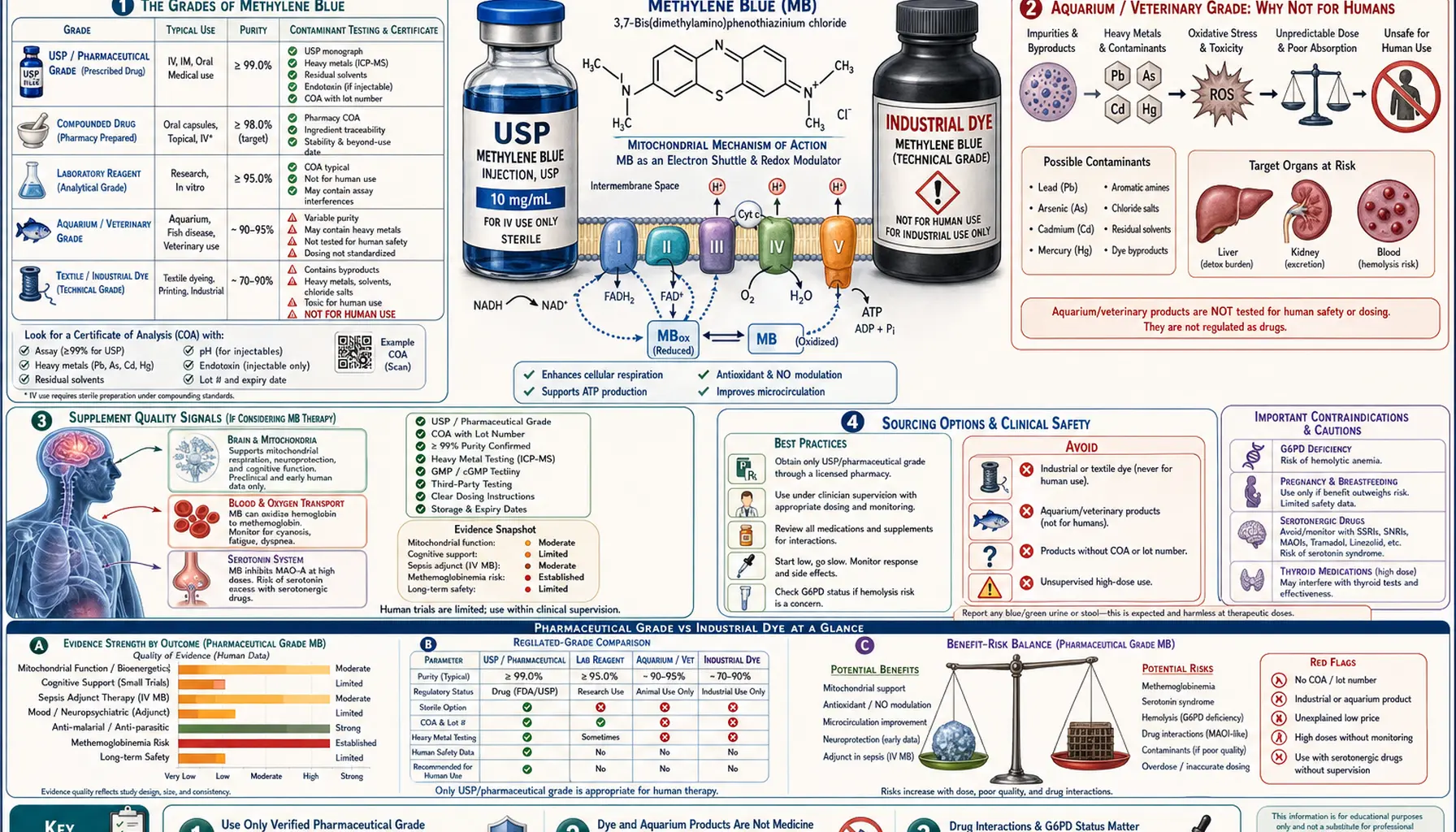
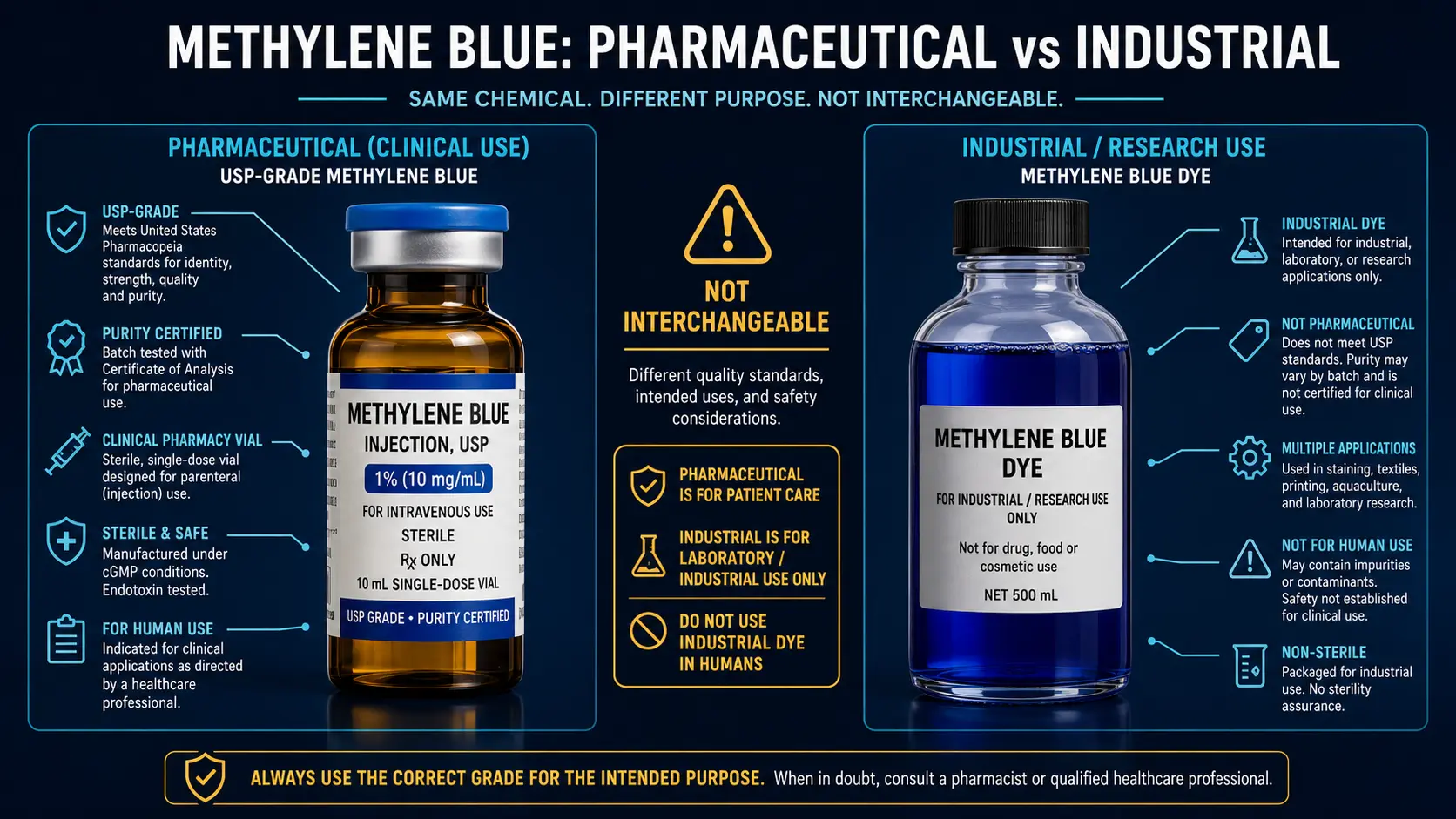
Methylene blue is one chemical sold in very different grades. The FDA-approved product is a sterile 5 mg/mL solution for intravenous use, labelled “methylene blue injection USP” and first approved in the US in 2016, under accelerated approval, for acquired methemoglobinemia (FDA label, 2023). The same dye is also sold for laboratory staining, for treating aquarium fish and for industrial dyeing. When the European Medicines Agency (EMA) assessed the first methylene blue made to the European Pharmacopoeia standard, it noted that methylene blue has a strong affinity for metals, that a substance meeting the European Pharmacopoeia monograph is difficult to manufacture, and that there was at the time no commercial source of the active substance that complied with it (EMA 2011).
This page sets out what regulators’ documents and published analyses report about the grades, about the impurities that have been measured — chiefly Azure B and metals — and about what is not known. No published analysis of aquarium, industrial or supplement methylene blue sold today was found in PubMed or Crossref. Decisions about medicines belong with a clinician.
Table of Contents
- The Grades of Methylene Blue
- Pharmaceutical Grade: USP and Ph. Eur.
- Laboratory and Stain Grades
- Aquarium Products
- Impurities: What Has Been Measured
- What a Stated Grade Does and Does Not Show
- FDA Regulatory Status
- Blue Discoloration in the Label
- Where Each Grade Is Used
- Key Research Papers
- Connections
- Featured Videos
The Grades of Methylene Blue
Methylene blue is supplied in several grades, each made for a different use:
- Pharmaceutical grade — made to a pharmacopoeial monograph: the United States Pharmacopeia (USP) in the US and the European Pharmacopoeia (Ph. Eur.) in Europe (FDA 2016; EMA 2011). The FDA-approved injection is a sterile solution for intravenous use (FDA label, 2023).
- Laboratory, reagent and stain grades — sold for staining cells and tissues and for chemical analysis. Methylene blue has been used as a staining reagent for more than a century (Schirmer 2011), and commercial samples analysed in the 1970s contained related dyes and metal salts (Marshall 1975, purification; Marshall 1975, metal analysis).
- Aquarium products — sold as a treatment for aquarium fish and dosed into tank water.
- Industrial grade — sold as a dye for textiles and other industrial uses.
Only the pharmaceutical grade is made and tested as a medicine. The impurity content of the other grades is not set by a pharmacopoeial monograph for medicines.
Pharmaceutical Grade: USP and Ph. Eur.
A pharmacopoeial monograph sets the tests and limits that a medicine’s active ingredient must meet. The EMA’s 2011 assessment report describes the specification of the first European Pharmacopoeia–grade methylene blue (methylthioninium chloride is its international name) as in compliance with the Ph. Eur. monograph. It covers identity, assay, related substances (Azure B, each other impurity, and the sum of impurities other than Azure B), metals (aluminium, cadmium, chromium, copper, tin, iron, manganese, mercury, molybdenum, nickel, lead and zinc), loss on drying, sulphated ash, methanol-insoluble substances, residual solvents, impurities from synthesis, microbial purity and endotoxins (EMA 2011). The public report does not give the numerical limits.
According to the EMA, the manufacturer used a synthesis route that involves no metals, so that no purification step to remove metals was needed, and the resulting methylene blue was very low in organic and inorganic impurities and met the Ph. Eur.’s strict criteria for metal content. Because this purer substance dissolves less readily than less pure grades, the injection was made at 5 mg/mL rather than the 10 mg/mL of the older reference product. The report also notes that methylene blue absorbs metals from brown glass, so clear glass ampoules were used (EMA 2011).
A 2013 paper on the same European Pharmacopoeia–grade methylene blue states that the total concentration of metals, Azure B and other impurities in it is below 20 ppm, 2% and 0.5% respectively, and that pharmaceutical use of methylene blue had been held back by contamination with organic impurities and heavy metals of recognized toxicity (Dormoi 2013). These are figures for one product, as reported by researchers studying it; they are not the monograph’s limits.
The USP also publishes a methylene blue monograph: the FDA’s 2016 clinical review describes “Methylene Blue USP 1%” as formulations stated to comply with it (FDA 2016). The USP text is available only by subscription, and its numerical limits — including any for heavy metals or arsenic — could not be checked for this page.
In the US, the FDA-approved product is a 5 mg/mL solution in 10 mg/2 mL and 50 mg/10 mL single-dose ampules and vials, approved for intravenous treatment of acquired methemoglobinemia; the label gives no oral dose (FDA label, 2023).
Laboratory and Stain Grades
Laboratory and stain-grade methylene blue is the dye used in microscopy. Analyses from the 1970s describe what stain-grade dye can contain. Oxidizing methylene blue — as in the older methods for making polychrome methylene blue and the azure stains — gave complex mixtures of up to eleven dyes, ten of which were identified, including Azure A, Azure B, Azure C, thionine and methylene violet Bernthsen (Marshall 1976). Commercial methylene blue could be purified by solvent extraction and crystallization, which removed contaminating dyes and metal salts (Marshall 1975, purification).
Azure B is the main related substance in methylene blue. The US label describes it as a minor impurity in methylene blue that is also formed in the body as a metabolite, and states that it has 8-fold lower potency than methylene blue, without naming the effect measured (FDA label, 2023). A 2020 rat study notes that Azure B is already present in commercially available methylene blue solutions (Haouzi 2020). Azure B is biologically active: in a laboratory study with human enzymes it inhibited monoamine oxidase A — the enzyme behind methylene blue’s serotonin-syndrome warning — about 6 times more potently than methylene blue (Petzer 2012), and in rats it mimicked methylene blue’s effects and acted as a cyanide antidote (Haouzi 2020).
No current published analysis of the Azure B or metal content of laboratory-grade methylene blue was found, and no study of repeated human intake of stain-grade methylene blue was found.
Aquarium Products
Aquarium methylene blue is sold as a treatment for fish and is dosed into tank water. No published analysis of the purity or impurity content of aquarium methylene blue products was found in PubMed or Crossref, so how these products compare with pharmaceutical grade is not known from published data.
Fish remedies are not limited to methylene blue. A 2008 case report describes methemoglobinemia of 51% in a 3-year-old girl who swallowed malachite green, a dye used to treat parasitic and fungal disease in fish, from a commercially available aquarium product (Spiller 2008).
Impurities: What Has Been Measured
- Related dyes — Azure B, the singly demethylated form of methylene blue (Petzer 2012), is the impurity the US label and the Ph. Eur. specification name; the specification also covers each other related substance and their sum (FDA label, 2023; EMA 2011). Azure A, Azure C and other related dyes form when methylene blue is oxidized (Marshall 1976).
- Metals — in 38 commercial samples of thiazine dyes analysed in 1975 (methylene blue, the azures, thionine, toluidine blue and related stains), iron, potassium, sodium and zinc together made up between 0.02% and 25.35% of individual samples (Marshall 1975, metal analysis). That study measured those four metals only; it did not report lead, cadmium, mercury or arsenic. The EMA notes methylene blue’s strong affinity for metals (EMA 2011).
- Synthesis impurities and residual solvents — tested in the pharmaceutical specification (EMA 2011); no published measurements in non-pharmaceutical grades were found.
- Microbial contamination and endotoxins — tested in the pharmaceutical specification for the sterile injection (EMA 2011); no published data for other grades were found.
No published analysis of heavy metals or arsenic in methylene blue products sold today for laboratory, aquarium, industrial or supplement use was found in PubMed or Crossref. The figures above are the ones that have been published; the content of any particular product is not known without testing that product.
What a Stated Grade Does and Does Not Show
A grade is a statement about the specification a product was made and tested to. For a medicine, the regulator reviews that specification and its test methods: the EMA, for example, reviewed the validation of the methods used for trace metals (by ICP-MS), residual solvents and synthesis impurities, and results from three production-scale batches (EMA 2011). Outside the drug-approval system there is no regulatory review of that kind behind a product’s stated grade.
A USP label and the content of a given lot can also differ. In a healthy-volunteer study submitted to the FDA, the applicant reported that the lot of a 1% methylene blue injection labelled USP used as the comparator contained only 82% of its labelled amount of methylene blue, so that volunteers given a nominal 2 mg/kg dose received a mean of 1.64 mg/kg (FDA 2016).
FDA Regulatory Status
- Before 2016 — methylene blue had been in clinical use for over 100 years and was marketed in the US as an unapproved product without an approved new drug application. The FDA’s 2016 clinical review describes 1% injections stated to comply with the USP monograph, and lists marketed but unapproved oral drug products that contain methylene blue (FDA 2016). The FDA’s October 2011 communication noted that methylene blue was not then an FDA-approved drug (FDA, October 2011).
- 2011 — the FDA issued two Drug Safety Communications on serotonin syndrome when methylene blue is given to people taking serotonergic psychiatric medicines; they are covered on the Drug Interactions and Serotonin Syndrome page.
- 2016 — the FDA approved methylene blue injection 5 mg/mL for acquired methemoglobinemia under accelerated approval; the label states that continued approval may be contingent on verification of clinical benefit (FDA label, 2023).
Blue Discoloration in the Label
Methylene blue is a dye, and the US label describes its colour effects. In the label’s safety study, in which 82 healthy adults each received a single 2 mg/kg intravenous dose, chromaturia (discoloured urine) was reported by 74% and skin discoloration by 13% of participants; the label states that methylene blue may cause a blue discoloration of the skin and body fluids. After large cumulative intravenous doses (7 mg/kg or more), the effects reported included blue staining of the urine, skin and mucous membranes and mild methemoglobinemia (up to 7%), lasting 2–12 hours (FDA label, 2023).
The label also states that methylene blue passes freely into the urine and may interfere with urine tests that rely on a blue indicator, such as the dipstick test for leucocyte esterase, and that methylene blue in the blood may make pulse oximetry underestimate oxygen saturation. It warns that hemolysis can occur during treatment and contraindicates methylene blue in G6PD deficiency (FDA label, 2023) — see the G6PD page.
Where Each Grade Is Used
- FDA-approved injection — a sterile 5 mg/mL solution given intravenously for acquired methemoglobinemia; the label calls for monitoring of vital signs, the electrocardiogram and methemoglobin levels during treatment (FDA label, 2023).
- Oral forms — the approved label covers intravenous use only and gives no oral dose (FDA label, 2023); the oral methylene blue products listed in the FDA’s 2016 review were marketed unapproved or homeopathic products (FDA 2016). Oral and sublingual use is covered in the Dosing Guide.
- Laboratory, aquarium and industrial grades — sold for staining, fish treatment and dyeing; they are not made to a pharmacopoeial monograph for medicines, and no published analysis of their current impurity content was found.
Key Research Papers
- U.S. Food and Drug Administration, Drugs@FDA. Methylene blue injection, 5 mg/mL, for intravenous use: prescribing information (NDA 204630), revised November 2023 — accessdata.fda.gov
- U.S. Food and Drug Administration, Center for Drug Evaluation and Research (2016). Clinical review, NDA 204630: methylene blue injection for acquired methemoglobinemia (review completed March 26, 2016) — accessdata.fda.gov
- U.S. Food and Drug Administration (2011). FDA Drug Safety Communication: Updated information about the drug interaction between methylene blue (methylthioninium chloride) and serotonergic psychiatric medications. October 20, 2011 (archived copy) — web.archive.org
- European Medicines Agency, Committee for Medicinal Products for Human Use (2011). Assessment report: methylthioninium chloride 5 mg/mL solution for injection, procedure EMEA/H/C/002108 (positive opinion 17 February 2011) — ema.europa.eu
- Marshall PN, Lewis SM (1975). Metal contaminants in commercial thiazine dyes. Stain Technology 50(3):143–7 — PubMed PMID: 1145655
- Marshall PN, Lewis SM (1975). The purification of methylene blue and azure B by solvent extraction and crystallization. Stain Technology 50(6):375–81 — PubMed PMID: 1226556
- Marshall PN (1976). The composition of stains produced by the oxidation of Methylene Blue. Histochemical Journal 8(4):431–42 — PubMed PMID: 60311
- Petzer A, Harvey BH, Wegener G, Petzer JP (2012). Azure B, a metabolite of methylene blue, is a high-potency, reversible inhibitor of monoamine oxidase. Toxicology and Applied Pharmacology 258(3):403–9 — PubMed PMID: 22197611
- Haouzi P, McCann M, Tubbs N (2020). Azure B as a novel cyanide antidote: Preclinical in-vivo studies. Toxicology Reports 7:1459–64 (rat study) — PubMed PMID: 33194557
- Dormoi J, Briolant S, Desgrouas C, Pradines B (2013). Impact of methylene blue and atorvastatin combination therapy on the apparition of cerebral malaria in a murine model. Malaria Journal 12:127 (mouse study) — PubMed PMID: 23587099
- Schirmer RH, Adler H, Pickhardt M, Mandelkow E (2011). “Lest we forget you — methylene blue…”. Neurobiology of Aging 32(12):2325.e7–16 (review) — PubMed PMID: 21316815
- Spiller H, Rodgers G, Willias D, Bosse G, Sullivan J (2008). Methemoglobinemia due to malachite green ingestion in a child. Clinical Toxicology 46(4):320–1 (case report) — PubMed PMID: 18363129
PubMed Topic Searches
- MB impurity profile and pharmacopoeia — PubMed search
- USP grade contamination standards — PubMed search
- Industrial dye contamination — PubMed search
- FDA-approved methylene blue injection — PubMed search
External Authoritative Resources
Connections
- Methylene Blue
- Methemoglobinemia and G6PD Deficiency
- Heavy Metals
- Lead
- Mercury
- Cadmium
- Drug Interactions and Serotonin Syndrome
- Methylene Blue Dosing Guide
- Mitochondrial Mechanism and Bioenergetics
- Cognitive Enhancement and ADHD
- History: Ehrlich and Phenothiazines
- Methylene Blue and Long COVID
- Photodynamic Therapy and Cancer Research
- Cancer
- Autism
- Toxins