Methylene Blue Drug Interactions and Serotonin Syndrome: The Critical Safety List
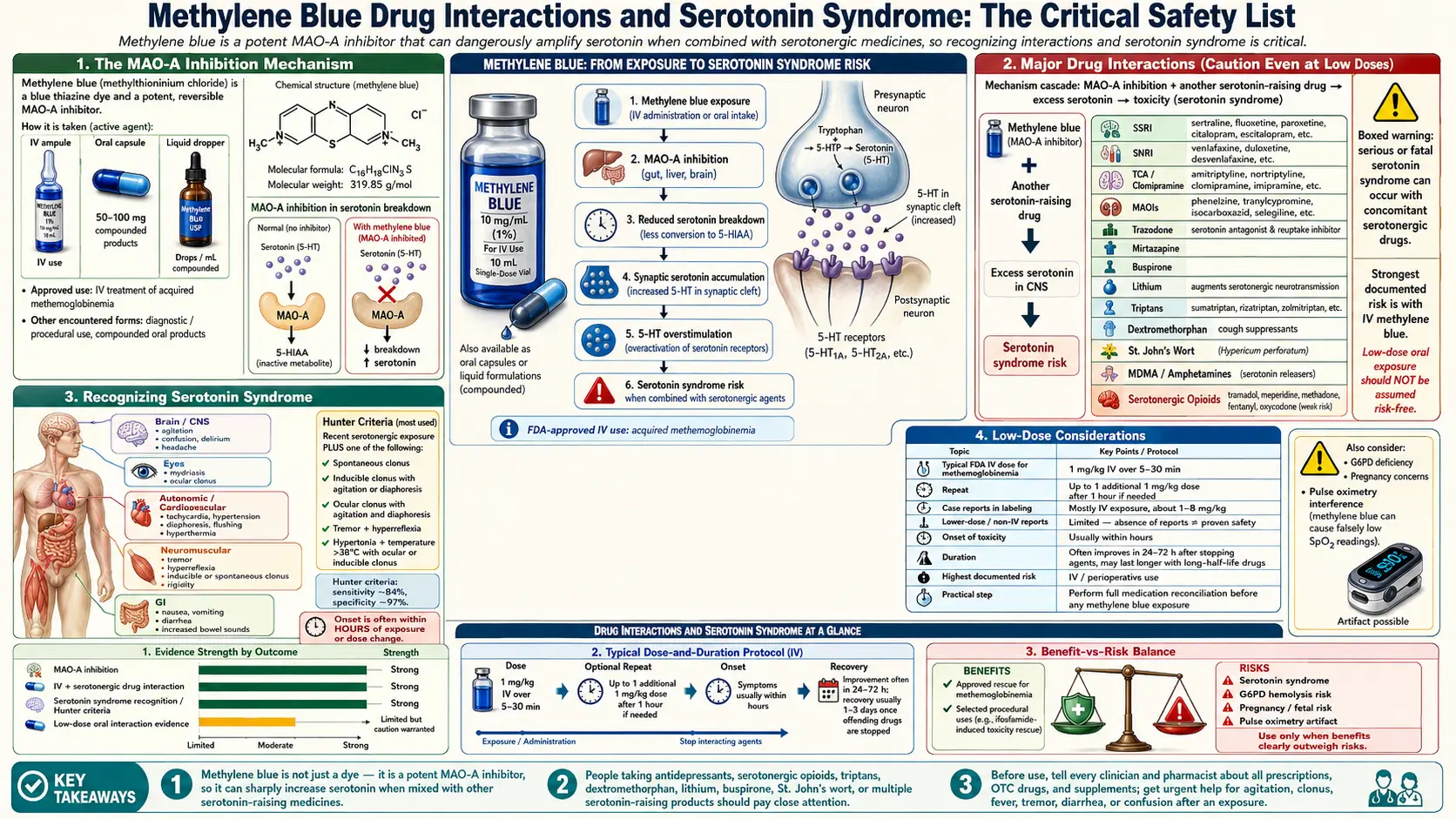
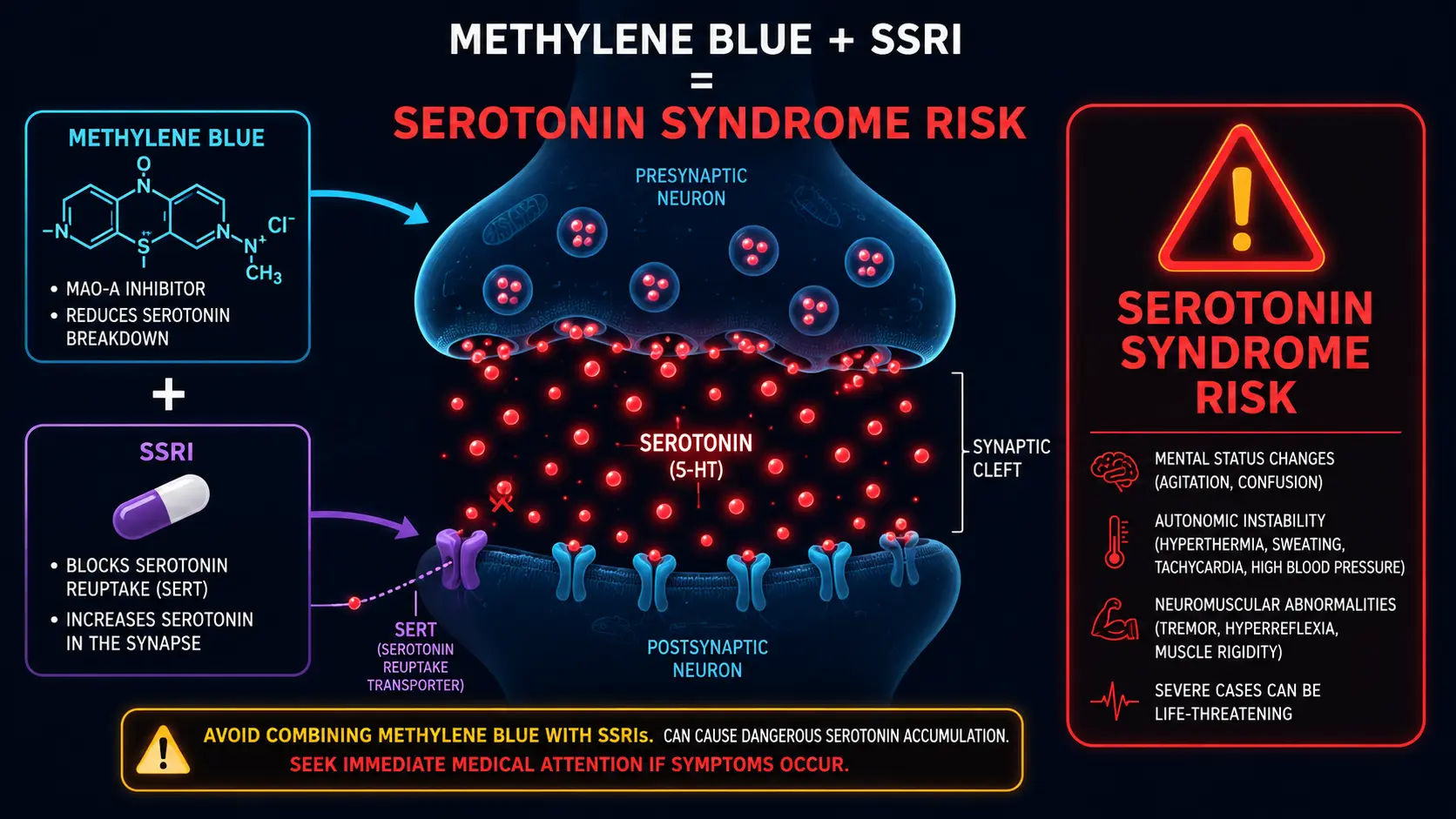
Methylene blue is a potent, reversible inhibitor of monoamine oxidase A (MAO-A), the enzyme that breaks down serotonin in the brain (FDA 2011; Ramsay 2007). Given to people taking serotonergic medicines, it has been linked to serotonin syndrome (also called serotonin toxicity) — a combination of mental-status changes, autonomic instability and neuromuscular symptoms that can be life-threatening. The FDA issued two Drug Safety Communications on the interaction in 2011, and the current US label for the FDA-approved intravenous methylene blue injection carries a boxed warning that the drug may cause serious or fatal serotonin syndrome when combined with serotonergic drugs and opioids.
This page sets out what the November 2023 US label, the FDA’s July and October 2011 communications, laboratory work on MAO-A inhibition, and published case reviews state about which medicines interact, the timing the FDA described, how serotonin syndrome is recognized and treated, and what is and is not known about low doses and oral use. Decisions about medicines belong with a clinician.
Table of Contents
- The MAO-A Inhibition Mechanism
- The FDA Communications and the Boxed Warning
- Drugs Named by the Label and the FDA
- Other Drugs and Foods: What the Sources Say
- Stopping and Restarting: FDA and Label Timing
- Recognizing Serotonin Syndrome
- Treatment Described in the Label and Reviews
- Supplements: What Is Reported
- Low Doses and Oral Use: What Is Known
- Key Research Papers
- Connections
- Featured Videos
The MAO-A Inhibition Mechanism
The FDA’s July 2011 communication describes methylene blue as a potent, reversible monoamine oxidase inhibitor (MAOI): it inhibits monoamine oxidase A, an enzyme responsible for breaking down serotonin in the brain, and when it is given to people taking serotonergic psychiatric medicines, high levels of serotonin are believed to build up in the brain and cause toxicity. The FDA noted that the exact mechanism is unknown, and that healthcare professionals and patients may not realize methylene blue has MAOI properties.
Laboratory work on purified human enzyme supports this. In a 2007 study, methylene blue was a potent, tight-binding inhibitor of MAO-A; it also inhibited MAO-B, but only at much higher concentrations. The authors concluded that at the concentrations reported after intravenous use, MAO-A would be completely inhibited and MAO-B partially, which would be expected to disturb serotonin metabolism and account for serotonin toxicity in patients taking SSRIs (Ramsay 2007).
Serotonin syndrome in these cases comes from two effects together: the MAOI property of methylene blue and a drug that blocks serotonin reuptake (Gillman 2011). A 2010 review states that activation of the 5-HT2A receptor is required for serious serotonin syndrome (Gillman 2010). The label states that some reported cases were fatal, and a 2005 review describes rhabdomyolysis (muscle breakdown) in severe cases (Jones 2005).
The inhibition depends on concentration. A 2011 review reports that an intravenous dose of 0.75 mg/kg produced a peak plasma concentration of about 500 ng/mL (1.6 µM), indicating that brain levels reach the range that inhibits MAO-A, and that severe serotonin toxicity has occurred in humans at 1 mg/kg; its author concluded that all proposed uses of methylene blue appear to involve levels that block monoamine oxidase (Gillman 2011).
The FDA Communications and the Boxed Warning
On July 26, 2011, the FDA reported that it had received reports of serious central nervous system reactions in people taking serotonergic psychiatric medicines who were given methylene blue; reported events included confusion, delirium, agitation, obtundation and coma, often with myoclonus, hypertonia, seizures, fever or raised blood pressure. The communication listed its uses as treatment of methemoglobinemia, vasoplegic syndrome, ifosfamide-induced encephalopathy and cyanide poisoning, and as a dye in diagnostic and therapeutic procedures. It stated that methylene blue should generally not be given to patients taking serotonergic drugs, with exceptions for life-threatening or urgent conditions such as emergency treatment of methemoglobinemia, ifosfamide-induced encephalopathy or cyanide poisoning (FDA, July 2011).
The October 20, 2011 update reported that most of the FDA’s cases occurred during parathyroid surgery, where methylene blue was given intravenously as a visualizing agent at doses of 1 to 8 mg/kg. It stated that it is not known whether there is a risk with other routes, such as oral use or local tissue injection, or with intravenous doses below 1 mg/kg, and that not all serotonergic psychiatric drugs carry an equal risk; it also noted that methylene blue was not then an FDA-approved drug (FDA, October 2011).
The current US label for the FDA-approved methylene blue injection, a 5 mg/mL solution approved for acquired methemoglobinemia, opens with a boxed warning: methylene blue may cause serious or fatal serotonin syndrome when used with serotonergic drugs and opioids, and concomitant use with SSRIs, SNRIs, MAOIs and opioids is to be avoided. The label states that some reported cases were fatal and calls for patients to be monitored for serotonin syndrome during treatment. Separately, the same label contraindicates methylene blue in glucose-6-phosphate dehydrogenase (G6PD) deficiency because of the risk of hemolytic anemia, stating that treating these patients may result in severe hemolysis and severe anemia (FDA label, 2023).
Drugs Named by the Label and the FDA
The 2023 label. Its boxed warning names SSRIs, SNRIs, MAOIs and opioids. Its drug-interaction section also names bupropion, buspirone, clomipramine, mirtazapine, linezolid and dextromethorphan, and states that opioids and dextromethorphan may increase the risk. Its patient-counseling section names medicines used to treat depression and migraines. The label names opioids as a class and does not list individual opioids (FDA label, 2023).
The FDA’s 2011 lists. The October 2011 update divided serotonergic psychiatric drugs into two groups:
- Implicated in the FDA’s case reports — SSRIs (paroxetine, fluvoxamine, fluoxetine, sertraline, citalopram, escitalopram, and vilazodone, which the FDA placed in this group on pharmacological grounds although it had received no cases involving it), SNRIs (venlafaxine, desvenlafaxine, duloxetine) and the tricyclic clomipramine.
- Risk unclear — other tricyclics (amitriptyline, desipramine, imipramine, nortriptyline, protriptyline, doxepin, trimipramine), MAOIs (isocarboxazid, phenelzine, transdermal selegiline, tranylcypromine), and amoxapine, maprotiline, nefazodone, trazodone, bupropion, buspirone and mirtazapine.
Linezolid, an antibiotic, was the subject of a separate FDA communication released the same day in July 2011 because of a similar potential interaction with serotonergic psychiatric medicines (FDA, July 2011).
Opioids. A 2005 review names pethidine (meperidine) and tramadol as drugs used in anaesthesia that can be complicated by serotonin syndrome (Jones 2005), and a 2018 case report describes serotonin syndrome after heart surgery in a patient taking an SSRI who was given fentanyl and methylene blue (Haacker 2018).
Triptans. The label’s counseling mentions migraine medicines. A 2010 review concluded that there is neither significant clinical evidence nor theoretical reason to expect serious serotonin syndrome from triptans combined with SSRIs; it did not study triptans with methylene blue (Gillman 2010).
Other Drugs and Foods: What the Sources Say
- Bupropion — named in the label’s drug-interaction list; the October 2011 update placed it in the “risk unclear” group.
- Lithium, stimulant medicines, decongestants, anticonvulsants and antipsychotics — not named in the label or in either 2011 FDA communication.
- Amines in food — the 2007 MAO-A study noted that the inhibition has implications for the absorption of amines from the gut when methylene blue is taken by mouth (Ramsay 2007). The label does not mention food or tyramine, and no study of dietary tyramine with methylene blue was found.
Stopping and Restarting: FDA and Label Timing
The figures below come from the FDA’s July 2011 communication and the 2023 label; they are not the same, and the label is the more recent document.
- Planned (non-emergency) treatment, FDA 2011 — the communication described stopping most serotonergic psychiatric drugs at least 2 weeks before methylene blue, and fluoxetine, which has a longer half-life, at least 5 weeks before. It stated that the psychiatric medicine may be resumed 24 hours after the last dose of methylene blue, and that serotonergic psychiatric medicines are not started in a patient receiving methylene blue until 24 hours after its last dose.
- Emergency treatment, FDA 2011 — if methylene blue must be given to a patient taking a serotonergic drug, the communication described stopping the serotonergic drug immediately and monitoring closely for central nervous system toxicity for two weeks (five weeks if fluoxetine was taken) or until 24 hours after the last dose of methylene blue, whichever comes first. It also noted that the interaction appears able to occur after a serotonergic drug with a long half-life has been stopped.
- The 2023 label — its warnings section calls for patients to be told not to take serotonergic drugs within 72 hours after the last dose of methylene blue. Where intravenous use cannot be avoided in a patient taking serotonergic medicines, it describes choosing the lowest possible dose and observing the patient closely for central nervous system effects for up to 4 hours after administration.
The FDA’s 2011 information for patients stated that a serotonergic psychiatric medicine is not to be stopped without first talking to a healthcare professional, who decides when methylene blue can be started (FDA, July 2011).
Recognizing Serotonin Syndrome
The Hunter Serotonin Toxicity Criteria come from a study of 2,222 patients admitted after an overdose of a serotonergic drug; the new rules were simpler, more sensitive (84% vs 75%) and more specific (97% vs 96%) than the older Sternbach criteria (Dunkley 2003). A 2010 review summarizes them: in a person exposed to a serotonergic drug, the criteria require one of the following (Ables 2010):
- Spontaneous clonus
- Inducible clonus with agitation or diaphoresis (sweating)
- Ocular clonus with agitation or diaphoresis
- Tremor and hyperreflexia
- Hypertonia, temperature above 38°C, and ocular or inducible clonus
A 2011 review concluded that 13 of the 14 reported cases of central nervous system toxicity with methylene blue it examined were serotonin toxicity meeting the Hunter criteria (Gillman 2011).
The label groups the symptoms associated with serotonin syndrome as follows (FDA label, 2023):
- Mental status changes — for example agitation, hallucinations, delirium and coma
- Autonomic instability — for example tachycardia, labile blood pressure, dizziness, sweating, flushing and hyperthermia
- Neuromuscular symptoms — for example tremor, rigidity, myoclonus, hyperreflexia and incoordination
- Seizures and gastrointestinal symptoms — for example nausea, vomiting and diarrhea
The FDA’s 2011 communication listed, in plain terms, confusion, hyperactivity, memory problems, muscle twitching, excessive sweating, shivering or shaking, diarrhea, trouble with coordination and fever. A 2014 case report noted that after general anaesthesia the presentation may be atypical and harder to diagnose (Top 2014).
Treatment Described in the Label and Reviews
The label states that if symptoms of serotonin syndrome occur, methylene blue is discontinued and supportive treatment started, and its counseling section describes seeking immediate medical attention if mental-status changes, autonomic instability or neuromuscular symptoms occur after treatment (FDA label, 2023).
Reviews describe the treatment of serotonin syndrome in general. Most cases are mild and are treated by withdrawing the drug responsible and with supportive care; benzodiazepines may be used for agitation and tremor, and cyproheptadine may be used as an antidote; moderate or severe cases require hospital admission, and critically ill patients may need sedation, neuromuscular paralysis and intubation (Ables 2010). Another review describes benzodiazepines and muscle relaxants for the neuromuscular excitability thought to cause rhabdomyolysis, supportive treatment of hyperthermia and autonomic dysfunction, and notes that cyproheptadine, the most commonly used serotonin antagonist, is not available in an injectable form (Jones 2005).
Supplements: What Is Reported
The label and the FDA’s 2011 communications do not name any dietary supplement. The label’s drug-interaction statement covers medicinal products that enhance serotonergic transmission in general. 5-HTP and L-tryptophan are precursors of serotonin, and St. John’s wort is used as an herbal antidepressant; a PubMed search found no case report of methylene blue combined with any of them, so the risk of these combinations has not been measured.
Low Doses and Oral Use: What Is Known
Most published cases involved intravenous methylene blue in hospital:
- A 2010 systematic review found nine case reports and two retrospective reviews: 26 patients developed an acute confusional state after a methylene blue infusion, 24 of them taking a serotonin reuptake inhibitor and 1 taking clomipramine, and serotonin syndrome was a possible diagnosis in all 25 (Ng 2010).
- A 2012 systematic review of intravenous methylene blue in parathyroid surgery (39 observational studies) found neurotoxicity reported in 25 patients, all taking serotonergic medicines; its authors concluded that toxicity appears mild without concomitant serotonin reuptake inhibitors (Patel 2012).
- A 2014 case report described what its authors called the first fatal outcome of serotonin toxicity from an interaction between methylene blue and venlafaxine, and stated that the syndrome is completely preventable if serotonin reuptake inhibitors are stopped beforehand (Top 2014).
- A 2018 systematic review found 50 unique cases in 23 publications, mostly from parathyroid surgery or treatment of vasoplegic shock; all involved methylene blue given parenterally and concurrent serotonergic antidepressants, and one was fatal. The same paper reported a new case after a patient taking several serotonergic drugs started an oral urinary analgesic containing methylene blue, which its authors said suggests that oral methylene blue can also induce serotonin syndrome (Zuschlag 2018).
The FDA’s October 2011 update stated that it is not known whether there is a risk of serotonin syndrome with oral methylene blue or with intravenous doses below 1 mg/kg. The 2011 review, from the concentration reached after 0.75 mg/kg intravenously, concluded that all proposed uses of methylene blue appear to involve levels that block MAO, and that stopping serotonin reuptake inhibitors needs very careful consideration before methylene blue is used (Gillman 2011). No controlled study has measured the risk at low oral doses. Decisions about combining methylene blue with any prescribed medicine belong with the prescribing clinician.
Key Research Papers
- U.S. Food and Drug Administration, Drugs@FDA. Methylene blue injection, 5 mg/mL, for intravenous use: prescribing information (NDA 204630), revised November 2023 — accessdata.fda.gov
- U.S. Food and Drug Administration (2011). FDA Drug Safety Communication: Serious CNS reactions possible when methylene blue is given to patients taking certain psychiatric medications. July 26, 2011 (archived copy) — web.archive.org
- U.S. Food and Drug Administration (2011). FDA Drug Safety Communication: Updated information about the drug interaction between methylene blue (methylthioninium chloride) and serotonergic psychiatric medications. October 20, 2011 (archived copy) — web.archive.org
- Ramsay RR, Dunford C, Gillman PK (2007). Methylene blue and serotonin toxicity: inhibition of monoamine oxidase A (MAO A) confirms a theoretical prediction. British Journal of Pharmacology 152(6):946–51 — PubMed PMID: 17721552
- Gillman PK (2006). Methylene blue implicated in potentially fatal serotonin toxicity. Anaesthesia 61(10):1013–4 (letter) — PubMed PMID: 16978328
- Gillman PK (2011). CNS toxicity involving methylene blue: the exemplar for understanding and predicting drug interactions that precipitate serotonin toxicity. Journal of Psychopharmacology 25(3):429–36 (review) — PubMed PMID: 20142303
- Gillman PK (2010). Triptans, serotonin agonists, and serotonin syndrome (serotonin toxicity): a review. Headache 50(2):264–72 (review) — PubMed PMID: 19925619
- Ng BK, Cameron AJ (2010). The role of methylene blue in serotonin syndrome: a systematic review. Psychosomatics 51(3):194–200 — PubMed PMID: 20484716
- Patel HP, Chadwick DR, Harrison BJ, Balasubramanian SP (2012). Systematic review of intravenous methylene blue in parathyroid surgery. British Journal of Surgery 99(10):1345–51 — PubMed PMID: 22961511
- Top WM, Gillman PK, de Langen CJ, Kooy A (2014). Fatal methylene blue associated serotonin toxicity. Netherlands Journal of Medicine 72(3):179–81 (case report) — PubMed PMID: 24846936
- Zuschlag ZD, Warren MW, K Schultz S (2018). Serotonin Toxicity and Urinary Analgesics: A Case Report and Systematic Literature Review of Methylene Blue-Induced Serotonin Syndrome. Psychosomatics 59(6):539–546 — PubMed PMID: 30104021
- Haacker L, Maliekel M, Bardsley CEH, Bergren R, Meresh E, Halaris A (2018). Serotonin Syndrome Following Septal Myectomy in Association With Fentanyl and Methylene Blue: A Case Report. Psychosomatics 59(5):512–516 (case report) — PubMed PMID: 29571985
- Dunkley EJ, Isbister GK, Sibbritt D, Dawson AH, Whyte IM (2003). The Hunter Serotonin Toxicity Criteria: simple and accurate diagnostic decision rules for serotonin toxicity. QJM 96(9):635–42 — PubMed PMID: 12925718
- Ables AZ, Nagubilli R (2010). Prevention, recognition, and management of serotonin syndrome. American Family Physician 81(9):1139–42 (review) — PubMed PMID: 20433130
- Jones D, Story DA (2005). Serotonin syndrome and the anaesthetist. Anaesthesia and Intensive Care 33(2):181–7 (review) — PubMed PMID: 15960399
- U.S. Food and Drug Administration. Drug Safety and Availability (index of Drug Safety Communications) — fda.gov
PubMed Topic Searches
Connections
- Methylene Blue
- Dosing Guide
- Methemoglobinemia and G6PD Deficiency
- Pharmaceutical Grade vs Industrial Dye
- Mitochondrial Mechanism and Bioenergetics
- Cognitive Enhancement and ADHD
- Methylene Blue and Long COVID
- Photodynamic Therapy and Cancer Research
- Depression
- ADHD
- Tryptophan
- Anxiety
- Natural Anxiety Relief
- Hypertension
- Longevity Protocols
- History Ehrlich Phenothiazines
- Psychiatry