Methylene Blue Dosing Guide: mg/kg, Oral, Sublingual, IV
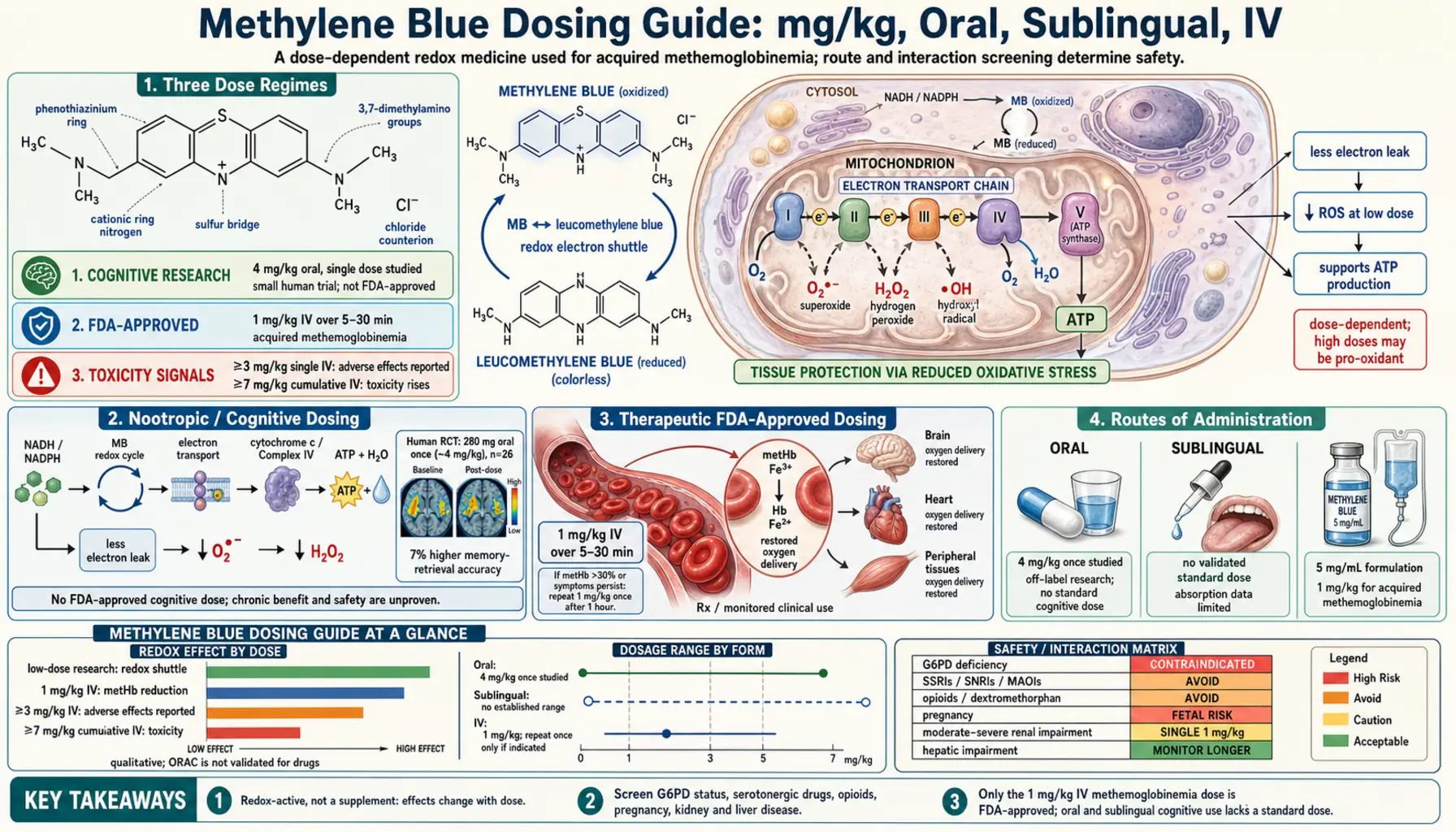
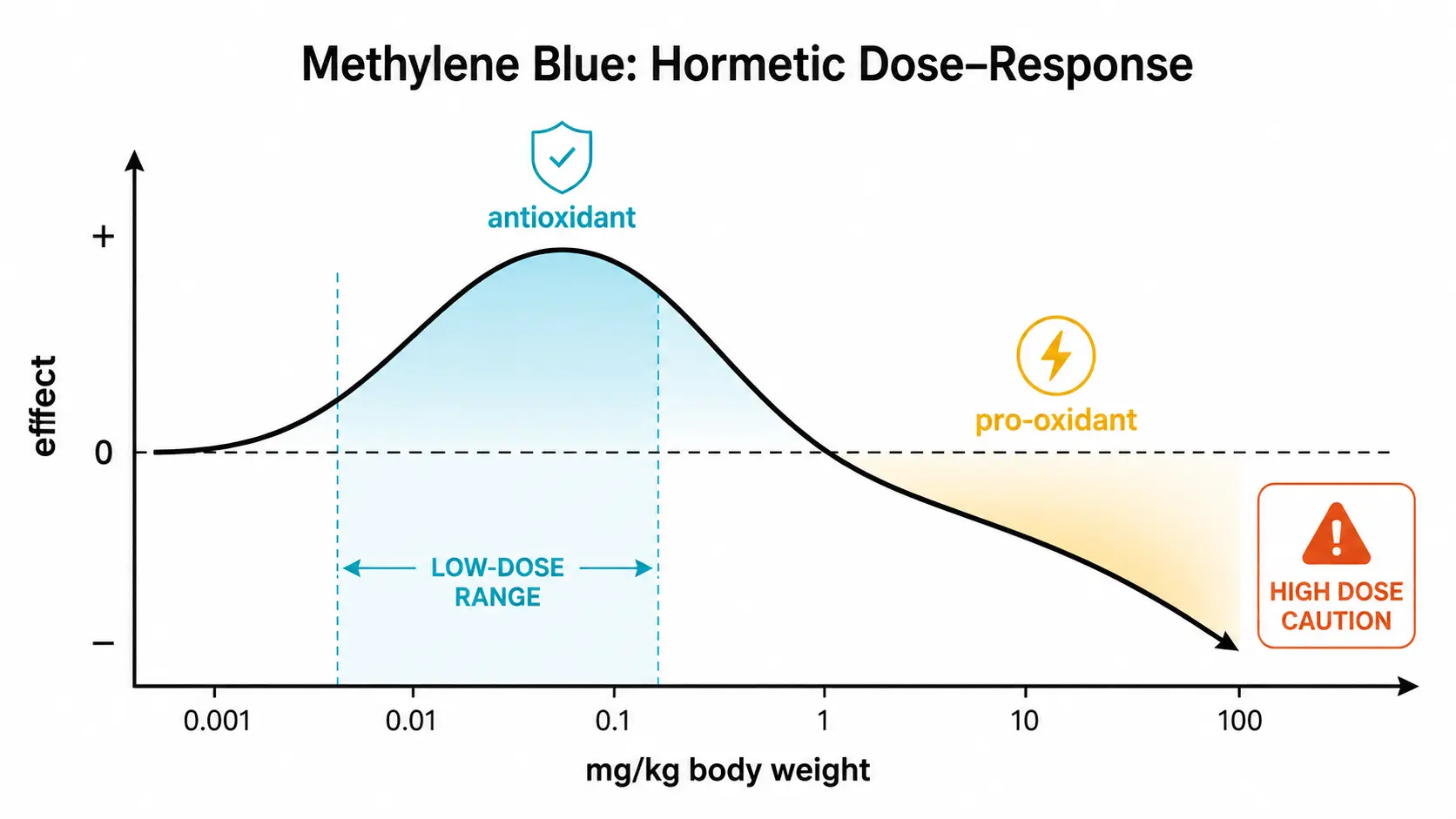
Methylene blue’s effects change with dose. Its dose–response has been described as hormetic: in a 2008 review, responses rose at low doses and fell below control at higher doses — cytochrome oxidase activity, for example, increased at intermediate doses and decreased at higher ones (Bruchey 2008). The authors of a 2016 human trial describe 0.5–4 mg/kg as the low-dose range in which a single dose enhanced memory in animals and humans, with opposite effects above 10 mg/kg (Rodriguez 2016); the biology is covered on the mitochondrial mechanism page. According to the US label, the drug that treats acquired methemoglobinemia at 1 mg/kg can itself cause mild methemoglobinemia after large cumulative intravenous doses. This page sets out what the November 2023 US label for methylene blue injection, the FDA’s 2011 drug safety communications, and published trials and case reports state about doses, routes, timing and safety.
This page is informational, not a prescription. The FDA label approves methylene blue only as an intravenous treatment for acquired methemoglobinemia and gives no oral dose; the oral, sublingual and other uses described below are off-label. Decisions about methylene blue belong with a clinician.
Table of Contents
- Dose Ranges in the Label and Studies
- Doses Used in Cognitive and Neuropsychiatric Trials
- FDA-Approved Dosing and Off-Label Hospital Uses
- Routes of Administration
- Oral Bioavailability and PK
- Timing and Co-Administration: What Is Reported
- Vitamin C and Light: What Studies Show
- Weight-Based Dosing in the Label
- Frequency and Duration in Published Studies
- Contraindications and Warnings in the Label
- Key Research Papers
- Connections
- Featured Videos
Dose Ranges in the Label and Studies
The doses reported for methylene blue come from different settings, each with its own source:
- FDA label (acquired methemoglobinemia) — 1 mg/kg intravenously over 5–30 minutes; a repeat dose of 1 mg/kg may be given one hour after the first if the methemoglobin level stays above 30% or symptoms persist. In the label’s safety study, 82 healthy adults each received a single 2 mg/kg intravenous dose.
- Cognitive research (off-label) — a 2016 randomized trial gave a single 280 mg oral dose, which its authors estimated as 4 mg/kg for an average body weight of 70 kg (Rodriguez 2016). A 2012 review puts the behaviorally effective range in normal rodents at 1–4 mg/kg, becoming ineffective by 10 mg/kg (Rojas 2012).
- Hospital and research use (off-label) — 1.5 mg/kg intravenously in a randomized trial in vasoplegia after cardiac surgery (Levin 2004); 1, 3 or 7 mg/kg infused over 20 minutes in a 15-patient septic-shock dose-finding study, whose authors concluded that high doses may compromise blood flow to the abdominal organs (Juffermans 2010); and 15 mg/kg per day in malaria trials in West African children (Müller 2013).
The label’s overdosage section reports hypotension, wheezing and reduced oxygenation after single doses of 3 mg/kg or more; nausea, chest pain, shortness of breath, confusion, mild methemoglobinemia (up to 7%) and electrocardiogram changes after cumulative intravenous doses of 7 mg/kg or more; and severe intravascular hemolysis, hyperbilirubinemia and death after a single dose of 20 mg/kg or more. The label covers intravenous use only.
Doses Used in Cognitive and Neuropsychiatric Trials
In a 2016 randomized, double-blind, placebo-controlled trial, 26 healthy adults aged 22–62 had functional MRI before and 1 hour after a single oral dose: 13 received 280 mg of methylene blue and 13 a blue food coloring as placebo. Methylene blue increased the brain response in the insular cortex during a sustained-attention task and in prefrontal, parietal and occipital cortex during a short-term memory task, and it was associated with a 7% increase in correct responses during memory retrieval (Rodriguez 2016). The trial tested one dose; it did not test repeated dosing.
Trials that gave methylene blue over months used fixed milligram doses:
- Bipolar disorder — a 6-month double-blind crossover trial in 37 people taking lamotrigine compared an active dose of 195 mg with a 15 mg dose used as the “placebo”. The active dose improved depression and anxiety ratings; effects on cognitive symptoms were not significant (Alda 2017).
- Alzheimer’s disease — a dose-finding trial in 321 people with mild or moderate disease gave methylthioninium, the active component of methylene blue, at 69, 138 or 228 mg a day for 24 weeks, followed by blinded extension phases. The authors reported that delivery of the highest dose was limited by dissolution and absorption, and named 138 mg a day as the minimum safe and effective dose (Wischik 2015).
None of these trials set a dose for cognitive enhancement in healthy people, and the label gives no oral dose.
FDA-Approved Dosing and Off-Label Hospital Uses
- Acquired methemoglobinemia (the label’s only indication) — first approved in the US in 2016, under accelerated approval; the label states that continued approval may be contingent on verification of clinical benefit in later trials. The label dose is 1 mg/kg intravenously over 5–30 minutes; if the methemoglobin level remains above 30% or symptoms persist, a repeat dose of 1 mg/kg may be given one hour after the first, and if two doses do not resolve methemoglobinemia the label points to alternative interventions. In moderate or severe renal impairment (eGFR 15–59 mL/min/1.73 m2) it gives a single 1 mg/kg dose. In the label’s efficacy data — a combined analysis of 47 patients from a retrospective chart review and published cases — methemoglobin fell by at least 50% within an hour in 15 of 17 patients treated with 1 mg/kg and 12 of 13 treated with 2 mg/kg, with no difference in response rate by dose.
- Vasoplegic and septic shock (off-label) — 1.5 mg/kg intravenously in a randomized trial of 56 patients with vasoplegia after cardiac surgery, in which mortality was 0% with methylene blue and 21.4% (6 of 28) with placebo (Levin 2004). A 20-patient septic-shock pilot trial gave a 2 mg/kg intravenous bolus followed 2 hours later by infusions stepped up through 0.25, 0.5, 1 and 2 mg/kg per hour, each for 1 hour (Kirov 2001). A 2016 review found that blood pressure improved consistently in small trials and case reports, but that better oxygen delivery or lower mortality had not been shown and large randomized trials are still needed (Hosseinian 2016).
- Ifosfamide encephalopathy (off-label) — in a 12-patient case series, 8 patients with encephalopathy were treated with 6 × 50 mg a day intravenously, and 3 received 4 × 50 mg a day intravenously as prevention in later chemotherapy cycles (Pelgrims 2000).
- Cyanide poisoning — the FDA’s July 2011 communication listed cyanide poisoning among the conditions methylene blue is used to treat; the current label does not include it and gives no dose for it.
All of these are intravenous uses in monitored hospital settings: the label calls for monitoring of vital signs, the electrocardiogram and methemoglobin levels during treatment.
Routes of Administration
Oral
Oral use is off-label; the FDA label covers intravenous use only. In a 16-person study, a 500 mg dose of an aqueous (water-based) oral formulation had an absolute bioavailability of 72.3% (± 23.9%) compared with a 50 mg intravenous dose (Walter-Sack 2009). An earlier 7-person study of 100 mg doses measured much lower exposure in whole blood after oral than after intravenous dosing (area under the curve 9 vs 137 nmol/min/mL) and attributed the difference mainly to differences in distribution into organs (Peter 2000). In the 2016 cognitive trial, the second brain scan was taken 60 minutes after the oral dose, to allow for absorption (Rodriguez 2016).
Sublingual
Sublingual drops and troches are an off-label form. No published pharmacokinetic study of sublingual methylene blue was found in PubMed, so how quickly it acts by this route, and how much of a dose is absorbed through the lining of the mouth rather than swallowed, have not been measured.
Intravenous
Intravenous use is the only route covered by the FDA label, which describes giving 1 mg/kg over 5–30 minutes through an open (patent) intravenous line and states that the injection is not to be given subcutaneously. Intravenous dosing is also the reference against which oral bioavailability is measured (Walter-Sack 2009).
Topical
Applied to tissue and activated by light, methylene blue is used in photodynamic therapy. A 2005 review describes clinical cases in basal cell carcinoma, Kaposi’s sarcoma, melanoma, and viral and fungal infections (Tardivo 2005), and a 2020 split-mouth trial in 20 people with periodontitis used it with red and infrared laser light; added to full-mouth disinfection, both that approach and low-level laser therapy improved periodontal measures, with no clear difference between them (Engel Naves Freire 2020). The mechanism differs from systemic use: in a laboratory study, methylene blue excited by 660 nm laser light generated singlet oxygen, which killed Enterococcus faecalis bacteria (Komine 2013).
Intranasal
Intranasal methylene blue has been studied in animals as a way of delivering it to the brain — a 2024 study of an intranasal gel in mouse models of Alzheimer’s disease (Liu 2024) and a 2025 study in rats after exhaustive exercise (Peng 2025). No human pharmacokinetic or safety study of the intranasal route was found in PubMed.
Oral Bioavailability and PK
The label describes how the body handles intravenous methylene blue. In the body it is first converted to leucomethylene blue, the form that reduces methemoglobin back to normal hemoglobin. It is about 94% bound to plasma proteins, with a volume of distribution of about 255 L. In laboratory tests it is metabolized by the enzymes CYP1A2, CYP2C19 and CYP2D6, with conjugation by UGT enzymes appearing to be the main pathway, and Azure B is formed as a metabolite. About 40% is excreted unchanged in the urine, and the label gives a half-life of approximately 24 hours. An earlier study estimated a terminal half-life of 5.25 hours in whole blood after a 100 mg intravenous dose (Peter 2000).
For oral doses, the 2009 study found an absolute bioavailability of 72.3% (Walter-Sack 2009). In the 2000 study, urinary excretion of methylene blue and its leuco form was 18% of the dose after oral and 28% after intravenous administration; in rats, doses given into the duodenum reached higher concentrations in the intestinal wall and liver, and lower concentrations in blood and brain, than intravenous doses (Peter 2000). Time to peak concentration after an oral dose was not reported in either study’s abstract.
Timing and Co-Administration: What Is Reported
- Food — no published study of the effect of food on oral methylene blue was found. In the 2016 trial, participants were asked to eat a very light meal on the morning of the study and to avoid caffeine, to limit interference with drug intake (Rodriguez 2016).
- Time of day — no study comparing morning and evening doses was found. Methylene blue inhibits monoamine oxidase A, an enzyme that breaks down serotonin in the brain (FDA 2011); that property underlies the serotonin-syndrome warning below.
- Vitamin C — laboratory findings on the pairing are summarized in the next section.
- Serotonergic drugs — the label’s boxed warning states that methylene blue may cause serious or fatal serotonin syndrome when combined with serotonergic drugs and opioids, and that concomitant use is to be avoided; see Drug Interactions.
Vitamin C and Light: What Studies Show
Vitamin C: ascorbic acid chemically reduces blue methylene blue to colorless leucomethylene blue (Suzuki 2024, a chemistry study). In cell studies, human red blood cells reduced methylene blue outside the cell, took up the reduced form and partly re-oxidized it inside (May 2004); in cultured human endothelial cells, methylene blue above 5 µM increased oxidant stress when glucose was absent, loading the cells with ascorbate partly prevented one measure of that oxidation, and the ascorbate itself was progressively oxidized (May 2003). No trial of vitamin C added to methylene blue for cognitive or general use was found.
Light: in a laboratory study, methylene blue excited by 660 nm red laser light generated singlet oxygen, a reactive form of oxygen — the reaction used in photodynamic therapy (Komine 2013). The label lists phototoxicity among reactions reported with methylene blue products, and its patient-counseling section tells prescribers to advise patients to take protective measures against exposure to light. Combinations of methylene blue and light aimed at the brain have been tested in mice — daily 0.5 mg/kg injections with 810 nm near-infrared laser light improved memory measures in sleep-deprived mice where either treatment alone mostly did not (Marzabadi 2022) — and described in one human case report of intranasal red-light photobiomodulation combined with methylene blue in Kleine–Levin syndrome (Hamper 2021). No controlled human trial of pairing oral methylene blue with light, or of avoiding light after an oral dose, was found.
Weight-Based Dosing in the Label
The label states each dose per kilogram of body weight (1 mg/kg) and gives no table of doses by weight. The injection contains 5 mg of methylene blue per mL and is supplied as 10 mg/2 mL and 50 mg/10 mL single-dose ampules and vials. The label states that it may be diluted in 50 mL of 5% dextrose to avoid local pain, particularly in children, and that dilution with sodium chloride solutions is avoided because chloride reduces the solubility of methylene blue.
Outside the label, the hospital studies and malaria trials above dosed by body weight (single intravenous doses of 1 to 7 mg/kg, a bolus followed by infusions in mg/kg per hour, or 15 mg/kg per day), while the cognitive and neuropsychiatric trials used fixed doses (280 mg once; 195 mg; 69–228 mg a day).
Frequency and Duration in Published Studies
The label gives a half-life of approximately 24 hours. Its regimen is one dose, repeated once after an hour if needed, with alternative treatments considered if two doses do not resolve methemoglobinemia; it notes that hemolysis can occur during treatment and calls for the lowest effective number of doses.
- Trials of repeated use ran for months: 6 months in the bipolar-disorder crossover trial (Alda 2017), and 24 weeks followed by blinded extension phases in the Alzheimer’s dose-finding trial (Wischik 2015).
- Cycling schedules, such as five days on and two days off, have not been tested in published trials; no such study was found in PubMed.
- No study of how methylene blue is stopped — tapering versus stopping at once — was found.
Contraindications and Warnings in the Label
The label lists two contraindications and a boxed warning, and the FDA’s 2011 communications add detail on serotonergic drugs:
- Serotonergic medications and opioids (boxed warning) — the label states that methylene blue may cause serious or fatal serotonin syndrome when combined with serotonergic drugs and opioids, and that concomitant use with SSRIs, SNRIs, MAOIs and opioids is to be avoided; its drug-interaction section also names bupropion, buspirone, clomipramine, mirtazapine, linezolid and dextromethorphan, and its counseling section names medications to treat depression and migraines. The label’s counseling is that patients not take serotonergic drugs within 72 hours after the last dose. For planned, non-emergency treatment, the FDA’s July 2011 communication described stopping most serotonergic psychiatric drugs at least 2 weeks before methylene blue, and fluoxetine at least 5 weeks before. Its October 2011 update reported that most cases occurred during parathyroid surgery, where methylene blue was given intravenously as a visualizing agent at 1 to 8 mg/kg, and that it is not known whether there is a risk with oral methylene blue or with intravenous doses below 1 mg/kg. See Drug Interactions.
- G6PD deficiency (contraindication) — the label contraindicates methylene blue in glucose-6-phosphate dehydrogenase deficiency because of the risk of hemolytic anemia; it states that treatment of these patients may result in severe hemolysis and severe anemia, and that methylene blue may not be effective in them. In a pooled analysis of four malaria trials in 1,005 West African children, 15 mg/kg per day was associated with a significant fall in hemoglobin, to a minimum of 8.5 g/dL, in children with hemizygous or homozygous G6PD (A−) deficiency (Müller 2013). See G6PD page.
- Severe hypersensitivity (contraindication) — to methylene blue or any other thiazine dye; the label reports anaphylactic reactions to methylene blue products.
- Pregnancy and breastfeeding — the label states that methylene blue may cause fetal harm: intra-amniotic injection in the second trimester was associated with neonatal intestinal atresia and fetal death, and oral doses at least 32 and 16 times the clinical dose of 1 mg/kg caused adverse developmental outcomes in rats and rabbits. Its summary limits use in pregnancy to cases where the potential benefit justifies the potential risk to the fetus, and it describes stopping breastfeeding during and for up to 8 days after treatment.
- Kidney impairment — about 40% is excreted unchanged in the urine. After a single 1 mg/kg dose, exposure (AUC) was 52%, 116% and 192% higher in mild, moderate and severe renal impairment, and the label’s dosage for moderate or severe impairment (eGFR 15–59) is a single 1 mg/kg dose.
- Liver impairment — methylene blue is extensively metabolized in the liver, and the label calls for monitoring patients with any hepatic impairment for toxicity and drug interactions for an extended period after treatment.
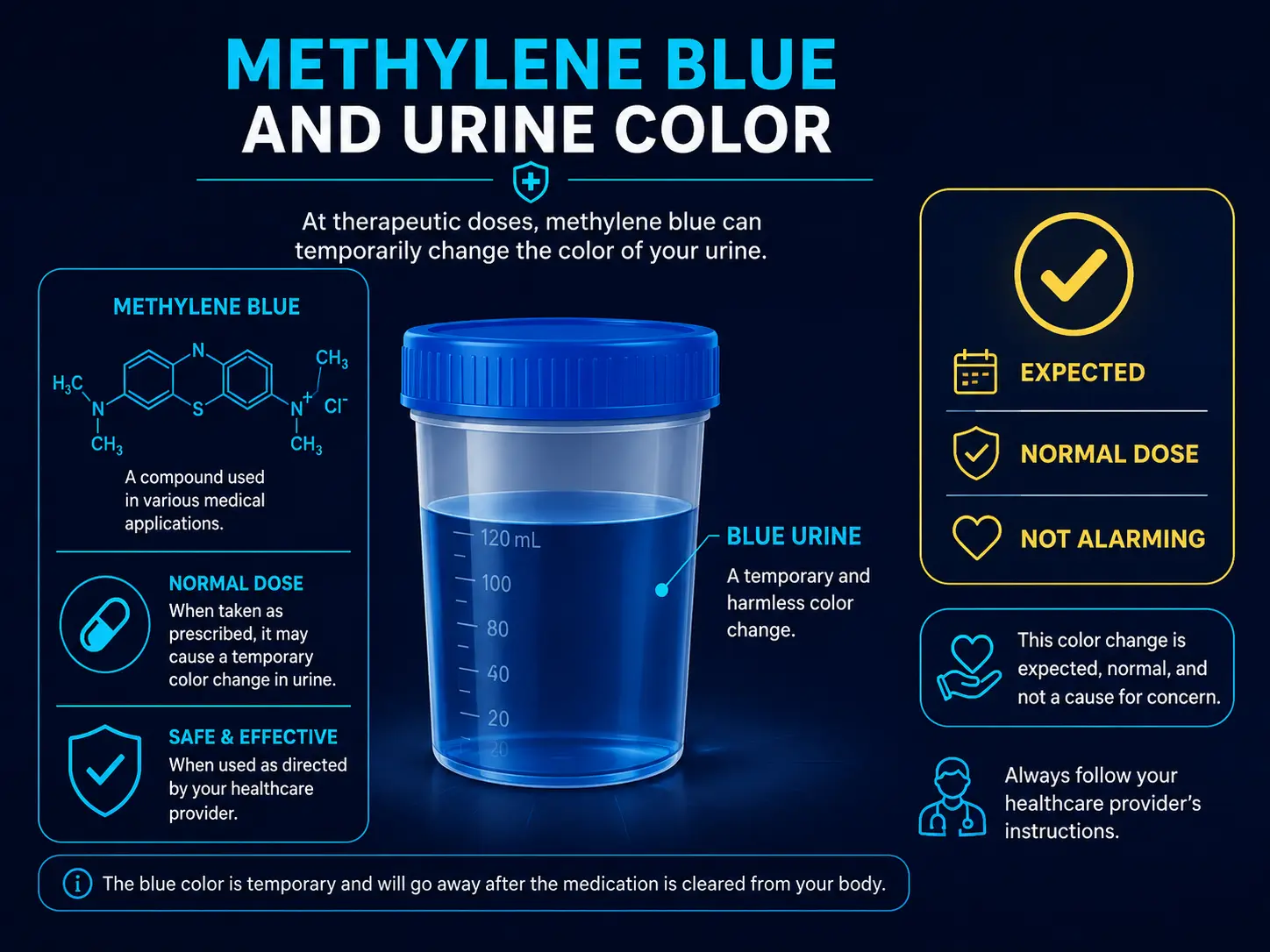
- Other label warnings — hemolysis can occur during treatment, and the onset of anemia may be delayed by a day or more; methylene blue in the blood can make pulse oximetry underestimate oxygen saturation; it can interfere with urine tests that rely on a blue indicator; and confusion, dizziness and visual disturbances can affect driving. In the label’s healthy-volunteer study, chromaturia (discolored urine) was reported by 74% and skin discoloration by 13% of participants, and the label notes that methylene blue may turn the skin and body fluids blue.
- Product grade — the FDA-approved product is a sterile solution for intravenous use, and the label notes that Azure B is a minor impurity in methylene blue. Methylene blue is also used as a dye and stain (FDA 2011; Tardivo 2005); the differences between grades are covered in Pharmaceutical vs Industrial.
Key Research Papers
- U.S. Food and Drug Administration, Drugs@FDA. Methylene blue injection, 5 mg/mL, for intravenous use: prescribing information (NDA 204630), revised November 2023 — accessdata.fda.gov
- U.S. Food and Drug Administration (2011). FDA Drug Safety Communication: Serious CNS reactions possible when methylene blue is given to patients taking certain psychiatric medications. July 26, 2011 (archived copy) — web.archive.org
- U.S. Food and Drug Administration (2011). FDA Drug Safety Communication: Updated information about the drug interaction between methylene blue (methylthioninium chloride) and serotonergic psychiatric medications. October 20, 2011 (archived copy) — web.archive.org
- Rodriguez P, Zhou W, Barrett DW, et al. (2016). Multimodal Randomized Functional MR Imaging of the Effects of Methylene Blue in the Human Brain. Radiology 281(2):516–526 — PubMed PMID: 27351678
- Rojas JC, Bruchey AK, Gonzalez-Lima F (2012). Neurometabolic mechanisms for memory enhancement and neuroprotection of methylene blue. Progress in Neurobiology 96(1):32–45 (review) — PubMed PMID: 22067440
- Bruchey AK, Gonzalez-Lima F (2008). Behavioral, Physiological and Biochemical Hormetic Responses to the Autoxidizable Dye Methylene Blue. American Journal of Pharmacology and Toxicology 3(1):72–79 (review) — PubMed PMID: 20463863
- Wischik CM, Staff RT, Wischik DJ, et al. (2015). Tau aggregation inhibitor therapy: an exploratory phase 2 study in mild or moderate Alzheimer's disease. Journal of Alzheimer’s Disease 44(2):705–20 — PubMed PMID: 25550228
- Alda M, McKinnon M, Blagdon R, et al. (2017). Methylene blue treatment for residual symptoms of bipolar disorder: randomised crossover study. British Journal of Psychiatry 210(1):54–60 — PubMed PMID: 27284082
- Levin RL, Degrange MA, Bruno GF, et al. (2004). Methylene blue reduces mortality and morbidity in vasoplegic patients after cardiac surgery. Annals of Thoracic Surgery 77(2):496–9 — PubMed PMID: 14759425
- Kirov MY, Evgenov OV, Evgenov NV, et al. (2001). Infusion of methylene blue in human septic shock: a pilot, randomized, controlled study. Critical Care Medicine 29(10):1860–7 — PubMed PMID: 11588440
- Juffermans NP, Vervloet MG, Daemen-Gubbels CR, et al. (2010). A dose-finding study of methylene blue to inhibit nitric oxide actions in the hemodynamics of human septic shock. Nitric Oxide 22(4):275–80 — PubMed PMID: 20109575
- Hosseinian L, Weiner M, Levin MA, Fischer GW (2016). Methylene Blue: Magic Bullet for Vasoplegia? Anesthesia & Analgesia 122(1):194–201 (review) — PubMed PMID: 26678471
- Pelgrims J, De Vos F, Van den Brande J, et al. (2000). Methylene blue in the treatment and prevention of ifosfamide-induced encephalopathy: report of 12 cases and a review of the literature. British Journal of Cancer 82(2):291–4 (case series) — PubMed PMID: 10646879
- Müller O, Mockenhaupt FP, Marks B, et al. (2013). Haemolysis risk in methylene blue treatment of G6PD-sufficient and G6PD-deficient West-African children with uncomplicated falciparum malaria: a synopsis of four RCTs. Pharmacoepidemiology and Drug Safety 22(4):376–85 (pooled analysis of four trials) — PubMed PMID: 23135803
- Walter-Sack I, Rengelshausen J, Oberwittler H, et al. (2009). High absolute bioavailability of methylene blue given as an aqueous oral formulation. European Journal of Clinical Pharmacology 65(2):179–89 — PubMed PMID: 18810398
- Peter C, Hongwan D, Küpfer A, Lauterburg BH (2000). Pharmacokinetics and organ distribution of intravenous and oral methylene blue. European Journal of Clinical Pharmacology 56(3):247–50 — PubMed PMID: 10952480
- May JM, Qu ZC, Cobb CE (2004). Reduction and uptake of methylene blue by human erythrocytes. American Journal of Physiology – Cell Physiology 286(6):C1390–8 (cell study) — PubMed PMID: 14973146
- May JM, Qu ZC, Whitesell RR (2003). Generation of oxidant stress in cultured endothelial cells by methylene blue: protective effects of glucose and ascorbic acid. Biochemical Pharmacology 66(5):777–84 (cell study) — PubMed PMID: 12948858
- Suzuki T, Nakamura F, Ie K, et al. (2024). Novel photochromic system using methylene blue reduction with l-ascorbic acid. RSC Advances 14(53):39708–39714 (chemistry study) — PubMed PMID: 39691228
- Komine C, Tsujimoto Y (2013). A small amount of singlet oxygen generated via excited methylene blue by photodynamic therapy induces the sterilization of Enterococcus faecalis. Journal of Endodontics 39(3):411–4 (laboratory study) — PubMed PMID: 23402518
- Tardivo JP, Del Giglio A, de Oliveira CS, et al. (2005). Methylene blue in photodynamic therapy: From basic mechanisms to clinical applications. Photodiagnosis and Photodynamic Therapy 2(3):175–91 (review) — PubMed PMID: 25048768
- Engel Naves Freire A, Macedo Iunes Carrera T, de Oliveira GJPL, et al. (2020). Comparison between Antimicrobial Photodynamic Therapy and Low-level laser therapy on non-surgical periodontal treatment: A Clinical Study. Photodiagnosis and Photodynamic Therapy 31:101756 — PubMed PMID: 32302705
- Marzabadi EA, Meftahi GH, Refahi S (2022). Pretreatment with combined low-level laser therapy and methylene blue improves learning and memory in sleep-deprived mice. Lasers in Medical Science 37(5):2403–2412 (mouse study) — PubMed PMID: 35059872
- Hamper M, Cassano P, Lombard J (2021). Treatment of Kleine-Levin Syndrome With Intranasal Photobiomodulation and Methylene Blue. Cureus 13(10):e18596 (single case report) — PubMed PMID: 34659921
- Liu Y, Tan Y, Cheng G, et al. (2024). Customized Intranasal Hydrogel Delivering Methylene Blue Ameliorates Cognitive Dysfunction against Alzheimer's Disease. Advanced Materials 36(19):e2307081 (mouse study) — PubMed PMID: 38395039
- Peng G, Pan W, Cai Z, et al. (2025). Intranasal methylene blue administration confers neuroprotection in rats subjected to exhaustive exercise training. Frontiers in Behavioral Neuroscience 19:1648837 (rat study) — PubMed PMID: 41064749
PubMed Topic Searches
Connections
- Methylene Blue
- Mitochondrial Mechanism and Bioenergetics
- Methemoglobinemia and G6PD Deficiency
- Drug Interactions and Serotonin Syndrome
- Pharmaceutical Grade vs Industrial Dye
- Cognitive Enhancement and ADHD
- Photodynamic Therapy and Cancer Research
- History: Ehrlich and Phenothiazines
- Methylene Blue and Long COVID
- Vitamin C
- Oxidative Stress
- Longevity Protocols
- Malaria
- Depression
- NAD and NMN
- All Remedies