Melatonin Dosing and Safety
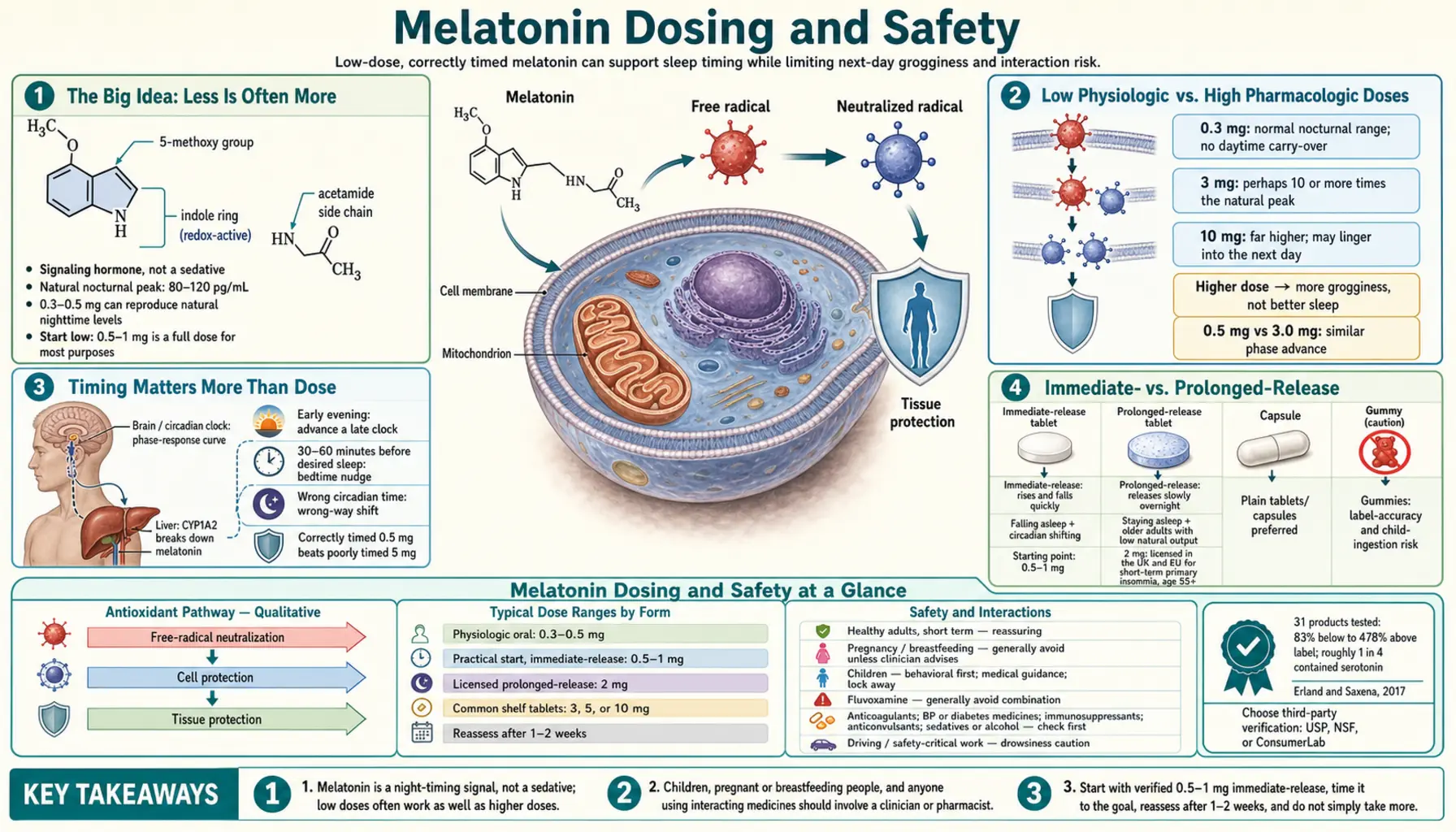
If you read only one page about melatonin, make it this one. The single most common mistake is taking too much: the typical 3, 5, or 10 mg tablets on store shelves deliver blood levels many times higher than the body ever makes naturally, yet study after study shows a small 0.5–1 mg dose often works just as well — with less next-day grogginess. With melatonin, timing matters more than amount, and more is frequently worse. Melatonin is genuinely one of the safer sleep aids for short-term use, but it is not free of concerns: it interacts with several important medications, the evidence in pregnancy and young children is thin, and — because it is sold as an unregulated supplement in the United States — the amount in the bottle can be wildly different from the label. This page covers dose, timing, side effects, interactions, special populations, and product quality.
Table of Contents
- The Big Idea: Less Is Often More
- Low Physiologic vs. High Pharmacologic Doses
- Timing Matters More Than Dose
- Immediate- vs. Prolonged-Release
- Grogginess, Hangover, and Vivid Dreams
- General Safety Profile
- Drug Interactions
- Children and Adolescents
- Pregnancy and Breastfeeding
- Supplement Quality and Mislabeling
- Who Should Be Cautious: Bottom Line
- Key Research Papers
- Connections
- Featured Videos
The Big Idea: Less Is Often More
At night, the healthy adult pineal gland raises blood melatonin from a daytime baseline near zero to a nocturnal peak of roughly 80–120 picograms per milliliter. A 0.3–0.5 mg oral dose is enough to reproduce those natural nighttime levels. A common 3 mg tablet pushes blood melatonin to perhaps 10 or more times the natural peak; a 10 mg dose, far higher still. Those supraphysiologic levels do not clear by morning — they can linger into the next day, which is precisely why high doses cause grogginess without improving sleep.
This is counterintuitive because with most remedies we assume a bigger dose does more. Melatonin is a signaling hormone, not a sedative to be titrated upward: once the receptors have received the "it is night" message, additional melatonin adds little benefit and mostly adds side effects. The practical rule that follows — start low, and treat 0.5–1 mg as a full dose for most purposes — is one of the best-supported and least-followed pieces of advice in the supplement world.
Low Physiologic vs. High Pharmacologic Doses
The evidence that low doses match or beat high doses is consistent across independent research groups:
- Zhdanova and colleagues (2001) tested melatonin for age-related insomnia and found that a 0.3 mg physiologic dose restored sleep as effectively as a 3 mg dose — and, unlike the higher dose, it produced blood levels within the normal nocturnal range and did not cause daytime carry-over. Higher doses left melatonin elevated into the day.
- Burgess and colleagues (2010) compared 0.5 mg versus 3.0 mg for shifting the body clock and found the small dose produced a similar phase advance. For the circadian-timing purpose, 0.5 mg did the job.
- Reviews of jet lag (Herxheimer and Petrie, 2002) likewise found doses from 0.5 to 5 mg similarly effective for realignment, with no added benefit above 5 mg.
So why are 5 and 10 mg products everywhere? Largely marketing and the intuition that "stronger = better," not evidence. There are a few niche exceptions where clinicians deliberately use higher doses (for example some pediatric neurodevelopmental protocols, or specific research settings), but for ordinary sleep-timing and jet lag, the science points firmly to low doses. If a low dose is not helping, the fix is usually to correct the timing (next section) or to reconsider whether melatonin is the right tool at all — not simply to swallow more.
Timing Matters More Than Dose
Because melatonin shifts the clock along a phase-response curve, when you take it determines what it does — often more than how much you take:
- To fall asleep earlier (advance a late clock), a small dose in the early evening, a few hours before your current sleep time, is more effective than a big dose at bedtime.
- For a simple bedtime nudge, 30–60 minutes before the desired sleep time is typical.
- Taken at the wrong circadian time, melatonin can shift the clock the wrong way and worsen the problem — a real risk for jet lag and shift work.
The Sleep & Circadian Rhythm and Jet Lag & Shift Work pages give the direction-specific timing rules. The headline for this page: a correctly timed 0.5 mg beats a poorly timed 5 mg.
Immediate- vs. Prolonged-Release
Immediate-release melatonin rises and falls quickly, mimicking a brief nighttime pulse. It is best suited to problems of falling asleep and to circadian shifting, and it is the form used in most jet-lag protocols.
Prolonged- (or extended-) release melatonin is engineered to release slowly over the night, more closely imitating the body's natural overnight melatonin curve. It is aimed at problems of staying asleep and at older adults with low natural output. In the UK and EU, a 2 mg prolonged-release product (Circadin) is a licensed prescription medicine for short-term treatment of primary insomnia in adults aged 55 and older, based on trials by Wade and Lemoine and colleagues showing improved sleep quality and morning alertness with no withdrawal effects. The existence of a regulated prescription melatonin in many countries is a useful reminder that this is a genuine pharmacologic agent, not a benign "food."
Grogginess, Hangover, and Vivid Dreams
Melatonin's side effects are usually mild and dose-related. The most common:
- Daytime drowsiness / "melatonin hangover" — the most frequent complaint, and largely a consequence of taking too much or too late, so that supraphysiologic levels persist into the morning. Lowering the dose often resolves it.
- Headache and dizziness.
- Nausea.
- Vivid dreams or nightmares — commonly reported, more often at higher doses.
- Transient low mood or irritability in some people.
- A drop in body temperature and, in some individuals, a mild blood-pressure or heart-rate effect.
Importantly, unlike benzodiazepines and "Z-drugs," melatonin is not known to cause dependence, tolerance, or a withdrawal syndrome, and it does not appear to impair next-day performance the way sedative-hypnotics can — provided the dose and timing are sensible. Because it can cause drowsiness, do not drive or operate machinery until you know how it affects you.
General Safety Profile
For short-term use in healthy adults, melatonin has a reassuring safety record. Systematic reviews of adverse events (for example Besag and colleagues, 2019, and Foley and Steel, 2019) find that reported side effects are generally mild, transient, and not clearly more frequent than placebo in many trials, and that Andersen and colleagues' 2016 review concluded melatonin is safe for short-term use. There is no established lethal overdose in adults, and acute toxicity from a single large ingestion is typically limited to drowsiness and grogginess.
The honest gaps are about the long term. High-quality data on daily use for many months or years are limited, and questions about effects on hormonal axes with chronic use have not been fully resolved. Prudence favors using the lowest effective dose, using it intermittently or for defined periods where possible, and revisiting the need periodically rather than assuming indefinite nightly use is proven safe.
Drug Interactions
This is where melatonin's "natural" reputation misleads people. It has several meaningful interactions:
- Fluvoxamine and other CYP1A2 inhibitors. Melatonin is broken down mainly by the liver enzyme CYP1A2. The antidepressant fluvoxamine is a potent CYP1A2 inhibitor and can raise melatonin blood levels dramatically (studies report many-fold increases), greatly amplifying its effect. This combination should generally be avoided. Some quinolone antibiotics (e.g. ciprofloxacin), cimetidine, and oral contraceptives (see below) also inhibit CYP1A2 and can raise melatonin levels.
- Oral contraceptives / estrogens raise melatonin levels by slowing its breakdown; effects may be stronger than expected on the usual dose.
- Tobacco smoking induces CYP1A2 and lowers melatonin levels — smokers may notice less effect, and quitting can change how a given dose feels. Caffeine shares the CYP1A2 pathway and can interact modestly.
- Sedatives, benzodiazepines, "Z-drugs," alcohol, and other CNS depressants can have additive drowsiness with melatonin.
- Anticoagulants and antiplatelet drugs (warfarin, and others). There are reports suggesting melatonin might increase bleeding risk; use caution and inform your clinician.
- Blood-pressure medications. Melatonin can influence blood pressure; interactions are complex (some blood-pressure drugs, such as beta-blockers, actually suppress the body's own melatonin). Monitor if you are treated for hypertension.
- Diabetes / blood-sugar medications. Melatonin signaling is linked to glucose regulation (the MTNR1B melatonin-receptor gene is a recognized type-2-diabetes risk locus), and melatonin may affect glucose tolerance; people with diabetes should monitor and discuss with their clinician.
- Immunosuppressants. Melatonin has immune-modulating (generally immune-stimulating) effects, so caution is advised in people on immunosuppressive therapy, transplant recipients, or those with active autoimmune disease.
- Anticonvulsants / seizure threshold. Evidence is mixed; because of uncertainty, melatonin should be used cautiously in people with seizure disorders and under medical guidance, particularly in neurologically impaired children.
Anyone taking prescription medication — especially the drugs above — should check with a pharmacist or clinician before starting melatonin. A pharmacist is an excellent, accessible resource for this.
Children and Adolescents
Melatonin use in children has risen sharply, and it deserves careful handling:
- Behavioral approaches come first. For most childhood sleep problems, consistent bedtimes, wind-down routines, limiting evening screens, and good sleep hygiene are the recommended first line, not a supplement.
- The best evidence is in specific groups. Randomized trials — notably Gringras and colleagues (2017) with a pediatric prolonged-release formulation — support melatonin for sleep-onset problems in children with autism spectrum disorder and some other neurodevelopmental conditions (e.g. ADHD), where it can meaningfully improve sleep onset. This is the strongest pediatric use case.
- Use the lowest effective dose, under medical guidance. Because melatonin is a hormone and children are still developing, long-term effects (including any influence on the timing of puberty) have not been fully established; this uncertainty argues for the smallest dose that works, defined treatment periods, and clinician involvement — not routine indefinite self-treatment.
- Accidental overdose is a real and growing hazard. Sweet, candy-like gummies have driven a large increase in accidental pediatric ingestions and poison-control calls. Store melatonin like a medication — out of reach, in child-resistant packaging — and be aware that gummy products are among the worst for label accuracy (see below).
Pregnancy and Breastfeeding
Here the honest answer is we do not have enough safety data, so caution is warranted. Melatonin crosses the placenta and passes into breast milk. While maternal melatonin has genuine roles in pregnancy physiology, the safety of supplemental doses — particularly the supraphysiologic amounts in common products — has not been established in well-designed human trials. The general guidance is to avoid melatonin supplements during pregnancy and breastfeeding unless specifically advised by a clinician who judges the benefit to outweigh the unknowns. This is a place to be conservative rather than to experiment.
Supplement Quality and Mislabeling
In the United States, melatonin is sold as a dietary supplement, which means it is not tested or approved by the FDA for content or purity before sale. That regulatory gap produces a startling real-world problem, documented most clearly by Erland and Saxena (2017) in the Journal of Clinical Sleep Medicine. They analyzed 31 commercial melatonin supplements and found:
- Actual melatonin content ranged from about 83% below to 478% above the amount stated on the label.
- The great majority of products did not contain melatonin within 10% of the labeled dose, and content varied substantially even lot to lot within the same brand.
- Roughly one in four products also contained serotonin, an unlabeled and potentially problematic contaminant.
The practical consequences are large: a "3 mg" gummy might really deliver anywhere from a fraction of a milligram to well over 10 mg, making the low-dose principle impossible to follow reliably and raising the odds of grogginess or accidental overdose (a key issue for children). Sensible steps:
- Choose products with independent third-party verification — look for a USP Verified mark or testing by NSF or ConsumerLab.
- Prefer plain tablets/capsules over gummies, which had some of the worst accuracy and are the most tempting to children.
- Recognize that in countries where melatonin is a regulated prescription medicine, dose accuracy is far more dependable.
Who Should Be Cautious: Bottom Line
Melatonin is reasonable for many adults to try for short-term sleep-timing problems and jet lag, at a low dose and the right time. Be especially cautious — and involve a clinician — if you:
- Are pregnant or breastfeeding (generally avoid).
- Are giving it to a child (behavioral first; lowest dose; medical guidance; lock it away).
- Take fluvoxamine, anticoagulants, blood-pressure or diabetes medications, immunosuppressants, anticonvulsants, or other sedatives.
- Have an autoimmune disease or are a transplant recipient.
- Need to drive or do safety-critical work soon after a dose.
- Have chronic insomnia that is not a timing problem — pursue CBT-I and rule out apnea, restless legs, pain, and mood disorders rather than escalating the dose.
Practical starting point for a healthy adult: a third-party-verified 0.5–1 mg immediate-release product, taken at the right time for your goal, reassessed after one to two weeks. If it is not helping, fix the timing or reconsider the approach — do not simply take more. This is general education, not medical advice; individual circumstances vary, and a clinician or pharmacist can tailor it to you.
Key Research Papers
- Zhdanova IV, Wurtman RJ, Regan MM, et al. (2001). Melatonin treatment for age-related insomnia. Journal of Clinical Endocrinology & Metabolism. — PubMed
- Erland LA, Saxena PK (2017). Melatonin natural health products and supplements: presence of serotonin and significant variability of melatonin content. Journal of Clinical Sleep Medicine. — PubMed
- Andersen LPH, Gøgenur I, Rosenberg J, Reiter RJ (2016). The safety of melatonin in humans. Clinical Drug Investigation. — PubMed
- Besag FMC, Vasey MJ, Lao KSJ, Wong ICK (2019). Adverse events associated with melatonin for the treatment of primary or secondary sleep disorders: a systematic review. CNS Drugs. — PubMed
- Foley HM, Steel AE (2019). Adverse events associated with oral administration of melatonin: a critical systematic review of clinical evidence. Complementary Therapies in Medicine. — PubMed
- Burgess HJ, Revell VL, Molina TA, Eastman CI (2010). Human phase response curves to three days of daily melatonin: 0.5 mg versus 3.0 mg. Journal of Clinical Endocrinology & Metabolism. — PubMed
- Gringras P, Nir T, Breddy J, Frydman-Marom A, Findling RL (2017). Efficacy and safety of pediatric prolonged-release melatonin for insomnia in children with autism spectrum disorder. Journal of the American Academy of Child & Adolescent Psychiatry. — PubMed
- Härtter S, Grozinger M, Weigmann H, et al. (2000). Increased bioavailability of oral melatonin after fluvoxamine coadministration. Clinical Pharmacology & Therapeutics. — PubMed
- Lelak K, Vohra V, Neuman MI, Toce MS, Sethuraman U (2022). Pediatric melatonin ingestions and increasing accessibility. MMWR / pediatric ingestion trends. — PubMed
- Wade AG, Ford I, Crawford G, et al. (2007). Efficacy of prolonged release melatonin in insomnia patients aged 55–80 years. Current Medical Research and Opinion. — PubMed
- Costello RB, Lentino CV, Boyd CC, et al. (2014). The effectiveness of melatonin for promoting healthy sleep: a rapid evidence assessment of the literature. Nutrition Journal. — PubMed
PubMed Topic Searches
- PubMed: Melatonin dose-response
- PubMed: Melatonin drug interactions
- PubMed: Melatonin supplement label accuracy
- PubMed: Melatonin in children
- PubMed: Melatonin in pregnancy
External Authoritative Resources
- NIH NCCIH — Melatonin: What You Need To Know (dose, safety, and children)
- MedlinePlus — Melatonin (interactions and cautions)
- Poison Control — Melatonin (accidental ingestion guidance)
- USP Verified Mark (what third-party supplement verification means)
Connections
- Melatonin (Main Page)
- Melatonin Benefits Hub
- Melatonin for Sleep & Circadian Rhythm
- Melatonin for Jet Lag & Shift Work
- Melatonin as Antioxidant
- Insomnia
- Tryptophan
- L-Theanine
- Magnesium
- Valerian
- Chamomile
- Depression
- Endocrinology
- All Antioxidants