Melatonin — Benefits Deep Dive
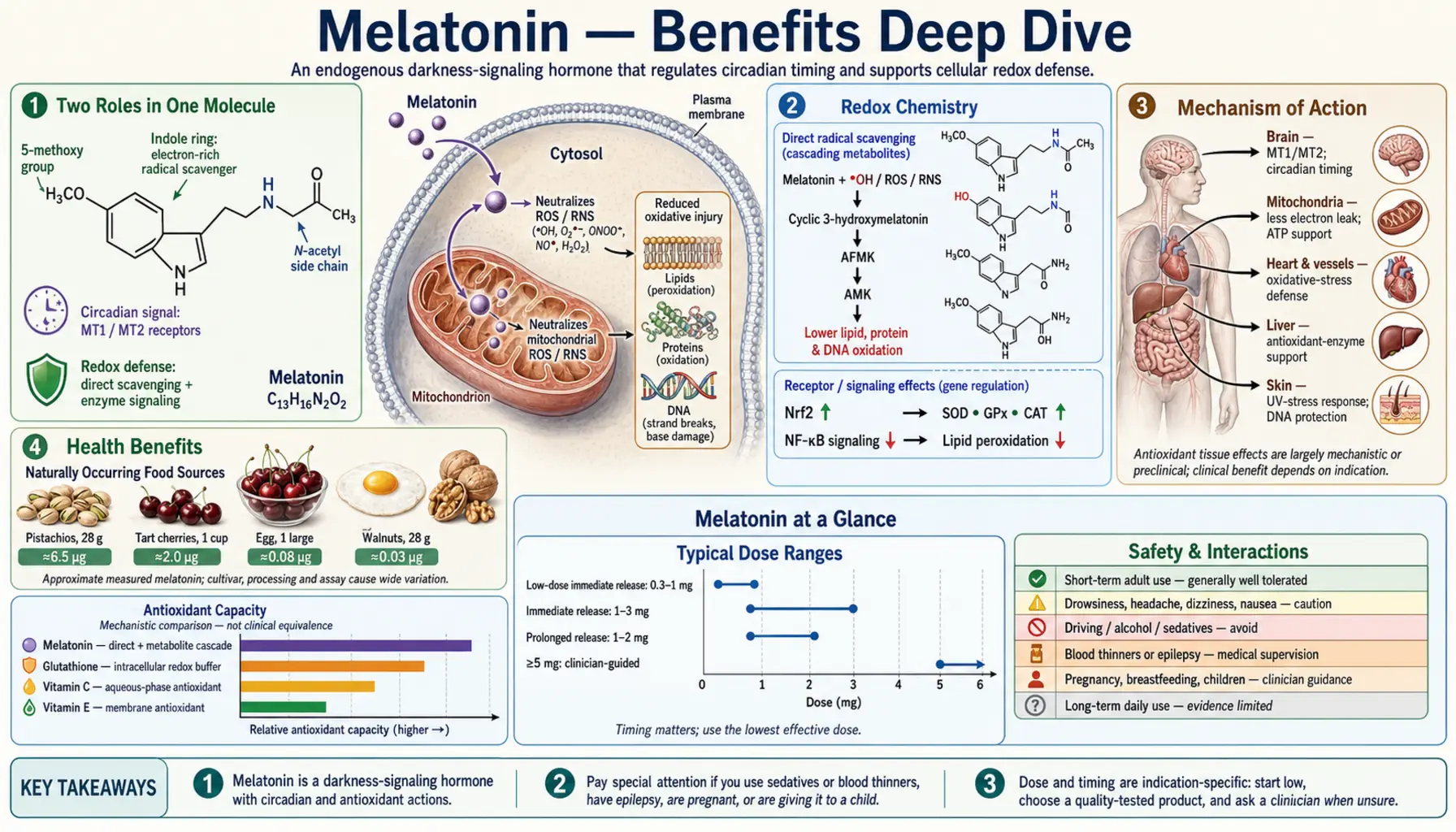
Melatonin is one of the few molecules the body uses in two entirely different ways. It is a hormone — secreted by the pineal gland only in darkness, it is the chemical signal that tells every cell "it is biological night," setting the timing of sleep, body temperature, and dozens of daily rhythms. It is also a direct antioxidant — a small, cheap free-radical scavenger that is unusually concentrated inside mitochondria, where most cellular oxidation happens. The honest picture is that these two roles rest on very different amounts of evidence. Melatonin's value as a circadian timer (delayed sleep phase, jet lag, non-24-hour rhythm in the blind, older adults with low natural output) is well established in human trials. Its value as a sedative sleeping pill is real but modest. And its dramatic antioxidant and mitochondrial actions, while genuine in the test tube and in animals, remain largely unproven as human therapy. The four deep-dive pages below explore each role — and, crucially, why with melatonin the timing and the dose matter more than most people assume.
Deep-Dive Articles
Sleep & Circadian Rhythm
Melatonin's best-proven use: a chronobiotic that shifts the body clock, not a strong hypnotic. Honest effect sizes from the major meta-analyses (roughly 7 minutes faster sleep onset, 8–13 minutes more total sleep), why it works best for delayed sleep phase, older adults, and the blind, and why it is weaker than prescription hypnotics as a general "sleeping pill."
Antioxidant & Mitochondria
Melatonin's "other" job: a direct hydroxyl-radical and peroxynitrite scavenger whose breakdown products are also antioxidants (the AFMK/AMK cascade), synthesized inside mitochondria themselves. The biochemistry is striking — but we are honest that most of this evidence is preclinical, and human antioxidant benefit is still being tested.
Jet Lag & Shift Work
Where circadian timing becomes practical. The Cochrane evidence that melatonin is "remarkably effective" for jet lag across five or more time zones, the phase-response-curve rules for eastward vs. westward travel, how to combine it with strategic light, and the more sobering, weaker evidence for rotating shift work.
Dosing & Safety
The most practical page: why low physiologic doses (0.5–1 mg) often work as well as 3–10 mg, why timing beats dose, grogginess and "hangover," drug interactions (fluvoxamine, warfarin, blood-pressure drugs), children and pregnancy cautions, and the supplement-quality problem — one study found actual content ranged from 83% below to 478% above the label.
Table of Contents
- Deep-Dive Articles
- Two Roles in One Molecule
- Research Papers: Sleep & Circadian Timing
- Research Papers: Antioxidant & Mitochondria
- Research Papers: Jet Lag & Shift Work
- Research Papers: Dosing, Safety & Quality
- Research Papers: Physiology & Special Populations
- External Authoritative Resources
- Connections
- Featured Videos
Two Roles in One Molecule
Most supplement molecules do one thing. Melatonin does two, and keeping them separate is the key to understanding it honestly.
1. Melatonin the hormone (circadian signal). A pea-sized gland deep in the brain — the pineal gland — converts the amino acid tryptophan (via serotonin) into melatonin, but only when the eyes report darkness. Bright light, especially blue-rich light, suppresses it within minutes. So blood melatonin is essentially a chemical clock hand: high at night, near-zero by day. Cells throughout the body carry MT1 and MT2 receptors that "read" this signal and align their own activity to it. This is why melatonin is called a chronobiotic — an agent that shifts the timing of the body clock — rather than a sedative. It does not knock you out; it tells your physiology that night has arrived. That distinction explains almost everything about how melatonin succeeds and where it disappoints.
2. Melatonin the antioxidant. Independent of receptors, the melatonin molecule is a potent, broad-spectrum free-radical scavenger. It is amphiphilic (it dissolves in both water and fat), so it reaches compartments many antioxidants cannot, and it accumulates especially in mitochondria — the cellular power plants that generate most reactive oxygen species. Remarkably, when melatonin neutralizes a radical its own breakdown products (cyclic-3-hydroxymelatonin, AFMK, and AMK) are themselves antioxidants, so one molecule can quench several radicals in a cascade. It also up-regulates the body's own antioxidant enzymes (superoxide dismutase, glutathione peroxidase, catalase). Evolutionary biologists note melatonin appears in bacteria, plants, and nearly all animals, and argue its original function billions of years ago was antioxidant protection, with the hormone role evolving later.
The honesty that matters. These two roles do not carry equal clinical proof. The circadian-hormone role is supported by dozens of randomized human trials and is the basis for melatonin's legitimate medical uses. The antioxidant role is spectacular in cell cultures and animal models — and mechanistically real — but human trials showing that swallowing melatonin meaningfully reduces disease through antioxidant action are still preliminary. Throughout these pages we keep the two straight, and we resist the common marketing move of borrowing the strength of the sleep evidence to sell the antioxidant claims (or vice versa).
Research Papers: Sleep & Circadian Timing
- Ferracioli-Oda E, Qureshi IA, Bloch MH (2013). Meta-analysis: melatonin for the treatment of primary sleep disorders. PLoS One. — PubMed
- Brzezinski A, Vangel MG, Wurtman RJ, et al. (2005). Effects of exogenous melatonin on sleep: a meta-analysis. Sleep Medicine Reviews. — PubMed
- Buscemi N, Vandermeer B, Hooton N, et al. (2005). The efficacy and safety of exogenous melatonin for primary sleep disorders: a meta-analysis. Journal of General Internal Medicine. — PubMed
- van Geijlswijk IM, Korzilius HPLM, Smits MG (2010). The use of exogenous melatonin in delayed sleep phase disorder: a meta-analysis. Sleep. — PubMed
- Zhdanova IV, Wurtman RJ, Regan MM, et al. (2001). Melatonin treatment for age-related insomnia. Journal of Clinical Endocrinology & Metabolism. — PubMed
- Wade AG, Ford I, Crawford G, et al. (2007). Efficacy of prolonged release melatonin in insomnia patients aged 55–80 years. Current Medical Research and Opinion. — PubMed
- Lewy AJ, Ahmed S, Latham Jackson JM, Sack RL (1992). Melatonin shifts human circadian rhythms according to a phase-response curve. Chronobiology International. — PubMed
- Arendt J, Skene DJ (2005). Melatonin as a chronobiotic. Sleep Medicine Reviews. — PubMed
Research Papers: Antioxidant & Mitochondria
- Reiter RJ, Mayo JC, Tan DX, Sainz RM, Alatorre-Jimenez M, Qin L (2016). Melatonin as an antioxidant: under promises but over delivers. Journal of Pineal Research. — PubMed
- Galano A, Tan DX, Reiter RJ (2011). Melatonin as a natural ally against oxidative stress: a physicochemical examination. Journal of Pineal Research. — PubMed
- Reiter RJ, Tan DX, Rosales-Corral S, Galano A, Zhou XJ, Xu B (2018). Mitochondria: central organelles for melatonin's antioxidant and anti-aging actions. Molecules. — PubMed
- Tan DX, Manchester LC, Qin L, Reiter RJ (2016). Melatonin: a mitochondria-targeted molecule. International Journal of Molecular Sciences. — PubMed
- Hardeland R (2005). Antioxidative protection by melatonin: multiplicity of mechanisms from radical detoxification to radical avoidance. Endocrine. — PubMed
- Rodriguez C, Mayo JC, Sainz RM, et al. (2004). Regulation of antioxidant enzymes: a significant role for melatonin. Journal of Pineal Research. — PubMed
Research Papers: Jet Lag & Shift Work
- Herxheimer A, Petrie KJ (2002). Melatonin for the prevention and treatment of jet lag. Cochrane Database of Systematic Reviews. — PubMed
- Sack RL (2010). Clinical practice. Jet lag. New England Journal of Medicine. — PubMed
- Burgess HJ, Revell VL, Molina TA, Eastman CI (2010). Human phase response curves to three days of daily melatonin: 0.5 mg versus 3.0 mg. Journal of Clinical Endocrinology & Metabolism. — PubMed
- Liira J, Verbeek JH, Costa G, et al. (2014). Pharmacological interventions for sleepiness and sleep disturbances caused by shift work. Cochrane Database of Systematic Reviews. — PubMed
- Arendt J (2009). Managing jet lag: some of the problems and possible new solutions. Sleep Medicine Reviews. — PubMed
Research Papers: Dosing, Safety & Quality
- Erland LA, Saxena PK (2017). Melatonin natural health products and supplements: presence of serotonin and significant variability of melatonin content. Journal of Clinical Sleep Medicine. — PubMed
- Andersen LPH, Gøgenur I, Rosenberg J, Reiter RJ (2016). The safety of melatonin in humans. Clinical Drug Investigation. — PubMed
- Besag FMC, Vasey MJ, Lao KSJ, Wong ICK (2019). Adverse events associated with melatonin for the treatment of primary or secondary sleep disorders: a systematic review. CNS Drugs. — PubMed
- Foley HM, Steel AE (2019). Adverse events associated with oral administration of melatonin: a critical systematic review of clinical evidence. Complementary Therapies in Medicine. — PubMed
- Gringras P, Nir T, Breddy J, Frydman-Marom A, Findling RL (2017). Efficacy and safety of pediatric prolonged-release melatonin for insomnia in children with autism spectrum disorder. Journal of the American Academy of Child & Adolescent Psychiatry. — PubMed
Research Papers: Physiology & Special Populations
- Cipolla-Neto J, Amaral FGD (2018). Melatonin as a hormone: new physiological and clinical insights. Endocrine Reviews. — PubMed
- Zisapel N (2018). New perspectives on the role of melatonin in human sleep, circadian rhythms and their regulation. British Journal of Pharmacology. — PubMed
- Claustrat B, Leston J (2015). Melatonin: physiological effects in humans. Neurochirurgie. — PubMed
- Auld F, Maschauer EL, Morrison I, Skene DJ, Riha RL (2017). Evidence for the efficacy of melatonin in the treatment of primary adult sleep disorders. Sleep Medicine Reviews. — PubMed
- Hardeland R (2019). Aging, melatonin, and the pro- and anti-inflammatory networks. International Journal of Molecular Sciences. — PubMed
External Authoritative Resources
- NIH National Center for Complementary and Integrative Health — Melatonin: What You Need To Know — balanced, plain-language government summary of the evidence
- NIH Office of Dietary Supplements — Fact Sheets (sleep and dietary-supplement resources)
- MedlinePlus — Melatonin (uses, interactions, cautions)
- American Academy of Sleep Medicine (clinical practice guidelines for circadian rhythm sleep-wake disorders)
- PubMed — All research on melatonin (tens of thousands of papers)
Connections
- Melatonin (Main Page)
- Melatonin for Sleep & Circadian Rhythm
- Melatonin as Antioxidant & Mitochondrial Protector
- Melatonin for Jet Lag & Shift Work
- Melatonin Dosing & Safety
- Melatonin: History & Discovery
- All Antioxidants
- Tryptophan (Precursor)
- Magnesium
- L-Theanine
- CoQ10 (Mitochondrial Antioxidant)
- Glutathione
- Insomnia
- Oxidative Stress
- Neurology