Melatonin as an Antioxidant and Mitochondrial Protector
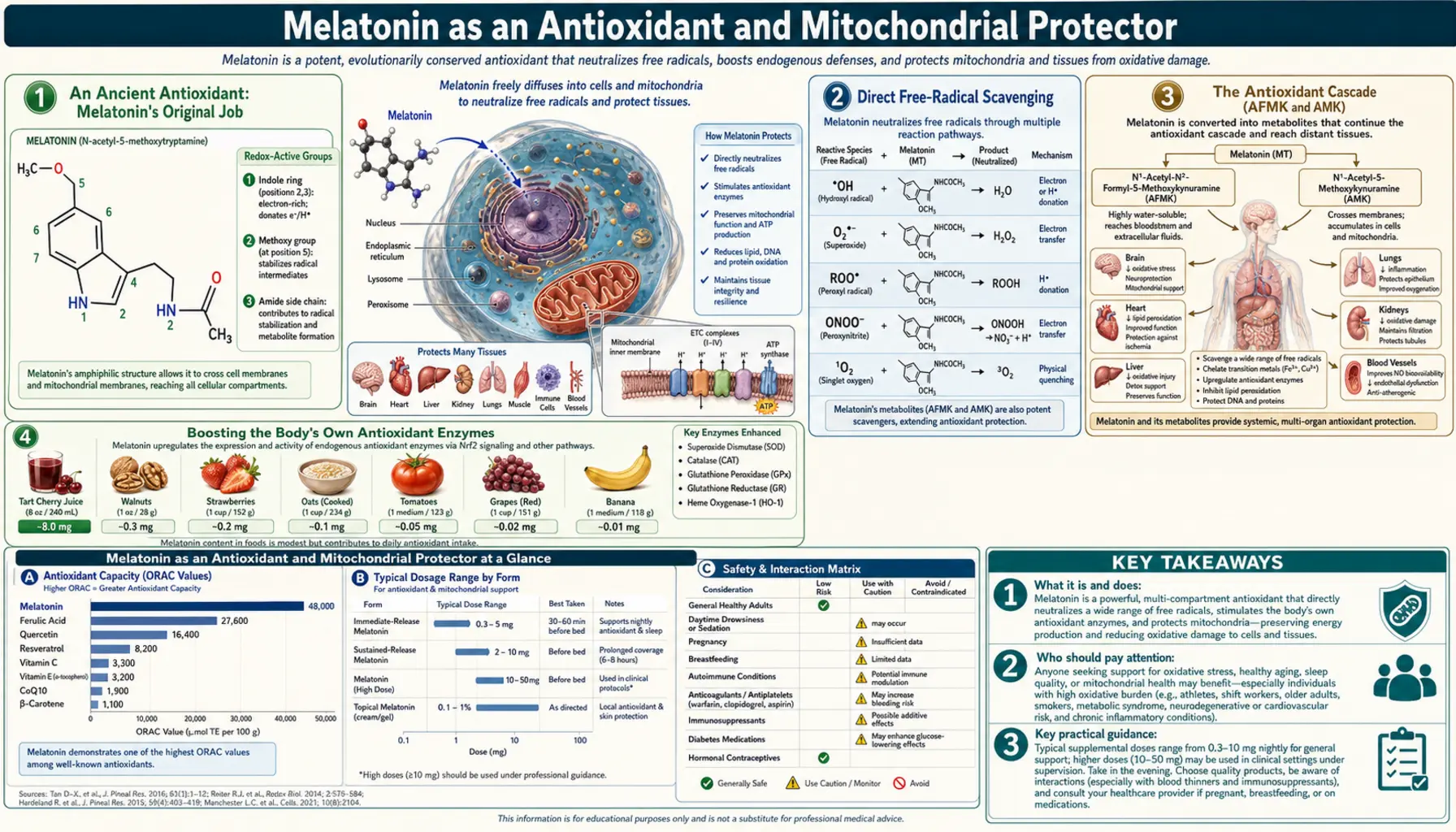
Beyond its familiar role as the sleep hormone, melatonin is one of biology's most versatile antioxidants — and this may in fact be its oldest job, predating its use as a circadian signal by billions of years. Unlike most antioxidants, melatonin dissolves in both water and fat, so it reaches parts of the cell others cannot; it concentrates inside mitochondria, the very site where most damaging free radicals are made; and when it neutralizes a radical, its breakdown products are themselves antioxidants, so a single molecule can mop up several radicals in a cascade. This page lays out that biochemistry honestly — it is genuinely remarkable — while being equally clear about the limit: the great majority of this evidence comes from test tubes and animals. Whether swallowing melatonin delivers meaningful antioxidant protection in living humans is still an open, actively researched question, not a settled fact.
Table of Contents
- An Ancient Antioxidant: Melatonin's Original Job
- Direct Free-Radical Scavenging
- The Antioxidant Cascade (AFMK and AMK)
- Boosting the Body's Own Antioxidant Enzymes
- Mitochondria: Where Melatonin Concentrates
- Melatonin Made Inside the Mitochondria
- What This Might Mean for Aging and Disease
- The Honest Limits: Preclinical vs. Human Evidence
- A Grounded Practical Perspective
- Key Research Papers
- Connections
- Featured Videos
An Ancient Antioxidant: Melatonin's Original Job
Melatonin is not a specialized vertebrate hormone that happens to have antioxidant side effects. It is an ancient molecule found in bacteria, single-celled algae, plants, fungi, insects, and virtually every animal ever tested. Because it appears so early and so universally in the tree of life — long before pineal glands, eyes, or sleep existed — a leading hypothesis (advanced especially by Russel Reiter, Dun-Xian Tan, and colleagues) is that melatonin's first function, in early oxygen-exposed cells, was chemical defense against reactive oxygen species. The circadian-hormone role would have been layered on much later, once melatonin's reliable nightly rhythm made it a convenient timekeeping signal.
This evolutionary framing helps explain an otherwise puzzling fact: melatonin turns up in tissues and fluids far from the pineal gland — the gut, bone marrow, retina, skin, and lens — often at concentrations far higher than in blood, and not following the day-night rhythm. In those places melatonin is not acting as a clock signal at all; it appears to be doing its ancestral job of local antioxidant protection.
Direct Free-Radical Scavenging
Antioxidants fall into two broad camps: those that donate an electron and stop there, and those that can directly detoxify the most dangerous radicals. Melatonin belongs to the second, more useful camp. In laboratory chemistry it directly neutralizes several damaging species:
- The hydroxyl radical (•OH) — the most reactive and destructive oxygen radical in biology, which indiscriminately shreds DNA, proteins, and membrane lipids. Melatonin is a particularly effective hydroxyl scavenger.
- Peroxynitrite and related reactive nitrogen species, which arise when nitric oxide meets superoxide and drive inflammatory tissue damage.
- Peroxyl radicals involved in the chain reaction of lipid peroxidation that damages cell membranes.
- Singlet oxygen and hydrogen peroxide under various conditions.
Two structural features make melatonin unusually well suited to this. First, it is amphiphilic — soluble in both water and lipid — so unlike vitamin E (fat-only) or vitamin C (water-only) it can move through membranes, the cytoplasm, and even into the cell nucleus and mitochondria. Second, it is small and uncharged, so it crosses biological barriers, including the blood-brain barrier, with ease. In other words, melatonin can bring antioxidant capacity to compartments that other antioxidants struggle to reach.
The Antioxidant Cascade (AFMK and AMK)
Here is the feature that most distinguishes melatonin from ordinary antioxidants. When a typical antioxidant reacts with a radical, it is used up — often becoming a mild radical itself that must be regenerated by another antioxidant (this is why vitamin C recycles vitamin E). Melatonin is different: as it is oxidized, it forms a series of metabolites — cyclic 3-hydroxymelatonin, then N1-acetyl-N2-formyl-5-methoxykynuramine (AFMK), then N1-acetyl-5-methoxykynuramine (AMK) — and each of these breakdown products is itself a competent free-radical scavenger.
Researchers call this the antioxidant cascade or "free-radical scavenging cascade." Because one parent melatonin molecule and its successive daughters can each quench radicals, a single melatonin molecule is estimated to neutralize multiple reactive species before the chain is exhausted — a stoichiometric efficiency few other antioxidants match. Galano, Tan, and Reiter's physicochemical analyses (2011 onward) map these reactions in detail and are the basis for the memorable review title "Melatonin as an antioxidant: under promises but over delivers."
Boosting the Body's Own Antioxidant Enzymes
Direct scavenging is only half the story. Melatonin also acts indirectly, appearing to up-regulate the cell's own enzymatic antioxidant defenses. In numerous cell and animal studies, melatonin increases the activity or expression of:
- Superoxide dismutase (SOD) — converts superoxide to hydrogen peroxide (see also selenium, magnesium, and other cofactor minerals that support these systems).
- Glutathione peroxidase (GPx) — a selenium-dependent enzyme that detoxifies peroxides using glutathione.
- Catalase — breaks down hydrogen peroxide into water and oxygen.
- Glutathione reductase and glucose-6-phosphate dehydrogenase, which keep the glutathione pool in its active reduced form.
Some of this indirect action appears to run through Nrf2, the master transcription factor that switches on batteries of antioxidant and detoxification genes. There is also evidence that melatonin lowers the activity of pro-oxidant enzymes such as nitric oxide synthase and lipoxygenase. The upshot is that melatonin does not merely react with radicals one at a time; it seems to shift the whole cell toward a more reduced, better-defended state — at least in preclinical models.
Mitochondria: Where Melatonin Concentrates
Mitochondria are the reason the antioxidant story matters. They generate the cell's energy (ATP) by passing electrons down the respiratory chain, and a small fraction of those electrons inevitably leak to form superoxide. Mitochondria are therefore both the main source of reactive oxygen species and, because their DNA and membranes sit right next to that source, one of the main victims of oxidative damage. Mitochondrial dysfunction is a recurring theme in aging and in neurodegenerative, cardiovascular, and metabolic disease.
Melatonin is unusually concentrated inside mitochondria — levels there appear to exceed those in blood by a wide margin. This is exactly where an antioxidant is most useful: at the point of radical generation, before the damage spreads. In preclinical models melatonin helps stabilize the inner mitochondrial membrane potential, supports efficient electron transport, and reduces the leak of electrons that would otherwise become superoxide. It also inhibits opening of the mitochondrial permeability transition pore, an event that can trigger cell death. Reiter and colleagues have argued (2016–2018) that this mitochondrial targeting is the single most important aspect of melatonin's antioxidant biology.
Other mitochondria-focused antioxidants and cofactors are covered elsewhere on the site: CoQ10 (a component of the respiratory chain itself), PQQ, alpha-lipoic acid, and NAD+/NMN. Melatonin is a distinctive member of this group because it is both fat- and water-soluble and is synthesized on-site, as the next section describes.
Melatonin Made Inside the Mitochondria
One of the more surprising findings of the past decade is that mitochondria appear to make their own melatonin. The enzymes required for the final steps of melatonin synthesis have been detected inside mitochondria, and isolated mitochondria can produce melatonin from precursors. If confirmed and generalized, this means the organelle most exposed to oxidative stress manufactures, on the spot, an antioxidant tuned to protect it — a remarkably elegant local defense system.
This subcellular, non-pineal melatonin does not follow the day-night rhythm and is not the melatonin that makes you sleepy; it is a housekeeping antioxidant pool. It also reframes the question of supplementation: because tissue and mitochondrial melatonin operate somewhat independently of blood levels, it is not obvious that an oral dose timed for sleep meaningfully tops up the antioxidant pool inside a given cell's mitochondria. This is one of several honest uncertainties that the sections below confront directly.
What This Might Mean for Aging and Disease
Because oxidative stress and mitochondrial decline are woven through so many age-related conditions, melatonin's antioxidant biology has been explored in a long list of settings. It is important to read this list as areas of active investigation and mostly preclinical or early-clinical evidence, not as proven treatments:
- Neurodegeneration. In cell and animal models of Alzheimer's and Parkinson's disease, melatonin reduces oxidative markers and protects neurons. Human data are limited and mixed; melatonin is not an established disease-modifying therapy for either condition, though it is sometimes used for the sleep and circadian disruption that accompany them.
- Cardiovascular and metabolic stress. Preclinical work shows protection against ischemia-reperfusion injury and improved markers of oxidative stress; human trials are small and preliminary.
- Migraine. There is more encouraging clinical signal here — some randomized trials suggest melatonin may reduce migraine frequency, plausibly through a mix of antioxidant, anti-inflammatory, and circadian effects — though results are not uniform.
- Aging and inflammation. The age-related fall in melatonin has fueled interest in it as a component of longevity protocols, but robust human evidence that melatonin extends healthspan is lacking.
For the broader science of reactive oxygen species and the body's defenses, see the site's Oxidative Stress overview.
The Honest Limits: Preclinical vs. Human Evidence
This is the most important section on the page. The antioxidant story is scientifically real, but it is easy to oversell, and much of the marketing around melatonin does exactly that. The honest caveats:
- Most evidence is preclinical. The dramatic radical-scavenging chemistry and mitochondrial protection are documented overwhelmingly in test tubes, cell cultures, and rodents — often at melatonin concentrations far higher than a human achieves from an oral dose. Extrapolating from a rat given a large weight-adjusted dose to a person taking 1–3 mg is not straightforward.
- Antioxidant supplements have a humbling track record. The history of antioxidant trials (high-dose vitamin E, beta-carotene, and others) is a cautionary tale: compounds that looked powerful in the lab repeatedly failed — and occasionally harmed — in large human trials. Reactive oxygen species also serve necessary signaling roles, so "more antioxidant" is not automatically better. Melatonin has not been shown to fall into the harmful category, but the general lesson counsels humility.
- Compartment mismatch. As noted above, the antioxidant melatonin pool inside cells and mitochondria is partly independent of blood levels, so it is not established that an oral dose meaningfully raises the antioxidant defense at the sites that matter.
- Human antioxidant endpoints are early. Trials that measure actual disease outcomes (rather than a biomarker of oxidation) are still few and generally small.
None of this means the antioxidant biology is fake — it is some of the most interesting chemistry in the antioxidant field. It means the correct posture is curiosity plus caution: real mechanism, promising early data, unproven as a human antioxidant therapy.
A Grounded Practical Perspective
How should a thoughtful reader hold all this? A few grounded conclusions:
- Use melatonin for what it is proven to do — timing and sleep (see Sleep & Circadian Rhythm and Jet Lag & Shift Work). Do not take it primarily as an "antioxidant supplement" expecting proven disease protection.
- Consider the antioxidant action a plausible bonus, not a reason to escalate the dose. There is no good evidence that megadoses deliver superior antioxidant benefit, and higher doses carry the downsides covered in Dosing & Safety.
- Support the whole antioxidant system through diet and sleep. A colorful whole-food diet, adequate selenium and other cofactors, and good sleep (which supports your own nightly melatonin) do more for your redox balance than any single supplement.
- Watch this space. Melatonin's mitochondrial biology is a genuinely active research frontier; conclusions may firm up in either direction as human trials mature.
Key Research Papers
- Reiter RJ, Mayo JC, Tan DX, Sainz RM, Alatorre-Jimenez M, Qin L (2016). Melatonin as an antioxidant: under promises but over delivers. Journal of Pineal Research. — PubMed
- Galano A, Tan DX, Reiter RJ (2011). Melatonin as a natural ally against oxidative stress: a physicochemical examination. Journal of Pineal Research. — PubMed
- Reiter RJ, Tan DX, Rosales-Corral S, Galano A, Zhou XJ, Xu B (2018). Mitochondria: central organelles for melatonin's antioxidant and anti-aging actions. Molecules. — PubMed
- Tan DX, Manchester LC, Qin L, Reiter RJ (2016). Melatonin: a mitochondria-targeted molecule. International Journal of Molecular Sciences. — PubMed
- Tan DX, Manchester LC, Reiter RJ, et al. (2000). Significance of melatonin in antioxidative defense system: reactions and products. Biological Signals and Receptors. — PubMed
- Hardeland R (2005). Antioxidative protection by melatonin: multiplicity of mechanisms. Endocrine. — PubMed
- Rodriguez C, Mayo JC, Sainz RM, et al. (2004). Regulation of antioxidant enzymes: a significant role for melatonin. Journal of Pineal Research. — PubMed
- Reiter RJ, Tan DX, Galano A (2014). Melatonin: exceeding expectations. Physiology (Bethesda). — PubMed
- Acuña-Castroviejo D, Escames G, Venegas C, et al. (2014). Extrapineal melatonin: sources, regulation, and potential functions. Cellular and Molecular Life Sciences. — PubMed
- Hardeland R (2019). Aging, melatonin, and the pro- and anti-inflammatory networks. International Journal of Molecular Sciences. — PubMed
PubMed Topic Searches
- PubMed: Melatonin free-radical scavenging
- PubMed: Melatonin and mitochondria
- PubMed: AFMK / AMK antioxidant cascade
- PubMed: Melatonin and antioxidant enzymes
- PubMed: Extrapineal / mitochondrial melatonin
External Authoritative Resources
- NIH NCCIH — Antioxidants: In Depth (why lab promise often fails to translate to human benefit)
- NIH NCCIH — Melatonin: What You Need To Know
- PubMed — Melatonin antioxidant reviews
Connections
- Melatonin (Main Page)
- Melatonin Benefits Hub
- Melatonin for Sleep & Circadian Rhythm
- Melatonin Dosing & Safety
- Oxidative Stress
- CoQ10
- Glutathione
- Alpha-Lipoic Acid
- PQQ
- NAD+ / NMN
- Selenium
- Parkinson's Disease
- Migraine
- Longevity Protocols
- All Antioxidants