Grape Seed Extract for Heart Health and Blood Pressure
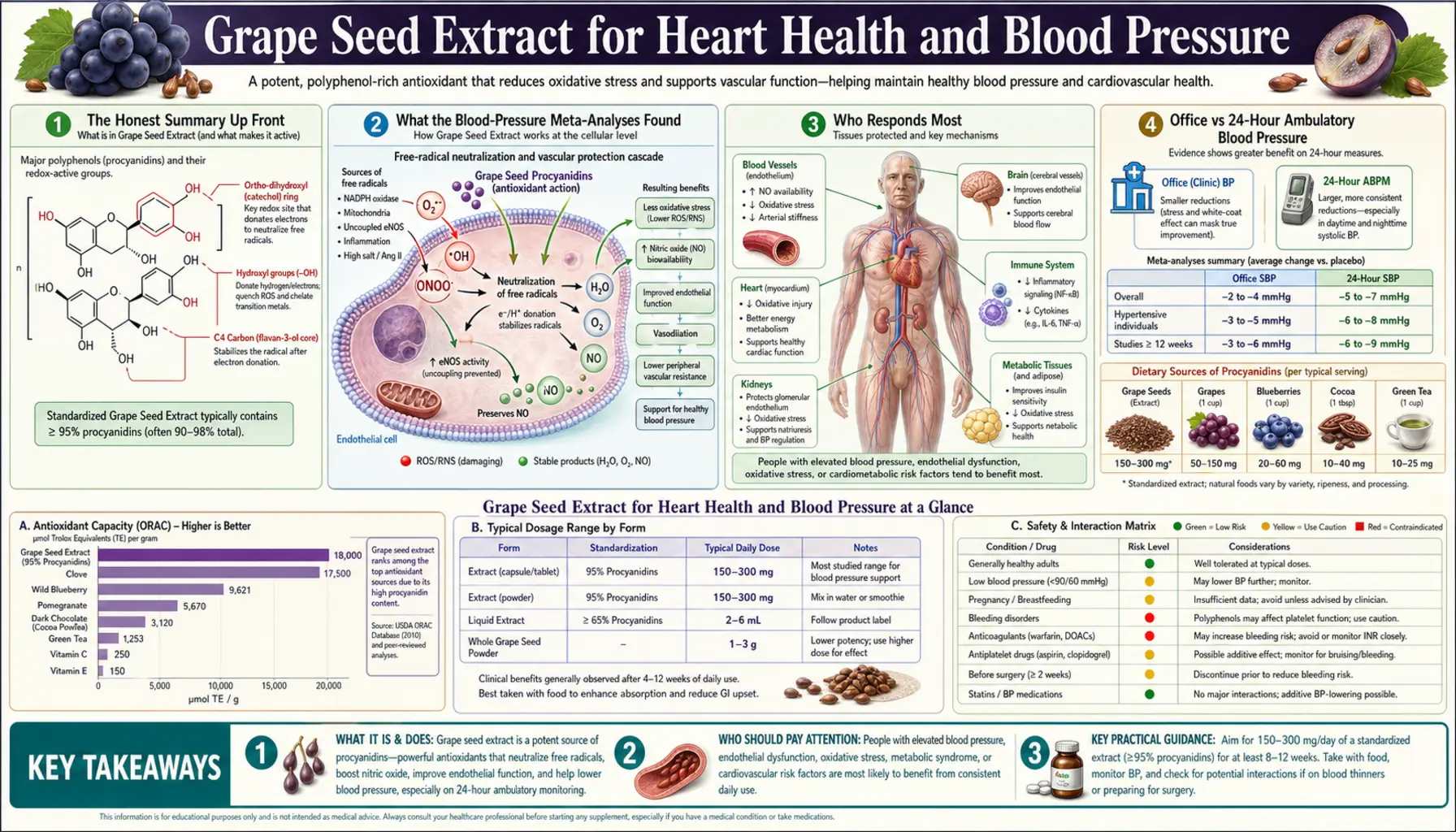
Grape seed extract lowers blood pressure — but the honest headline is that it does so modestly, and mainly in the people who have the most room to improve. Several meta-analyses of randomized controlled trials find small average reductions in systolic blood pressure, with the largest effects in younger adults, people who are obese, and those with metabolic syndrome. Alongside blood pressure, grape seed oligomeric proanthocyanidins (OPCs) improve endothelial function and can protect LDL cholesterol from oxidation. This page walks through the actual effect sizes, who is most likely to respond, and where the hype outruns the data — grape seed extract is a reasonable adjunct, not a replacement for blood-pressure medication.
Table of Contents
- The Honest Summary Up Front
- What the Blood-Pressure Meta-Analyses Found
- Who Responds Most
- Office vs 24-Hour Ambulatory Blood Pressure
- Endothelial Function and Flow-Mediated Dilation
- LDL Oxidation and Lipid Effects
- Type 2 Diabetes and Metabolic Syndrome
- Mechanisms: Nitric Oxide, Oxidation, Inflammation
- What Grape Seed Extract Is Not
- Key Research Papers
- Connections
- Featured Videos
The Honest Summary Up Front
It is worth stating the bottom line before the details, because grape seed extract is often oversold. Across randomized trials, grape seed extract produces a small but statistically real reduction in systolic (top-number) blood pressure, on the order of a few millimeters of mercury on average, with a smaller and less consistent effect on diastolic (bottom-number) pressure. The average effect is not large enough to control diagnosed hypertension on its own. But in specific subgroups — younger people, those with obesity, and those with metabolic syndrome — the reductions are larger and more meaningful.
Read that way, grape seed extract is a legitimate, low-risk adjunct for cardiovascular risk reduction, most sensibly used alongside diet, exercise, weight management, and (where indicated) prescribed medication. It is not a stand-alone antihypertensive, and anyone with high blood pressure should still be treated according to guidelines.
What the Blood-Pressure Meta-Analyses Found
Two pooled analyses anchor the blood-pressure evidence. Feringa and colleagues published a meta-analysis of randomized controlled trials examining grape seed extract's effect on cardiovascular risk markers, and found a significant reduction in systolic blood pressure and heart rate, without a significant change in lipids or C-reactive protein in that particular pooled dataset. A later, larger meta-analysis by Zhang and colleagues pooled 16 randomized controlled trials and confirmed a significant reduction in systolic blood pressure with grape seed extract compared with control, again with a smaller effect on diastolic pressure.
The consistent theme across these syntheses is direction and modesty: grape seed extract reliably nudges systolic blood pressure downward, but the magnitude is small on average and varies a lot between trials. That heterogeneity is not noise to be ignored — it is a clue that the effect depends heavily on who is being treated, which is exactly what the subgroup analyses show.
Who Responds Most
The subgroup pattern is the most practically useful finding in this literature. The meta-analyses and individual trials point to larger blood-pressure reductions in:
- Younger adults — effects tend to be greater below middle age
- People with obesity — higher baseline weight is associated with larger responses
- People with metabolic syndrome — the cluster of central obesity, high blood pressure, high triglycerides, low HDL, and elevated blood sugar
The metabolic-syndrome signal is well illustrated by the trial of Sivaprakasapillai and colleagues, who gave grape seed extract to people with metabolic syndrome and measured a meaningful reduction in both systolic and diastolic blood pressure over the study period. This fits a general principle in cardiovascular prevention: interventions that work through the endothelium and oxidative stress tend to help most when endothelial dysfunction and oxidative stress are worst — which is precisely the metabolic-syndrome and obesity setting.
The corollary is equally important: a healthy, normotensive person with an unremarkable metabolic profile should expect little measurable blood-pressure benefit. Grape seed extract corrects a dysfunctional vascular state better than it improves a healthy one.
Office vs 24-Hour Ambulatory Blood Pressure
A crucial nuance separates a good trial from a weak one: how blood pressure is measured. Office readings (a cuff in a clinic) are prone to variability and placebo effects. Twenty-four-hour ambulatory monitoring — a wearable cuff that records pressure throughout a normal day and night — is the more rigorous method.
Ras and colleagues put grape seed extract to this harder test in people with pre- and stage I hypertension, using ambulatory blood-pressure monitoring, and found no significant effect on 24-hour blood pressure. This is an honest and important counterweight to the positive office-based meta-analyses: when measured with the most rigorous method in a relatively healthy borderline-hypertensive group, the effect was not demonstrable. It does not erase the positive trials, but it caps expectations and reinforces the "modest, subgroup-dependent" reading. The most credible summary is that grape seed extract can lower blood pressure in the right person, but the effect is not robust enough to appear in every well-controlled study.
Endothelial Function and Flow-Mediated Dilation
Blood pressure is downstream of endothelial function — the ability of the artery lining to release nitric oxide and relax. Grape seed procyanidins are endothelium-active: as shown in classic pharmacology, they trigger endothelium-dependent, nitric-oxide-mediated relaxation of blood vessels. In humans, Odai and colleagues tested grape seed proanthocyanidin extract in people with prehypertension and reported improvement in vascular endothelial function in a randomized, double-blind, placebo-controlled design.
Flow-mediated dilation (FMD) — ultrasound measurement of how much an artery widens after a brief blood-flow stimulus — is the standard non-invasive readout of endothelial health, and it is a predictor of long-term cardiovascular risk. Improvements in endothelial function are biologically meaningful even when the accompanying blood-pressure change is small, because endothelial dysfunction is an early step on the road to atherosclerosis. This is part of why grape seed extract's cardiovascular story is more than its blood-pressure number alone.
LDL Oxidation and Lipid Effects
Grape seed OPCs are potent antioxidants in the laboratory, and one of the most studied downstream effects is protection of LDL cholesterol from oxidation. Oxidized LDL is the more atherogenic form — it is what macrophages engulf to become the foam cells of an early atherosclerotic plaque — so reducing LDL oxidation is a plausible route to slower plaque development. A trial of red grape seed extract in people with mild-to-moderate hyperlipidemia reported increased serum paraoxonase activity, an enzyme carried on HDL that helps protect LDL from oxidation.
Effects on the standard lipid panel (total, LDL, HDL cholesterol, triglycerides) are less consistent. A systematic review and dose-response meta-analysis of grape seed extract on dyslipidaemia examined this directly and found effects that were, at best, modest, with the clearest signal for specific lipid fractions rather than a broad cholesterol-lowering action. In short: grape seed extract is not a substitute for a statin or for dietary change in someone who needs lipid lowering, but its antioxidant protection of LDL is a mechanistically reasonable adjunct benefit. For lipid management itself, see the site's Cholesterol Management page.
Type 2 Diabetes and Metabolic Syndrome
Because grape seed extract's benefits concentrate in dysmetabolic states, it has been tested in type 2 diabetes. Kar and colleagues ran a double-blind, randomized, placebo-controlled trial of grape seed extract in type 2 diabetic subjects at high cardiovascular risk, examining metabolic markers, vascular tone, inflammation, oxidative stress, and insulin sensitivity. The trial reported improvements in markers of inflammation and oxidative stress and in some cardiovascular parameters over the treatment period, consistent with the endothelial and antioxidant mechanisms.
This aligns with the metabolic syndrome subgroup findings and with the general principle that grape seed extract does most for people whose vasculature is under oxidative and inflammatory stress. It should be viewed as a supportive adjunct to standard diabetes care (glycemic control, blood-pressure and lipid management, lifestyle), not as a glucose-lowering treatment in its own right. See also the site's Diabetes page.
Mechanisms: Nitric Oxide, Oxidation, Inflammation
Three interlocking mechanisms explain grape seed extract's cardiovascular effects:
- Nitric oxide and vasodilation — procyanidins prompt the endothelium to release nitric oxide, relaxing arterial smooth muscle and lowering resistance, which is the direct route to reduced blood pressure and improved flow-mediated dilation.
- Antioxidant protection — OPCs quench reactive oxygen species that would otherwise inactivate nitric oxide and oxidize LDL; by preserving nitric-oxide availability and reducing LDL oxidation, they support both vascular tone and slower plaque formation.
- Anti-inflammatory effects — grape seed polyphenols dampen inflammatory signaling in the vessel wall, and chronic low-grade vascular inflammation is a driver of endothelial dysfunction and atherosclerosis.
These mechanisms are the same ones that underlie the vein and capillary effects on the Circulation and Veins page — the endothelium is the common organ, whether the target vessel is a leg vein or a coronary artery.
What Grape Seed Extract Is Not
- Not a replacement for antihypertensive medication. If you have been prescribed blood-pressure drugs, do not stop them in favor of a supplement. Grape seed extract's average effect is too small to control established hypertension alone.
- Not a proven treatment for heart disease. There are no large outcome trials showing that grape seed extract prevents heart attacks, strokes, or cardiovascular death. The evidence is for surrogate markers (blood pressure, endothelial function, oxidation), not hard clinical endpoints.
- Not without interactions. Its mild antiplatelet activity means additive bleeding risk with warfarin, direct oral anticoagulants, and antiplatelet drugs — a real consideration for cardiac patients, who are often on exactly these medications. See the Safety and Standardization page.
- Not a license to skip the basics. Diet, physical activity, sodium reduction, weight management, and not smoking outperform any polyphenol supplement for cardiovascular risk.
Key Research Papers
- Feringa HH, Laskey DA, Dickson JE, Coleman CI (2011). The effect of grape seed extract on cardiovascular risk markers: a meta-analysis of randomized controlled trials. Journal of the American Dietetic Association. — PubMed 21802563
- Zhang H et al. (2016). The impact of grape seed extract treatment on blood pressure changes: a meta-analysis of 16 randomized controlled trials. Medicine (Baltimore). — PubMed 27537554
- Sivaprakasapillai B et al. (2009). Effect of grape seed extract on blood pressure in subjects with the metabolic syndrome. Metabolism. — PubMed 19608210
- Ras RT et al. (2013). Effect of polyphenol-rich grape seed extract on ambulatory blood pressure in subjects with pre- and stage I hypertension. British Journal of Nutrition. — PubMed 23702253
- Odai T et al. (2019). Effects of grape seed proanthocyanidin extract on vascular endothelial function in participants with prehypertension. Nutrients. — PubMed 31757033
- Kar P et al. (2009). Effects of grape seed extract in Type 2 diabetic subjects at high cardiovascular risk. Diabetic Medicine. — PubMed 19646193
- Effects of grape seed extract on dyslipidaemia: a systematic review and dose-response meta-analysis of randomised controlled trials (2020). British Journal of Nutrition. — PubMed 32138795
- The effect of red grape seed extract on serum paraoxonase activity in patients with mild to moderate hyperlipidemia (2016). Sao Paulo Medical Journal. — PubMed 27191247
- Effect of 7-day dietary supplementation with grape seed extract on cardiac autonomic and hemodynamic responses in elevated and stage 1 hypertension (2025). Clinical Physiology and Functional Imaging. — PubMed 40341867
PubMed Topic Searches
- PubMed: Grape seed extract and blood pressure
- PubMed: OPCs and endothelial function
- PubMed: Grape seed extract and LDL oxidation
- PubMed: Grape seed extract and metabolic syndrome
- PubMed: Grape seed extract and type 2 diabetes
External Resources
Connections
- Grape Seed Extract (Main Page)
- Grape Seed Extract Benefits Hub
- Circulation & Veins
- Antioxidant & Skin
- Safety & Standardization
- Hypertension
- Atherosclerosis
- Cholesterol Management
- Coronary Artery Disease
- Metabolic Syndrome
- Diabetes
- CoQ10
- Resveratrol
- Quercetin
- Vitamin C
- All Antioxidants