Grape Seed Extract for Circulation and Veins
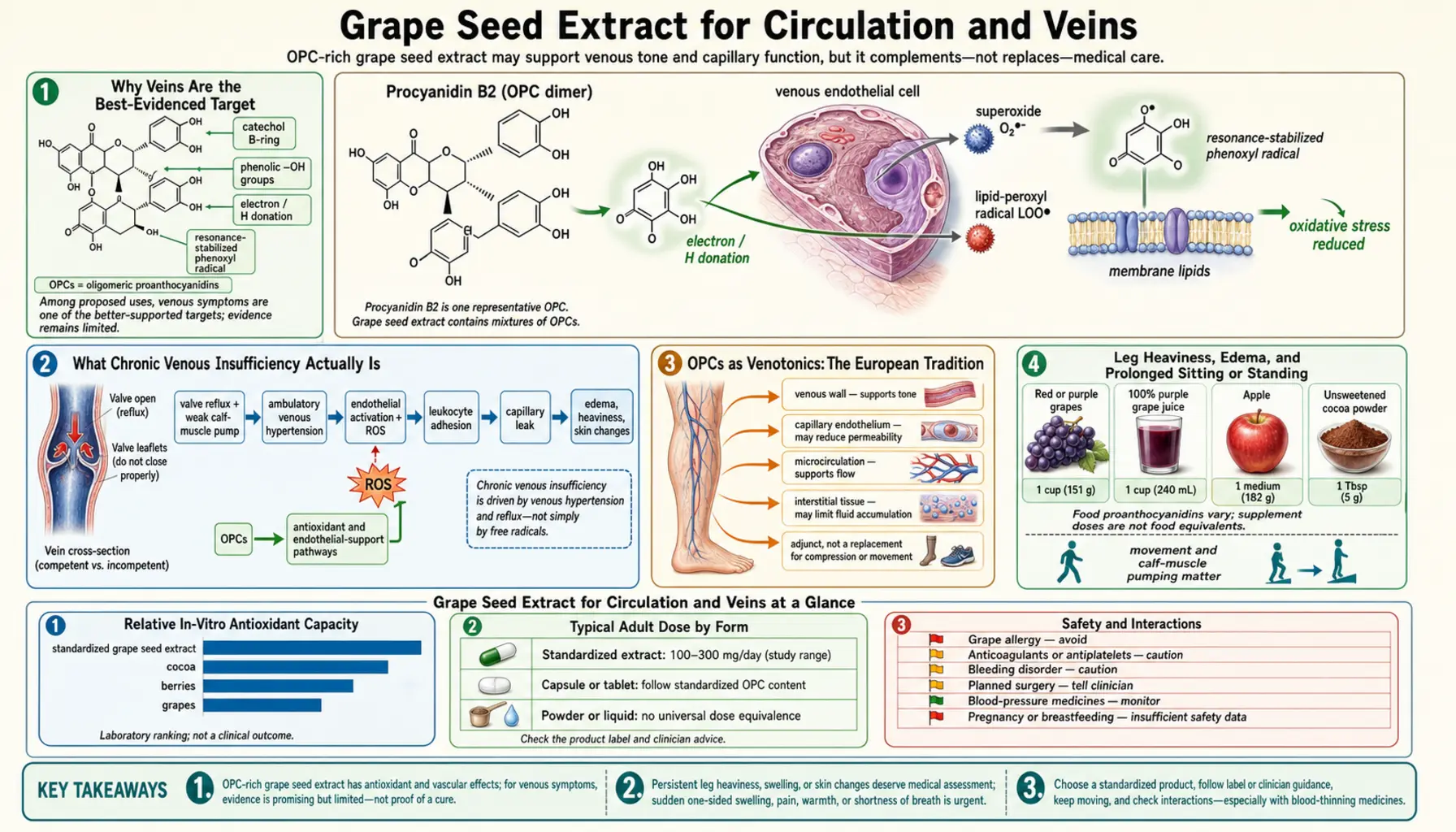
If grape seed extract has one genuinely well-supported clinical use, it is for the veins and small blood vessels. Standardized oligomeric proanthocyanidins (OPCs) have been used for decades in Europe as venotonics — agents that improve the tone and integrity of vein walls — for chronic venous insufficiency, heavy and swollen legs, and capillary fragility. The mechanism is unusually concrete: OPCs bind to the collagen and elastin of vessel walls and protect them from enzymatic breakdown, while also supporting endothelial function. This page explains what chronic venous insufficiency is, what the trials and systematic reviews actually show, and where the evidence is strong versus where it is only suggestive.
Table of Contents
- Why Veins Are the Best-Evidenced Target
- What Chronic Venous Insufficiency Actually Is
- OPCs as Venotonics: The European Tradition
- Leg Heaviness, Edema, and Prolonged Sitting or Standing
- Capillary Fragility and Vascular Permeability
- How OPCs Stabilize Collagen and Vessel Walls
- Endothelial Function and Nitric Oxide
- What the Evidence Does and Does Not Show
- Practical Use for Vein and Circulation Support
- Key Research Papers
- Connections
- Featured Videos
Why Veins Are the Best-Evidenced Target
Grape seed extract is sold for dozens of purposes, but the science is lopsided: the vein and capillary evidence is substantially stronger than any other claim. There is a clear biological reason for this. When you swallow OPCs, only a small fraction is absorbed intact into the bloodstream, and much of what circulates has a strong physical affinity for proline-rich structural proteins — the collagen and elastin that make up vein walls and capillary basement membranes. In effect, the molecule concentrates its action exactly where the vein-related benefit is claimed.
This is different from a diffuse "antioxidant" story. A venotonic effect can be measured directly: reduced ankle circumference, reduced calf volume by water displacement, improved venous refilling time on plethysmography, and patient-reported reduction in the heaviness, aching, and swelling that define venous leg symptoms. Those are concrete endpoints, and grape seed OPCs — along with their close cousin, French maritime pine bark extract (Pycnogenol) — have been studied against them for decades.
What Chronic Venous Insufficiency Actually Is
Chronic venous insufficiency (CVI) is what happens when the veins in your legs can no longer return blood to the heart efficiently. Leg veins fight gravity, and they rely on two things to move blood upward: the squeezing action of your calf muscles, and one-way valves inside the veins that stop blood from flowing backward. When those valves become leaky — from age, genetics, pregnancy, obesity, or long hours of sitting or standing — blood pools in the lower legs. The pressure inside the veins rises, and that sustained high pressure (venous hypertension) drives the whole syndrome.
The visible and felt consequences form a spectrum:
- Early: aching, heaviness, and a feeling of tightness or fullness in the legs, worse at the end of the day and better with elevation
- Edema: swelling of the ankles and lower legs as high venous pressure pushes fluid out of leaky capillaries into the tissues
- Skin changes: visible varicose veins, spider veins, brownish discoloration (hemosiderin staining), and eczema-like skin over the shins
- Advanced: hardening of the skin and, in severe long-standing cases, venous leg ulcers
CVI is extremely common, affecting a large fraction of adults to some degree, and it tends to progress slowly over years. First-line management is always compression stockings, leg elevation, exercise, and weight management. Venotonic agents such as grape seed OPCs are used as an adjunct — something added to compression, not a replacement for it.
OPCs as Venotonics: The European Tradition
In much of Europe, a class of drugs and supplements called phlebotonics (or venotonics) has been part of routine CVI care for decades. The category includes plant flavonoids such as diosmin and hesperidin (micronized purified flavonoid fraction), horse chestnut seed extract (aescin), French maritime pine bark OPCs, and grape seed OPCs. Grape seed procyanidin standardized extracts have been marketed in France and elsewhere specifically for venous and capillary indications.
Phlebotonics are thought to work through several overlapping actions: increasing venous tone (making the vein wall contract more firmly), reducing capillary leakiness, improving lymphatic drainage, and dampening the low-grade inflammation that accompanies venous hypertension. Grape seed OPCs fit this profile because of their collagen-binding and endothelial effects.
The most authoritative synthesis of this whole drug class is the Cochrane systematic review of phlebotonics for venous insufficiency (Martinez-Zapata and colleagues). Its measured conclusion is worth quoting in spirit: phlebotonics probably reduce edema slightly compared with placebo (moderate-certainty evidence), and may make little or no difference, or only a small difference, to many other outcomes, with the certainty of evidence often low. In plain terms: the effect on leg swelling is real but modest, and the honest position is cautious optimism rather than enthusiasm.
Leg Heaviness, Edema, and Prolonged Sitting or Standing
The symptom most consistently helped by OPCs is lower-leg swelling and the heaviness that goes with it. A well-designed randomized study by Sano and colleagues tested proanthocyanidin-rich grape seed extract in healthy women during prolonged sitting — a model for the leg swelling that many people experience on long flights, desk-bound workdays, or car journeys. The extract measurably reduced leg swelling compared with placebo, consistent with a genuine effect on capillary filtration and fluid retention in the lower leg.
This matters because it addresses one of the most common everyday complaints — puffy, tired, aching legs after a long day — with a plausible mechanism and a controlled trial behind it, even in people who do not have diagnosed CVI. It is not a dramatic effect; it will not empty severely swollen legs, and it does not replace movement, elevation, or compression. But for mild, positional leg swelling, it is one of the better-supported natural options.
Practical expectations: if OPCs are going to help your leg symptoms, most trials suggest you will notice a difference in heaviness and swelling over a few weeks of daily use, not immediately. If there is no benefit after 6 to 8 weeks, it is reasonable to stop.
Capillary Fragility and Vascular Permeability
Capillaries are the smallest blood vessels, where oxygen, nutrients, and fluid exchange with tissues. Their walls are delicate, and when they become excessively fragile or leaky, the results include easy bruising, tiny skin hemorrhages (petechiae), and the fluid leakage that contributes to swelling. Historically, this is exactly the property that made proanthocyanidins interesting: the older term "vitamin P" was coined for flavonoids that reduced capillary fragility and permeability, before the concept was abandoned as too vague.
OPCs reduce abnormal capillary permeability in laboratory and animal models, and this action dovetails with the anti-edema effect: less fluid escaping from capillaries means less tissue swelling. In people, capillary-fragility indications (easy bruising, fragile small vessels) are among the traditional European uses of grape seed procyanidins, though the modern controlled-trial evidence for these specific endpoints is thinner than for edema. The mechanism is credible; the human outcome data are modest.
How OPCs Stabilize Collagen and Vessel Walls
The defining biochemical property of proanthocyanidins is their affinity for proteins, especially collagen and elastin. This is the same chemistry that lets these compounds tan leather (cross-linking collagen fibers into a durable matrix) and that gives red wine and unripe fruit their astringent, mouth-puckering quality (binding salivary proteins). Applied to blood vessels, three consequences follow:
- Cross-linking and reinforcement — OPCs associate with collagen and elastin fibers in the vessel wall and extracellular matrix, which is thought to reinforce the structural scaffold that gives veins and capillaries their strength and resilience.
- Protection from enzymatic breakdown — by binding these structural proteins, OPCs can shield them from degrading enzymes such as collagenase and elastase, which are elevated in the inflamed, high-pressure environment of a failing vein.
- Antioxidant protection of the matrix — venous hypertension generates reactive oxygen species that damage the vessel wall; OPCs quench these radicals locally, which may slow matrix degradation.
Together these actions add up to a "stabilize the wall, reduce the leak" mechanism that maps neatly onto the observed reduction in edema and the traditional capillary-fragility indication. It is one of the cleaner examples of a supplement whose proposed mechanism and claimed benefit actually line up.
Endothelial Function and Nitric Oxide
Beyond the structural matrix, grape seed procyanidins act on the endothelium — the single-cell lining of every blood vessel that regulates its tone. Classic pharmacology work by Fitzpatrick and colleagues showed that grape seed-derived procyanidins produce endothelium-dependent relaxation of blood vessels: they prompt the endothelium to release nitric oxide, the body's own vasodilator, which relaxes the smooth muscle in the vessel wall and improves blood flow.
In the venous and microcirculatory context, better endothelial function and nitric-oxide signaling support healthier vascular tone and may improve microcirculatory flow. This same endothelial action is the bridge to the modest blood-pressure effects covered on the Heart and Blood Pressure page — the endothelium is the shared organ where grape seed extract's circulatory effects converge, whether the target is a leg vein or a systemic artery.
What the Evidence Does and Does Not Show
An honest appraisal keeps three things straight:
- Reasonably well supported: a modest reduction in lower-leg edema and the heaviness/aching of mild venous symptoms, backed by randomized trials of grape seed OPCs and by the broader phlebotonics literature.
- Plausible but less proven: reductions in capillary fragility and improvements in microcirculation — strong mechanism, thinner human outcome data.
- Not established: grape seed extract does not cure varicose veins, does not eliminate existing valve damage, and is not a proven treatment for venous leg ulcers or deep-vein thrombosis. It does not replace compression therapy, and it is not an anticoagulant for clot prevention (in fact its mild antiplatelet activity is a caution, not a treatment — see the Safety page).
The Cochrane phlebotonics review is the anchor here: it supports a small, real anti-edema effect for the drug class while being candid that certainty is limited and effects on harder outcomes are uncertain. That is the correct level of confidence to carry into a decision about using grape seed extract for your legs.
Practical Use for Vein and Circulation Support
If you want to try grape seed extract for mild venous leg symptoms, a sensible approach:
- Set the foundation first. Compression stockings, regular walking, calf-muscle exercise, leg elevation, and weight management are the evidence-based core of CVI care. Grape seed OPCs are an add-on, not a substitute.
- Use a standardized extract. Look for a product standardized to roughly 95% proanthocyanidins (OPCs), typically dosed around 150–300 mg per day. See the Safety and Standardization page for details.
- Give it a fair trial. Judge the effect on heaviness and swelling over 6 to 8 weeks. Objective self-tracking — ankle circumference in the evening, or a heaviness score — beats impression.
- Mind the interactions. Because OPCs have mild antiplatelet activity, be cautious if you take warfarin, direct oral anticoagulants, aspirin, or other antiplatelet drugs, and stop before elective surgery. Discuss with a clinician if you have a bleeding disorder or are pregnant.
- Know when to seek care. New one-sided leg swelling, calf pain and warmth, skin breakdown, or a non-healing leg wound warrant medical evaluation, not a supplement.
Key Research Papers
- Martinez-Zapata MJ et al. (2020). Phlebotonics for venous insufficiency. Cochrane Database of Systematic Reviews. — Search PubMed
- Sano A et al. (2013). Proanthocyanidin-rich grape seed extract reduces leg swelling in healthy women during prolonged sitting. Journal of the Science of Food and Agriculture. — PubMed 22752876
- Fitzpatrick DF et al. (2002). Vasodilating procyanidins derived from grape seeds. Annals of the New York Academy of Sciences. — PubMed 12074963
- Odai T et al. (2019). Effects of grape seed proanthocyanidin extract on vascular endothelial function in participants with prehypertension: a randomized, double-blind, placebo-controlled study. Nutrients. — PubMed 31757033
- Shi J et al. (2003). Polyphenolics in grape seeds — biochemistry and functionality. Journal of Medicinal Food. — PubMed 14977436
- Khanna S et al. (2002). Dermal wound healing properties of redox-active grape seed proanthocyanidins. Free Radical Biology and Medicine. — PubMed 12374620
PubMed Topic Searches
- PubMed: Grape seed extract and chronic venous insufficiency
- PubMed: Proanthocyanidin, leg edema, venotonic
- PubMed: Phlebotonics and venous edema
- PubMed: Procyanidins and capillary permeability
- PubMed: OPCs, endothelium, and nitric oxide
External Resources
Connections
- Grape Seed Extract (Main Page)
- Grape Seed Extract Benefits Hub
- Heart & Blood Pressure
- Antioxidant & Skin
- Safety & Standardization
- Pycnogenol (Pine Bark OPCs)
- Bilberry
- Anthocyanins
- Varicose Veins
- Hypertension
- Peripheral Artery Disease
- All Cardiology
- All Antioxidants