Grape Seed Extract: Safety, Dosing, and Standardization
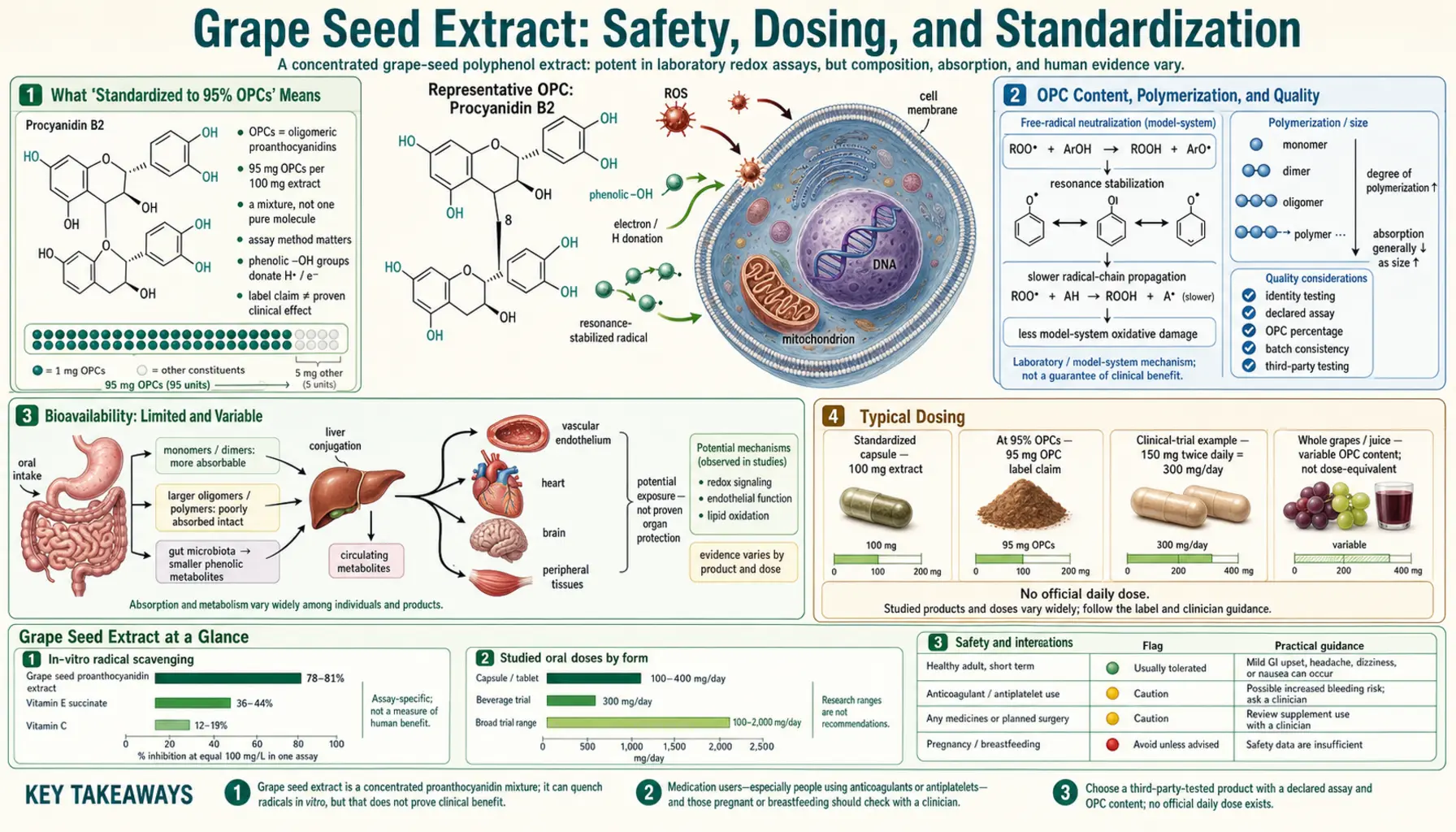
Grape seed extract is generally well tolerated at typical supplement doses, but two things determine whether a given product is worth taking and whether it is safe for you: how it is standardized, and how it interacts with medications. "Standardized to 95% oligomeric proanthocyanidins (OPCs)" is the phrase to look for, because the OPC content is what the clinical trials measured. The single most important safety issue is that grape seed OPCs have mild antiplatelet and anticoagulant activity, so they add to the bleeding risk of warfarin, direct oral anticoagulants, and antiplatelet drugs, and should be stopped before surgery. This page covers standardization, bioavailability, dosing, tolerability, drug interactions, and how to choose a quality product.
Table of Contents
- What "Standardized to 95% OPCs" Means
- OPC Content, Polymerization, and Quality
- Bioavailability: Limited and Variable
- Typical Dosing
- Safety Profile and Tolerability
- Blood Thinners and Antiplatelet Interaction
- Drug Metabolism and CYP Enzyme Interactions
- Who Should Be Cautious
- Choosing a Quality Product
- Key Research Papers
- Connections
- Featured Videos
What "Standardized to 95% OPCs" Means
Grape seed extract is not a single molecule — it is a mixture of polyphenols, and the active fraction that clinical trials care about is the oligomeric proanthocyanidins (OPCs), also written as proanthocyanidins or procyanidins. Standardization means the manufacturer has controlled the extract so that a defined percentage of its weight is OPCs. The most common specification is 95% proanthocyanidins, and many trial products are standardized this way.
Why this matters: a raw or poorly characterized grape seed powder might contain a small and unpredictable amount of OPCs, so a "500 mg grape seed" capsule with no standardization could deliver far less active compound than a "150 mg standardized to 95% OPCs" capsule. When comparing products or matching a research dose, the number that counts is milligrams of OPCs, not milligrams of total extract. Standardization is what makes grape seed extract a reproducible product rather than a variable botanical.
OPC Content, Polymerization, and Quality
Beyond the headline percentage, the character of the proanthocyanidins matters. Grape seed proanthocyanidins are built from flavan-3-ol units (catechin and epicatechin) linked into chains. The number of units linked together is the degree of polymerization:
- Monomers and small oligomers (2–5 units) — better absorbed and the fraction most associated with vascular effects
- Larger polymers (many units) — poorly absorbed intact; they act mostly in the gut and are metabolized by gut bacteria
The classic characterization of grape seed polyphenol composition and functionality by Shi and colleagues describes this mixture of monomeric and oligomeric flavan-3-ols and its biochemical properties. A well-made extract emphasizes the lower-molecular-weight oligomers that are more bioavailable. Because product quality varies, third-party testing and reputable manufacturing matter — the same molecule sold by two companies can differ substantially in its real OPC profile.
Bioavailability: Limited and Variable
A realistic understanding of grape seed extract requires accepting that most of what you swallow is not absorbed intact. Small proanthocyanidins (monomers and dimers) are absorbed to a limited degree; larger polymers largely are not. What is absorbed is extensively metabolized — conjugated in the liver and, importantly, broken down by colonic bacteria into smaller phenolic acids that circulate and may carry some of the biological activity.
This has three practical consequences. First, the "antioxidant power" measured in a test tube overstates what reaches your tissues (see the Antioxidant and Skin page). Second, individual gut microbiomes differ, so two people can extract different amounts of active metabolite from the same dose — part of why clinical responses vary. Third, taking grape seed extract with food, and choosing extracts richer in low-molecular-weight oligomers, are reasonable ways to favor absorption. Bioavailability is the quiet reason grape seed extract's real-world effects are modest even though its laboratory potency is high.
Typical Dosing
Doses used in clinical studies vary, but a common and reasonable range is:
- General use / cardiovascular support: roughly 150–300 mg per day of standardized extract
- Venous / edema studies: often in a similar range, sometimes up to around 300–400 mg per day
- Higher research doses: some trials have used higher amounts short-term, but more is not clearly better and increases interaction concerns
Practical guidance: start at the lower end, take it with food, and give any given use a fair trial of several weeks before judging. Match the milligrams of OPCs to what the relevant studies used rather than chasing the largest total-extract number on a label. There is no established benefit to megadosing, and higher intakes amplify the bleeding-interaction risk discussed below.
Safety Profile and Tolerability
At typical doses, grape seed extract is well tolerated in most people. A dedicated safety assessment by Sano evaluated four weeks of oral intake of proanthocyanidin-rich grape seed extract in healthy subjects and supported its safety at the doses studied, with no serious adverse effects. Reported side effects across the literature are generally mild and uncommon, and may include headache, nausea, dry or itchy scalp, dizziness, or mild stomach upset.
Grape seed extract is a concentrated food-derived product with a long history of dietary exposure (grapes, wine, and grape products), which is part of why its baseline tolerability is good. That said, "well tolerated" refers to healthy adults at normal doses — it does not override the specific interaction and caution issues that follow, which are where the real risk lies.
Blood Thinners and Antiplatelet Interaction
This is the most important safety point on the page. Grape seed OPCs have measurable antiplatelet and anticoagulant activity — they can reduce platelet aggregation and interfere with clotting. A study by Golanski and colleagues characterized the dual anticoagulant/antiplatelet activity of polyphenolic grape seed extract, confirming a plausible mechanism for additive bleeding risk.
The clinical implication:
- Anticoagulants — warfarin and direct oral anticoagulants (apixaban, rivaroxaban, dabigatran, edoxaban): grape seed extract may add to their blood-thinning effect and increase bleeding risk.
- Antiplatelet drugs — aspirin, clopidogrel, and similar agents: additive antiplatelet effect.
- Other supplements with bleeding risk — fish oil, ginkgo, garlic, high-dose vitamin E, and others can compound the effect.
- Surgery and dental procedures — stop grape seed extract well before any planned surgery (commonly advised around two weeks prior) and tell your surgeon and dentist you take it.
If you take any blood thinner or antiplatelet drug, do not start grape seed extract without discussing it with the clinician who manages that medication. This is not a theoretical concern — it is the single most relevant risk for the cardiovascular patients most likely to be interested in the supplement.
Drug Metabolism and CYP Enzyme Interactions
The body clears many medications using cytochrome P450 (CYP) enzymes in the liver and gut, especially CYP3A4. Substances that inhibit these enzymes can raise blood levels of drugs that depend on them, and grape-derived polyphenols have been examined for this effect. Research on commercial herbal supplements found variable inhibition of human CYP3A4 across different brands and products — a finding that carries two messages: grape seed and similar polyphenol supplements can have some CYP-inhibiting potential, and the degree varies unpredictably from product to product.
Practically, this means grape seed extract has the theoretical potential to affect the levels of medications metabolized by CYP3A4 (a very large group, including some statins, certain blood-pressure drugs, immunosuppressants, and others). The interaction is generally considered modest at usual supplement doses, but if you take a medication with a narrow safety margin, mention grape seed extract to your pharmacist or prescriber so they can consider it. It is a good reason to prefer well-characterized, third-party-tested products over unknown ones.
Who Should Be Cautious
- Anyone on anticoagulant or antiplatelet therapy — the primary caution, as above.
- People with bleeding disorders — avoid or use only under medical supervision.
- Upcoming surgery — stop in advance and disclose use.
- Pregnancy and breastfeeding — there is not enough safety data for concentrated grape seed extract supplements; dietary grapes are fine, but concentrated extracts are best avoided in the absence of evidence.
- People on multiple prescription medications — review for CYP and bleeding interactions with a pharmacist.
- Known allergy to grapes — avoid.
As with the rest of this hub, the responsible framing is that grape seed extract is a low-risk adjunct for most healthy adults but requires genuine caution in the exact population — cardiovascular patients on blood thinners — that is often most drawn to it.
Choosing a Quality Product
- Look for OPC standardization. "Standardized to 95% proanthocyanidins (OPCs)" or a stated OPC content lets you compare products meaningfully.
- Judge by OPC milligrams, not total extract. Match the active dose to what studies used.
- Prefer third-party testing. Independent verification (USP, NSF, or equivalent) reduces the risk of under-dosed or contaminated products, which is real in a lightly regulated supplement market.
- Favor low-molecular-weight-rich extracts. Products emphasizing monomeric and oligomeric fractions align with better absorption.
- Be skeptical of ORAC marketing. A high ORAC number is a laboratory statistic, not a health claim.
- Keep expectations calibrated. Grape seed extract's best-evidenced benefits are vascular and modest; a quality product used sensibly is a reasonable adjunct, not a cure.
Key Research Papers
- Sano A (2017). Safety assessment of 4-week oral intake of proanthocyanidin-rich grape seed extract in healthy subjects. Food and Chemical Toxicology. — PubMed 27889390
- Shi J, Yu J, Pohorly JE, Kakuda Y (2003). Polyphenolics in grape seeds — biochemistry and functionality. Journal of Medicinal Food. — PubMed 14977436
- Dual anticoagulant/antiplatelet activity of polyphenolic grape seeds extract (2019). Nutrients. — PubMed 30621248
- Variable inhibitory effect of different brands of commercial herbal supplements on human cytochrome P-450 CYP3A4 (2009). Drug Metabolism and Drug Interactions. — PubMed 19353999
- Bagchi D et al. (2014). Free radical scavenging, antioxidant and cancer chemoprevention by grape seed proanthocyanidin: an overview. Mutation Research. — PubMed 24751946
- Feringa HH et al. (2011). The effect of grape seed extract on cardiovascular risk markers: a meta-analysis of randomized controlled trials. Journal of the American Dietetic Association. — PubMed 21802563
PubMed Topic Searches
- PubMed: Grape seed extract safety and tolerability
- PubMed: OPC bioavailability and metabolism
- PubMed: Grape seed extract and platelet aggregation
- PubMed: Grape seed extract standardization
- PubMed: OPC degree of polymerization and absorption
External Resources
- NCCIH — Grape Seed Extract (safety and interactions)
- Memorial Sloan Kettering — About Herbs: Grape Seed (interactions)
- MedlinePlus — Grape Seed
Connections
- Grape Seed Extract (Main Page)
- Grape Seed Extract Benefits Hub
- Circulation & Veins
- Heart & Blood Pressure
- Antioxidant & Skin
- Grape Seed Extract History
- Pycnogenol (Pine Bark OPCs)
- Quercetin
- Resveratrol
- CoQ10
- Hypertension
- Coronary Artery Disease
- All Antioxidants